Blue Balls: Causes and Relief
“Blue balls” is the well-known slang term for an aching, heavy discomfort in the testicles that can follow sexual arousal without orgasm. Clinicians call it epididymal hypertension. Understanding blue balls causes starts with basic anatomy: during arousal, the body floods the genitals with extra blood, and when that blood does not drain away promptly after arousal subsides, pressure builds in the tissues around the testicles. The result is a temporary, harmless ache that usually fades within minutes to a few hours. This guide explains exactly what happens in the body, what relieves it fastest, how it differs from serious testicular conditions, and when discomfort deserves a doctor’s attention.
What Are Blue Balls? (Epididymal Hypertension)
Blue balls — medically termed epididymal hypertension — describes the dull ache, pressure, or heaviness some people feel in the scrotum after a period of sexual arousal that does not end in orgasm. It is not considered a medical condition by most clinicians, because it causes no tissue damage and resolves on its own. Urologists describe it as a benign, self-limited sensation rather than an illness that needs treatment.
The name is misleading in two ways. First, the scrotum does not normally turn blue; any faint bluish tint comes from deoxygenated blood pooling in surface veins, and doctors disagree on whether a visible color change actually occurs. Second, despite the formal-sounding medical name, there is very little published research on the phenomenon, precisely because it is not harmful. What clinicians know comes from established vascular physiology rather than dedicated clinical trials. Those same vascular principles explain blue balls causes in straightforward terms.
Blue Balls Causes: The Physiology of Vasocongestion
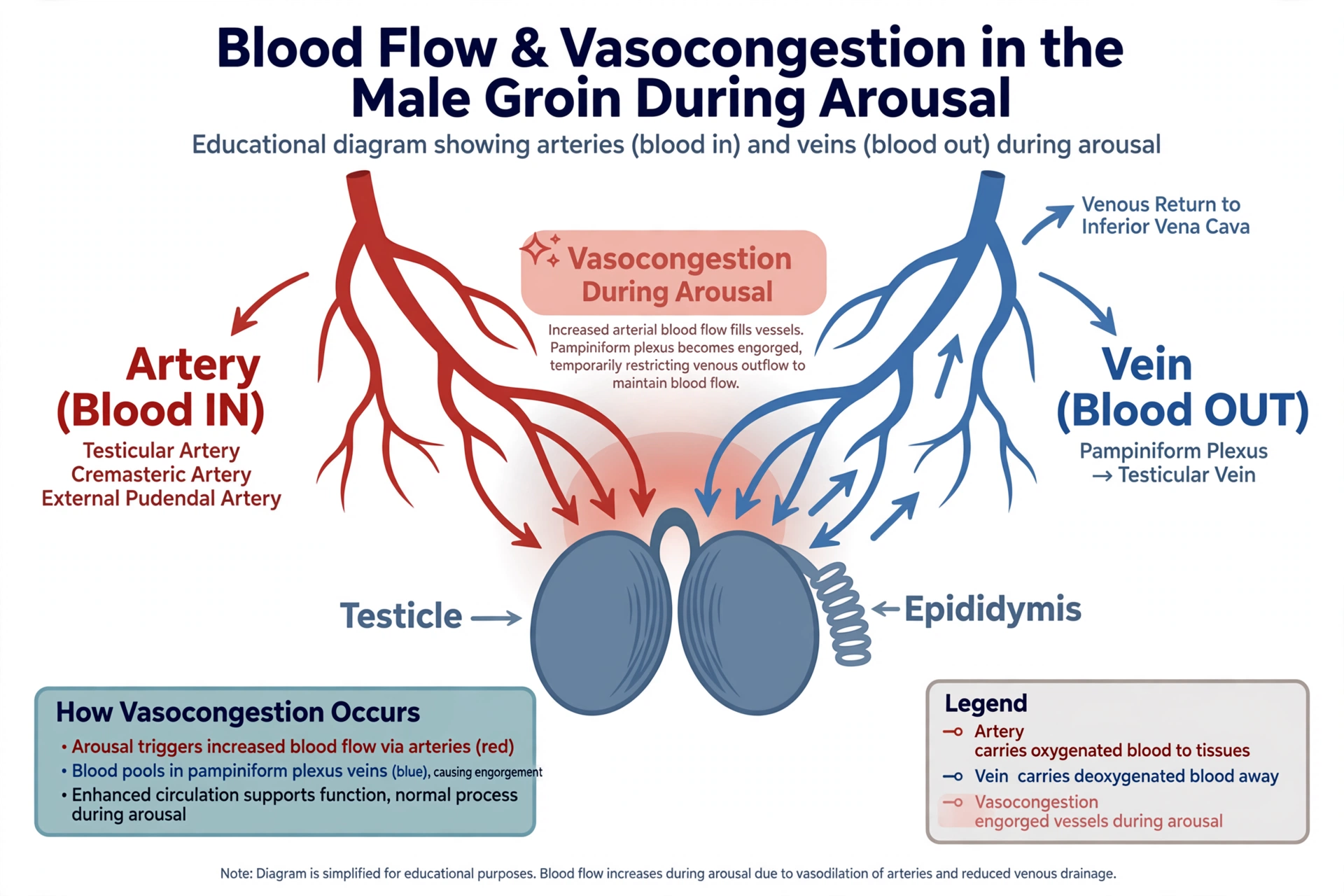
The core mechanism behind blue balls causes is vasocongestion — the deliberate engorgement of genital tissue with blood during sexual arousal. Here is the step-by-step process:
- Arteries widen. At the onset of arousal, the arteries supplying the penis and testicles (including the testicular artery) dilate, sharply increasing blood inflow to the area. This increased inflow is what produces an erection.
- Veins constrict. At the same time, the veins that normally drain blood away from the genitals narrow, trapping the extra blood in place so the erection can be maintained.
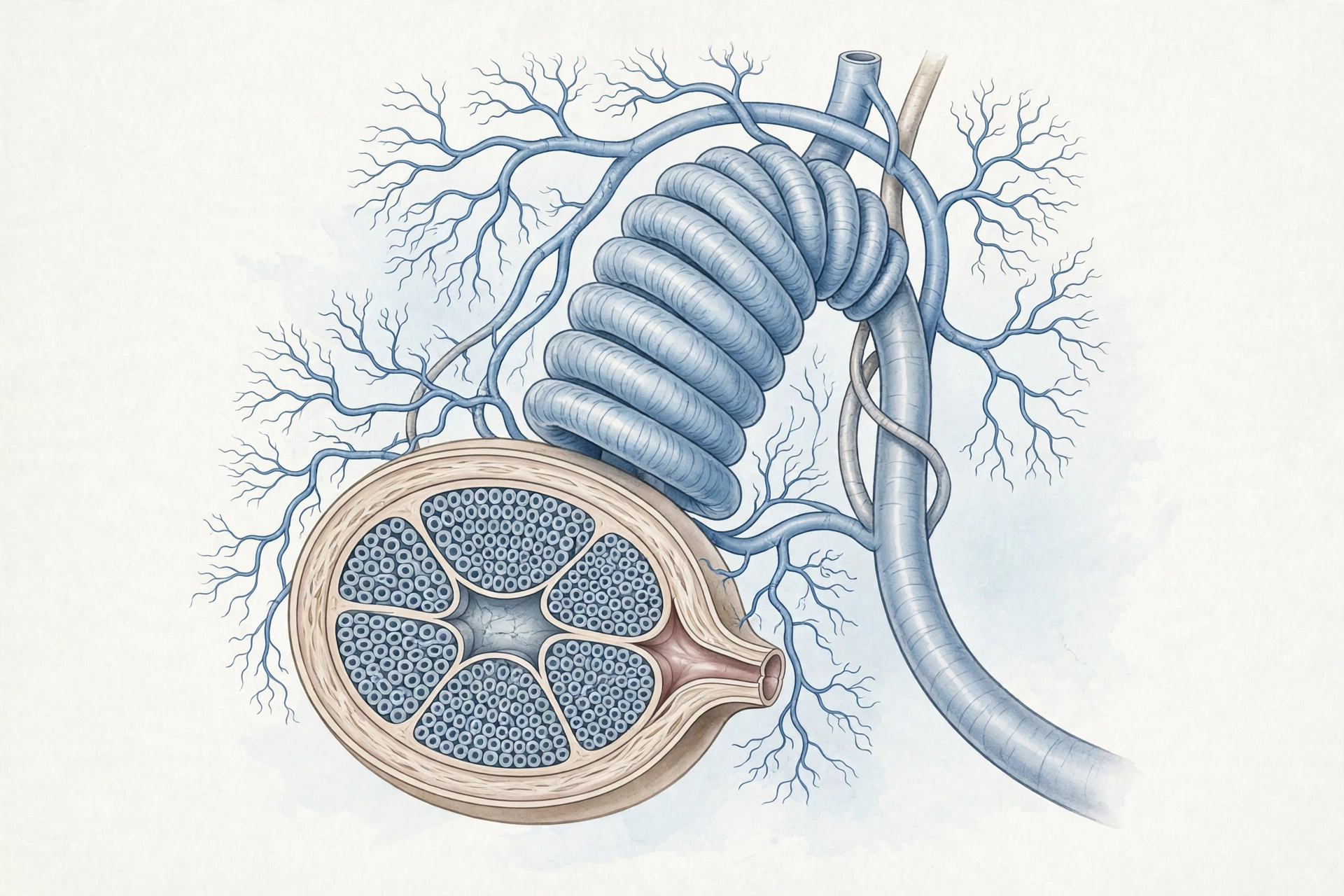
- Pressure builds in the epididymis. Blood also pools in the pampiniform plexus — the network of veins in the spermatic cord — and pressure rises in the epididymis, the coiled tube above each testicle through which sperm pass. This elevated pressure is the literal meaning of “epididymal hypertension.”
- Release restores balance. At orgasm, rhythmic muscular contractions and a surge of sympathetic nervous system activity allow the veins to relax; the trapped blood drains, and everything returns to its resting state within minutes.
When orgasm does not occur, the system drains more slowly. The excess blood lingers in the genital vasculature, and the unrelieved pressure registers as aching or heaviness. Researchers describe it with a “pressure cooker” analogy: arousal builds pressure like steam, and orgasm is the release valve. Without that release, it simply takes the body longer to equalize on its own. Every one of the common blue balls causes — extended arousal, interrupted encounters, and deliberately delayed orgasm — works through this same delayed-drainage mechanism.
Common Situations That Trigger Blue Balls
Blue balls causes are always rooted in prolonged arousal without release, but certain situations make it more likely:
- Extended arousal without orgasm — long periods of intimacy, teasing, or stimulation that stop before climax.
- Interrupted encounters — being aroused and then interrupted, which strands the vascular system in its engorged state.
- Delayed or deliberately postponed orgasm — practices such as edging, where ejaculation is repeatedly delayed, keep blood pooled for longer stretches.
- High sensitivity to arousal — people who become aroused quickly or intensely may notice the sensation more readily; younger people report it most often, and one study found it becomes less common with age.
- Physiological responses outside intercourse — arousal from any source (including fantasy, media, or non-penetrative activity) involves the same vasocongestion.
It is worth noting what does not cause blue balls: it is not caused by a buildup of sperm or semen. Semen production and reabsorption are continuous, unrelated processes. People experiencing delayed orgasm or difficulty reaching climax may be more familiar with this discomfort, but the underlying vascular mechanism is the same for everyone. That shared mechanism is why blue balls causes are identical regardless of how arousal began.
What Does Blue Balls Feel Like? (Symptoms)
People most commonly describe the sensation as:
- A dull ache in one or both testicles
- Heaviness or a feeling of pressure or fullness in the scrotum
- Mild throbbing that comes and goes
- Slight swelling or tenderness of the testicles
- Occasionally, a faint bluish tint to the scrotal skin
The discomfort is typically mild. In the first large-scale survey on the topic — conducted by researchers at Queen’s University in Ontario with more than 2,600 respondents — intense or frequent pain was described as “exceptionally rare.” Pain thresholds vary, and some people barely notice the sensation at all. What the sensation should never be is severe or debilitating: sharp, intense, or one-sided pain that arrives suddenly is not blue balls and warrants prompt medical evaluation.
The discomfort almost always resolves on its own once arousal fully subsides, typically within minutes and rarely lasting more than a few hours. Because blue balls causes are purely vascular, the ache cannot linger once blood flow normalizes.
How to Get Relief From Blue Balls
The fastest and most reliable way to relieve the discomfort is to reach orgasm — through masturbation or consensual partnered sex — because the contractions and vascular changes of climax drain the pooled blood quickly. But orgasm is a preference, not a requirement; the sensation fades on its own. In short, relief targets blue balls causes directly by helping the pooled blood drain faster. If you would rather wait it out, these strategies help the body return to its resting state faster:
- Exercise. Brisk walking, jogging, or a short workout redirects blood flow from the groin to the large muscles being used, which both eases pressure and shifts your focus. Even a few minutes of physical activity makes a noticeable difference.
- Cold compress. Applying a cold cloth or ice pack wrapped in a towel to the groin for 10 to 15 minutes constricts blood vessels and dulls the aching sensation. Never place ice directly on the skin.
- Warm shower or bath. Warm water relaxes tense muscles and dilates blood vessels in the skin, drawing blood away from the groin toward a much larger surface area. Both warm and cool water help — choose whichever feels better.
- Mental distraction. Focusing on arousal keeps the vascular system engaged. Reading, work, a non-arousing show, or simply waiting until you fall asleep allows blood flow to normalize naturally.
- Urination. Many people find that emptying the bladder provides some relief, possibly because it relaxes the pelvic floor and reduces local pressure.
- Deep breathing. Slow, deliberate breathing lowers heart rate and sympathetic arousal, helping the body’s vascular system settle.
What not to do: do not ask or pressure anyone else to relieve it for you. Blue balls is mild, temporary, and entirely self-resolvable — framing it as an emergency that someone else must fix is a form of coercion, not a medical necessity. Clinicians and researchers are consistent on this point. This is because blue balls causes are mild and self-resolving — no other person is ever required for relief.

Blue Balls vs. Conditions That Need Medical Attention
Blue balls only occurs during or immediately after sexual arousal. Any testicular pain that appears without arousal, arrives suddenly, or feels severe is a different matter. This comparison table helps tell them apart:
| Condition | Typical pain | Link to arousal | Urgency |
|---|---|---|---|
| Blue balls (epididymal hypertension) | Dull ache, heaviness, mild throbbing | Only after arousal without orgasm | None — resolves on its own |
| Epididymitis | Gradual pain, swelling, redness, warmth | Not linked to arousal | See a doctor promptly — often infection-related |
| Testicular torsion | Sudden, severe, often one-sided pain; nausea | Not linked to arousal | Emergency — surgery may be needed within hours |
| Priapism | Prolonged painful erection (4+ hours) | Erection that will not subside | Emergency — can cause permanent damage |
| Varicocele | Dull, aching heaviness, often left-sided | Not linked to arousal; worse after standing | See a doctor if persistent |
Note that epididymal hypertension and epididymitis sound similar but are unrelated: the first is temporary pressure from arousal, while the second is inflammation of the epididymis, usually from a bacterial or sexually transmitted infection. Learn the signs in our guide to epididymitis symptoms and treatment. For any testicular pain not clearly tied to arousal, review the red flags of testicular pain — and if pain is sudden and severe, read about testicular torsion symptoms and seek emergency care.
The Female Equivalent: “Blue Vulva”
People with female anatomy experience the same vasocongestion during arousal: blood pools in the vulva, clitoris, and pelvic veins, and prolonged arousal without orgasm can produce a similar heavy, aching feeling, sometimes informally called “blue vulva” or “blue bean.” Like blue balls, it is temporary, harmless, and resolves as blood flow normalizes. The Queen’s University survey found it to be a genuinely reported experience, not a myth — and it is equally no reason to pressure a partner.
Can You Prevent Blue Balls?
Because orgasm is never guaranteed, there is no sure way to prevent the sensation — but a few habits reduce how often it happens:
- Communicate with your partner about expectations before intimacy, so long sessions of arousal without resolution are less likely to happen by accident.
- Reduce interruptions by choosing times and settings where you are less likely to be cut off mid-encounter.
- Limit very long arousal sessions without climax if you know you are prone to the discomfort.
- Include self-pleasure as a normal option for resolving arousal when partnered sex is not available or desired.
None of these habits removes blue balls causes entirely — arousal itself is the trigger — but they reduce how often arousal goes unresolved.
Most importantly, treat the sensation as the minor, self-resolving event it is. Anxiety about it tends to prolong the focus on arousal, which can actually slow recovery.
Blue Balls and Consent: An Important Boundary
This topic deserves a direct statement. Research has found that a meaningful share of people report having been pressured into sexual activity because a partner claimed to be suffering from blue balls. The Queen’s University survey found that more than 40 percent of respondents with a vagina said they had experienced such pressure.
The facts are unambiguous: epididymal hypertension is mild, always temporary, and never requires another person’s involvement to resolve. Using it as leverage is manipulation, and clinicians — including urologists at institutions like the Cleveland Clinic — state plainly that it should never be used to pressure anyone into intimacy. Reliable medical sources agree that blue balls is not medically serious and needs no treatment (Cleveland Clinic overview; Healthline guide). Knowing the actual blue balls causes — trapped blood, not something a partner must ‘fix’ — makes that boundary clear.
Frequently Asked Questions
Is blue balls a real medical condition?
The discomfort is real, but clinicians do not classify epididymal hypertension as a medical condition or disease. It is a benign, temporary vascular response — pressure from pooled blood after arousal without orgasm — that causes no damage and requires no treatment. Research into blue balls causes confirms the sensation is a benign vascular response rather than a disease.
How long do blue balls last?
Usually just a few minutes once arousal subsides. In rare cases the aching lingers for a few hours. If discomfort persists for days, or keeps recurring without a clear connection to arousal, it is worth discussing with a primary care doctor or urologist to rule out another cause. Either way, blue balls causes resolve on their own once circulation returns to normal.
Do the testicles actually turn blue?
Not usually. The nickname comes from the idea that deoxygenated blood pooling in the area could give the scrotal skin a faint bluish tint, but doctors disagree about whether this visibly happens. Cleveland Clinic urologists note that the regions do not turn blue — and any actual skin discoloration should be checked by a healthcare provider, as it can signal a more serious problem.
Can women experience something similar?
Yes. Prolonged arousal without orgasm causes blood to pool in the vulva, clitoris, and pelvic veins, producing a comparable feeling of heaviness or aching, sometimes called “blue vulva.” It is equally temporary and harmless.
Does blue balls affect fertility or sperm health?
No. Blue balls has nothing to do with sperm buildup, and it does not affect fertility, sperm quality, or future sexual function. Semen production and reabsorption run continuously regardless of whether orgasm occurs.
When should I see a doctor about testicular pain?
See a doctor if pain is severe, sudden, one-sided, or unrelated to sexual arousal — or if it comes with swelling, redness, fever, nausea, a lump, blood in semen, or pain during urination. Sudden intense testicular pain may indicate testicular torsion, a medical emergency that can require surgery within hours.
Is masturbation the only way to get rid of blue balls?
No. Orgasm is the fastest route to relief, but the discomfort always fades on its own once arousal passes. Exercise, a cold compress or shower, urination, deep breathing, and simple distraction all help the body return to normal more quickly.
Medical disclaimer: This article is for educational purposes only and is not medical advice. It does not diagnose any condition or reader. Testicular pain can have many causes, some of them serious. If you are experiencing persistent, severe, or unexplained genital pain, consult a qualified clinician or urologist for personalized evaluation and care.
Blue balls causes are straightforward: arousal floods the genitals with blood, and without orgasm the drainage takes longer, leaving a temporary ache behind. It is uncomfortable but harmless, easily relieved, and never a reason to pressure anyone. Knowing the difference between this benign sensation and the warning signs of real testicular emergencies — sudden severe pain, swelling, or pain unrelated to arousal — is the most important takeaway of all.