Peyronie’s Disease: Causes, Symptoms, and Treatment Options
Peyronie's Disease: Causes, Symptoms, and Treatment Options
Noticing a new bend or curve in your penis can be worrying — even frightening. You're not alone, and you're not dealing with something rare. Peyronie's disease affects an estimated 1 in 10 men, yet most men never talk about it because it feels embarrassing.
Here's the reassuring truth: this is a well-understood medical condition, not a personal failing. The bend comes from scar tissue under the skin, and doctors have real, effective ways to treat it. The sooner you understand what's happening, the sooner you can get the right help.
What Is Peyronie's Disease?
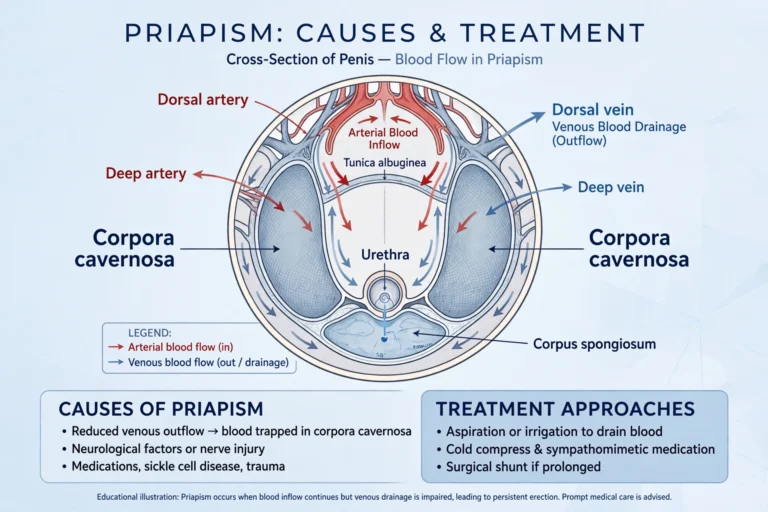
Inside your penis are two spongy chambers called the corpora cavernosa. When you're aroused, these chambers fill with blood and expand, producing an erection. Each chamber is wrapped in a stretchy sheath called the tunica albuginea.
In Peyronie's disease, patches of firm scar tissue — called plaque — form inside that sheath. Unlike healthy tissue, plaque doesn't stretch. So when you get an erection, the scarred area pulls the penis to one side, upward, or downward. Depending on where the plaque sits, you might also notice narrowing, an indentation, or even an hourglass shape.
One important point: almost every man has a slight natural curve. That's completely normal. Peyronie's disease is different — it involves a bend that appears over time, is often painful, and can interfere with sex.
The Two Phases of Peyronie's Disease
This condition moves through two distinct stages, and knowing which one you're in matters because it shapes treatment choices.
The Acute Phase
This is the early stage, typically lasting 6 to 12 months. Scar tissue is actively forming. You may notice:
- Pain during erections, sometimes even when soft
- A curve that seems to be getting worse
- Hard lumps you can feel under the skin
The Chronic Phase
Around 12 to 18 months after symptoms begin, things usually settle down. The plaque stops growing, and the curve stabilizes. The pain often fades — but the bend and any loss of length usually remain. Treatment is most successful once you've reached this stable phase.
Peyronie's Disease Symptoms
Symptoms can appear suddenly or creep in gradually. The most common ones include:
- Hard lumps or a firm band you can feel under the skin of the penis
- A noticeable bend — up, down, or to one side — during erections
- Pain with or without an erection, especially in the early phase
- Shortening or narrowing of the penis
- An hourglass shape or dent along the shaft
- Trouble getting or keeping an erection — erectile dysfunction affects many men with this condition
If you suspect erectile dysfunction is part of the picture, it's worth reading about erectile dysfunction causes to understand the full range of contributing factors.
What Causes Peyronie's Disease?
Doctors don't know the exact cause, but the leading explanation starts with minor injury. Repeated small traumas to the erect penis — during vigorous sex, sports, or accidents — can cause tiny tears inside the sheath. In most men, these heal cleanly. In some, the healing process goes off track, and the body lays down too much scar tissue.
Many men can't recall any specific injury, which is completely typical. Some researchers believe the damage can be microscopic — you may never have noticed it happening.
Risk Factors That Raise Your Odds
- Age: Most cases begin between ages 45 and 70, with an average onset around 55.
- Family history: If your father or brother has it, your risk is higher.
- Connective tissue disorders: Men with Dupuytren's contracture (thickened palm tissue that pulls fingers inward) are more likely to develop it.
- Diabetes: Men with diabetes are more prone to both erectile dysfunction and Peyronie's disease.
- Smoking: Smoking harms blood vessels and slows healing.
- Low testosterone: Inadequate testosterone can interfere with healthy tissue repair. If that sounds familiar, see our guide to low testosterone symptoms and when to get tested.
- Prostate surgery: Some prostate procedures increase the risk slightly.
- Certain medications: Some blood pressure and heart medicines have been linked to it.
How Doctors Diagnose It
Diagnosis is usually straightforward. Your doctor will ask about your symptoms and medical history, then do a physical exam of your penis while it's soft. To see the full extent of the curve, they may induce an erection in the office with a safe injection, or they may ask you to bring photos taken at home.
An ultrasound can pinpoint where the plaque is, show whether calcium has built up in it, and check blood flow. Blood tests are sometimes done to look for underlying conditions. If Peyronie's disease is suspected, you'll likely be referred to a urologist — a specialist in urinary and reproductive health.
Peyronie's Disease Treatment Options
Not everyone needs treatment. If the curve is mild, painless, and doesn't interfere with sex, your doctor may simply watch and wait. But when symptoms affect your sex life or quality of life, there are seven proven treatment paths.
1. Injections Into the Plaque
Medicines injected directly into the scar tissue can break it down or stop it growing. The best-known is collagenase (Xiaflex), an enzyme treatment approved for curves greater than 30 degrees. Other injections include interferon and verapamil. These work best during the acute phase.
2. Penile Traction Therapy
A traction device gently stretches the penis over weeks or months. It can reduce the curve, restore some lost length, and firm up erections — with very few side effects. The tradeoff is patience: results take months.
3. Oral Medications
Pills like pentoxifylline (which improves blood flow) and tadalafil (an ED medicine) are sometimes prescribed. Evidence is mixed, but they can slow progression and help with erections.
4. Shockwave Therapy
Focused sound waves applied to the penis may ease pain. It hasn't been shown to straighten the curve reliably, so it's mostly a pain-management option.
5. Pain Relief
Simple measures — ibuprofen or naproxen, a warm compress — can make the painful early months more bearable.
6. Lifestyle Changes
Quitting smoking, getting blood sugar under control, and staying active improve blood flow and healing, which supports every other treatment.
7. Surgery
Surgery is reserved for men whose curvature makes sex difficult or impossible, and only after the condition has been stable (no pain) for 6 to 12 months. The main options are:
- Plication: stitching the opposite side of the penis to straighten it (may shorten length slightly)
- Grafting: removing plaque and patching the area (preserves length better)
- Penile implant: recommended when erectile dysfunction is severe
The Emotional Side: Coping With the Stress
Let's be honest — this condition can shake your confidence. Studies show men with Peyronie's disease have higher rates of anxiety and depression, and relationship stress is common. That's a normal reaction, not weakness.
A few things that genuinely help:
- Talk to your partner openly. Hiding it usually makes the anxiety worse; most partners respond with understanding.
- See a therapist or sex therapist. Working through the mental load alone is hard — professional support makes a real difference.
- Join a support group. Hearing from other men who've been through it takes away the isolation.
- Focus on what works. This condition is treatable, and many men return to a fully satisfying sex life.
When to See a Doctor
Don't wait if you notice any of these:
- A new bend or curve in your erection that wasn't there before
- Hard lumps or a firm band under the skin
- Pain during erections or during sex
- Trouble getting or maintaining an erection
- Any shortening, narrowing, or hourglass shape
Early treatment gives you the best chance of stopping the curve from worsening. And remember: a urologist has seen this hundreds of times. There's nothing to be embarrassed about. For trustworthy background reading, the Mayo Clinic's overview is an excellent starting point.
Frequently Asked Questions
Can Peyronie's disease go away on its own?
Very rarely. In most men, the curve stays the same or gets slightly worse in the first year. Early treatment is the best way to prevent progression.
Is Peyronie's disease contagious or a sign of cancer?
No to both. It's not caused by infection and has nothing to do with cancer — it's simply scar tissue forming where it shouldn't.
Can I still have sex with Peyronie's disease?
Many men can, especially with mild curves. If penetration is painful or impossible, that's exactly when treatments — from traction devices to surgery — can help restore your sex life.
Does Peyronie's disease affect fertility?
Not directly. But if the curve makes intercourse impossible, conceiving naturally becomes difficult — which is one more reason to get treated.
The Bottom Line
Peyronie's disease is common, well understood, and treatable — from injections and traction devices to surgery for severe cases. The curve you notice today doesn't have to define your sex life tomorrow. Talk to your doctor early, be open with your partner, and get the help you deserve. Your confidence and your relationship are worth it.