Testicular Self-Exam: How and When to Do It
A testicular self-exam takes less than two minutes, costs nothing, and can be done in the shower. Yet most men have never done one — and many would not know what to feel for if they tried. This testicular self exam guide walks you through exactly how to perform a testicular self-exam, when to do it, what is normal, which warning signs deserve a prompt doctor visit, and how to get past the embarrassment that keeps so many men from acting.
Testicular cancer is the most common cancer in males ages 15 to 34, according to the Testicular Cancer Foundation, and about half of all cases are diagnosed in men between 20 and 34, with an average age at diagnosis of 33, per the American Cancer Society. The reassuring news: when testicular cancer is caught while still localized, the five-year survival rate is about 99%. The whole point of a self-exam is simple — to know your own body well enough to notice when something changes.
Why a Monthly Self-Check Matters
Unlike many cancers, testicular cancer gives few early warnings you can see or feel from the outside — but the most common first sign, a lump on the testicle, is something you can discover yourself long before it would ever show up in a routine checkup. Because the disease strikes young men who rarely see doctors, self-detection is often the only early warning system in place.
One honest nuance: the U.S. Preventive Services Task Force gives routine screening of asymptomatic men a Grade D recommendation — it recommends against formal screening programs, citing low incidence, high cure rates even at later stages, and the downsides of false positives and anxiety. Yet the American Cancer Society advises men to be aware of testicular cancer and seek care right away for symptoms, and urologists and cancer foundations widely encourage monthly self-checks. This testicular self exam guide is not a formal screening program — it is a low-effort way to learn your own anatomy so you can spot a real change early, when treatment is simplest. For more on the official position, see the USPSTF recommendation on testicular cancer screening.
Who Should Do a Testicular Self-Exam?
Any male who has gone through puberty can benefit from a monthly self-exam. Health providers generally suggest starting around age 15. Self-checks are especially worth making a habit if you have any known risk factors for testicular cancer, including:
- An undescended testicle at birth (cryptorchidism) — one of the strongest known risk factors
- A family history of testicular cancer, such as a father or brother with the disease
- A personal history of testicular cancer in the other testicle
- HIV infection, which is associated with a higher risk
About half of cases occur between ages 20 and 34, but testicular cancer can appear at any age. If you are unsure whether self-exams make sense for you, ask your doctor at your next visit — most clinicians are happy to demonstrate the technique in person.
Testicular Self Exam Guide: The 7-Step Technique

Follow these steps once a month. The whole process takes about a minute per testicle.
1. Pick the right moment
Do the exam during or right after a warm bath or shower. Heat relaxes the scrotal skin so the testicles hang lower, which makes them much easier to examine. Choose the same date each month — many men use the first of the month — so it becomes routine.
2. Start with a visual check
Stand in front of a mirror and look at the scrotum. Check for visible swelling, redness, or changes in the skin. It is completely normal for one side to appear slightly larger or to hang lower than the other — you are looking for new changes compared with your last check, not natural asymmetry.
3. Examine one testicle at a time
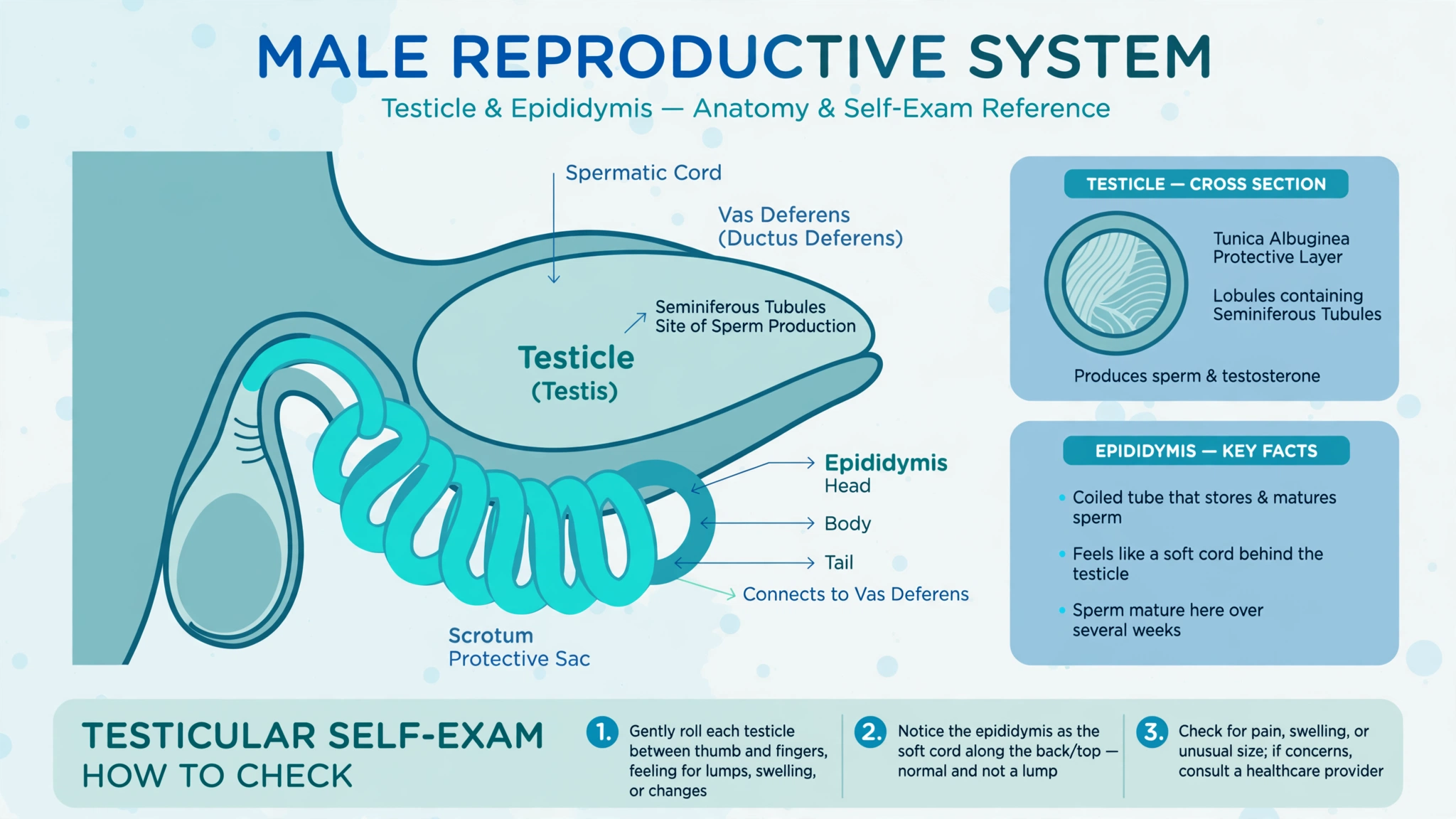
Using both hands, place your index and middle fingers underneath the testicle and your thumbs on top. This two-handed grip gives you control and lets you feel the entire surface.
4. Roll gently — do not squeeze
Gently roll the testicle between your thumbs and fingers, covering the front, back, sides, top, and bottom with firm but light pressure — never hard enough to cause pain. Mayo Clinic’s testicular exam guide describes the same technique and what to expect if you find a change.
5. Learn your epididymis
At the back and top of each testicle you will feel a soft, rope-like tube — the epididymis, which stores and carries sperm. It can feel slightly bumpy, and many men mistake it for a lump on their first exam; cancerous lumps are more often found on the front of the testicle. With practice you will easily tell the two apart.
6. Repeat on the other side
Examine the second testicle the same way. Compare the two sides, remembering that slight size differences are normal. What matters is any new difference — a lump, a change in size, shape, firmness, or texture that was not there last month.
7. Note pain, heaviness, or fullness
Beyond lumps, pay attention to how the area feels overall. A feeling of heaviness in the scrotum, a dull ache in the lower abdomen or groin, or a sudden buildup of fluid around the testicle are all changes worth mentioning to a doctor, even if you cannot feel a distinct lump.
A common mistake is checking too quickly or too roughly — or assuming pain must be present. Testicular cancer lumps are usually painless, so “it doesn’t hurt” is no reason to ignore a change.
What’s Normal and What’s Not
Knowing what healthy testicles feel like is the whole point of monthly checks. Here is a quick reference.
Normal findings:
- Smooth, oval-shaped testicles, firm but not rock-hard
- One testicle slightly larger than the other, or hanging slightly lower
- A soft, rope-like epididymis along the back and top of each testicle
- No pain or tenderness during the exam itself
Warning signs — see a doctor promptly if you notice:
- A hard lump on the testicle, often painless and about pea-sized or larger
- Sudden swelling or enlargement of a testicle
- A change in the size, shape, or consistency of a testicle
- A dull ache in the lower abdomen or groin, or a heavy feeling in the scrotum
- Sudden fluid buildup around the testicle
If you are experiencing testicular pain and want to understand which symptoms are red flags, our dedicated guide walks through the urgent and non-urgent causes.
What a Lump Might Actually Be
Finding something unusual is frightening, but most scrotal lumps and swellings are not cancer. Several common, benign conditions can cause changes you might notice during a self-exam:
- Epididymal cyst (spermatocele): a smooth, fluid-filled sac that sits above or behind the testicle, separate from it. Usually painless and harmless.
- Hydrocele: a collection of fluid around the testicle that makes the scrotum feel swollen and smooth, as if the testicle is surrounded by a water balloon.
- Varicocele: enlarged veins above the testicle that feel like a “bag of worms,” often more noticeable when standing. Varicoceles can also affect fertility — see our guide on varicocele, its symptoms, and treatment options.
- Epididymitis: inflammation of the epididymis, often caused by infection, which typically causes tenderness, swelling, and pain rather than a painless lump. Read more in our guide to epididymitis symptoms, causes, and when to see a doctor.
These descriptions are orientation only — you cannot reliably tell benign from serious by feel, and you should never try to self-diagnose. If you find anything new, book a doctor’s appointment. Only a clinician, usually with an ultrasound, can determine what a change actually is.
The Emergency That Can’t Wait: Testicular Torsion
One scrotal condition is a genuine emergency: testicular torsion, where the spermatic cord twists and cuts off the testicle’s blood supply. The signs are very different from a slow-growing lump — they arrive suddenly:
- Sudden, severe pain in one testicle, often waking you from sleep
- Swelling of the scrotum, sometimes with nausea or vomiting
- One testicle sitting higher than normal or at an unusual angle
- Sometimes abdominal pain, especially in younger teens
Torsion is most common in teenage boys but can happen at any age. The testicle can only survive a limited time without blood flow, so treatment works best within about six hours of symptom onset. Do not wait to see whether the pain improves — go to an emergency department immediately. Read our full guide to testicular torsion symptoms and emergency treatment.
What Happens at the Doctor’s Office
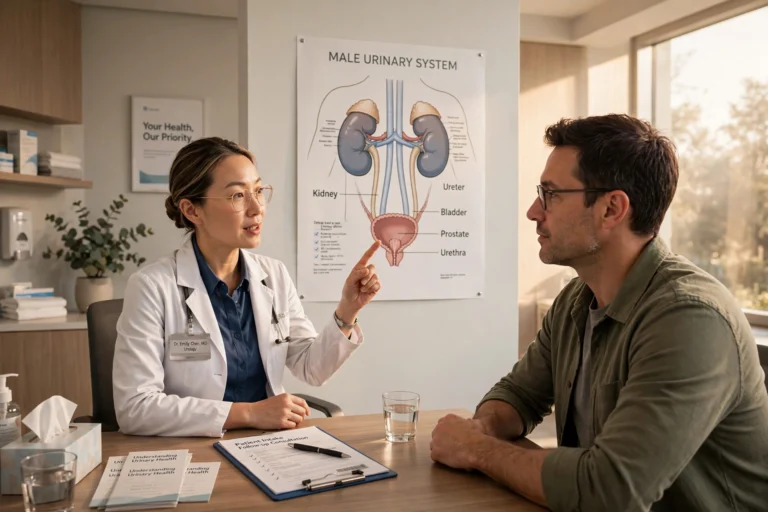
Fear of the unknown keeps many men from booking the appointment. Here is what actually happens when you report a testicular change:
- A physical exam. The doctor will feel both testicles and the surrounding structures. It takes a couple of minutes, and clinicians do this routinely — there is nothing unusual about it from their side of the desk.
- A scrotal ultrasound. This is usually the key test. It is painless, non-invasive, and takes about 15–20 minutes. Sound waves create images that clearly show whether a lump is solid or fluid-filled, which guides everything that follows.
- Blood tests. Your doctor may order blood tests for tumor markers — proteins such as alpha-fetoprotein (AFP), beta-hCG, and LDH — that can be elevated in testicular cancer and help with diagnosis and monitoring.
One reassurance: doctors do not perform needle biopsies through the scrotum for suspected testicular cancer. If cancer is strongly suspected after imaging and blood work, the standard approach is removal of the affected testicle through the groin — but in the large majority of evaluations, the finding turns out to be benign.
Getting Past the Embarrassment
Embarrassment is one of the biggest reasons men delay care for testicular concerns. A few practical points help:
- Doctors see this every day. Genital exams are routine clinical work. Your doctor will not be surprised, awkward, or judgmental — this is as ordinary to them as checking blood pressure.
- Use a simple script when booking. You do not need graphic detail on the phone. “I’d like to book an appointment about a testicular concern” is completely sufficient.
- Request the clinician you are most comfortable with. Many practices let you ask for a male or female doctor, or a specific provider. Asking is normal and clinics hear it constantly.
- Write it down. A short note describing what you felt and when it appeared is easier than improvising — and it helps the doctor too.
If you are unsure what to ask once you are in the room, our guide on questions to ask your doctor about men’s health concerns offers a practical checklist you can adapt.
For parents: teenage boys are the group most likely to skip self-checks and most likely to need emergency care for torsion. A short, matter-of-fact conversation works best — explain that a monthly one-minute check is normal health maintenance, like brushing teeth, and that sudden severe testicular pain is always a reason to tell an adult immediately, day or night. Offer to book the appointment yourself if your son finds something; removing the logistics barrier matters.
Making It a Monthly Habit
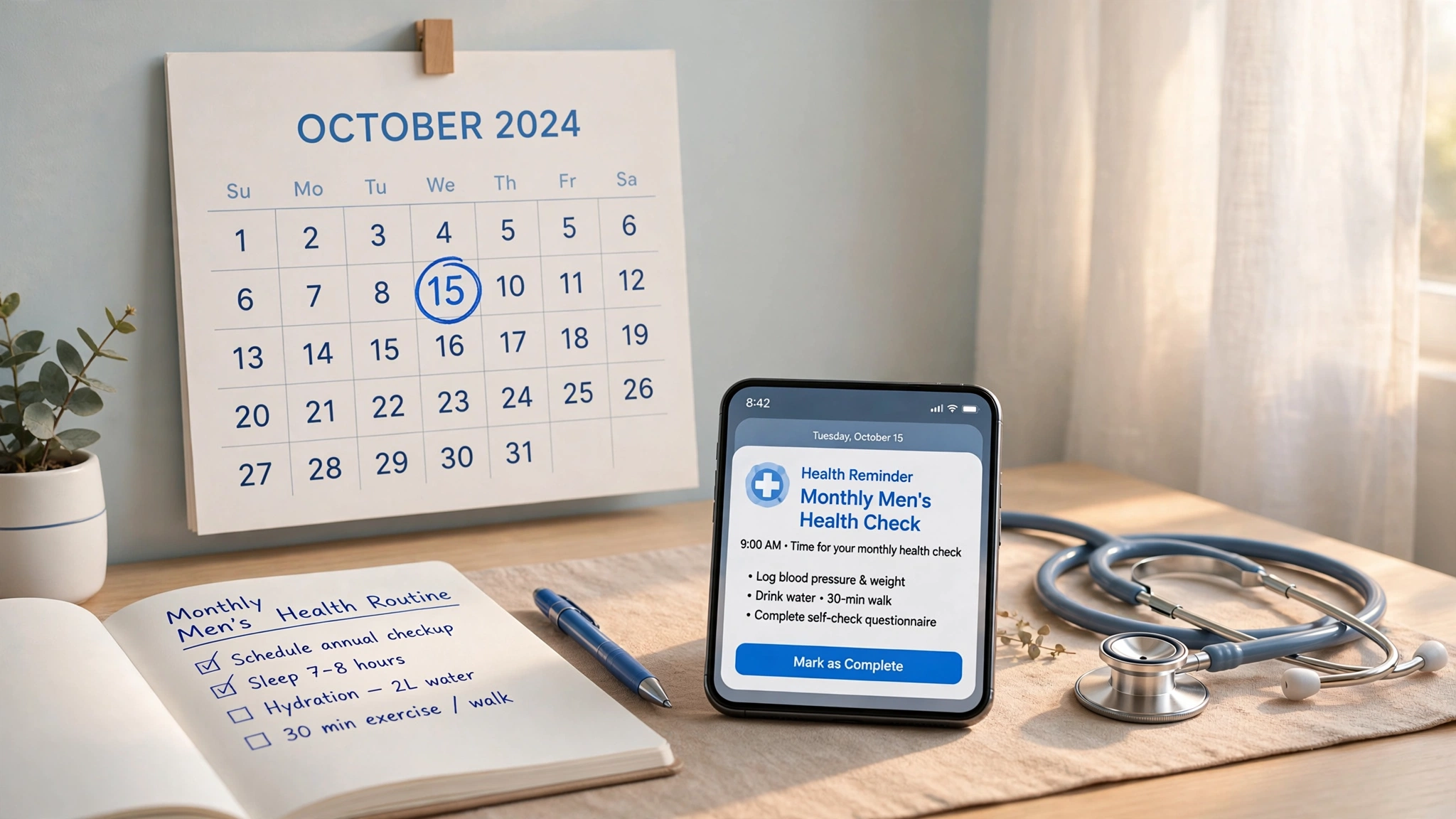
A few habit tricks make monthly checks stick:
- Anchor it to an existing routine. Do the check in the shower on the first of every month, or right after your monthly haircut — attaching it to something you already do is more reliable than willpower.
- Set a recurring phone reminder. A monthly calendar alert with a neutral label like “health check” takes ten seconds to set up and removes the need to remember.
- Keep a one-line baseline note. In your phone’s notes app, jot down what feels normal for you (“left slightly lower, epididymis easy to feel on right”). Next month’s comparison takes seconds.
Consistency is what makes self-exams useful. A single check tells you little; twelve checks a year teach you your body’s baseline, and that baseline is what lets you catch a real change early.
Frequently Asked Questions
At what age should I start doing testicular self-exams?
Most health providers suggest starting after puberty, generally around age 15, since testicular cancer risk rises from the mid-teens. There is no upper age limit — older men can develop testicular conditions too, and knowing your baseline remains useful at any age. If you are a parent, a brief conversation with your teenage son is the most effective way to get the habit started.
Does a testicular self-exam hurt?
No. A proper self-exam should be completely painless. You use gentle rolling pressure between your thumbs and fingers — never squeezing. If the exam itself causes pain, or if you find an area that is tender when touched, that is itself a finding worth mentioning to your doctor, especially if the tenderness is new.
I found a lump. Does that mean I have cancer?
Not necessarily — most scrotal lumps turn out to be benign conditions such as cysts, hydroceles, varicoceles, or infections. But there is no way to tell the difference by feel alone, and a painless lump is the classic presentation of testicular cancer. Do not try to self-diagnose or “wait and see” for more than a few days; book a doctor’s appointment promptly. Early evaluation almost always leads to a simpler answer and simpler treatment.
Is it normal for one testicle to be bigger than the other?
Yes. It is completely normal for one testicle to be slightly larger than the other, and for one to hang lower. What would be a warning sign is a new difference — if one side grows, changes shape, becomes firmer, or starts hanging differently than it did last month, have it checked.
How is a self-exam different from the exam my doctor does?
The technique is similar, but a doctor brings clinical experience, comparison across thousands of patients, and access to follow-up testing. A self-exam’s real job is not diagnosis — it is noticing change. Think of it as an early-warning system: you flag that something is different, and your doctor determines what it is, usually with a quick, painless ultrasound.
Do official guidelines actually recommend monthly self-exams?
The guidance is nuanced. The USPSTF recommends against formal screening of asymptomatic men (Grade D), finding insufficient evidence that screening programs add benefit beyond their harms, given the disease’s low incidence and high cure rates. However, the American Cancer Society advises men to be aware of testicular cancer and seek care immediately for symptoms, and urologists and cancer foundations widely promote monthly self-checks. The practical takeaway: a self-exam is not a medical screening test, but a simple way to know your own body.
Can I still do a self-exam after a vasectomy or testicular surgery?
Yes. A vasectomy does not change the testicles themselves, so the exam technique is the same. If you have had surgery on one testicle, examine the remaining tissue as usual and be extra attentive to changes — men with a history of testicular conditions are at higher risk and should keep the monthly habit. When in doubt about what is normal after surgery, ask your urologist to walk you through it once.
Testicular self-exams are one of the simplest health habits a man can build: one minute a month, no equipment, no cost — and the knowledge to act early if something changes. Start with your next shower, set a monthly reminder, and treat it like any other routine maintenance. Your future self will be glad you did.
This article is for educational purposes only and is not medical advice. It does not replace professional diagnosis or treatment. If you notice a lump, swelling, pain, or any change in your testicles, please see a qualified healthcare provider promptly.