Vasectomy Reversal: Success Rates Explained
A vasectomy is meant to be permanent, but life changes. A new relationship, the loss of a child, or a renewed desire to grow a family leads thousands of men each year to ask whether the decision can be undone. If you are considering a vasectomy reversal, the first question you need answered honestly is about vasectomy reversal success rates — and the honest answer is more nuanced than a single number.
Published studies report that sperm return to the semen in roughly 70 to 97 percent of cases, while actual pregnancy rates range from about 30 to 76 percent, depending mostly on how many years have passed since the original vasectomy. In this guide to vasectomy reversal success rates, we break down what those numbers really mean, which factors move them up or down, how the two types of reversal surgery differ, and when sperm retrieval with IVF may be the smarter path.
Vasectomy Reversal Success Rates: The Two Numbers That Matter
Most men confuse the two different ways success is measured, and the distinction matters more than anything else you will read here.
Patency rate is the surgeon’s number: the percentage of men who have sperm return to their ejaculate after the operation. It answers the question “did the plumbing work?”
Pregnancy rate is the couple’s number: the percentage of couples who actually conceive. It answers the question “did we get a baby?”
The pregnancy rate is always lower than the patency rate — typically by 20 to 30 percentage points — because conceiving a child depends on the partner’s fertility, the couple’s age, how often they have intercourse, and the quality of the returning sperm, not just whether sperm are present. When a clinic advertises a “95% success rate,” ask which number they mean. When comparing vasectomy reversal success rates across studies, always check whether the reported figure is patency, pregnancy, or a mix of the two.
Success Rates by Years Since Vasectomy
The single biggest predictor of outcome is the obstructive interval — the time between your vasectomy and the reversal. The largest study ever published on this topic, the Vasovasostomy Study Group’s analysis of 1,469 procedures, established a pattern that later research has consistently confirmed:
- Less than 3 years since vasectomy: patency around 97%, pregnancy around 76%
- 3 to 8 years: patency around 88%, pregnancy around 53%
- 9 to 14 years: patency around 79%, pregnancy around 44%
- 15 or more years: patency around 71%, pregnancy around 30%
Modern microsurgical series from high-volume surgeons report somewhat better results than these historical averages, particularly for reversals performed within the first decade. The American Urological Association’s 2024 vasectomy guideline explicitly acknowledges this time-dependent gradient when counseling reversal candidates about vasectomy reversal success rates.
Why does time matter so much? The longer the vas deferens has been blocked, the more pressure builds up behind the blockage in the epididymis — the coiled organ where sperm are stored behind each testicle. Over years, that pressure can cause tiny ruptures (called blowouts) in the delicate epididymal tubules, which then require a more complex operation to fix.
The Procedure You Need Changes Your Odds
“Vasectomy reversal” is an umbrella term for two different operations, and which one you need is a major driver of vasectomy reversal success rates for each patient.
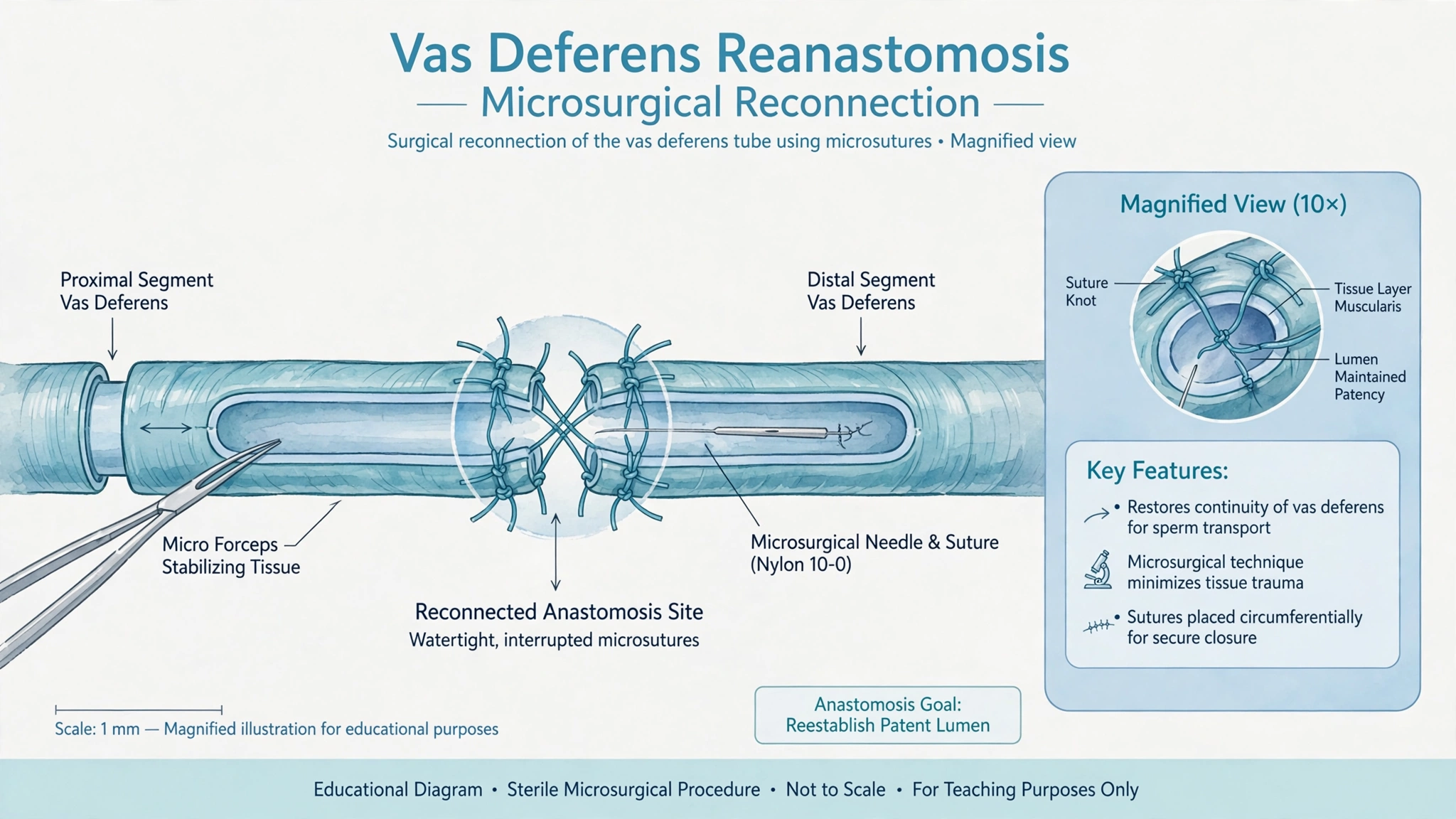
Vasovasostomy is the standard reversal. The surgeon trims back the scarred ends of the vas deferens and sutures the two ends together under an operating microscope, using sutures finer than a human hair. In experienced hands, patency rates for vasovasostomy run 90 to 99 percent, with pregnancy rates of roughly 65 to 75 percent when the vasectomy was recent.
Vasoepididymostomy is the fallback operation for when a blowout has occurred. Instead of rejoining the vas to itself, the surgeon connects the vas deferens directly to a tiny tubule inside the epididymis, bypassing the damaged section. It is technically far more difficult, takes longer, and carries lower success rates: patency of 60 to 85 percent and pregnancy rates of roughly 30 to 45 percent in most series.
Here is the part most patients do not know: the choice between the two operations is made during surgery, not before it. The surgeon examines fluid from the testicular end of the cut vas under the microscope. If sperm are present, vasovasostomy is performed. If the fluid is thick, pasty, and sperm-free, vasoepididymostomy is required on that side. Because of this, choosing a microsurgeon who performs both procedures regularly — not just vasovasostomy — is the single most important decision you can make. In reversals performed more than 10 years after the original vasectomy, 20 to 40 percent end up needing vasoepididymostomy on at least one side.
What Raises or Lowers Your Chances
Beyond the years since your vasectomy, several personal factors influence where your vasectomy reversal success rates land within the published ranges:
- Your partner’s age and fertility. This is the second-biggest factor after time. Pregnancy rates fall noticeably when the female partner is over 35, regardless of how perfect the surgery was.
- Your proven fertility history. Men who fathered pregnancies easily before the vasectomy — especially with the same partner — tend to do better.
- Surgeon experience. High-volume microsurgeons report consistently better patency rates than general urologists who perform the procedure occasionally. Ask how many reversals your surgeon does per year; 25 to 50 or more is the range experts recommend.
- Sperm granuloma. A small lump at the old vasectomy site, where sperm leaked and formed a tiny nodule, may actually be good news — it acted as a pressure-relief valve that protected the epididymis from blowout.
- Anti-sperm antibodies. Around half to three-quarters of men develop antibodies against their own sperm after vasectomy. Most still conceive after reversal, but very high levels can impair the sperm’s ability to reach and fertilize the egg.
- Overall health and habits. Smoking, heavy alcohol use, and untreated conditions that affect sperm production lower your odds. A hormonal screen (testosterone, LH, FSH) before surgery can catch testicular problems that no plumbing repair will fix.
Men who had a vasectomy after already completing their families sometimes worry the original procedure damaged their fertility permanently. For most men this is not the case — sperm production continues normally, which is why patency rates remain high. If you are still researching the original procedure, our guide to common vasectomy myths and facts separates rumor from reality.
Your Partner’s Fertility Is Half the Equation
A reputable surgeon will insist on evaluating your partner before scheduling surgery. Reversal counseling is incomplete without it. The typical workup includes her age, menstrual regularity, hormone testing (AMH and day-3 FSH), and a pelvic ultrasound. If she is over 35, many clinicians also recommend a test of the fallopian tubes, because restoring his sperm achieves nothing if another barrier blocks conception.
This is also the point at which the decision between reversal and assisted reproduction gets serious. A large meta-analysis comparing vasectomy reversal success rates with IVF outcomes found that for women under 35 with no fertility problems, reversal produced higher cumulative live-birth rates per couple. For women over 38, IVF outperformed reversal on time-to-pregnancy — the couple had a baby sooner. When the woman’s fertile window is short, waiting 12 to 18 months for sperm to return and conception to happen naturally may waste the very time she needs.
If conception is not happening after a year of trying with normal semen results on both sides, a specialist can sort out next steps. Read our guide on when couples should see a fertility specialist to know the right timing.
Vasectomy Reversal vs. IVF: When Each Path Wins
For a couple whose only fertility barrier is the vasectomy, there are two legitimate routes: reverse the vasectomy, or bypass it entirely by retrieving sperm directly from the testicle or epididymis and using it in an IVF cycle (ICSI).
Reversal usually wins when: the female partner is under 35 with normal fertility, the vasectomy was less than 10 to 15 years ago, and the couple would like more than one child. It is a one-time intervention; once the plumbing is open, the couple can try naturally for months or years, and one successful surgery can lead to multiple pregnancies with no further treatment.
Sperm retrieval with IVF usually wins when: the female partner is over 38 or has reduced ovarian reserve, she has tubal problems or severe endometriosis, the vasectomy is more than 20 years old, or the couple wants a baby as quickly as possible. IVF also sidesteps high anti-sperm antibody levels, because the sperm is injected directly into the egg.
There is no universally correct answer — only the right answer for your couple, in your year, at your cost. A good clinician will run your specific numbers (years since vasectomy, her age and test results, how many children you want) rather than steering you by default.
The Conception Timeline After Surgery
Success is not measured the week after the operation. Sperm may reappear in the semen within a few weeks, but in many men it takes three to six months, and in some cases up to a year or more for counts to reach levels that support conception. After a vasoepididymostomy, the wait can be longer still.
The standard monitoring schedule is:
- 3 months: first semen analysis to check whether sperm have returned
- 6 to 9 months: repeat analyses to track whether counts are climbing
- 12 to 18 months: if sperm never appear, the surgery is generally considered to have failed, and the conversation shifts to a second attempt or IVF
Among couples with a successful reversal, most pregnancies happen within 8 to 15 months after surgery, though some conceive within six months and others need more than two years. Regular semen analyses during this window are the only reliable way to confirm the operation worked — other than a pregnancy itself. During recovery, couples often ask about resuming intimacy; see our guide on sex after a vasectomy for realistic recovery timelines after scrotal surgery.
Can a Successful Reversal Fail Later?
Yes, and patients are rarely warned about this. Scar tissue can form at the reconnection site months or years later and re-block the tube. Published figures put this late failure at roughly 5 to 10 percent after vasovasostomy and up to 35 percent after vasoepididymostomy. This is one reason surgeons schedule follow-up semen analyses even after an initial good result.
If a reversal fails — early or late — the options are not exhausted:
- A second-attempt reversal is possible. Success rates for a redo are slightly lower than for the first attempt, but many men still achieve patency.
- Freezing sperm as a backup is worth discussing before surgery. Some men choose to have sperm frozen (cryopreservation) in case the reversal does not work. Mayo Clinic notes that while this is not routinely recommended, it is a legitimate option, and that frozen sperm can later be used with assisted reproductive technology such as IVF. Sperm can be retrieved directly from the testicle or epididymis, either at the time of the reversal or later: Mayo Clinic’s overview of vasectomy reversal.
Cost Comparison: One-Time Surgery vs. Multiple IVF Cycles
Money is a real part of this decision, and the math depends on how many children you want. A vasectomy reversal is typically a single out-of-pocket charge, since most insurance plans classify it as elective. IVF with ICSI is priced per cycle, and most couples need more than one cycle.
The crossover point: couples who want two or more children almost always come out ahead financially with a reversal, because one successful surgery enables multiple natural pregnancies. Couples comparing vasectomy reversal success rates against cumulative IVF odds should run the numbers for their own situation. A couple who wants one child quickly, with a partner approaching 40, will often find IVF the better value despite the per-cycle cost — because time, not money, is their scarcest resource.
When comparing surgeons, compare outcomes, not just prices. A cheaper operation with a 60 percent patency rate is a worse deal than a pricier one at 95 percent if it leads to a failed reversal followed by IVF anyway.
Questions to Ask Your Surgeon
Before you commit, ask these questions and expect specific numbers, not vague reassurance:
- How many microsurgical reversals do you perform each year?
- Are you trained and experienced in both vasovasostomy and vasoepididymostomy?
- What percentage of your reversals end up needing vasoepididymostomy on at least one side?
- What are your patency and pregnancy rates — in other words, your vasectomy reversal success rates — broken down by years since vasectomy?
- What does your follow-up and semen analysis schedule look like?
- Do you offer sperm retrieval and freezing at the time of surgery as a backup?
Frequently Asked Questions
What is the average success rate of a vasectomy reversal?
There is no single average for vasectomy reversal success rates, because the rate depends on the time since your vasectomy. Across published studies, sperm return to the semen in 70 to 97 percent of cases and pregnancy occurs in 30 to 76 percent of couples. The classic large study of 1,469 reversals found 76 percent pregnancy within 3 years of vasectomy, falling to 30 percent at 15 or more years.
How long after a vasectomy can you still have a successful reversal?
Although vasectomy reversal success rates decline over time, a reversal can technically be attempted at any interval — surgeons have performed them more than 25 years after the original vasectomy. The realistic question is whether it is the best path: patency stays above 70 percent even beyond 15 years, but pregnancy rates drop toward 30 percent and the odds of needing the more complex vasoepididymostomy rise sharply. Beyond 20 years, many couples are better served by sperm retrieval with IVF.
Does a vasectomy reversal affect testosterone or sexual performance?
No. A vasectomy reversal only reconnects the sperm-carrying tubes; it does not change hormone production, erections, libido, or the sensation of ejaculation. Testosterone is produced in the testicles and travels through the bloodstream, a pathway the surgery does not touch.
How long until we can try for a baby after the reversal?
Most surgeons advise waiting about 3 to 4 weeks before resuming sexual activity so the microsurgical connection can heal. The first semen analysis is typically done at 3 months. Many couples conceive within 8 to 15 months after a successful surgery, though it can take longer.
What happens if the reversal does not work?
If no sperm appear in the semen by 12 to 18 months, the reversal is generally considered unsuccessful. Options include a second-attempt reversal (slightly lower success rates than the first) or fathering a child through IVF using sperm retrieved directly from the testicle or epididymis. Freezing sperm as a backup around the time of surgery gives couples a head start if they go the IVF route.
Is a vasectomy reversal covered by insurance?
Usually not. Most insurance plans classify vasectomy reversal as an elective fertility procedure and do not cover it, so patients typically pay out of pocket. IVF is also frequently uncovered. Check your specific policy and ask the clinic about payment plans before scheduling.
This article is for educational purposes only and is not medical advice. Vasectomy reversal success rates vary by individual, and only a qualified urologist or fertility specialist can evaluate your personal situation. Consult a healthcare professional before making decisions about fertility treatment.