Male Birth Control: Where the Research Stands in 2026
For more than half a century, contraception has been almost entirely a woman’s responsibility. Men have had two reliable options — condoms and vasectomy, as described by Mayo Clinic — and nothing in between. Male birth control research is finally trying to change that.
Several approaches are in or approaching human trials: a non-hormonal daily pill, a hormone gel rubbed on the shoulders, an on-demand pill, and a hydrogel injected into the vas deferens. This guide covers where male birth control research stands in 2026, the leading candidates, what reversibility data shows, and what couples should ask a doctor now.
Why Male Birth Control Research Matters
Contraceptive responsibility has never been evenly shared. Women can choose from pills, patches, rings, injections, implants, and intrauterine devices, while men who want reliable contraception without surgery have effectively one option: the condom.
There is also a medical equity argument: roughly one in five women cannot tolerate hormonal birth control. Male birth control research is not just about adding products — it is about giving couples more ways to share family planning.
Historically the field has been held back by an extremely high safety bar and limited funding. Both are shifting: multiple biotech companies and academic groups are now running human trials, with peer-reviewed progress reported in journals like PNAS and the Journal of Medicinal Chemistry in 2026.
The next decade of male birth control research will test whether industry funding finally matches public interest.
Male Birth Control Research: The Leading Candidates in 2026
Current male birth control research splits into two strategies. Hormonal approaches temporarily suppress sperm production via brain signaling, then add back a controlled hormone dose to keep energy, libido, and function normal. Non-hormonal approaches target specific steps of sperm production or transport without touching the body’s hormones. Here are the candidates furthest along.

YCT-529: The Non-Hormonal Daily Pill
YCT-529 is one of the most advanced non-hormonal candidates in male birth control research. Developed by YourChoice Therapeutics with university researchers, it blocks the retinoic acid receptor alpha (RAR-alpha) — a protein essential for sperm production. Without access to this receptor, sperm development stalls.
In animal studies across four species, YCT-529 reversibly suppressed sperm counts, and first-in-human results published in 2025 showed it was well tolerated in male volunteers. A phase 2a human study is now underway, and a drug-discovery paper published in the Journal of Medicinal Chemistry in January 2026 detailed the molecule’s development path.
NES/T: The Hormonal Contraceptive Gel
The NES/T gel combines a progestin (nestorone) with testosterone in a gel applied daily to the shoulders and upper arms. The progestin suppresses sperm production; the added testosterone maintains energy, mood, libido, and overall function.
This is one of the longest-running programs in male birth control research: in trials, a majority of men reached very low sperm counts within several months, and a large phase 2b trial has evaluated effectiveness as couples’ sole contraception.
DMAU and 11-beta-MNTDC: Once-Daily Hormonal Pills
These two experimental compounds — dimethandrolone undecanoate (DMAU) and 11-beta-methyl-19-nortestosterone-17-beta-dodecylcarbonate (11-beta-MNTDC) — are modified androgens designed to be taken once a day as pills. They act like testosterone and progestin at the same time: suppressing the hormones that drive sperm production while replacing testosterone so the body does not go without.
Early trials showed they were generally well tolerated. They remain in earlier clinical stages than the gel, but a once-daily pill would be the most familiar format for many users.
Researchers hope that familiar formats will help future male birth control research products gain acceptance once approved.
RISUG, Vasalgel, and ADAM: The Hydrogel Approach
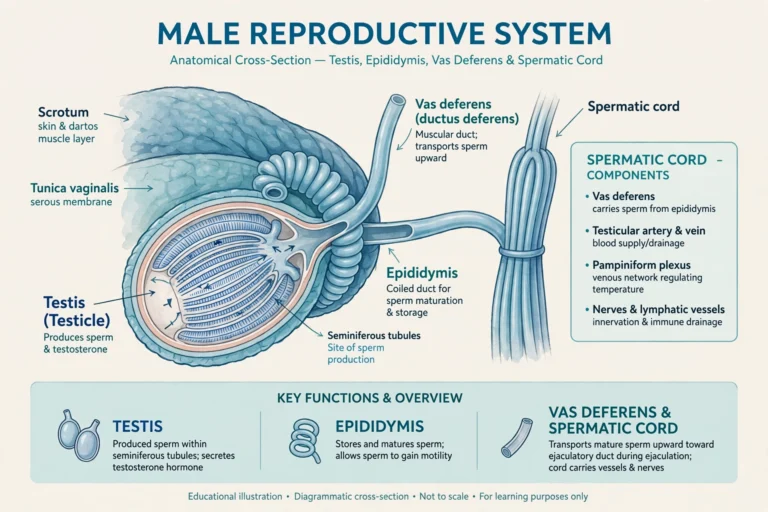
Another major branch of male birth control research is not a drug at all. Researchers are developing hydrogels injected into the vas deferens — the tubes that carry sperm — to block sperm from passing through. India’s RISUG program has been in clinical evaluation for years, and the U.S.-based Vasalgel and Contraline’s ADAM are following a similar path.
ADAM reported promising early human-trial safety results in 2025. The appeal is clear: a one-time, office-based procedure designed to be reversed by dissolving or removing the gel — filling the gap between daily methods and permanent sterilization.
JQ1 and the Meiosis Target: Early-Stage Science
Some of the most exciting basic science in this field appeared in 2026. Researchers at Cornell University published a six-year proof-of-principle study in PNAS showing that disrupting a checkpoint in meiosis — the cell division process that creates sperm — can temporarily halt sperm production in mice.
Using a research compound called JQ1, the team stopped sperm production completely within three weeks; normal production returned within six weeks after treatment ended. The key insight: targeting meiosis switches fertility off and back on without harming sperm-making stem cells.
The Candidate Pipeline at a Glance
Here is where the major programs in male birth control research stand right now.
| Candidate | Type | How it works | Stage (2026) |
| YCT-529 | Non-hormonal pill (daily) | Blocks RAR-alpha, stalling sperm development | Phase 2a human trials |
| NES/T gel | Hormonal gel (daily) | Progestin suppresses sperm; added testosterone maintains function | Phase 2b efficacy trials |
| DMAU / 11-beta-MNTDC | Hormonal pill (daily) | Modified androgens suppress sperm production | Early human trials |
| ADAM / Vasalgel | Non-hormonal hydrogel (one-time procedure) | Blocks sperm in the vas deferens; designed to be dissolvable | Early human trials |
| RISUG | Non-hormonal polymer (one-time procedure) | Chemical barrier in the vas deferens | Clinical evaluation in India |
| NLS-133 (“on-demand pill”) | Non-hormonal pill (as needed) | Interferes with the signal that releases sperm during ejaculation | Phase 2 trials |
| JQ1 / meiosis target | Non-hormonal (concept) | Temporarily disrupts the sperm-making process | Preclinical (mice) |
Hormonal vs Non-Hormonal Male Contraception
Scientists pursue both tracks because of trade-offs. Hormonal methods build on decades of hormonal experience and suppress sperm very effectively, but they can cause acne, mood changes, weight gain, or cholesterol shifts.
Non-hormonal methods avoid those hormonal side effects entirely — a major reason they generate so much excitement. But they are generally earlier in development, with less human safety data. Here is how the two tracks compare:
- How they work: Hormonal methods suppress the brain’s signal to produce sperm and add back controlled hormone. Non-hormonal methods block sperm production or release at specific biological steps.
- Side effects reported so far: Hormonal trials have reported mostly mild effects — acne, modest weight gain, small cholesterol changes, and occasional mood effects. Non-hormonal early trials have reported few systemic side effects, though long-term human data is still limited.
- Reversibility: Both are designed to be reversible. Hormonal methods typically take a few months to wear off; non-hormonal methods vary — some may act within hours or days, while hydrogels require a dissolving procedure.
- Daily routine: Pills and gels need consistent daily use; hydrogels are one-time procedures; on-demand pills are taken only when needed.
Most experts expect first-generation products from both tracks, since different men and couples will prefer different balances of convenience and effect. For a broader look at contraceptive choices today, see our guide on birth control and sex drive.
Couples following male birth control research should remember that no option is approved yet, so today’s decisions should still rest on today’s proven methods.

What the Reversibility Data Tells Us So Far
Reversibility is the single biggest question in male birth control research, and it is also the one the public understands least. Reversible does not mean instant. When any male contraceptive stops sperm production, the body needs time to restart the factory — and researchers have measured that.
From animal and human trial data, the emerging pattern is reassuring but slow: after hormonal methods are stopped, sperm counts typically recover over several months. In the Cornell meiosis study, treated mice recovered normal sperm production within about six weeks. Hydrogel approaches are designed to restore sperm passage once the gel is dissolved, though large-scale human reversibility data is still being collected.
Why does it take months? Sperm production runs on a roughly 70-day cycle, so new sperm still need time to mature after suppression ends. Researchers deliberately target steps that spare the sperm-making stem cells — the Cornell team emphasized that destroying them would risk permanent infertility, which is why meiosis is such an attractive target.
The honest limitation: full reversibility in humans has not yet been proven at scale for every candidate — that is exactly what phase 2 and 3 trials are measuring. Doctors and regulators will rightly demand this evidence before any method is recommended.
Future male birth control research will publish sperm-recovery curves for each candidate, giving couples concrete numbers to discuss with their doctors.
Side Effects: What Trials Have Actually Shown
Any contraceptive used by healthy people must have an excellent safety profile — the highest bar in this field. Here is what published trials have reported so far, without hype in either direction.
- Hormonal pills and gels: The most common effects are mild acne, modest weight gain, small decreases in HDL (“good”) cholesterol, and occasional mood changes or fatigue. In large trials of hormonal male contraception, most men reported these as tolerable, though a minority discontinued for mood-related reasons.
- Non-hormonal pills (early human data): YCT-529’s first-in-human study found it well tolerated with no major safety signals, but the data is from small, short-term studies.
- Hydrogel procedures: Early ADAM trial data showed most adverse events were mild and procedure-related (brief discomfort, swelling), consistent with no-scalpel vasectomy recovery. No long-term effects are yet known.
- Libido and function: Across hormonal trials, most men maintained normal erections and sexual desire — the added testosterone component is specifically there to preserve these functions. There is no evidence that male contraceptives reduce masculinity, muscle mass, or identity when properly formulated.
Context matters: regulators compare candidate safety against the risks of pregnancy and the side effects of existing female contraception — that comparison, not perfection, is the real standard. If persistent mood changes, acne, or other symptoms ever worry you, talk to your doctor early.
As male birth control research moves into larger trials, long-term safety registries will track effects over years rather than months.
When Could Male Birth Control Actually Be Available?
This deserves a straight answer: none of these products is approved yet, and none can be prescribed today.
Drug development follows a long path — phase 1 (safety), phase 2 (dosing and early efficacy), phase 3 (large-scale proof), then regulatory review. The most advanced candidates are in phase 2, so realistic estimates put the earliest approvals years away, assuming phase 3 trials confirm early results — and trials can still fail.
Funding remains a bottleneck: male contraception attracts far less investment, and several promising programs have slowed for lack of money rather than lack of science.
Advocacy groups argue that steady public funding for male birth control research would accelerate timelines more than any single scientific breakthrough.
In the meantime, men who want to share contraceptive responsibility can use condoms consistently, discuss vasectomy if their family is complete, and talk openly — surveys suggest one of the biggest obstacles is that couples never discuss who handles birth control at all. Our guide on causes of low libido also covers how hormonal shifts in either partner shape these conversations.
How Couples Can Think About Male Birth Control Today
Even before any product launches, these advances are already changing how couples talk about family planning. A shared-responsibility mindset starts with a few honest questions, and a doctor can help answer them.
- Who carries the contraceptive burden right now? If it is entirely one partner, is that a deliberate choice or just habit?
- What are the non-negotiables? Some couples want something immediately reversible; others are comfortable with a procedure. Write down what matters.
- What side effects has each partner experienced? Comparing experiences can reveal when switching who contracepts makes sense.
- Is a clinical trial an option? Men interested in participating in male contraception trials can search trial registries such as ClinicalTrials.gov, ask a urologist about enrolling, or explore Cleveland Clinic’s birth control care resources. Trial participation is how these products get proven.
Even small steps — like a man raising the topic first — signal the kind of support that male birth control research advocates say matters most.
When products do arrive, expect doctors to recommend confirming sperm suppression with a semen analysis before relying on any method — the same way vasectomy patients confirm success before stopping backup contraception.
FAQs
These are the questions readers ask most often about male birth control research in 2026.
Is the male birth control pill safe?
Early human trials of candidates like YCT-529, DMAU, and the NES/T gel have shown generally good short-term safety, with mostly mild effects such as acne, modest weight gain, or small cholesterol changes. However, no product has completed phase 3 trials or received regulatory approval. Long-term safety in large populations is exactly what ongoing and future trials must establish.
When will male birth control be available?
No male birth control product is approved yet. The most advanced candidates — YCT-529, the NES/T hormonal gel, and hydrogel implants — are in or approaching phase 2 trials. If phase 3 trials confirm effectiveness and safety, the earliest products could reach the market within several years.
How effective is male birth control expected to be compared to condoms or vasectomy?
Condoms are about 98% effective with perfect use but closer to 85% with typical use. Vasectomy is over 99% effective but should be considered permanent. Researchers aim for new male contraceptives to match female hormonal methods — over 99% with perfect use — while remaining reversible. True real-world effectiveness will only be known after large phase 3 trials, where couples use the method as their sole contraception.
Are there non-hormonal male birth control options in development?
Yes. Non-hormonal approaches include the YCT-529 pill (blocks sperm development via the RAR-alpha receptor), hydrogel implants that block the vas deferens, an on-demand pill that temporarily prevents sperm release during ejaculation, and early-stage research targeting the meiosis process itself. They aim to avoid hormonal side effects like acne and cholesterol changes, though they are generally earlier in human testing.
Is male birth control reversible?
All candidates are designed to be reversible, and animal and early human data are encouraging — sperm production returned within weeks to months after stopping treatment. The key principle is sparing the sperm-generating stem cells. Large-scale human data is still being collected, and recovery takes time: the sperm maturation cycle is about 70 days, so restarting production typically takes a few months.
What side effects have researchers reported so far?
Hormonal candidates have most commonly caused mild acne, modest weight gain, small changes in cholesterol, and occasional mood effects — with most men finding them tolerable but a minority stopping for mood-related reasons. Early non-hormonal trials have shown few systemic effects, and hydrogel procedures mainly caused brief discomfort. Because long-term data is limited, doctors will continue monitoring safety closely as trials scale up.
The Bottom Line for Couples
Male birth control research has never been this active — real candidates are in human trials and 2026 papers have opened new targets. The science is genuinely promising and genuinely unfinished: no product is approved, reversibility at scale is still being proven, and timelines measured in years are realistic.
The most useful steps today are simple: talk openly with your partner about who handles contraception, ask your doctor what options fit your situation now, and consider whether a clinical trial could be right for you. The future of shared contraception is being written now.
Watching male birth control research progress is worthwhile — but family planning decisions today should be based on the options available today.
Medical Disclaimer: This article is for educational purposes only and does not constitute medical advice. Male birth control products described here are investigational and not approved for use. Always consult a qualified healthcare professional about contraception choices and any medical concerns.