Gynecomastia in Men: Causes and Treatment Options
Noticing unexpected swelling in your chest can be confusing and even frightening. If you are researching gynecomastia causes treatment, you are not alone: this condition affects an estimated one in three adult men at some point in their lives, and up to two-thirds of teenage boys during puberty.
Gynecomastia is the benign growth of glandular breast tissue in boys or men, driven by an imbalance between estrogen and testosterone. The good news is that it is almost never dangerous, many cases resolve without any intervention, and a clear range of treatment options exists for cases that persist or cause distress. In this complete guide to gynecomastia causes treatment, we walk through what causes it, how doctors evaluate it, every treatment path available, what lifestyle steps actually help, and how to cope with the emotional side along the way.
What Is Gynecomastia?
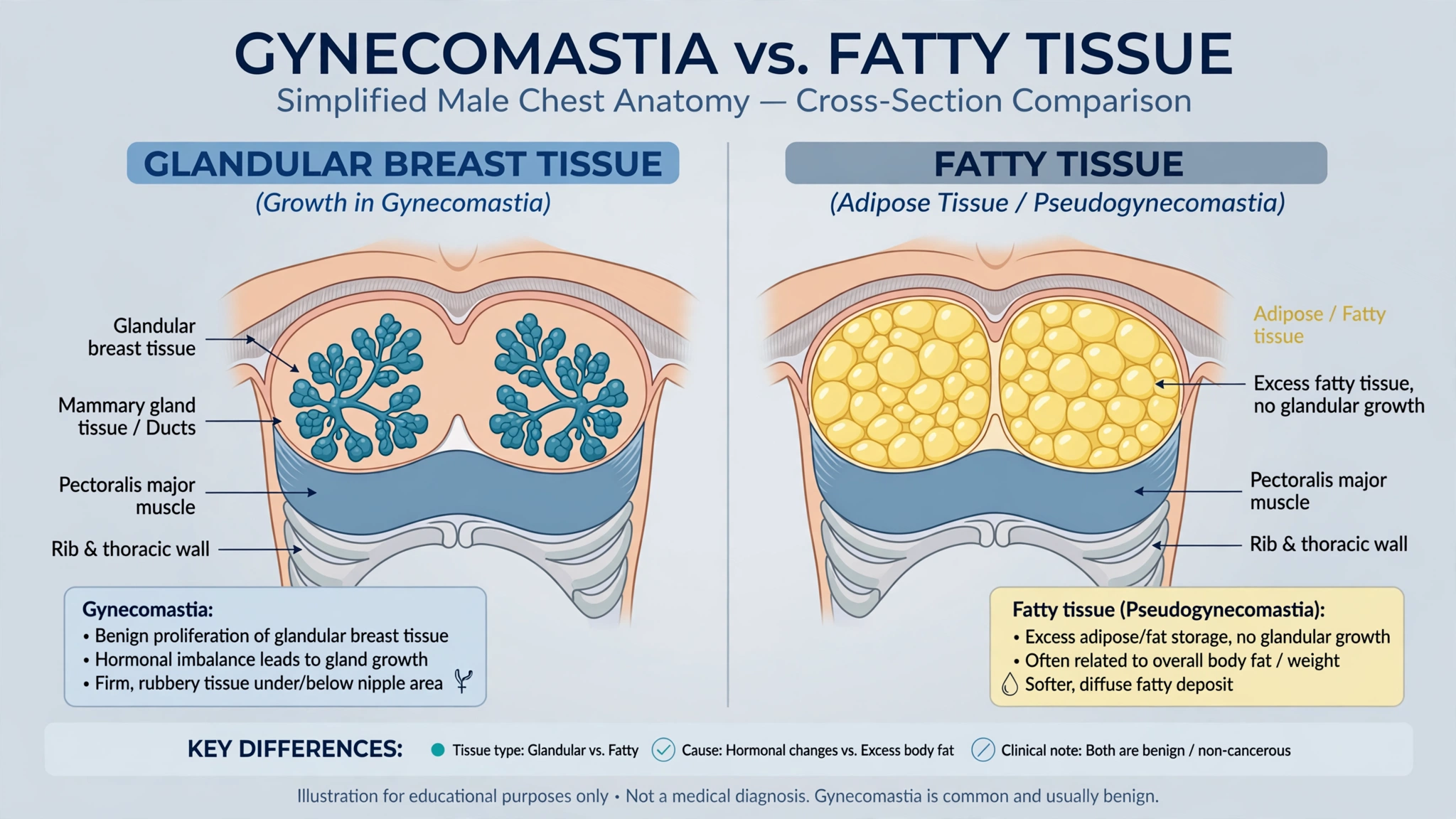
Gynecomastia is the non-cancerous enlargement of one or both breasts in a male due to growth of actual glandular breast tissue. It can be symmetrical or uneven, and it often feels like a firm, rubbery disc of tissue directly beneath the nipple and areola. It differs from pseudogynecomastia, which is simply excess fatty tissue in the chest area without glandular growth and is most common in men with obesity. Understanding gynecomastia causes treatment starts with knowing exactly what the condition involves.
Some key facts help put the condition in perspective:
- It is the most common benign disorder of male breast tissue.
- It can appear at any age, but clusters around three life stages: infancy, puberty, and later adulthood.
- It is usually painless, though tenderness and nipple sensitivity are common, especially in teenagers.
- It is benign, meaning not cancerous, but any new breast change still deserves a proper medical evaluation to rule out other conditions.
What Causes Gynecomastia?
At its core, gynecomastia is caused by a shift in the ratio between estrogen (which stimulates breast tissue growth) and androgens such as testosterone (which inhibit it). This shift can come from more estrogen, less testosterone, a blocked androgen effect, or a combination. The underlying trigger determines both the outlook and the best treatment approach. That is why any good overview of gynecomastia causes treatment covers the full range of triggers.
Natural Hormonal Shifts at Different Life Stages
The three most common patterns are entirely physiological:
- Newborns: Maternal estrogen passing through the placenta can cause temporary breast swelling in baby boys. This typically fades within two to three weeks and needs no treatment.
- Puberty: During early puberty, boys produce more estrogen relative to testosterone before hormone production stabilizes. Pubertal gynecomastia is very common, often tender, and resolves on its own within one to three years in the large majority of cases.
- Later adulthood: After roughly age 50, testosterone gradually declines while body fat, a site where testosterone is converted to estrogen, tends to increase. This combination makes gynecomastia increasingly common with age. Our testosterone and prostate health guide explains these hormonal shifts in more detail.
Medications Linked to Gynecomastia
An estimated 10 to 25 percent of cases are connected to medications. Drugs with a well-established link include antiandrogens used in prostate treatment, 5-alpha-reductase inhibitors such as finasteride, some anti-ulcer drugs like cimetidine, certain antipsychotics, calcium channel blockers, the antifungal ketoconazole, and opioids. Anabolic steroids and drugs marketed for muscle building are also a frequent cause, since the body converts excess testosterone-like substances into estrogen.
Never stop or change a prescribed medication on your own: if you suspect a link, bring a full medication list to your doctor, who can consider alternatives or dose adjustments.
Health Conditions That Can Trigger It
Several medical conditions disturb the estrogen-to-testosterone balance:
- Liver disease and cirrhosis: The liver clears estrogen from the blood, and a damaged liver does this poorly.
- Kidney failure: Uremia suppresses testosterone production.
- Thyroid disorders: Hyperthyroidism alters hormone-binding proteins.
- Hypogonadism: Any condition that lowers testosterone production, including Klinefelter syndrome, testicular injury, or pituitary problems.
- Tumors: Rarely, testicular, adrenal, pituitary, or lung tumors produce hormones that cause breast growth.
- Malnutrition and refeeding: After a period of severe undernourishment, the return of normal nutrition can cause a temporary hormonal rebound that mimics puberty.
In about a quarter of cases, no clear cause is ever found, and the condition is classified as idiopathic. That does not make it any less real or treatable.
Substances and Lifestyle Factors
Heavy alcohol use is associated with gynecomastia, partly because ethanol disrupts testosterone synthesis and some alcoholic drinks contain plant-based estrogen-like compounds. Marijuana, heroin, methadone, and amphetamines have also been linked to cases. Even some personal care products containing lavender or tea tree oil have been reported to cause breast tissue growth in prepubertal boys due to mild estrogen-like activity.
Gynecomastia Grades: How Doctors Classify It
Most men never hear about grading, but doctors often use the Simon grading scale to describe severity, and it directly influences treatment recommendations:
- Grade I: Small breast tissue enlargement without excess skin. Usually responds best to non-surgical approaches.
- Grade IIa: Moderate enlargement without excess skin.
- Grade IIb: Moderate enlargement with some excess skin.
- Grade III: Marked enlargement with excess skin resembling a female breast contour. Usually requires surgical correction.
Knowing the grade helps set realistic expectations for any gynecomastia causes treatment plan: a small Grade I case and a Grade III case are managed very differently, which is one reason a proper clinical assessment matters more than internet guesswork.
Warning Signs That Need Prompt Medical Care
While gynecomastia itself is benign, certain features should prompt a quicker medical evaluation because they can occasionally signal something else, including (rarely) male breast cancer:
- Rapid, one-sided breast growth in an adult
- A hard, fixed lump rather than soft, mobile tissue
- Nipple discharge, especially if bloody
- Skin changes such as dimpling, puckering, redness, or scaling
- Nipple retraction (the nipple pulling inward)
- Significant pain that does not ease, or swelling accompanied by testicular changes
Male breast cancer accounts for less than one percent of all breast cancers, so these signs are uncommon, but they are worth taking seriously. The Mayo Clinic’s overview of gynecomastia symptoms and causes offers a clear checklist of when to see a doctor.
How Gynecomastia Is Diagnosed
A diagnosis usually starts with a conversation and a physical examination, and most cases do not require extensive testing. This evaluation is the first step in any gynecomastia causes treatment plan. Here is what typically happens:
- Medical history: Your doctor will ask about medications, supplements, substance use, family history, and how the swelling began and changed.
- Physical exam: The doctor feels the breast tissue to distinguish firm glandular tissue from soft fat, checks both breasts, examines the genitals and testicles, and looks for signs of liver or thyroid disease.
- Blood tests: If the cause is unclear, tests may check testosterone, estrogen, LH, FSH, prolactin, thyroid hormones, and kidney and liver function.
- Imaging: A mammogram or breast ultrasound can confirm glandular tissue and rule out suspicious masses. Testicular ultrasound may be ordered if a testicular cause is suspected.
- Biopsy: Only in selected cases where a lump looks atypical.
If no cause is found and no red flags are present, the doctor may simply recommend watchful waiting with a re-check in a few months.
Gynecomastia Causes Treatment: Options Compared
Treatment depends on the cause, the grade, how long the condition has been present, and how much it bothers you physically or emotionally. Tissue that has been present for more than about two years tends to become fibrous and responds less well to medication, which is why timing matters.
Watchful Waiting
For pubertal gynecomastia and mild adult cases, the first recommendation is often to wait and re-evaluate in three to six months. Watchful waiting is a legitimate gynecomastia causes treatment strategy, not simply doing nothing. A large majority of teenage cases regress as hormones stabilize, and many adult cases improve once a contributing medication is changed or an underlying condition is treated.
Treating the Underlying Cause
When a specific trigger is identified, addressing it is the most effective gynecomastia causes treatment of all: switching a responsible medication, treating hypogonadism or thyroid disease, reducing alcohol intake, or stopping steroid use. Gynecomastia caused by substance or medication use often improves significantly once the trigger is removed.
Medications
For cases caught early, while tissue is still in the growth phase, doctors sometimes use medications that rebalance hormone signaling. The most studied gynecomastia causes treatment medications are selective estrogen receptor modulators (SERMs) such as tamoxifen and raloxifene, and occasionally aromatase inhibitors that reduce estrogen production.
Testosterone replacement can help in older men with genuinely low testosterone, but it does not help men whose testosterone is already normal and can sometimes worsen the problem by converting to estrogen. These are prescription treatments with their own side effects, so they must be managed by a physician rather than self-administered.
Surgery
Surgery is the most reliable gynecomastia causes treatment option for persistent, severe, or long-standing cases, especially Grade IIb and III cases and tissue that has been present for years. Two techniques are used, often combined:
- Liposuction: Removes excess fatty tissue through small incisions but does not remove glandular tissue itself.
- Glandular excision (mastectomy-type procedure): Surgically removes the dense glandular tissue, usually through a small incision along the edge of the areola.
Most procedures are done on an outpatient basis. Recovery typically involves a compression vest for several weeks, bruising and swelling that settle over a few weeks, and a return to desk work within about a week, with exercise restrictions lasting several weeks.
Risks include infection, scarring, asymmetry, contour irregularities, and changes in nipple sensation. Choosing a board-certified surgeon with specific experience in male chest surgery meaningfully improves outcomes.

Can Exercise or Lifestyle Changes Help?
Honest expectations matter here. Chest exercises and weight loss can improve the appearance of the chest, but they cannot dissolve established glandular tissue. Understanding what each change can and cannot do saves months of frustration.
- Exercise: Building the pectoral muscles beneath the tissue can make the chest look firmer and more contoured, and many men feel significantly better after a consistent training program. It will not remove glandular tissue, though.
- Weight loss: Losing body fat reduces both chest fat and estrogen production from fat tissue, which helps pseudogynecomastia considerably and may modestly improve true gynecomastia.
- Alcohol and drugs: Cutting back on heavy alcohol use and avoiding recreational drugs linked to the condition removes an ongoing hormonal trigger.
- Medication review: Bring every prescription, supplement, and over-the-counter product to your appointment so your doctor or pharmacist can flag possible contributors.
- Compression garments: Fitted compression shirts can discreetly flatten the chest contour while you decide on a longer-term plan. They are a cosmetic aid, not a treatment.
- Posture: Strengthening the upper back and standing tall improves chest appearance noticeably, a small win that costs nothing.
Common Myths About Gynecomastia
- “Just do more push-ups.” Exercise helps the look but does not remove gland tissue, so months of push-ups alone rarely change the underlying condition.
- “Taking testosterone will fix it.” Without medical supervision this can backfire, since excess testosterone converts to estrogen and may worsen breast growth.
- “Steroids will make your chest look more masculine.” Anabolic steroids are one of the most common causes of gynecomastia in young men, not a cure.
- “It always means something serious.” Most cases are benign and many resolve spontaneously; the concern is worth an evaluation, not panic.
- “Surgery always leaves terrible scars.” Modern techniques use small incisions that typically heal into faint lines, though scarring varies by individual.
Coping With the Emotional Side
Doctors increasingly recognize that the psychological impact of gynecomastia can be the hardest part. Studies describe body image disturbance, self-esteem problems, social withdrawal, anxiety, and shame, particularly in adolescents navigating identity and peer acceptance. Men describe avoiding swimming, changing rooms, fitted clothing, and intimate situations. Addressing the emotional side is a recognized part of complete gynecomastia causes treatment.
Practical coping strategies include:
- Talk about it: Shame thrives in silence. A trusted friend, partner, or counselor can make the condition feel far more manageable.
- Stay active socially: Withdrawing from activities you enjoy tends to deepen the distress rather than relieve it.
- Consider counseling: A therapist experienced in body image concerns can help, and support groups connect you with men who understand exactly what you are going through.
- Communicate with your partner: Partners are usually far more accepting than feared. Our body image and sexual confidence guide offers additional strategies for rebuilding confidence in intimate situations.
- For parents of teens: Take your son’s distress seriously rather than dismissing it as vanity. A timely doctor visit provides both medical clarity and emotional relief.
When to Talk to Your Doctor
Book an appointment if you notice new breast swelling or tenderness that does not fade within a few weeks, if it appeared rapidly or on one side only, if you have any of the warning signs listed above, or if the condition is affecting your mental health or daily life. Also consider an evaluation if you are taking medications known to be linked with gynecomastia, since a review could resolve the problem.
Discussing gynecomastia causes treatment options early gives you the widest range of choices. Men experiencing other possible hormonal symptoms, such as erectile dysfunction causes being explored alongside low energy or reduced libido, may benefit from a broader hormone assessment during the same visit.
Frequently Asked Questions
These answers cover the most common gynecomastia causes treatment questions.
Can gynecomastia go away on its own?
Often, yes. Pubertal gynecomastia resolves without treatment in the large majority of cases within one to three years. Adult cases linked to a medication or substance frequently improve once the trigger is removed. Tissue that has persisted for more than about two years is less likely to regress on its own and may need medical or surgical gynecomastia causes treatment.
Is gynecomastia the same as “man boobs” from being overweight?
Not exactly. “Man boobs” from excess weight is usually pseudogynecomastia, soft fatty tissue that improves with weight loss. True gynecomastia involves firm glandular tissue beneath the nipple that diet and exercise alone typically cannot remove, though a physical exam can distinguish the two.
Does gynecomastia increase the risk of male breast cancer?
The association is minimal. Gynecomastia itself is benign, and male breast cancer is very rare. However, because both can present as a breast lump, any new or changing breast tissue should be evaluated so the distinction is made by a professional, not assumed.
How long does gynecomastia surgery recovery take?
Most men return to office work within about a week. Swelling and bruising settle over two to four weeks, a compression vest is usually worn for several weeks, and strenuous exercise is restricted for roughly a month. Final contour results become clear after a few months as tissues settle.
Will insurance cover gynecomastia surgery?
Coverage varies widely. Insurance is more likely to consider coverage when the procedure is deemed medically necessary, for example with documented pain or a suspected underlying condition, and less likely when it is classified as cosmetic. A surgeon’s office can help you check your specific policy and documentation requirements.
Can supplements or creams marketed for gynecomastia work?
There is no credible evidence that over-the-counter supplements, creams, or “testosterone boosters” reduce glandular breast tissue. Some may contain undisclosed hormonal ingredients that worsen the problem. Save your money and discuss evidence-based gynecomastia causes treatment options with a doctor instead.
At what age should a teenager with gynecomastia see a doctor?
A pediatrician visit is reasonable whenever breast swelling causes a teenager significant distress, appears before puberty, grows rapidly, occurs only on one side, or persists beyond about two years. Most cases need only reassurance and monitoring, but the visit itself often relieves a great deal of anxiety.
This article about gynecomastia causes treatment is for educational purposes only and is not medical advice. Gynecomastia has many possible causes, and only a qualified healthcare professional can diagnose your condition and recommend appropriate treatment. If you notice new, changing, or painful breast tissue, please consult your doctor.