[Intimacy] Edging: What It Is, Benefits, and Risks
When people search for the edging technique explained in plain terms, they are usually looking for the same thing: what exactly edging is, whether it actually works, and whether it is safe. Edging is the practice of bringing yourself (or a partner) close to orgasm, then easing off stimulation before climax becomes inevitable, resting briefly, and repeating the cycle. Also called orgasm control, surfing, peaking, or the stop-start method, it is a technique with genuine clinical roots: it began life in the 1950s as a behavioral treatment for premature ejaculation and has since been adopted more broadly as a way to build body awareness, extend sexual encounters, and — for some people — intensify the eventual orgasm.
This guide explains the technique from the ground up: how arousal actually works in the body, the methods clinicians have studied, a practical beginner plan, how to practice it with a partner, and an honest look at the risks and myths. Everything is written in a clinical, educational style — because sexual health deserves the same clarity as any other health topic.
Edging Technique Explained: How the Method Works
At its core, edging has only one moving part: you deliberately pause stimulation when you reach the “edge” — the point just before orgasm becomes unavoidable — wait for arousal to dip slightly, and then resume. A typical solo session might involve two to five such cycles before you choose to climax; a partnered session might follow the same rhythm, with one or both partners signaling when a pause is needed.
The logic is straightforward. Ejaculation and orgasm are triggered by a cascade of nerve and muscle responses that, once they pass a threshold, cannot be stopped voluntarily. By practicing the pause at high-but-subthreshold arousal, people train two skills at once: recognizing the physical signals that precede that threshold, and learning that arousal can rise and fall without everything having to end in climax. Over time, many people report greater control over when they climax, less anxiety about “finishing too soon,” and a calmer, more observant relationship with their own arousal.
It is worth noting that edging is not a goal in itself. The Mayo Clinic notes that behavioral techniques like stop-start are a first-line approach for premature ejaculation, and clinicians have long framed these exercises as training tools, not as a lifestyle. Edging should feel like an experiment you run with curiosity — never like a test you can fail.
The Four Stages of Sexual Arousal (and Why They Matter for Edging)
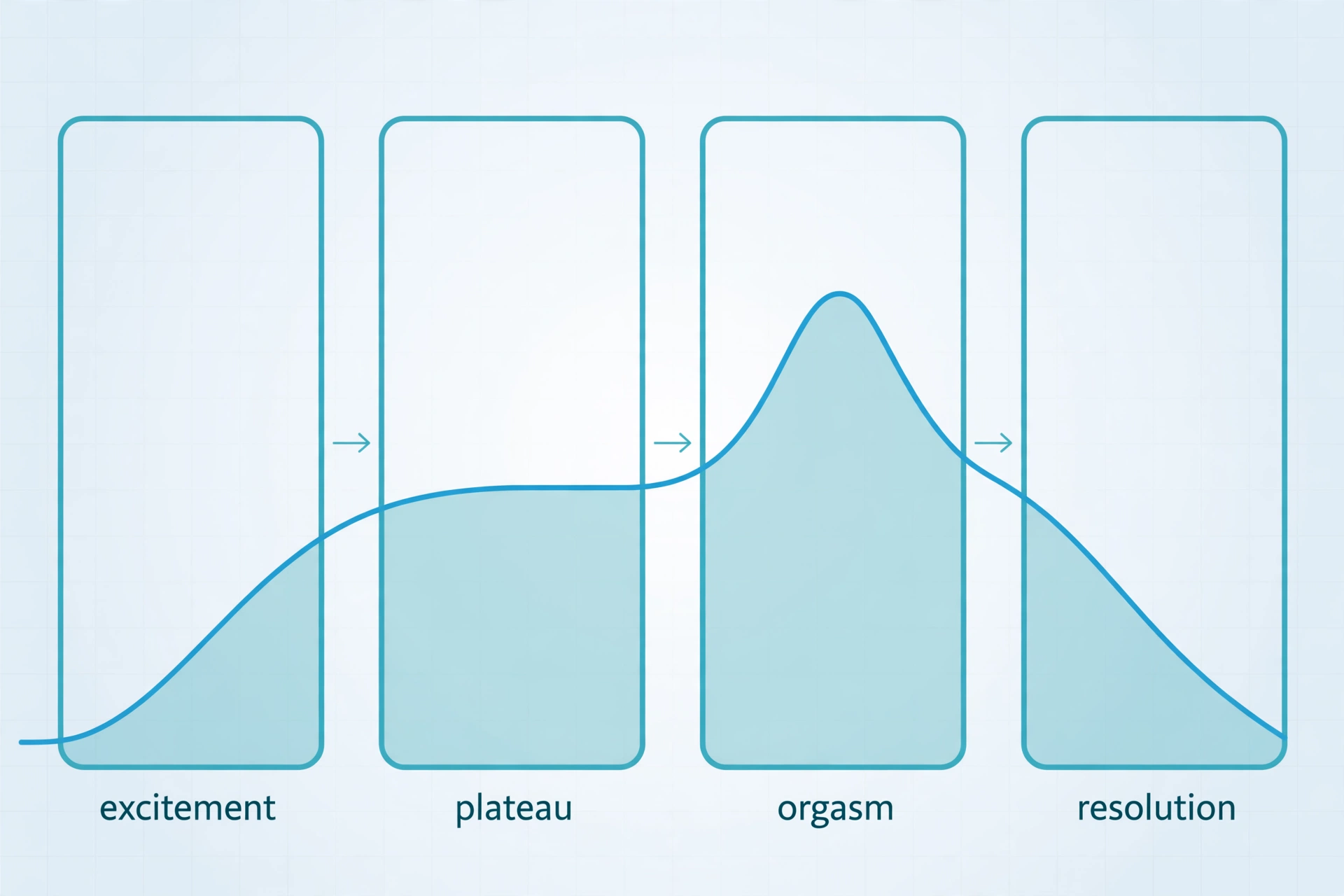
Sex therapists have traditionally described arousal in four stages, often attributed to the research of Masters and Johnson. Understanding them turns edging from guesswork into something you can actually navigate:
- Excitement. Blood flow to the genitals increases, heart rate and breathing quicken, muscles tense. Arousal is building but still low and fully controllable.
- Plateau. Everything from the excitement phase intensifies and levels off at a high pitch. This is the “edge” — the zone where edging happens. You hover here, dipping back toward late excitement during each pause.
- Orgasm. A series of rhythmic nerve and muscle responses, accompanied (in men) by ejaculation of semen. Once this cascade begins, it cannot be voluntarily stopped — which is why the pause must come before it.
- Resolution. Tissues return to their resting state, heart rate normalizes, and the refractory period begins — a window during which re-arousal is difficult or impossible. Its length varies enormously, from minutes to hours or longer.
The practical takeaway: edging is essentially a skill for recognizing late plateau and gently backing away from the orgasm threshold. Everything below is about how to build that recognition.
The 1-to-10 Arousal Scale: A Practical Framework
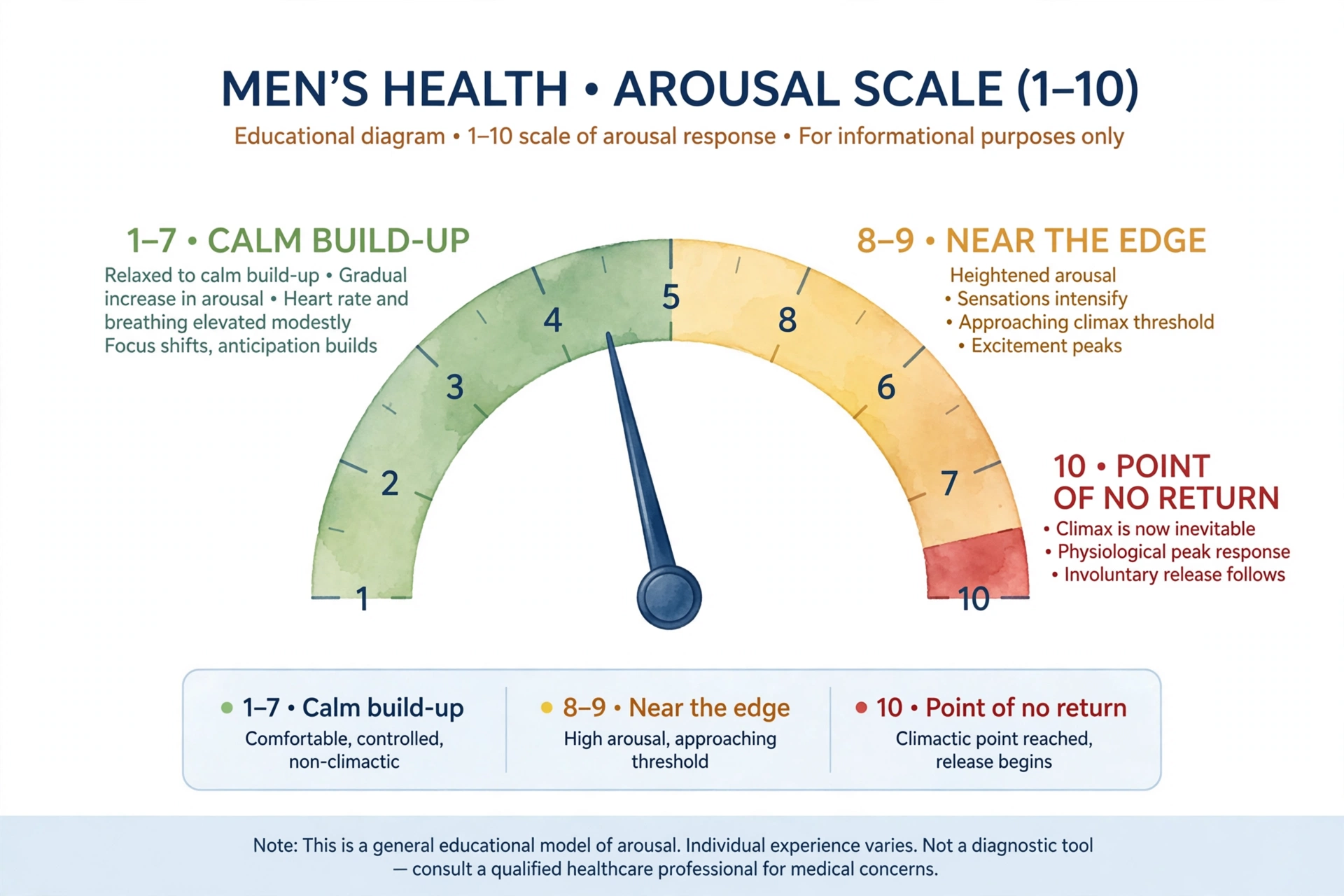
One tool sex therapists recommend that most online guides skip is a simple numbered arousal scale. Before a session, agree with yourself (or a partner) on what the numbers mean:
- 1–4: Relaxed to moderately aroused. Breathing slightly elevated, attention narrowing, everything comfortable and controlled.
- 5–7: High arousal but stable. This is your working range — pleasure is strong, yet you still feel fully in charge.
- 8–9: Near the edge. Sensations intensify rapidly; the body feels like it is accelerating toward climax. This is your signal to pause or change stimulation.
- 10: The point of no return. Orgasm is now inevitable and cannot be stopped.
The scale does two things. First, it gives you a shared language — “I was at an 8, I needed to stop” is far more useful than a vague “I was close.” Second, it turns each session into data: over a few weeks, most people notice their “8” moving further out, which is exactly what progress looks like. Beginners should aim to pause around 8; with practice, some people learn to ride a 9 briefly. Nobody should aim to hover at 10 — by definition, you cannot.
The Clinical History: From Semans (1956) to Modern Sex Therapy
Edging did not begin as an internet trend. In 1956, physician James H. Semans published a paper introducing the “stop-start method” for premature ejaculation: the man would stimulate himself to the brink of orgasm and then stop, repeating the cycle until he could sustain longer periods of stimulation. A decade and a half later, Masters and Johnson refined the idea with the “squeeze technique,” in which firm pressure applied to the head of the penis at the edge of climax reduces the urge to ejaculate.
Both approaches are still taught by sex therapists today, because the underlying principle holds up: the ejaculatory reflex can be modulated with practice, attention, and gradual desensitization. What the internet added was a name — “edging” — and a broader framing around pleasure, mindfulness, and partner play. But the technique’s credibility comes from its clinical history, not its trendiness. If you are dealing with persistent premature ejaculation, our guide to premature ejaculation treatment and causes walks through the full range of clinical options beyond behavioral techniques.
Potential Benefits of Edging
Research on edging specifically is limited — most of the evidence base comes from studies of the stop-start and squeeze techniques for premature ejaculation. Within that context, clinicians and researchers describe several plausible benefits:
- Greater ejaculatory control. Repeatedly approaching the threshold and backing away teaches the nervous system to tolerate high arousal without tipping into climax, which can help some people last longer during sex.
- Body awareness. Paying close attention to the signals that precede orgasm — muscle tension, breathing changes, warmth, tingling — builds a detailed map of your own arousal. Many people find this reduces performance anxiety.
- Potentially more intense orgasms. After several cycles of build-up and release, the eventual climax may feel stronger for some people, likely because of the extended period of engorgement and anticipation.
- Partner connection. When practiced together with clear communication, edging can make sex more playful and attentive, shifting the focus from “getting to the finish” toward shared sensation.
- Mindfulness spillover. The sustained attention edging requires resembles mindfulness practice — staying present with bodily sensation rather than rushing past it — and some practitioners report that this carries into lower general anxiety around sex.
These benefits are best viewed as possibilities, not promises. Bodies vary, and no technique works for everyone.
Five Edging Methods for Beginners
1. The Stop-Start Method
The original Semans technique and the simplest entry point. Stimulate yourself (or be stimulated by a partner) until you reach about an 8 on the arousal scale, then stop completely for 30 seconds to a minute — or slow to very light, non-goal-oriented touch — until arousal settles back toward a 6 or 7. Resume, and repeat for two to five cycles before allowing orgasm. Solo practitioners often start with manual stimulation; the only equipment required is privacy and patience.
2. The Squeeze Technique
When you reach the edge, apply firm (not painful) pressure with the thumb and two fingers just below the head of the penis for about 20 seconds, then release and pause briefly before resuming. The squeeze temporarily reduces the urge to ejaculate and is the method Masters and Johnson formalized. It can be done solo or by a partner, and many people find it useful as a “rescue move” when the stop alone arrives too late.
3. Ballooning
A lesser-known variation aimed at control training: focus stimulation on one small, sensitive area of the penis (such as the frenulum) using gentle circular touch, building to near-orgasm, then stopping until arousal softens, then repeating — without climaxing at all during the exercise. The theory is that training control on a small, highly sensitive zone generalizes to broader control during sex.
4. Slow Breathing and Body-Scan Pauses
Instead of (or alongside) stopping touch entirely, shift attention to slow diaphragmatic breathing during each pause: inhale for four counts, exhale for six, and mentally scan the body for where tension is held — jaw, shoulders, abdomen, pelvic floor. Deliberately softening those muscles often lowers arousal faster than simply waiting, and it adds the mindfulness dimension many practitioners value most.
5. Pelvic-Floor (Kegel) Integration
The pelvic floor muscles play a direct role in ejaculation, and learning to relax them — not just strengthen them — at high arousal can improve control. A quick contract-and-release of the pelvic floor during a pause can “reset” the urge, while chronic over-tensing of these muscles is a common reason pauses fail. If this angle interests you, read our guide to Kegel exercises for men before combining the two practices.
| Method | Best for | Partner-friendly | Difficulty |
|---|---|---|---|
| Stop-start | First-timers; learning your signals | Yes | Easy |
| Squeeze | A “rescue” when stops come too late | Yes | Easy–moderate |
| Ballooning | Focused sensitivity training | Less so | Moderate |
| Breathing/body scan | Anxiety reduction; mindfulness | Yes | Easy |
| Pelvic-floor integration | People who tense up at high arousal | Yes | Moderate |
A Beginner’s Two-Week Practice Plan
Most guides describe a single session and leave you to figure out the rest. Here is a structured progression that clinicians’ logic supports — short, solo sessions first, then partnered play:
- Days 1–3: Mapping. Three 15-minute solo sessions. Do not aim for control yet; simply notice. When do you first feel the shift from 7 to 8? What does it feel like in your body? Keep a one-line note after each session.
- Days 4–7: Two-cycle stop-start. In each session, reach an 8, pause for 60 seconds with slow breathing, resume, reach an 8 again, pause, then allow orgasm. The goal is a clean, calm pause — no frustration, no rushing.
- Days 8–10: Three cycles, shorter pauses. Add a third cycle and shorten pauses to 30–45 seconds. Experiment with one squeeze-technique pause if stops feel unreliable.
- Days 11–14: Consolidation. Practice with whatever method feels most natural. Try one session with a different kind of stimulation than usual (a change of pace is part of the training). If partnered play is on the table, introduce it only after solo control feels reliable.
Two rules apply throughout: never practice through pain, numbness, or soreness, and never treat a session as a performance. If frustration rises, end the session — the nervous system learns control from calm repetition, not from white-knuckling.
Edging With a Partner: Communication Comes First
Edging with a partner can deepen trust and playfulness, but only with explicit, ongoing consent. Delaying someone’s orgasm without their enthusiastic agreement is not edging — it is a boundary violation, and clinicians flag it as a source of relationship conflict. Have the conversation before clothes come off, not during.
A few practical communication tools that couples actually use:
- A number system. Call out your arousal number (“I’m at an 8”) so your partner knows when to ease off — no mind-reading required.
- A pause signal. Agree on a word or gesture that means “stop now, no questions.” It should be easy to say at high arousal and instantly respected.
- Defined roles. Decide who controls the pacing. Some couples trade off; others find it works better when one person leads the whole session.
- A check-in afterward. A two-minute debrief — what felt good, what felt like too much — makes each session better than the last and keeps the practice collaborative rather than one-sided.
During pauses, switch to non-goal-oriented touch: massage, kissing, holding. The pause is not dead air; it is part of the intimacy. And remember that either partner can end the exercise at any time, for any reason, without explanation.

Risks, Side Effects, and When to Stop
Edging is not harmful for most people, but it is not risk-free either, and honest guides say so. Here is what to know:
- Epididymal hypertension (“blue balls”). Prolonged arousal without ejaculation can cause a dull ache or heaviness in the testicles as blood pools in the pelvic region. It is benign, not dangerous, and resolves on its own — usually with ejaculation, rest, or even light exercise. There is no evidence it causes lasting harm.
- “Half” or disappearing orgasms. Repeatedly pulling back at the edge can occasionally blunt the eventual climax, producing a muted or unsatisfying orgasm. If this happens regularly, shorten your sessions or take a few days off.
- Dry orgasms. Sometimes the sensation of climax arrives with little or no semen — usually harmless and temporary, and not a sign of lost fertility or potency.
- Frustration and performance pressure. The most common real-world downside. If edging starts to feel like a high-stakes test — for you or your partner — it can increase anxiety and reduce satisfaction, which defeats the purpose.
- Delayed ejaculation confusion. Edging trains you to postpone climax; an actual difficulty reaching orgasm even when you want to is a different matter. The Mayo Clinic’s overview of delayed ejaculation describes it as a clinical condition with its own causes and treatments — if you cannot climax when you want to, see a clinician rather than assuming more practice will fix it. Our article on delayed ejaculation treatment options covers this in more depth.
Stop and seek medical advice if you experience: persistent pain in the testicles, penis, or pelvic area; numbness; blood in semen or urine; inability to ejaculate over multiple weeks when you want to; or significant distress, compulsive patterns, or relationship conflict around the practice. None of these are “part of the process.”
A note for couples trying to conceive: frequent edging sessions that end without ejaculation do not harm sperm production, but if you are timing intercourse for fertility, prioritize ejaculation during the fertile window rather than extended edging — and discuss any concerns with your clinician.
Common Myths About Edging
| Myth | What the evidence says |
|---|---|
| “Edging is only for men.” | Anyone can practice orgasm control. The clinical literature focuses on men because the techniques were developed for premature ejaculation, but the underlying principle — hovering near climax — applies regardless of anatomy. |
| “Holding back semen damages your body.” | Unejaculated semen is simply reabsorbed by the body. There is no evidence that delaying or skipping ejaculation causes prostate problems, infertility, or any lasting harm. |
| “Blue balls is dangerous.” | Epididymal hypertension is uncomfortable but benign and temporary. It has no known long-term health effects. |
| “Edging guarantees a stronger orgasm.” | Some people report more intense climaxes; others notice no difference, and some get blunted ones. It is a possibility, not a promise. |
| “The longer you edge, the better.” | Marathon multi-hour or multi-day sessions add little beyond what a focused 20–40 minute practice achieves, and they increase the odds of soreness, frustration, and “disappearing” orgasms. |
| “Edging cures premature ejaculation on its own.” | Stop-start and squeeze are legitimate behavioral tools, but persistent premature ejaculation often benefits from a combined approach — behavioral techniques plus counseling and, where appropriate, medical treatment under a clinician’s guidance. |
Frequently Asked Questions
What exactly is edging?
Edging is a sexual technique in which you bring yourself or a partner close to orgasm, then reduce or stop stimulation just before climax becomes inevitable, rest briefly, and repeat the cycle. It is also called orgasm control, surfing, peaking, or the stop-start method, and it originated as a behavioral treatment for premature ejaculation.
How long should an edging session last?
There is no required length. Beginners often start with 15–20 minute sessions involving two to three pause cycles, while experienced practitioners may go 30–45 minutes. Very long sessions (hours) offer diminishing returns and raise the chance of soreness, frustration, or a blunted final orgasm.
Is edging safe?
For most healthy adults, yes. The main physical side effect is temporary testicular aching (“blue balls”), which is benign and resolves on its own. Stop and consult a clinician if you experience persistent pain, numbness, blood in semen or urine, or an inability to ejaculate when you want to.
Can edging help with premature ejaculation?
The stop-start and squeeze techniques at the heart of edging are established behavioral treatments for premature ejaculation, first described by Semans in 1956 and refined by Masters and Johnson. They work best as part of a broader approach — practice, communication, and, for persistent cases, professional guidance.
Do I need a partner to try edging?
No. Most people start solo, since learning to read your own arousal signals is easier without the added variables of partnered sex. Once solo control feels reliable, the techniques transfer naturally to partnered play with clear communication.
What is the “point of no return”?
It is the moment — roughly a 10 on the 1-to-10 arousal scale — when the orgasm reflex cascade begins and can no longer be voluntarily stopped. Edging works by pausing at an 8 or 9, before that threshold. Once you cross it, no technique will hold the climax back.
Can edging cause delayed ejaculation?
Deliberately postponing climax during a session is not the same as delayed ejaculation, which is a clinical condition involving ongoing difficulty reaching orgasm even when you want to. However, if you find you increasingly cannot climax at all, take a break from the practice and speak with a clinician.
Medical disclaimer: This article is for educational purposes only and is not medical advice. It does not diagnose, treat, or prescribe for any condition. Sexual health concerns vary from person to person; always consult a qualified clinician — such as a urologist, primary-care physician, or certified sex therapist — about any persistent symptoms, pain, or concerns before changing your sexual practices.
Edging, at its best, is a practice of attention: learning to notice the body’s signals, to slow down on purpose, and to share that slowness with a partner. Approached with patience, clear communication, and realistic expectations, it can be a genuinely useful tool for sexual confidence — and like any tool, it works best when you know both what it can do and where its limits are.