Breast Self-Exam: A Step-by-Step Guide
Learning how to check your own breasts is one of the simplest habits you can build for your health — it costs nothing, takes about five minutes, and needs no special equipment. This breast self exam guide gives you the complete picture: why monthly exams matter, exactly when to do them, the three-step technique used by health educators worldwide, how to tell normal findings from warning signs, and what happens if you find something that worries you. By the end, you will know how your breasts normally look and feel — and that familiarity is the real power of the exam.
What Is a Breast Self-Exam — and What It Is Not
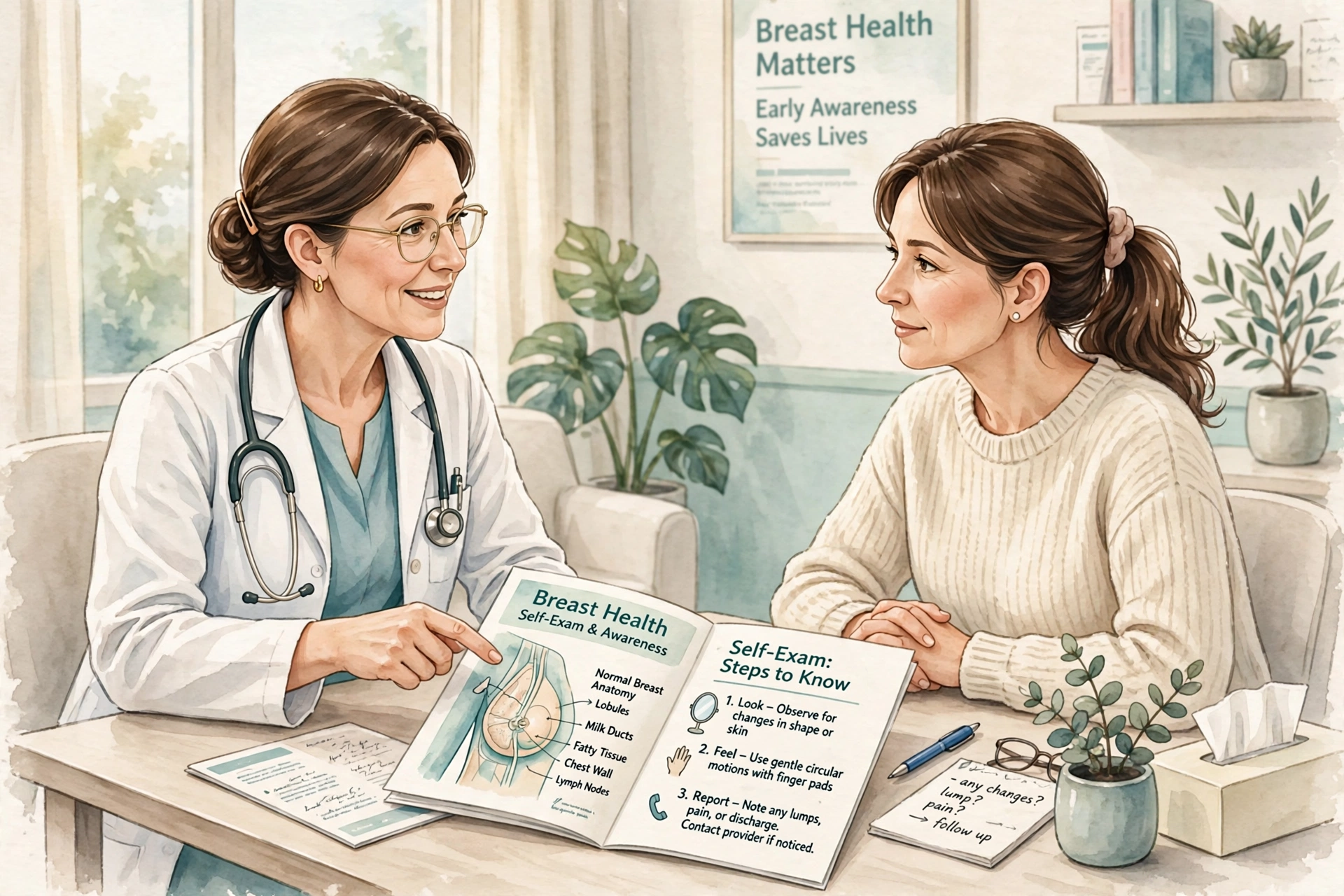
A breast self-exam (sometimes abbreviated BSE) is a combination of looking at and feeling your breasts on a regular schedule so you can detect changes early. Health organizations now frame the goal as breast self-awareness: knowing your own baseline so a new lump, skin change, or nipple change registers immediately.
Let’s be precise about what a self-exam cannot do. It is not a substitute for mammograms or clinical breast exams. Mammography can often detect tumors before they can be felt, so imaging remains the cornerstone of early detection for women in screening age groups. Think of the self-exam as the layer of awareness between your doctor’s visits — a habit that puts you in the best position to report changes promptly.
Who benefits most? Women under 40 who are not yet in routine mammography programs get particular value from following this breast self exam guide each month, because they have no other regular screening. And men should take note too: male breast cancer is rare, but it exists, and being aware of changes in your own chest tissue matters for everyone.
When to Do a Breast Self-Exam
Timing matters more than most people realize. The best window is a few days after your menstrual period ends — typically days 7–10 of your cycle — when breasts are least swollen and least tender. Examining during the week before your period, when hormonal shifts make tissue lumpy and sore, only creates unnecessary anxiety.
If you no longer menstruate — because of menopause, hormonal birth control, pregnancy, or a hysterectomy — pick the same calendar day every month (the 1st or 15th works well) and set a phone or calendar reminder. Consistency is the entire point: you are comparing this month’s findings against last month’s, so the exam must happen on a predictable rhythm.
This breast self exam guide takes roughly five minutes in a quiet, private space where you will not be rushed. If monthly feels hard to maintain at first, pair it with another monthly routine — the first Sunday of the month, for instance — so the reminder is built in.
How to Perform a Breast Self-Exam: A Step-by-Step Guide
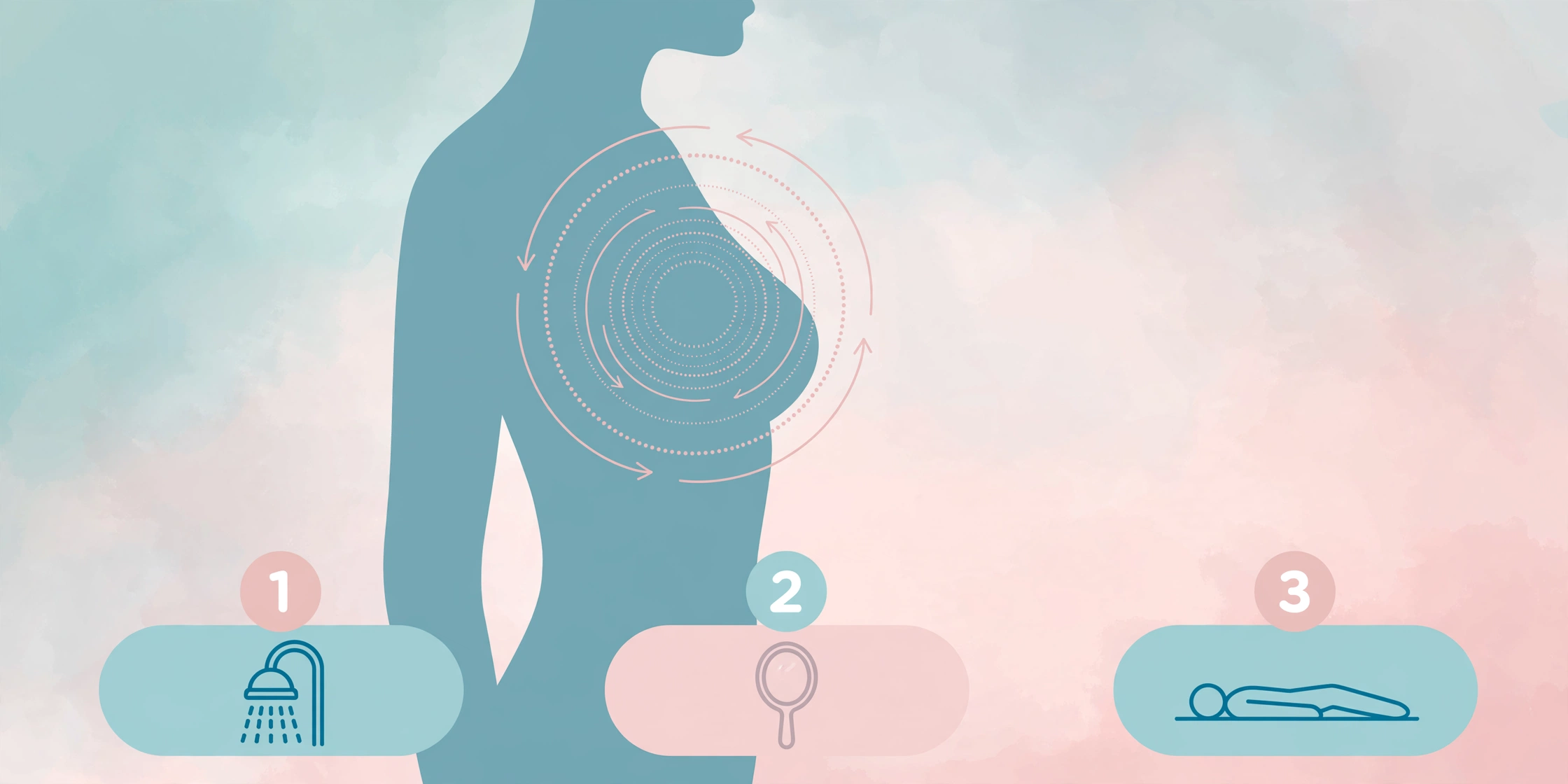
This breast self exam guide follows the three positions health educators teach worldwide, and each one should be completed every time.
Step 1: Look in the Mirror
Stand or sit in front of a mirror with your arms at your sides and shoulders straight. Look for changes in the contour or shape of your breasts, dimpling or puckering of the skin, swelling, redness, scaling, or any changes in your nipples. Then raise your arms overhead and look again — the stretch makes subtle asymmetries more visible.
Finally, rest your palms on your hips and press firmly to flex your chest muscles. Watch for dimpling, puckering, or other changes, particularly on one side. A note that reassures many first-timers: your left and right breasts will not match exactly — almost no woman’s do. You are looking for changes from your normal, not perfect symmetry.
Step 2: Check in the Shower
Many people find the physical part easiest in the shower because wet, soapy skin lets your fingers glide smoothly. Using the pads (the flat parts) of your three middle fingers — not the fingertips — check the entire breast and armpit area with small overlapping circular motions, about the size of a coin.
Apply three levels of pressure at each spot before moving on: light pressure for tissue just under the skin, medium pressure for mid-level tissue, and firm pressure to feel the tissue closest to the chest wall and ribs. Cover the full territory: from your collarbone down to the top of your abdomen, and from your armpit across to your cleavage.
Step 3: Feel While Lying Down
Lie flat on your back with your right arm behind your head and a pillow under your right shoulder. Lying down spreads breast tissue evenly over the chest wall, making it thinner and easier to examine. Using your left hand’s three middle finger pads, work around the entire right breast and armpit with the same small circular motions and three pressure levels.
Research suggests the up-and-down (vertical strip) pattern — sweeping from collarbone to rib cage in vertical lanes, like mowing a lawn — covers the whole area most reliably, but a circular “spokes of a wheel” or radial wedge pattern also works. What matters is picking one systematic pattern and using it every time, so no tissue goes unchecked. Gently squeeze each nipple to check for discharge, then repeat everything for the left breast.
Technique Tips Most Guides Skip
Small technique details make the difference between an exam you trust and one that leaves you unsure:
- Use finger pads, not fingertips. The pads are more sensitive to subtle differences in texture than the very tips.
- Do not lift your fingers. Keep them gliding in continuous overlapping circles so you never skip a patch of tissue.
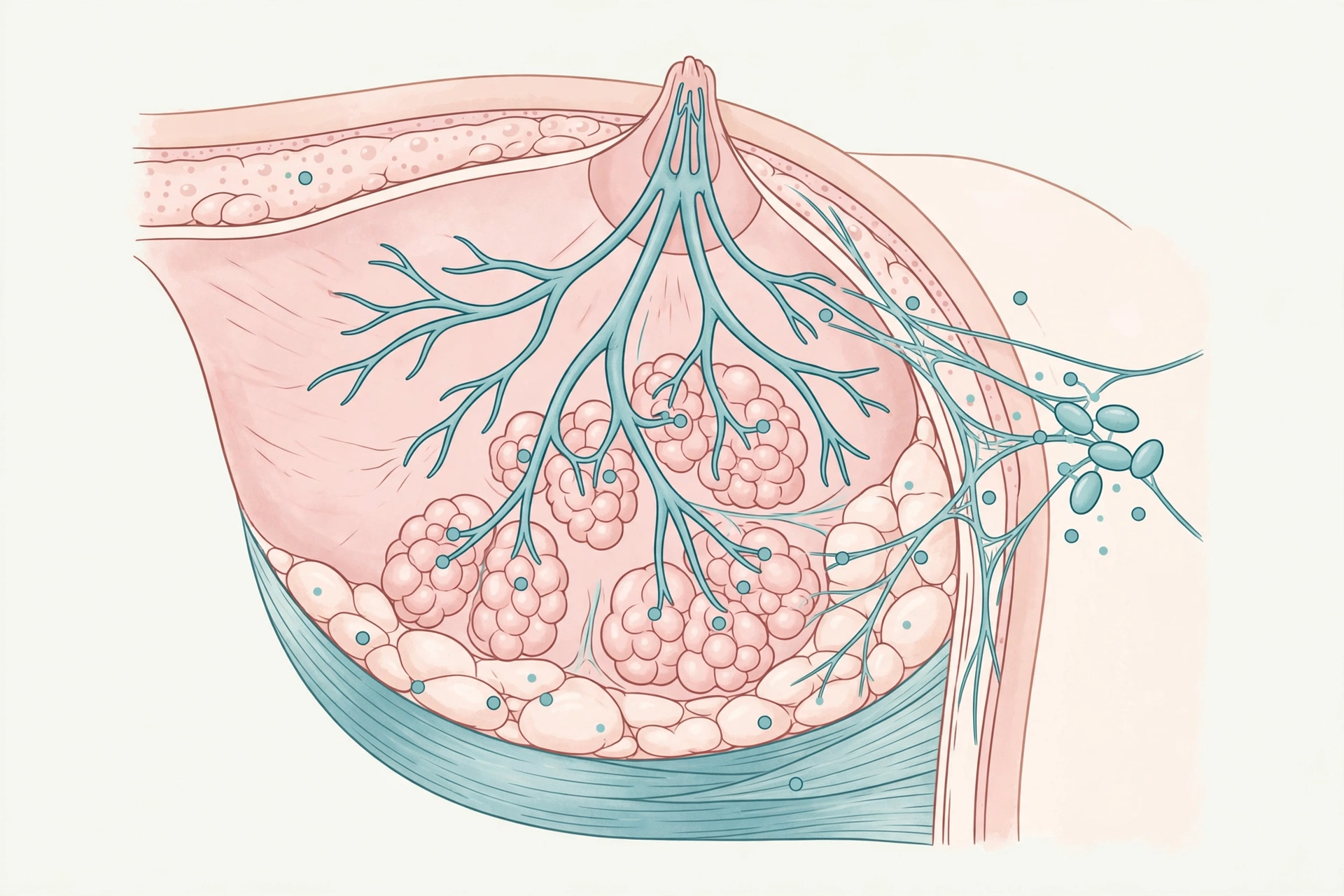
- Do not forget the armpit. Breast tissue extends into the underarm (the “tail of Spence”), where lymph nodes sit — feel this area gently with your arm slightly lowered, not raised straight up.
- It’s normal to feel a firm ridge along the lower curve of each breast. Many women are alarmed by this on their first exam; it is simply the normal edge of the breast against the chest wall.
- Note your texture baseline. Many women have naturally granular or rope-like tissue, especially in the upper outer areas. That is your normal — the exam teaches you what it feels like so you will recognize something different.
The first few times you go through it, keep this breast self exam guide open on your phone until the vertical-strip pattern becomes second nature.
What’s Normal vs. What Needs a Doctor’s Call
Here is the reassuring fact every breast self exam guide should lead with: most breast lumps are not cancerous. Common benign causes include fluid-filled cysts, fibroadenomas (firm, smooth, movable lumps common in younger women), fibrocystic changes, and simple hormonal thickening. But because you cannot tell from touch alone, any persistent change deserves a professional evaluation.
Call your provider promptly if you notice any of the following: a new lump or hard knot that feels different from surrounding tissue; thickening, swelling, or fullness in part of one breast; dimpling, puckering, or an orange-peel texture on the skin; redness, warmth, scaling, or a rash on the breast or nipple; a newly inverted nipple or a change in nipple shape; nipple discharge that is bloody, clear, or occurs without squeezing; or a persistent sore in one spot that does not heal.
The key word is persistent. A tenderness or fullness that appears the week before your period and fades afterward is typical hormonal fluctuation; note it in your log and watch whether it returns next cycle. Something that does not fade — or appears for the first time at mid-cycle — warrants a call.
Keep a Simple Monthly Log
This is the habit that turns a five-minute exam into a genuinely useful health record. After each exam, jot down the date and a few lines: what your tissue felt like overall, where any lumpiness or tenderness sat, and whether anything looked different in the mirror. Some women find it helpful to sketch a simple diagram and mark where bumps or grooves sit, refreshing it month to month.
A log does two things. First, it settles the common worry of “was this here last month?” — because you wrote it down, you know. Second, it makes your doctor’s visit far more productive: instead of “I think I felt something,” you can say, “This thickening in the upper outer area of my right breast appeared between my February and March exams.”
Paper journal, phone notes app, or a dedicated health-tracking app all work. Pick whichever you will actually open every month.
Special Situations: Implants, Pregnancy, Breastfeeding, and Dense Breasts
Most breast self exam guides assume an average situation — but many women’s bodies are not average, and the exam still works with a few adjustments:
- After breast implants: Continue monthly self-exams. Implants push natural tissue forward, which can actually make the exam easier, but be careful not to mistake the firm edge of an implant for a lump. Discuss exam technique with your surgeon or doctor.
- During pregnancy: Breasts change dramatically — growing, becoming more tender, developing new lumpiness as milk glands develop. Monthly exams help you track these changes, but always report any hard, fixed, or unusual lump to your provider rather than assuming it is pregnancy-related.
- While breastfeeding: Breasts feel fullest right before a feed and emptiest right after. Do the exam after feeding, when tissue is softest and changes are easiest to detect. Plugged ducts feel like tender, warm lumps that shift after nursing; anything that does not resolve should be checked.
- With dense breasts: Dense breast tissue (glandular and fibrous tissue rather than fat) makes both self-exams and mammograms harder to read, and it is very common — it is simply how many younger women’s breasts are built. It means your mammography program may recommend additional imaging, not that self-exams are useless; knowing your own texture baseline remains valuable.
If You Find a Lump: What Happens at the Doctor’s Visit
Knowing what comes next removes a surprising amount of fear, which is why this breast self exam guide walks you through the typical evaluation pathway:
- Clinical breast exam: Your provider will examine your breasts and underarms, ask when you noticed the change, and take your personal and family history.
- Imaging: Depending on your age and the finding, this usually means a diagnostic mammogram, a breast ultrasound, or both. Ultrasound is painless and excellent at distinguishing fluid-filled cysts from solid masses.
- Possible biopsy: If imaging shows something that needs a closer look, a needle biopsy takes a tiny tissue sample for lab analysis. It sounds frightening, but most biopsies confirm benign findings — and a biopsy is the only way to know for certain.
Do not skip the appointment out of fear, and do not try to diagnose yourself from internet searches. Getting checked promptly is what makes almost every outcome better, including the overwhelmingly common benign ones. If you have had breast cancer treatment in the past, staying in close contact with your care team about any new change is especially important.
Myths and Facts About Breast Self-Exams
Myth: “If it doesn’t hurt, it can’t be cancer.”
Fact: Most breast cancers do not cause pain in early stages. Pain or tenderness is far more often hormonal or cyst-related. This is exactly why looking for painless changes matters.
Myth: “A self-exam every few months is fine.”
Fact: Monthly is recommended because the whole method depends on comparing against your recent baseline. Skipping months lets subtle changes slip past unnoticed.
Myth: “I’m too young to need this.”
Fact: Breast self-awareness is recommended for adult women of all ages. Starting in your early twenties builds the baseline knowledge that will serve you for decades — and health educators encourage beginning monthly exams in your early twenties.
Myth: “Underwire bras, deodorant, or cell phones cause breast cancer.”
Fact: None of these have scientific support as breast cancer causes. Focus your energy on proven actions: regular screening, knowing your family history, limiting alcohol, maintaining a healthy weight, and staying physically active.
Myth: “I had a normal mammogram, so I can skip self-exams.”
Fact: Interval changes can appear between scheduled imaging. Your own awareness bridges the gap — and breast changes around menopause can make both tools more important, not less.
How Self-Exams Fit Into Your Screening Plan
Put the pieces together and your breast-health routine has three layers: monthly self-awareness at home, regular clinical breast exams with your provider, and guideline-recommended mammography starting at the age your national or local guidelines advise (many guidelines now recommend starting at 40 for average-risk women, with earlier or more frequent screening for those with family history or genetic risk factors). Confirm the current recommendation for your region with your doctor, since guidelines evolve — for a solid overview of screening options, see the CDC’s breast cancer screening guidance and the Mayo Clinic’s breast self-exam overview.
If breast cancer runs in your family, or you know you carry a genetic variant such as BRCA1 or BRCA2, talk to your doctor about a personalized screening plan — you may need to start imaging earlier and check in more often. Following this breast self exam guide matters just as much for you, if not more.
Breast Self Exam Guide: Frequently Asked Questions
How often should I do a breast self-exam?
Once a month. The best time is a few days after your period ends, when breasts are least tender and lumpy. If you no longer menstruate, choose the same day each month — the 1st or 15th — and set a recurring reminder.
At what age should I start doing breast self-exams?
Health educators generally recommend starting monthly breast self-exams in your early twenties. The goal at that age is building familiarity with your own baseline, which makes any future change easier to spot.
Can I rely on breast self-exams alone for breast cancer detection?
No. Self-exams are a valuable awareness tool, but they should not replace mammograms and clinical breast exams. Mammography can often detect tumors before they can be felt, so screening imaging remains essential for women in the recommended age groups.
What should a normal breast feel like during a self-exam?
Many women have naturally granular, lumpy, or rope-like tissue, especially in the upper outer areas — that is normal for them. You may also feel a firm ridge along the lower curve of each breast. “Normal” means your usual texture; the exam’s job is teaching you what that is so changes stand out.
Should men do breast self-exams?
Men can develop breast cancer, though it is much rarer than in women. While formal monthly exams are not typically recommended for men, everyone should be aware of changes in their chest area — a new lump, nipple change, or discharge — and report them to a doctor promptly.
Can I still do a self-exam if I have breast implants?
Yes. Implants do not exempt you from monthly exams; if anything, they push natural tissue forward and can make the exam easier. Learn to distinguish the firm edge of the implant from surrounding tissue, and ask your surgeon or doctor to confirm your technique.
I found a lump — how worried should I be, and what should I do?
Do not panic, but do act: schedule an appointment with your healthcare provider promptly. Most breast lumps turn out to be benign, such as cysts or fibroadenomas, but every persistent new lump needs professional evaluation with a clinical exam and usually imaging. Avoid trying to diagnose it yourself online while you wait.
This article is for educational purposes only and is not medical advice. It is not a substitute for professional diagnosis or treatment. If you notice any change in your breasts, consult your healthcare provider promptly. If you have a personal or family history of breast cancer, discuss a personalized screening plan with your doctor.