Open Relationships: An Honest Beginner’s Guide
If you are curious about open relationships, you are not alone. Interest in consensual non-monogamy has grown steadily in recent years, and more couples than ever are having honest conversations about whether exclusivity is the only structure that can work for them. This open relationships guide is written for beginners who want facts, not hype: what an open relationship actually is, how successful couples run them, what usually goes wrong, and how to protect both your emotional and sexual health if you decide to try.
Everything here is grounded in widely accepted relationship research and public health guidance. No judgment, no sales pitch — just the honest picture.
What Is an Open Relationship?
An open relationship is a romantic partnership in which both partners knowingly and willingly agree that one or both of them may pursue romantic or sexual connections with other people. It is a form of consensual non-monogamy (sometimes called ethical non-monogamy), and the word that carries all the weight is consensual: everyone involved knows what is happening and agrees to it.
That is the bright line between an open relationship and infidelity. Cheating is secrecy; an open relationship is transparency. Partners in healthy open arrangements discuss what is allowed, what is off-limits, and how they will check in with each other — openly, often, and with ongoing consent that can be revisited at any time.
Open relationships take many shapes. Some couples allow casual outside encounters but not emotional involvement. Others permit dating but not overnight stays. Still others place almost no restrictions beyond honesty and safer sex. The structure matters less than the process: mutual agreement, clear communication, and respect for everyone’s feelings.
Open Relationships vs. Other Non-Monogamy Styles
Beginners often confuse open relationships with related terms. This open relationships guide compares the main styles so you can ask for exactly what you want.
| Style | Core idea | Typical emphasis |
|---|---|---|
| Open relationship | A primary couple agrees to outside romantic or sexual connections | Primary bond is central; outside ties vary in depth |
| Polyamory | Multiple loving relationships with everyone’s knowledge and consent | Emotional bonds with several partners; may have no primary hierarchy |
| Swinging | Committed couples engage in sexual activity with other couples or individuals | Sexual experiences, usually together, rarely emotional bonds |
| Monogamish | Mostly monogamous with occasional agreed exceptions | Minor, rare outside experiences with strict limits |
| Don’t-ask-don’t-tell (DADT) | Outside connections are permitted but not discussed | Privacy prioritized; disclosure is limited |
Most open relationships guide articles focus only on definitions. What matters more for beginners is recognizing that you get to choose your version — and that the version can change as you learn what works.
Open Relationships Guide: The Honest Readiness Check
Before talking to your partner, be honest with yourself. Most relationship therapists who work with non-monogamous clients agree that the same predictors keep showing up: couples who open successfully tend to have a solid foundation first. Walk through these questions privately:
- Why do I want this? Curiosity, desire for variety, and personal growth are common, honest motives. Wanting to fix a struggling relationship, punish a partner, or avoid a breakup is not — opening a relationship to solve an existing problem almost always makes the problem worse.
- Is our relationship fundamentally stable? Do you trust each other, resolve conflicts without stonewalling or contempt, and feel secure when apart? If basic trust is already shaky, adding more people will amplify the cracks.
- Can I sit with discomfort? Jealousy, insecurity, and awkward conversations are part of this for nearly everyone. Success depends less on never feeling them and more on being willing to talk about them calmly.
- Do I communicate well under stress? You will need to say “that boundary I agreed to isn’t working” and “I feel threatened by this situation” without shutting down or exploding.
- Am I willing to hear “no”? Your partner may not want this. If you cannot accept a no — or a “not yet” — without pressure, coercion, or threats to leave, you are not ready. Consent obtained through ultimatums is not consent.
- Am I doing this for me, or for them? Agreeing to openness you do not want, just to keep a partner from leaving, is a reliable path to resentment. Genuine enthusiasm from both people is the minimum requirement.
- How do I feel about my partner with someone else — really? Picture a specific scenario, not an abstract idea. If the honest answer is panic or revulsion, take that seriously. There is nothing wrong with preferring monogamy.
There are no trick questions here. A “not ready” answer is useful information, not a failure. Many couples benefit from discussing these questions with a licensed couples therapist experienced in non-monogamy before making any changes — a step most online guides skip.
How to Start the Conversation With Your Partner
Raising the idea of an open relationship can feel like the hardest part — and this open relationships guide treats it as step one. Therapists who counsel non-monogamous couples generally recommend the same approach:
- Choose a calm, private moment — never during or right after an argument, and not when either of you is exhausted, drinking, or rushed.
- Lead with honesty about your motives. Explain why this appeals to you: curiosity, a desire for new experiences, feeling that monogamy does not fit you. Vague or defensive framing (“everyone is doing it”) invites suspicion; honest framing invites dialogue.
- Listen more than you pitch. Your partner may feel surprised, hurt, relieved, or intrigued — sometimes all four in sequence. Give them room to react without defending yourself against the reaction.
- Make it a series of conversations, not one big reveal. Expect days or weeks of processing between talks. Pressure to decide quickly usually produces a reluctant yes that collapses later.
- Raise boundaries early. Even in the first conversation, mentioning that you imagine strict rules, slow pacing, and ongoing check-ins signals that you take the risks seriously.
- Put veto power on the table. Many couples agree that either person can pause or stop the experiment at any time. Knowing there is an exit ramp makes the first step feel safer.
If your partner is open to exploring, your next job is the written agreement — the single most underrated tool in non-monogamy, and this open relationships guide walks you through it in the section below.
Building Your Ground-Rules Agreement
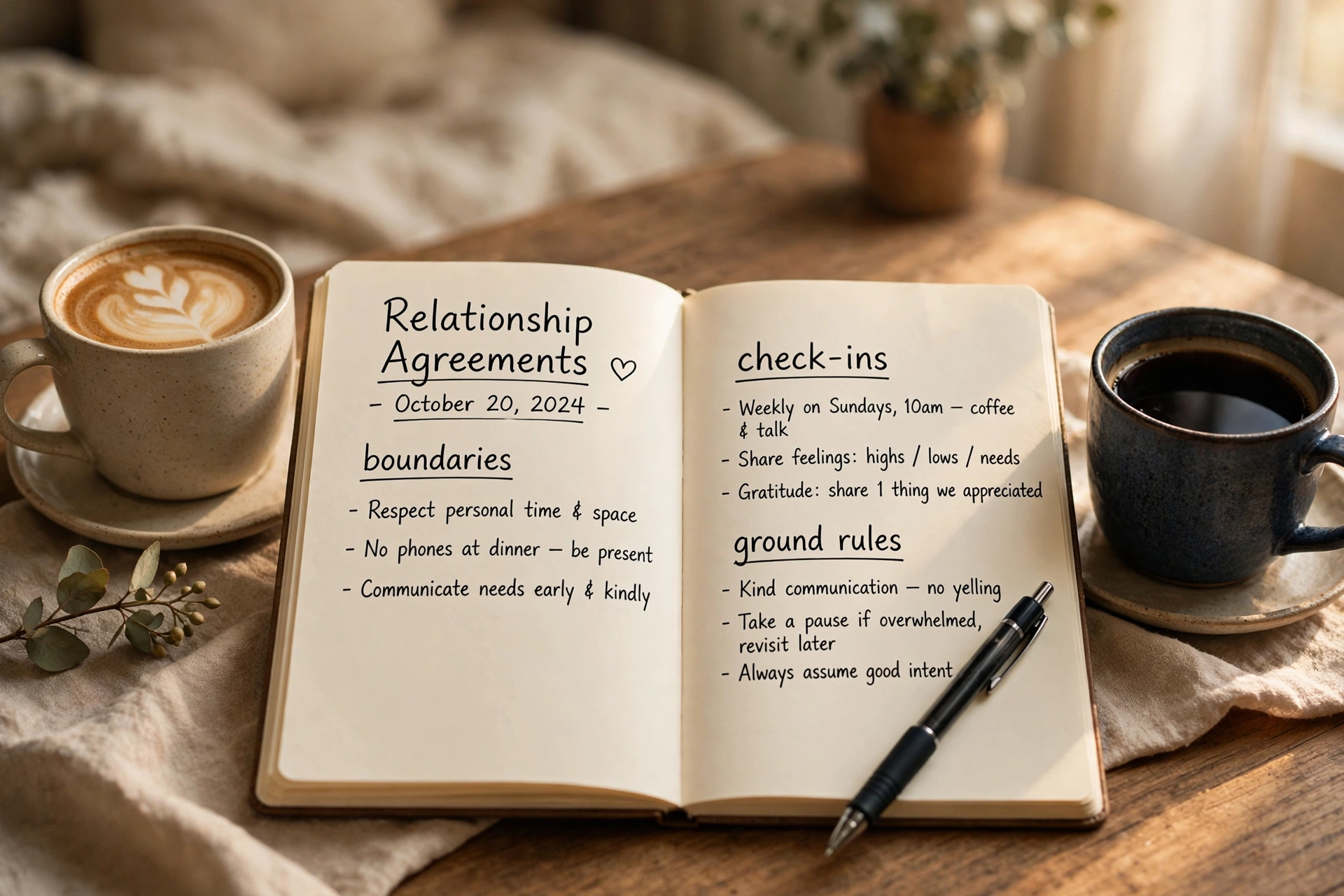
Verbal agreements fade and get misremembered, especially under emotional pressure. Successful couples put their rules in writing. Your agreement does not need to be a legal contract — it needs to be a living document you both sign, date, and revisit. Here are the categories most agreements cover:
1. What is allowed — and what is not
Be specific: casual dating only, or physical intimacy too? One-time encounters, or ongoing outside partners? Emotional involvement permitted, or physical only? The more concrete you are, the fewer misunderstandings you will have.
2. Off-limits people
Common restrictions include mutual friends, coworkers, ex-partners, and anyone in your shared social circle. Outside connections that overlap with your daily life create the most drama.
3. Time and logistics
How many evenings a week can go to outside partners? Are overnight stays allowed? Many couples protect certain rituals — date nights, weekends, holidays — as belonging to the primary relationship.
4. Safer-sex rules
This category is non-negotiable and detailed in the safer sex section below: barrier use with all outside partners, STI testing schedules, and what happens if a test comes back positive.
5. Disclosure: how much, to whom, when
Do you want to hear details, or just the basics? Do outside partners know about each other? Set a clear policy (more on the standard models in the next section).
6. The review schedule and sunset clause
Agree on when you will formally revisit the arrangement — many couples start with a monthly review — and write down that either partner can pause or close the relationship at any time without it counting as betrayal.
Review and update the document as you learn. Rules that felt essential on day one often look unnecessary by month six, and situations you never imagined will need new language. That is normal; the agreement evolves with the relationship.
Sexual Health and Safer Sex in Open Relationships
Opening a relationship increases the number of sexual partners involved, which increases STI exposure risk for everyone in the network. This is not a moral judgment — it is epidemiology. The CDC notes that most STIs have no signs or symptoms, so the only way to know anyone’s status is testing. A responsible open relationship therefore treats sexual health as a shared, ongoing project.
- Use barriers with all outside partners. Correct condom use every time reduces the risk of STI transmission. The CDC’s STI facts page is a clear, authoritative overview of how infections spread and how to prevent them.
- Decide your barrier policy at home too. Many couples use condoms with outside partners but not with each other; agree on this explicitly, and agree on what changes if a risk event occurs.
- Set a testing schedule and keep it. Many clinicians recommend more frequent testing for people with multiple partners — ask your own clinician what cadence fits your situation, and make it a calendar event, not an intention. Our guide to how often to get tested can help you plan the conversation with your provider.
- Plan for positive results. Agree in advance what happens if someone tests positive: pause outside activity, notify partners, treat, and retest. Partner notification is simpler when you have already discussed it — see our guide on talking to partners about STI testing.
- Consider vaccination. The HPV vaccine prevents the most common STI and HPV-related cancers; hepatitis B vaccination is also recommended for sexually active adults who were not vaccinated earlier. Ask your clinician what is appropriate for you.
- Watch for window periods. Tests cannot detect very recent infections, so a negative result from last week does not guarantee current status. This is another reason regular, repeated testing matters more than any single result.
For a concise refresher on prevention basics, the CDC’s lowdown on preventing STIs covers condoms, testing, vaccination, and partner communication in plain language.

Disclosure Models: How Much Do You Tell Each Other?
One of the least-discussed — and most consequential — decisions is how much information partners share about outside connections. Most open relationships guide articles mention this in passing; in practice, couples usually land on one of three models:
- Full disclosure: partners share who, when, and relevant details about outside encounters. This maximizes transparency but requires high emotional bandwidth and strict agreements about what stays private to the outside partner.
- Need-to-know: partners share the fact that something happened and anything relevant to health or scheduling, but not intimate details. This is the most common middle ground.
- Don’t-ask-don’t-tell (DADT): outside connections are permitted but not discussed. This reduces jealousy triggers for some people, but it concentrates risk: health information, boundary violations, and emotional entanglement can all hide inside the silence.
Whichever model you choose, two rules apply universally: health-relevant information is always shared, and the model itself is chosen together — never imposed. Many couples start with full disclosure for the first few months and relax into need-to-know as trust builds. Others discover that hearing details soothes their anxiety rather than feeding it. There is no universally correct answer, only the answer that works for both of you.
Also consider the feelings of outside partners: they deserve to know you are in an open relationship, what your boundaries are, and that they will be treated with respect rather than as a secret.
Managing Jealousy and Insecurity
This open relationships guide treats jealousy as the emotion beginners fear most, and experienced non-monogamous couples are unanimous on one point: it does not mean the relationship is failing. Jealousy is data. It usually points to an unmet need, a fear of losing connection, or uncertainty about where you stand.
- Name the specific fear. “I’m jealous” is vague and hard to address. “I’m afraid you’ll enjoy time with them more than with me” is a solvable problem — more quality time, more reassurance, more check-ins.
- Separate the feeling from the story. The feeling (a tight chest, a racing mind) is real; the story your brain attaches (“they’re going to leave me”) may not be. Noticing the difference is a skill that improves with practice.
- Ask for reassurance directly. There is nothing weak about saying “I need to hear that we’re solid right now.” Partners cannot read minds, and requesting reassurance is healthier than testing or withdrawing.
- Keep a jealousy log. Note when it spikes, what triggered it, and what helped. Patterns emerge quickly — often it is about scheduling, tiredness, or a specific boundary, not the concept of openness itself.
- Invest in the primary relationship deliberately. New-relationship energy with an outside partner can make the primary bond feel flat by comparison. Protect date nights, affection, and undivided attention — the routines that made the relationship good in the first place.
Jealousy that is frequent, intense, or escalating despite honest communication is a signal to slow down or pause — and possibly to work through it with a professional. If jealousy is damaging your connection, read our article on how jealousy hurts intimacy and consider whether a reset is in order.
Trial Periods, Check-Ins, and the Sunset Clause
Here is practical advice most open relationships guide articles omit: treat the first few months as a trial. A defined trial period — commonly 8 to 12 weeks — removes the pressure of a permanent decision and gives both partners real data instead of imagined scenarios.
- Schedule structured check-ins. Weekly 30-minute conversations work well during a trial: What went well? What felt hard? Is any rule not working? Write brief notes so you can compare month to month.
- Define success criteria in advance. What would make you say “this is working”? More honesty between us? No decrease in our connection? Fewer arguments? If you cannot name what success looks like, you will not recognize it.
- Include a sunset clause. Agree now that either partner can pause or close the arrangement at any time, for any reason, with a short cool-down conversation — and that using the clause is an act of care, not betrayal.
- Review on a fixed cadence. After the trial, move to monthly, then quarterly reviews. Agreements that are never revisited quietly become agreements that are resented.
- Plan for the “close back up” conversation. Some couples open for a season and return to monogamy, stronger for the experience. Decide in advance how you would wind things down kindly — including how to end outside connections respectfully.
The trial framework turns an abstract lifestyle choice into a manageable experiment. Whatever the outcome, you will finish this open relationships guide understanding your relationship better than before.
When an Open Relationship Isn’t Working
An honest open relationships guide names the failure modes too. Consider pausing or closing the arrangement if you notice:
- One partner consistently dreads check-ins, cries after them, or avoids the topic entirely.
- Boundaries are broken repeatedly — especially safer-sex rules. A broken health agreement is a serious breach of trust, not a minor slip.
- Outside relationships are consuming time and emotional energy meant for the primary partnership.
- You are staying open mainly because you fear your partner will leave if you ask to close.
- Jealousy has shifted from occasional discomfort to persistent anxiety, sleep problems, or loss of appetite.
- The relationship you were trying to protect is now worse than before you opened it.
Closing back up is not failure. Many couples experiment, learn, and choose monogamy with a deeper understanding of each other. If you are stuck in a painful loop, a couples therapist experienced with non-monogamy can help you decide whether to repair, restructure, or close — without the judgment some traditional counselors bring to the topic. If you are unsure whether therapy is the right step, our guide to questions to ask in couples therapy can help you prepare for a first session.
Frequently Asked Questions
Do open relationships actually work long-term?
They can, but they require more deliberate maintenance than monogamy because there is no default cultural script to follow. Research on consensual non-monogamy finds relationship satisfaction comparable to monogamous relationships among people who choose it freely and communicate well — and poor outcomes among people who were pressured into it. The structure is less predictive than the quality of communication and the genuineness of both partners’ consent.
Is wanting an open relationship a sign something is wrong with my relationship?
Not necessarily. Many people in happy, stable relationships are drawn to non-monogamy out of curiosity, desire for variety, or a belief that one person cannot meet every need. However, if the urge appears alongside serious existing problems — constant fighting, broken trust, emotional distance — opening up is unlikely to fix those issues and will probably intensify them. Fix the foundation first.
How do I deal with jealousy in an open relationship?
Treat jealousy as information, not as proof of failure. Identify the specific fear underneath it, communicate it calmly, and ask for what would help — more reassurance, more quality time, a boundary adjustment. Structured check-ins, a jealousy log, and deliberately investing in the primary relationship all help. If jealousy stays intense despite months of honest work, that is valid data that this structure may not suit you.
What are the most common rules couples set?
The most common categories are: what kinds of outside connections are allowed; off-limits people (often mutual friends and coworkers); time limits and protected rituals like date nights; mandatory safer-sex practices and testing schedules; how much detail partners share; and a review schedule with the right for either person to pause or close the arrangement. Writing these down in a shared agreement prevents most misunderstandings.
How often should we get STI tested in an open relationship?
There is no single schedule that fits everyone — it depends on number of partners, types of sexual activity, and barrier use. Many clinicians recommend more frequent testing for people with multiple partners, but you should ask your own healthcare provider what cadence fits your situation. What matters most is that testing is regular, scheduled, and shared: both partners know the plan and the results.
Should we tell other people that we’re in an open relationship?
That is entirely your decision, and many couples choose privacy — especially at first. Consider who actually needs to know (outside partners always do) versus who you simply might tell. Be aware that stigma exists in some families, workplaces, and communities, so discuss together what you will say if someone finds out, rather than improvising under pressure.
Can we go back to monogamy after trying an open relationship?
Yes, and many couples do. Build this possibility into your original agreement as a sunset clause: either partner can request closing the relationship, followed by an honest conversation and a respectful wind-down of outside connections. Couples who close thoughtfully often report that the experiment improved their communication even though they returned to monogamy.
A Final Note: This Guide Is Educational, Not Medical Advice
This article is for educational purposes only and is not medical advice. It cannot diagnose, treat, or prevent any health condition, and it is not a substitute for professional guidance. If you have questions about STI testing, contraception, or sexual health, please consult a qualified clinician. If opening your relationship is causing significant distress, consider speaking with a licensed couples therapist — ideally one experienced in consensual non-monogamy.