Anxious Attachment Style in Relationships
Do you replay your partner’s texts looking for hidden meaning, feel your stomach drop when they take too long to reply, or need repeated reassurance that you are truly loved? If so, you may be living with an anxious attachment style in relationships — and you are far from alone. Researchers estimate that roughly one in five adults shows this pattern, and the good news is that it is one of the most responsive attachment patterns to self-awareness, communication skills, and support.
This guide explains what the anxious attachment style is, where it comes from, how it shapes romantic relationships, and — most importantly — the practical, evidence-informed steps that help people move toward more secure, satisfying connections.
What Is Anxious Attachment? A Brief Overview of Attachment Theory
Attachment theory, first developed by psychiatrist John Bowlby and psychologist Mary Ainsworth, describes the emotional bonds humans form in close relationships. The theory proposes that the care we received as infants created “working models” — mental blueprints about whether love is reliable, whether we are worthy of care, and whether other people can be trusted.
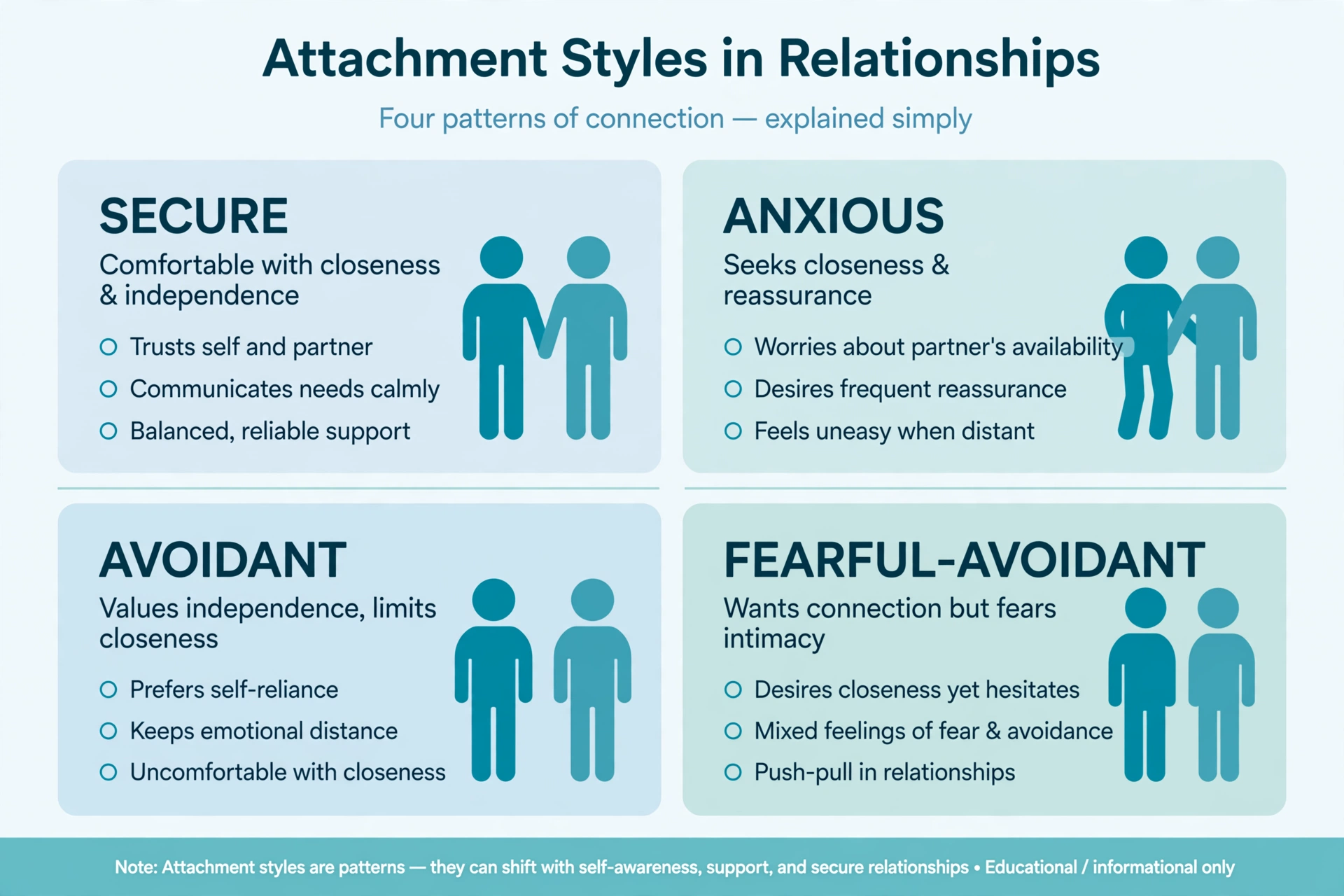
Researchers now recognize four broad attachment styles: secure (comfortable with closeness and independence), anxious (craving closeness but fearing rejection), avoidant (valuing independence and minimizing closeness), and disorganized (wanting closeness but fearing it simultaneously, often linked to trauma). The Cleveland Clinic’s overview of anxious attachment offers a clear clinical summary of how this pattern develops and how it affects relationships.
An anxious attachment style — sometimes called anxious-preoccupied or anxious-ambivalent attachment — is an insecure attachment pattern characterized by a deep desire for intimate connection paired with a persistent fear of abandonment and a strong need for reassurance. People with this style often hold a negative view of their own worthiness alongside a positive but anxious view of others: “I am not quite enough, but my partner must be wonderful — I cannot afford to lose them.”
It is important to understand that an attachment style is not a diagnosis, a character flaw, or a life sentence. It is a learned pattern, and learned patterns can be updated.
Signs of Anxious Attachment Style in Relationships
Anxious attachment shows up differently from person to person, but clinicians and researchers consistently describe a cluster of common signs. See how many of the following feel familiar:
- Fear of abandonment: a recurring worry that your partner will leave, even when the relationship is stable.
- Constant need for reassurance: frequently asking “Are you mad at me?” or “Do you still love me?” and needing the answer repeated.
- Hypervigilance to mood shifts: reading a partner’s quiet evening or slow text reply as evidence that something is wrong.
- Difficulty being apart: discomfort when your partner has independent plans, hobbies, or friendships.
- Prioritizing your partner’s needs over your own: people-pleasing, over-accommodating, and saying yes when you mean no.
- Rumination and over-analysis: replaying small comments or gestures and jumping to worst-case conclusions.
- Intense early dating energy: going from zero to one hundred quickly, idealizing a new partner, and feeling panicked by normal dating uncertainty.
- Trouble with boundaries: difficulty saying what you need directly, or swinging between no boundaries and rigid walls after being hurt.
- Emotional reactivity: emotions that escalate quickly during conflict, sometimes with tears or heated arguments, followed by strong guilt.
- Staying too long: lingering in unfulfilling relationships because ending them feels more frightening than the status quo.
If several of these resonate, it does not mean you are broken. It means your attachment system is working overtime to protect a connection it fears losing.
Where Anxious Attachment Comes From
Attachment styles are not chosen; they are shaped. The most consistently cited roots include:
Inconsistent early caregiving
The classic explanation is that a caregiver was sometimes warm and responsive and at other times distracted, dismissive, or unavailable. The child never knew which version of the parent would appear, so they learned to monitor the relationship constantly and amplify their bids for attention. That early strategy — stay alert, stay close — becomes the adult template for romance.
Caregiver anxiety and role reversal
Children of caregivers who were themselves anxiously attached sometimes learn to manage the adult’s emotions rather than their own. When a child is enlisted to soothe a parent, they learn that love requires self-erasure and constant monitoring of someone else’s mood.
Later relationship experiences
Attachment styles are not frozen in childhood. Clinical psychologists note that significant adult experiences — being ghosted, surviving ambiguous loss (a relationship that ended with no closure), carrying resentment from past relationships, or living through trauma — can shift a previously secure person toward anxious patterns. Attachment is a working model, and new experiences update it.
Understanding the origin matters because it replaces shame with explanation. You are not “too much.” Your nervous system learned a strategy that once made sense.
How Anxious Attachment Shapes Romantic Relationships
In day-to-day partnership life, anxious attachment tends to follow a predictable arc.
The early-dating accelerator
Anxiously attached daters often feel chemistry intensely and move fast — long messages, constant availability, emotional intimacy within days. This is not a character defect; it is the attachment system trying to lock in certainty. The difficulty is that moving fast can overwhelm a new partner and make it harder to assess compatibility calmly.
Conflict feels like a threat to the bond
For securely attached partners, a disagreement is a problem to solve. For someone with an anxious attachment style, conflict can feel like evidence the relationship is ending. This can produce walk-on-eggshells behavior — avoiding hard conversations, over-apologizing — or, when the anxiety spikes past the coping threshold, emotional flooding.
The pursue–withdraw cycle with avoidant partners
Research on romantic attachment describes a particularly painful dynamic: the anxious partner pursues closeness (more texts, more questions, more emotion) while an avoidant partner withdraws for space — which the anxious partner reads as rejection and pursues harder. Peer-reviewed research indexed by the National Institutes of Health has documented how anxious attachment styles relate to heightened jealousy and reassurance-seeking in romantic relationships. Neither person is the villain; their strategies are incompatible. Recognizing the cycle is the first step to interrupting it, ideally with a therapist’s help.
Intimacy as reassurance
Some anxiously attached people lean on physical closeness as proof of love, which can make calm periods feel threatening. Building multiple channels of connection — friendship, shared projects, quiet companionship — reduces the pressure on any single form of intimacy to carry all the reassurance.
Couples who learn to name this pattern often say it is a relief: the problem was never that one partner loved too little or the other too much. The problem was two nervous systems speaking different languages. Learning healthy conflict resolution skills can give both partners a shared language.
Modern Triggers: How the Digital Age Amplifies Attachment Anxiety
Most classic articles on attachment theory were written before smartphones, but anxious attachment lives in a world of read receipts and typing indicators. These modern triggers deserve attention:
- Read receipts and “last seen” timestamps turn ordinary delays into apparent evidence of withdrawal.
- Social media activity — your partner liking someone’s photo or being active online without replying — can spark jealousy spirals.
- Over-communication expectations formed by dating apps, where constant contact in the honeymoon phase becomes the baseline.
- Comparison culture: watching other couples’ highlight reels and concluding your real, imperfect relationship is failing.
Practical digital hygiene helps: turn off read receipts, agree on realistic texting rhythms with your partner, and treat a partner’s online activity as neutral information rather than a verdict on the relationship. If screens are eroding your connection, see our guide on how phones and screens damage intimacy for boundary ideas that work for couples.
Protest Behaviors: What They Are and How to Stop Them
Psychologists use the term protest behaviors for the things anxiously attached people do to regain closeness when they feel it slipping. Recognizing them is uncomfortable — and transformative. Common protest behaviors include:
- Sending a flurry of texts, then “punishing” by going silent to provoke a reaction.
- Withdrawing affection or warmth to make a partner chase.
- Checking a partner’s phone, location, or social media.
- Starting arguments about small things when the real fear is abandonment.
- Over-apologizing or making grand gestures instead of addressing the actual issue.
- Threatening to leave in order to be talked out of it.
Protest behaviors work in the moment — they usually do pull the partner back — but each round teaches the relationship that closeness must be extracted rather than freely given. The alternative is naming the need directly: “I felt shaky when you were quiet tonight. I just need to hear that we are okay.” Directness feels risky, but it is the behavior that actually builds the security protest behaviors only imitate.
Moving Toward Secure Attachment: Practical Steps That Work
Attachment styles are stable but not fixed. Research and clinical experience show that consistent, deliberate practice can move people toward what therapists call “earned secure attachment.” Here is where to start.
1. Map your triggers
Keep a brief log for two weeks: what happened, what you felt in your body, the thought that followed, and what you did. Patterns will emerge — perhaps it is always the quiet car ride home, or the partner’s busy work season. Knowing your triggers in advance lets you prepare rather than react. When anxiety surges, pause and ask: “Is this feeling about right now, or is it an old alarm bell?”
2. Practice direct communication with “I” statements
Instead of “You never text me back — you obviously don’t care,” try: “I feel anxious when I don’t hear from you during the day because of past experiences. A quick check-in text would really help me.” “I” statements name your experience without accusing, which lowers your partner’s defensiveness and raises the odds they will respond with care.
3. Build a self-soothing toolkit
Other people cannot be your only regulator. Self-soothing does not mean suppressing feelings; it means lowering their intensity so they are manageable. Evidence-supported options include:
- Grounding techniques: the 5-4-3-2-1 senses exercise, cold water on the wrists, or slow box breathing.
- Journaling: writing the catastrophic thought, then writing the balanced version beside it.
- Movement: a walk, stretching, or any exercise that discharges the adrenaline anxiety produces.
- Self-compassion practice: speaking to yourself the way you would speak to a close friend.
- Alternative sources of validation: friendships, creative work, volunteering, or activities where you feel competent.
Practices like mindfulness can be especially useful, training the nervous system to observe a feeling without obeying it.
4. Negotiate needs explicitly
Many anxiously attached people secretly hope their partner will intuit their needs — then feel hurt when they cannot. Making needs explicit is a gift to both of you. Sit down outside of conflict and agree on concrete supports: a good-morning text, a ten-minute check-in after work, or a standing weekly emotional check-in. Then, crucially, notice and appreciate when your partner follows through.
5. Choose partners (and friendships) consciously
One of the fastest accelerators toward security is spending time with securely attached people. In early dating, pace matters: watch how a potential partner responds to small expressions of need. Someone who meets vulnerability with steadiness rather than withdrawal or mockery is showing you something important.
6. Try therapy
A therapist experienced in attachment work can help you identify core beliefs (“I am too much,” “love always leaves”), process past wounds, and rehearse new relational behaviors in a safe setting. Modalities such as emotionally focused therapy (EFT) and attachment-informed cognitive behavioral approaches have strong clinical support for relationship distress.

For Partners: How to Support Someone With an Anxious Attachment Style
If your partner is anxiously attached, you are not their therapist — but your steady behavior genuinely helps them heal. A few guidelines:
- Do be consistent. Predictability is the antidote to abandonment fear. Follow through on what you say.
- Do offer reassurance freely. It may feel redundant to you; to them it is medicine. You can also appreciate it when they voice needs directly.
- Do name what is happening. “You seem worried — is this about the dishes or about us?” helps separate the trigger from the fear.
- Don’t mock or pathologize. Labels like “crazy” or “needy” deepen shame and make honest communication harder.
- Don’t abandon your own boundaries. Healthy support includes saying no sometimes. A secure relationship has room for two people’s needs.
- Do consider couples therapy. A neutral third party can translate between attachment languages far faster than two people can on their own.
And if jealousy has become a recurring fault line, our article on how jealousy hurts intimacy offers practical repair steps for both partners.
When to Seek Professional Help
Consider reaching out to a licensed mental health professional if relationship anxiety is significantly affecting your daily life — for example, if you cannot concentrate at work, if you feel persistent dread about your relationship, if conflict regularly escalates, or if you notice patterns of controlling behavior you cannot stop on your own. Therapy is not a sign that something is wrong with you; it is a structured way to learn skills that genuinely change how relationships feel. If you are ever in crisis or feel unsafe, contact your local emergency services or a crisis helpline immediately.
Frequently Asked Questions
What causes an anxious attachment style?
Anxious attachment is most commonly linked to inconsistent caregiving in childhood — a caregiver who was sometimes responsive and sometimes unavailable — but it can also develop from caregiver anxiety, relationship trauma, being ghosted, or significant losses later in life. It is a learned pattern of relating, not a personal failing, and patterns can be updated with awareness and practice.
Can an anxious attachment style change?
Yes. Research shows attachment styles are relatively stable but not fixed. Through self-awareness, communication skills, self-soothing practices, relationships with securely attached people, and therapy, many people develop what psychologists call “earned secure attachment” — functioning securely even though they did not start out that way.
How do I know if I have an anxious attachment style or just normal relationship worry?
Occasional worry is normal in any relationship. Anxious attachment is suggested when the pattern is chronic: persistent fear of abandonment, constant reassurance-seeking, intense reactions to small changes in a partner’s behavior, and difficulty feeling calm even in a stable, loving relationship. No online article can diagnose you; a licensed therapist can help you understand your patterns accurately.
What is the best partner match for someone with anxious attachment?
Securely attached partners tend to be the most healing match because their consistency directly soothes abandonment fears. Anxious–avoidant pairings are common but often painful, producing a pursue–withdraw cycle. That said, any pairing can work when both partners understand the dynamic and commit to communicating about it.
Should I tell my partner about my attachment style?
Sharing this information is usually helpful when done as information, not accusation. Framing it as “Here is how my alarm system works, and here is what helps me feel safe” gives your partner a roadmap instead of a mystery. Avoid using the label as an excuse for behavior you know is hurtful.
Does anxious attachment affect friendships and work relationships too?
Yes. The same working models apply beyond romance. You might replay a friend’s short reply as rejection, or interpret a manager’s neutral feedback as a sign you are about to be fired. The same tools — trigger mapping, direct communication, and self-soothing — work across all relationship types.
How long does it take to become more securely attached?
Many people notice meaningful shifts within months of sustained effort, with deeper change unfolding over one to two years. Progress is rarely linear, and setbacks during stress are normal.
Is anxious attachment the same as anxiety disorder?
No. Anxious attachment is a relational pattern describing how you behave in close relationships. An anxiety disorder is a clinical mental health condition. The two can coexist, and relationship anxiety can certainly feel intense, but only a qualified clinician can assess whether an anxiety disorder is present.
Medical disclaimer: This article is for educational purposes only and is not medical advice. Attachment patterns vary widely, and nothing here is intended to diagnose any condition or replace professional evaluation. If relationship distress is affecting your wellbeing, please consult a qualified clinician or mental health professional.