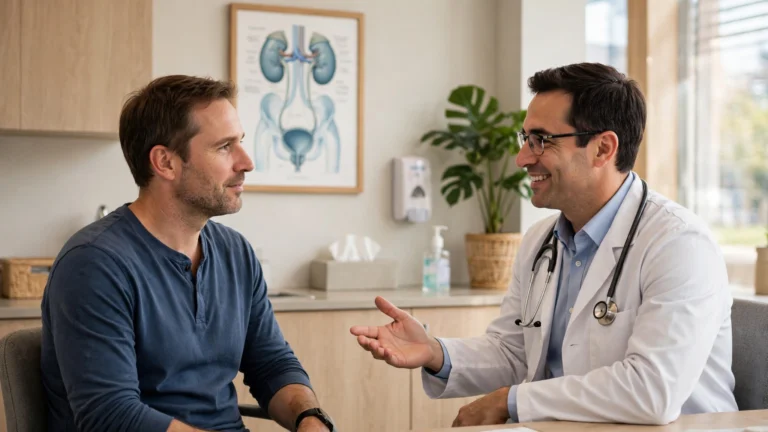
Is Oral Sex Safe? STI Risks Doctors Want You to Know
Asking is oral sex safe is one of the most common questions doctors hear in sexual health clinics — and one of the most misunderstood. Because pregnancy is not a possibility, many couples assume oral sex carries no real health risk. That assumption is where most of the trouble starts.
The honest, clinical answer to “is oral sex safe” is this: oral sex is generally safer than unprotected vaginal or anal intercourse, but it is not safe. Several sexually transmitted infections can and do spread through oral contact — some silently, and some with long-term consequences that surprise people. This guide walks through what the evidence actually shows, what doctors want couples to understand, and the practical steps that genuinely reduce risk.
Is Oral Sex Safe? What Doctors Actually Mean
When a doctor is asked “is oral sex safe,” the answer depends on what you mean by “safe.” The U.S. Centers for Disease Control and Prevention states that many STIs can spread through oral sex, and that using condoms, dental dams, or other barrier methods every time meaningfully reduces the risk (CDC: About STI Risk and Oral Sex). That official position matters, because surveys consistently show most people file oral sex under “safe sex” — often because pregnancy is off the table — while the infection risks are still real.
Risk also depends on context: whether a barrier is used, whether either partner has sores or bleeding gums, and whether infections are present but undiagnosed. Doctors think about oral sex the way they think about any exposure: lower risk is not the same as no risk, and the most dangerous infections through this route are the ones with no symptoms at all.
Which STIs Can Spread Through Oral Sex?
According to the CDC, the infections that can pass through oral-genital or oral-anal contact include chlamydia, gonorrhea, syphilis, herpes simplex virus types 1 and 2, HPV, and HIV. Hepatitis A, hepatitis B, and intestinal infections such as shigellosis can also spread through oral-anal contact. The risk is not equal across all of them:
- Gonorrhea — one of the most common throat infections from oral sex; often causes no symptoms and can persist for months.
- Chlamydia — can infect the throat, usually silently; far less recognized than genital chlamydia.
- Syphilis — the initial painless sore (chancre) can appear on the lips, tongue, or gums and is easy to mistake for a common mouth ulcer.
- Herpes (HSV-1 and HSV-2) — oral-genital contact is now one of the main routes for new genital herpes cases in many countries.
- HPV — spreads through skin-to-skin contact with no cut or sore required; certain high-risk types are linked to throat cancer.
- HIV — transmissible through oral sex but at very low probability compared with vaginal or anal sex.
- Hepatitis A and intestinal infections — mainly a concern with oral-anal contact, spread through the fecal-oral route.

The Throat Infections Most Couples Never Hear About
Ask most people to name an STI of the throat and you will get a blank stare — yet pharyngeal (throat) gonorrhea and chlamydia are among the most important reasons doctors take oral sex seriously. These infections rarely cause a sore throat or any symptom at all. One natural-history study found that untreated pharyngeal gonorrhea persisted for a median of about 16 weeks — roughly four months of unknowingly passing it on through oral contact.
Here is the part that matters most when asking “is oral sex safe”: standard STI testing usually misses these infections entirely. A routine screen based on a urine sample or genital swab will not detect gonorrhea or chlamydia living in the throat. Sexual health doctors therefore advise patients who have regular oral sex — especially with new or multiple partners — to ask explicitly for a throat swab (a nucleic-acid amplification test, or NAAT) alongside genital testing. If you have never been offered a throat swab at an STI check, it is entirely reasonable to request one.
HPV and Throat Cancer: The Long-Term Risk Doctors Worry About Most
The most consequential long-term risk of oral sex is infection with human papillomavirus, particularly HPV type 16. Research across multiple countries has found that a large share of oropharyngeal cancers — cancers of the tonsils and the base of the tongue — are caused by HPV, and these cancers have been rising for years, driven by sexual transmission rather than tobacco. The link is dose-dependent: patients with HPV-positive tumors reported significantly more lifetime oral-sex partners than those with HPV-negative tumors.
What makes this risk unsettling is the timeline and the testing gap. An HPV infection acquired through oral sex can linger silently for years or even decades before any cancer develops, and — unlike cervical cancer — there is currently no recommended screening test for HPV-related throat cancer. That makes prevention the entire strategy. The HPV vaccine has been shown to sharply reduce oral HPV infections, and many guidelines now recommend vaccination through age 45 for people who were not vaccinated earlier. If you missed vaccination as a teenager, doctors say it is worth asking about it now — for both men and women.
Can You Get HIV From Oral Sex?
When people ask “is oral sex safe” in relation to HIV, this is where nuance matters. The CDC’s position is that there is little to no risk of getting or transmitting HIV through oral sex — the lowest-risk sexual route by a wide margin. A widely cited study from the University of California, San Francisco estimated the risk at roughly 4 cases per 10,000 exposures, because the oral mucosa is a less hospitable entry point for the virus than vaginal or rectal tissue.
That said, “little to no risk” is not “zero risk.” Doctors point to the same factors that raise risk across the board: sores in the mouth, bleeding gums or gum disease, and recent dental work. The practical takeaway: the infections worth worrying about through this route are mostly the bacterial and other viral ones — gonorrhea, chlamydia, syphilis, herpes, and HPV — not HIV.
Herpes, Cold Sores, and the Swap Nobody Talks About
Herpes simplex virus type 1 (HSV-1) — the virus behind cold sores — deserves special attention, because oral sex has quietly become one of its main routes into new territory. If a person with oral HSV-1 performs oral sex, they can give their partner genital herpes, and the risk peaks during an active outbreak or the tingling “prodrome” phase just before blisters appear.
Two facts make this easy to overlook. First, most people who carry HSV-1 have no idea — the virus can shed from the skin even when no sore is visible, though transmission is highest when sores are present. Second, many people do not think of a cold sore as an STI risk at all. Doctors advise a simple rule: no oral sex during a cold-sore outbreak or the tingling phase that precedes one, and a candid conversation with a new partner about cold-sore history.
Why Your Mouth’s Condition Matters More Than You Think
The state of your mouth changes how vulnerable you are during oral sex, and this is one of the least appreciated parts of the “is oral sex safe” question. Cuts, bleeding gums, canker sores, recent tooth extractions, and active lip sores all create openings for pathogens that intact oral mucosa might otherwise block.
This leads to advice that surprises many people: do not brush or floss vigorously immediately before oral sex. Aggressive brushing can cause minor gum bleeding and fresh micro-abrasions — exactly the tiny openings that raise risk. Some clinicians suggest waiting at least 30 minutes after brushing or flossing, and skipping oral sex entirely with active mouth sores or healing dental work. Good everyday oral hygiene is protective; overzealous hygiene minutes beforehand is not.
How to Make Oral Sex Safer: What Doctors Recommend
No strategy makes oral sex completely risk-free, so “is oral sex safe” is really a question about layering protections — and doctors agree that several steps meaningfully lower the odds of acquiring or passing on an infection. Think of them as layers rather than a single fix:
- Use barriers every time. Condoms for oral sex on a penis, and dental dams — thin latex or polyurethane sheets placed over the vulva or anus — for oral-vaginal or oral-anal contact. If no dental dam is available, a condom cut lengthwise into a flat sheet works as an improvised barrier. For latex allergy, polyurethane or polyisoprene options exist.
- Get vaccinated against HPV. It remains the only real prevention tool against HPV-related throat cancer, and it is worth discussing with a doctor even in adulthood if you were never vaccinated.
- Get tested — and ask for throat swabs. Standard panels test genital sites only. If you have oral sex regularly, request a throat NAAT for gonorrhea and chlamydia alongside your usual screen.
- Mind the timing. Avoid oral sex during a partner’s cold-sore outbreak (or your own), when either of you has open mouth sores, or shortly after dental procedures. Wait at least 30 minutes after brushing or flossing.
- Know each other’s status. Mutual, recent STI testing before dropping barriers is the most effective “protection” for couples in committed relationships — it removes the guesswork.
How to Talk to Your Partner About STI Testing
Doctors say that after couples ask “is oral sex safe,” the hardest part of safer oral sex is rarely the barrier — it is the conversation. Many people avoid raising STI testing because it feels like an accusation. Clinicians suggest reframing it as a shared health habit, the same category as dental checkups: “I get tested regularly and I think we both should — can we do it together before we stop using protection?” Raising it early, before intimacy deepens, keeps it from feeling like a reaction to suspicion.
A few practical lines help: ask about cold-sore history as part of health background; agree together on what “we both get tested” means and when; and revisit the talk if either of you has a new partner. If desire itself has faded, that is a separate health question — stress, medications, and medical conditions can quietly lower libido, and our guide on low libido: the common causes worth ruling out first covers what doctors check first.
When to See a Doctor: Symptoms and What Testing Involves
Many throat STIs cause no symptoms, which is exactly why testing matters more than symptom-watching. Still, doctors advise booking an appointment promptly if you notice any of the following after oral sex: a persistent sore throat that does not behave like a normal cold, unusual discharge, pain or burning when urinating, or sores, blisters, ulcers, warts, or rashes on or around the mouth, lips, or genitals.
At the clinic, tell the doctor plainly that you have oral sex and ask what the standard panel covers. What doctors typically recommend: a throat swab (NAAT) for gonorrhea and chlamydia, a blood test for syphilis and HIV, and — if sores are present — a swab of the sore itself. Because infections need time to become detectable, ask about the right testing window for your situation rather than testing the next morning. The more honestly you describe the exposure, the more accurate the testing will be.
Is Oral Sex Safe During Pregnancy?
For couples expecting a baby, the question “is oral sex safe during pregnancy” comes up often. In most cases, giving and receiving oral sex is considered safe during pregnancy when both partners are STI-free — the baby is well protected inside the uterus. The cautions are the same ones that apply outside pregnancy, with higher stakes: STIs such as herpes, gonorrhea, chlamydia, and syphilis can in some cases affect the pregnancy or be passed to the baby during delivery, so testing and barriers matter even more.
There is one pregnancy-specific warning that doctors and the International Society for Sexual Medicine emphasize: a partner should never blow air into the vagina during oral sex. Forcing air in can, in rare cases, cause an air embolism — an air bubble entering the bloodstream — which is dangerous for both mother and baby (ISSM: Is Oral Sex Safe for Pregnant Women?).
FAQs
Can you get an STI from oral sex if neither partner has symptoms?
Yes. Many throat infections — especially gonorrhea and chlamydia — cause no symptoms, and herpes and HPV can spread through skin contact even without visible sores. Symptom-free does not mean infection-free, which is why doctors recommend regular testing, including throat swabs, rather than relying on how anyone feels.
Can oral sex really cause throat cancer?
Oral sex itself does not cause cancer, but it can transmit high-risk HPV — particularly type 16 — which is a leading cause of oropharyngeal cancers of the tonsils and base of the tongue. So when people ask “is oral sex safe” for the throat, HPV is the long-term risk doctors point to. Risk increases with more lifetime partners, and HPV vaccination is currently the only proven prevention tool.
Can you get HIV from oral sex?
The CDC describes it as little to no risk, and one widely cited study estimated roughly 4 transmissions per 10,000 exposures. Risk rises slightly with mouth sores, bleeding gums, or recent dental work. HIV is far less of a concern through oral sex than gonorrhea, chlamydia, syphilis, herpes, or HPV.
Does brushing your teeth right before oral sex make it riskier?
It can. Vigorous brushing or flossing can cause tiny gum abrasions and minor bleeding, creating entry points for pathogens. Doctors suggest waiting at least 30 minutes after brushing before oral sex. Keep up good daily oral hygiene — just not aggressively in the minutes beforehand.
Should I get tested for STIs if I only have oral sex?
Yes, if you have new or multiple partners. Ask specifically for a throat swab (NAAT) for gonorrhea and chlamydia, since standard urine or genital tests miss throat infections. Many sexual health clinics offer this routinely once you mention oral sex — you just have to ask.
Is oral sex safe during pregnancy?
Generally yes, when both partners are STI-free — the baby is well protected. Use barriers if either partner’s STI status is unknown, avoid it during cold-sore outbreaks, and never allow air to be blown into the vagina, as this can rarely cause a dangerous air embolism. Discuss any concerns with your obstetrician.
If you are still asking “is oral sex safe” for your own situation, the best next step is a conversation with your doctor or a sexual health clinic — bring this article’s testing checklist with you. And if low desire is part of the picture, start with the common medical causes of low libido.
Medical disclaimer: This article is for educational purposes only and is not medical advice. It does not replace professional diagnosis or treatment. Sexual health decisions depend on your individual circumstances — please consult a qualified healthcare professional, such as your doctor or a sexual health clinic, for advice tailored to you.