Vaginal Estrogen Cream: Benefits and How It Works
As estrogen levels decline during perimenopause and menopause, many women notice changes that rarely make it into polite conversation: persistent vaginal dryness, burning or itching, discomfort during intimacy, and even more frequent urinary tract infections. These symptoms are collectively known as genitourinary syndrome of menopause (GSM), and they affect the majority of postmenopausal women.
One of the most studied and widely recommended treatments is a low-dose local therapy — and understanding vaginal estrogen cream benefits starts with understanding what this treatment actually does at the tissue level.
Unlike systemic hormone therapy (pills or patches that deliver estrogen throughout the body), vaginal estrogen cream is applied directly where it is needed. It delivers a small, localized dose of estrogen to vaginal, vulvar, and urethral tissues, helping to reverse the tissue changes caused by estrogen deficiency — with minimal absorption into the bloodstream. In this article, we will walk through how the cream works, the key vaginal estrogen cream benefits reported in clinical practice and research, what the evidence says about safety, how it compares with other local treatments, common myths worth clearing up, and answers to the questions women ask most.
What Is Vaginal Estrogen Cream?
Vaginal estrogen cream is a prescription hormone treatment applied inside the vagina, usually with a small calibrated applicator. It typically contains estradiol or conjugated estrogens — forms of estrogen — in a low dose designed to act on local tissues rather than to circulate widely in the body.
The condition it treats has an official name: genitourinary syndrome of menopause (GSM). When estrogen falls, the vaginal and vulvar tissues become thinner, drier, and less elastic. The vaginal pH rises from its normally acidic range toward neutral, which changes the protective microbial environment and makes both vaginal and urinary tract infections more likely.
Blood flow to the area decreases, and the urethra and bladder lining — which also contain estrogen receptors — become more vulnerable to irritation, urgency, and infection. GSM is not just about sexual comfort; it affects everyday quality of life, from sitting comfortably to sleeping through the night without bladder urgency.
Because these changes can also appear in any low-estrogen state — such as during breastfeeding, after certain cancer treatments, or with some hormonal contraceptives — vaginal estrogen cream is not only relevant after menopause. If you want a deeper look at the symptom side of this picture, see our guide to vaginal dryness causes and treatment.
How Vaginal Estrogen Cream Works
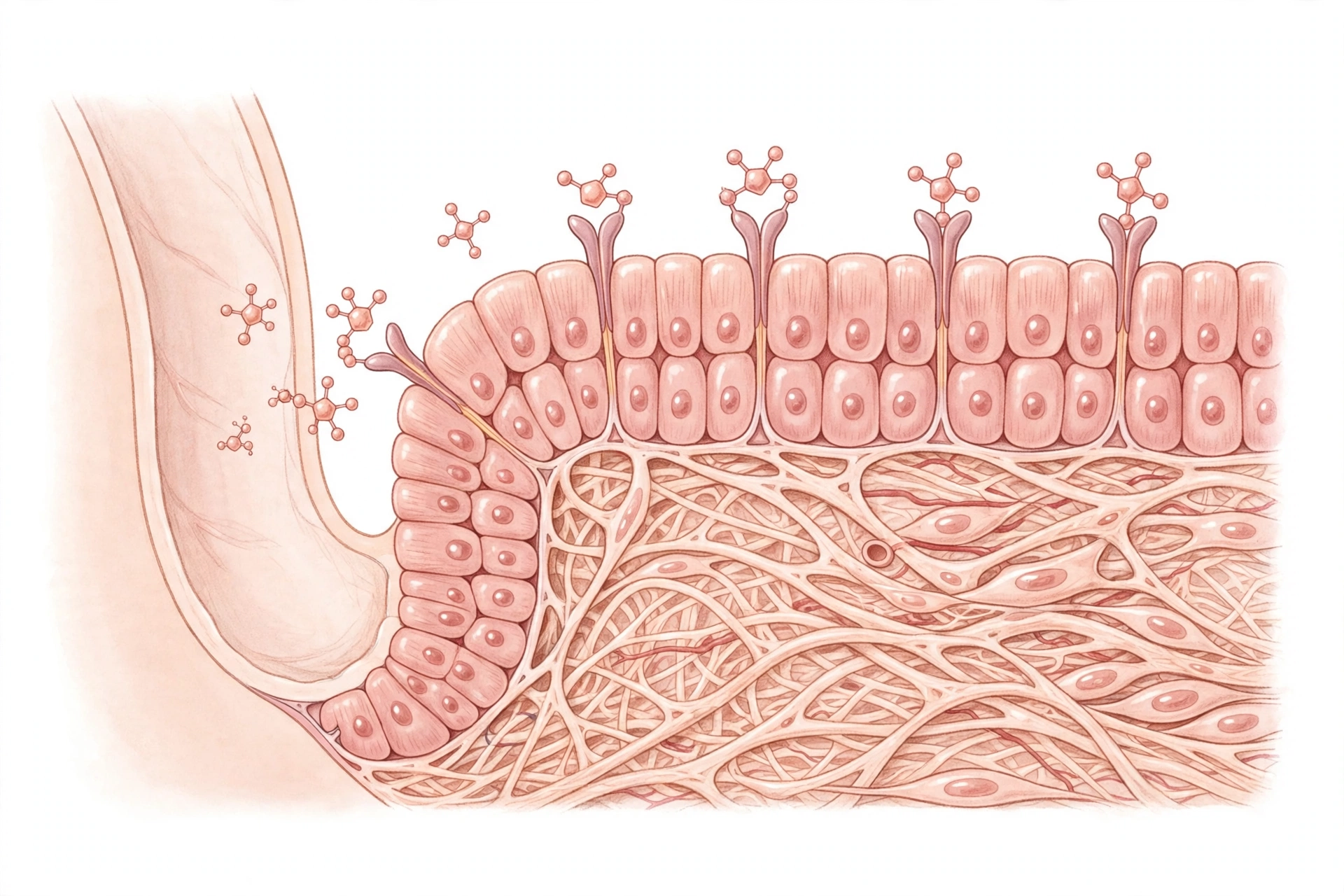
The science behind vaginal estrogen cream benefits starts at the receptor level: estrogen receptors are densely present in the vaginal lining, the vulva, the urethra, and the lower bladder area. When vaginal estrogen cream is applied, the hormone binds directly to these local receptors and sets several tissue-level changes in motion:
- Tissue thickening and elasticity. Estrogen supports the growth and maintenance of the vaginal epithelium (the tissue lining). With regular use, the lining becomes thicker, more elastic, and more resilient to friction and everyday irritation.
- Restored natural moisture. Estrogen stimulates the glands and blood flow that support natural lubrication, reducing dryness from the inside out rather than merely coating the surface.
- Lowered vaginal pH. Estrogen-rich tissue produces glycogen, which feeds protective lactobacilli — the beneficial bacteria that keep the vagina acidic. A restored acidic pH helps defend against infections.
- Improved blood flow. Better circulation supports tissue repair and maintenance, keeping the tissue nourished and responsive.
- Urethral and bladder support. Because the urethra shares embryonic origins with the vaginal tissue and carries the same receptors, local estrogen also helps the urethral lining stay thicker and less exposed — one reason it is linked to fewer recurrent UTIs.
Improvement is gradual rather than instant. Many women notice initial relief from dryness and itching within the first couple of weeks of consistent use, with the fullest tissue restoration typically developing over one to three months. The treatment usually begins with a more frequent application schedule and then tapers to a maintenance schedule of a few times per week, as directed by your clinician. Because the cream addresses the underlying tissue changes rather than just masking symptoms, consistency matters more than any single application.
Key Vaginal Estrogen Cream Benefits
The key vaginal estrogen cream benefits flow directly from that tissue-level repair. Here is what the clinical literature and treatment guidelines emphasize:
Relief from dryness, itching, and burning
Vaginal dryness is the hallmark symptom of GSM, often accompanied by persistent itching or a burning sensation that can make sitting, exercising, or wearing fitted clothing uncomfortable. By thickening the tissue and restoring natural moisture, vaginal estrogen cream targets the cause of this discomfort rather than only soothing it. Studies and position statements from The Menopause Society note that local estrogen is an effective treatment for these moderate-to-severe symptoms in most postmenopausal women.
More comfortable intimacy
Painful intercourse (dyspareunia) is one of the most common reasons women seek treatment for GSM. Thinner, drier tissue is more vulnerable to microtears and friction during sex. As the tissue thickens and natural lubrication improves, intimacy typically becomes more comfortable and pleasurable. For more on this topic, read painful intercourse after menopause: causes and help.
Healthier vaginal pH and microbiome
A less-discussed vaginal estrogen cream benefit is the restoration of the vagina’s protective microbial balance. Estrogen encourages the growth of lactobacilli, the beneficial bacteria that keep vaginal pH acidic and make it harder for pathogens to take hold. This matters for everyday comfort and long-term tissue health, not just for preventing infections.
Fewer recurrent urinary tract infections
Recurrent UTIs after menopause are strongly linked to estrogen deficiency: a thinner urethral lining and a less acidic vaginal environment make it easier for bacteria to migrate toward the bladder. Among the most practical vaginal estrogen cream benefits is a lower rate of these infections — local vaginal estrogen has been shown to reduce the frequency of recurrent UTIs in postmenopausal women, and treating GSM is now considered part of UTI prevention strategy in this age group.
Notably, in 2025 the American Urological Association, the Society of Urodynamics, Female Pelvic Medicine & Urogenital Reconstruction (SUFU), and the American Urogynecologic Society (AUGS) jointly issued guidance on GSM strongly recommending that clinicians offer low-dose local vaginal estrogen to patients with vulvovaginal dryness, irritation, and painful intercourse — a significant endorsement reflecting how firmly the evidence supports this therapy.
Relief from bladder urgency and frequency
The lower urinary tract is directly affected by estrogen. Its receptors are found in the urethral and bladder lining, as well as in surrounding muscles and ligaments.
Supporting these tissues is one of the everyday vaginal estrogen cream benefits: the cream can help ease urgency, frequency, and the sense that you “always need to go,” improving sleep and daily confidence.
Localized action with minimal systemic exposure
One of the biggest practical advantages of the cream is that it works where it is applied. Low-dose vaginal estrogen results in minimal absorption into the bloodstream compared with pills or patches.
This favorable risk-benefit profile is why medical organizations including the American College of Obstetricians and Gynecologists (ACOG) and The Menopause Society identify low-dose vaginal estrogen as a preferred first-line option when symptoms are confined to the vaginal and urinary tract — and it is also why some women who cannot use systemic hormone therapy (for example, those with a history of blood clots) may still be candidates for local treatment. ACOG’s committee opinion on vaginal estrogen discusses how this therapy is considered even in complex cases, always with individualized clinical judgment.
What the Research Says About Safety
The safety evidence behind vaginal estrogen cream benefits has been studied extensively and is one of the therapy’s strongest features. The Menopause Society’s position statement on low-dose vaginal estrogen describes a favorable risk-benefit profile for symptom relief in most postmenopausal women, and low-dose vaginal estrogen does not carry the same risk profile as systemic hormone therapy. In particular, at low local doses it has not been associated with increased risks of stroke, heart attack, or blood clots the way systemic estrogen can be.
A few nuances are worth understanding:
- The boxed warning. Vaginal estrogen products carry the same class boxed warning as all estrogen products, which was written for systemic therapy and describes risks such as blood clots, stroke, and certain cancers. Medical organizations, including The Menopause Society and ACOG, have long noted that this warning does not reflect the evidence for low-dose vaginal estrogen specifically and may unnecessarily discourage women from an effective treatment. Still, any decision should be made with a clinician who understands this distinction.
- No progestogen is typically needed. Systemic estrogen therapy requires a progestogen to protect the uterine lining in women who still have a uterus — but at low local vaginal doses, the evidence shows minimal endometrial stimulation, so routine progestogen is generally not required. This is one reason the therapy stays simple.
- Breast cancer history requires individualized discussion. This is the area that most often needs nuance. Mayo Clinic notes that vaginal estrogen can be considered in some women with a previous history of breast cancer, but it is a complex decision that should involve the patient’s oncology team — especially for those taking aromatase inhibitors. ACOG’s committee opinion similarly discusses non-hormonal options as first-line for estrogen-dependent breast cancer survivors, with vaginal estrogen considered for persistent bothersome symptoms not relieved by other approaches, in coordination with oncology care.
- Unexplained vaginal bleeding should always be evaluated. Any unscheduled or unexplained vaginal bleeding during menopause warrants a clinical evaluation to rule out other causes before starting or continuing treatment.
Vaginal Estrogen Cream vs. Other Local Treatments
Cream is only one delivery format for low-dose vaginal estrogen. Understanding the alternatives helps explain why a clinician might recommend one over another — a comparison that most “benefits” articles skip:
| Treatment | How it is used | Practical advantages |
|---|---|---|
| Vaginal estrogen cream | Applied inside the vagina with an applicator, usually at bedtime | Flexible dosing; can also be applied to the outer vulva where itching is worst |
| Vaginal estrogen tablet | Small tablet placed in the vagina with an applicator | Neat and discreet; minimal mess; pre-measured doses |
| Vaginal moisturizers (non-hormonal) | Applied in or around the vagina regularly | No prescription; good for mild dryness or as a complement to estrogen |
| Vaginal lubricants (non-hormonal) | Used right before intimacy | Immediate friction relief during sex; pairs well with estrogen therapy |
Clinical evidence on vaginal estrogen cream benefits suggests the estrogen formats work similarly well, so the choice often comes down to personal preference, dexterity, cost, and insurance coverage. A useful rule of thumb from Mayo Clinic: lubricants help in the moment, moisturizers keep tissues hydrated between episodes of dryness, and vaginal estrogen addresses the underlying tissue changes. They are complements, not competitors — you can learn more about the distinction in vaginal moisturizer vs. lubricant: what’s the difference.
Who Should Consider It — and Who Should Talk to a Clinician First
Vaginal estrogen cream is most commonly considered for women with moderate-to-severe GSM symptoms — persistent dryness, burning, painful intimacy, or recurrent UTIs — that have not been relieved by over-the-counter moisturizers and lubricants. It is also relevant in low-estrogen states outside of menopause, such as after breastfeeding or certain cancer treatments.
Be sure to discuss your full health history with a clinician before starting, particularly if any of the following apply:
- A history of estrogen-dependent cancers, especially breast or uterine cancer
- Unexplained vaginal bleeding
- A history of blood clots or stroke
- Current use of aromatase inhibitors or other endocrine therapies
- Pregnancy or breastfeeding
For context on how vaginal estrogen fits into the broader hormone therapy picture, see menopause HRT: benefits and risks guide.
Common Myths About Vaginal Estrogen Cream
Because this treatment carries the word “estrogen,” it attracts a lot of misinformation. When weighing vaginal estrogen cream benefits, it helps to clear up a few common myths:
- Myth: “It’s the same as taking estrogen pills.” Not at all. The dose is far lower and the action is local, with minimal blood absorption. The risk profile is fundamentally different from systemic hormone therapy.
- Myth: “It will raise my risk of blood clots like birth control pills.” Low-dose vaginal estrogen has not been associated with the clot risks linked to systemic estrogen — one reason it is often considered for women who cannot take systemic hormones.
- Myth: “Once I feel better, I can stop forever.” Symptom improvement usually requires ongoing maintenance (typically a few times per week). Stopping often leads to symptoms returning, because the underlying tissue changes resume.
- Myth: “It’s fine to use vaginal estrogen cream on my face.” A social media trend has encouraged applying vaginal estrogen to facial skin for anti-aging purposes. Clinical experts note there is very little quality evidence that this helps skin, and applying a prescription vaginal product to the face is off-label use with unknown systemic absorption effects. Prescription products should be used only as directed.
- Myth: “Only menopausal women need it.” Any low-estrogen state — breastfeeding, chemotherapy, or certain hormonal contraceptives — can produce the same symptoms, and the same therapy may be discussed with a clinician.

Tips for Getting the Most From Treatment
Getting the full vaginal estrogen cream benefits comes down to consistency and a few practical habits:
- Use it consistently. The biggest determinant of success is regular, ongoing use — including the maintenance schedule after the initial treatment period. Skipping applications slows tissue recovery.
- Apply at bedtime. Most clinicians recommend applying the cream before sleep, which gives the product time to be absorbed while you lie still, with minimal leakage.
- Time intimacy thoughtfully. Applying the cream after intimacy rather than immediately before avoids timing concerns. If used beforehand, allowing a couple of hours before sex — and longer before oral sex — limits transfer to a partner.
- Keep the applicator clean. Wash the applicator with mild soap and warm water after each use (never boil it or use hot water), so it is ready and hygienic next time.
- Pair it with lubricants and moisturizers. A water- or silicone-based lubricant before intimacy plus a regular vaginal moisturizer can complement the cream, especially during the first weeks while tissue is still rebuilding.
- Support the pelvic floor. Pelvic floor exercises (Kegels) strengthen the muscles supporting the bladder and uterus and can complement estrogen therapy’s benefits for urinary symptoms.
- Track your symptoms. Noting dryness, itching, pain, and UTI episodes over time helps your clinician fine-tune your maintenance schedule.
- Stay in follow-up. Periodic check-ins allow your clinician to confirm the tissue is responding well and adjust the plan if symptoms change.
Frequently Asked Questions
How quickly does vaginal estrogen cream work?
Most women notice early relief from dryness, itching, or burning within the first couple of weeks of consistent use. Fuller tissue restoration — the thickening, improved elasticity, and healthier pH that underpin the biggest benefits — typically develops over one to three months. Consistency matters more than any single application, so sticking with the schedule your clinician recommends gives the best results, and most vaginal estrogen cream benefits build steadily from there.
Can vaginal estrogen cream reduce recurrent UTIs?
Yes — this is one of its well-supported benefits. By thickening the urethral lining, restoring the vagina’s protective acidic environment, and supporting healthy lactobacilli, low-dose vaginal estrogen makes it harder for bacteria to colonize and migrate toward the bladder. Clinical studies in postmenopausal women have shown reduced recurrence rates, and urinary health is now a major reason clinicians recommend the therapy.
Is vaginal estrogen cream safe long-term?
Low-dose vaginal estrogen is considered safe for ongoing use in most women when used under a clinician’s guidance, and The Menopause Society’s position statement supports a favorable risk-benefit profile. Because the dose is low and locally acting, it does not carry the systemic risk profile of estrogen pills or patches. Regular follow-up with your clinician is still recommended to confirm the treatment plan remains appropriate.
Do I need a progestogen with vaginal estrogen cream?
Generally no. Systemic estrogen therapy requires a progestogen to protect the uterine lining, but low-dose vaginal estrogen produces minimal systemic absorption and has not shown meaningful endometrial stimulation at typical low doses, so routine progestogen is usually not needed. Your clinician will confirm based on your individual history.
Can I use vaginal estrogen cream if I have had breast cancer?
This requires an individualized discussion with your care team. Non-hormonal options are usually tried first for women with a history of estrogen-dependent breast cancer, but ACOG and Mayo Clinic note that vaginal estrogen may be considered for persistent bothersome symptoms that do not respond to other approaches — with involvement of the patient’s oncology team, particularly for those taking aromatase inhibitors. Do not start this therapy without that coordinated conversation.
Will the cream affect my partner during sex?
There is a small possibility of trace transfer during sexual activity. Applying the cream after intimacy rather than before is the simplest way to avoid timing concerns. If applied beforehand, waiting a few hours before sex — and longer before oral sex — allows the product to be absorbed.
What is the difference between vaginal estrogen cream, moisturizers, and lubricants?
Vaginal estrogen cream treats the underlying cause: it restores estrogen to the tissue, thickening it and rebuilding natural moisture over weeks. Moisturizers are non-hormonal products used regularly to keep tissue hydrated. Lubricants are used right before intimacy to reduce friction in the moment. The cream addresses the root cause, while moisturizers and lubricants manage symptoms — and all three can be used together. Mayo Clinic’s guide to vaginal atrophy treatment explains how these options complement each other.
Will I need to use it forever?
In practice, yes — treatment is usually ongoing. After the initial treatment phase, most women continue on a maintenance schedule a few times per week. If the cream is stopped, the underlying estrogen deficiency remains and symptoms typically return over time. The maintenance routine is generally simple and well tolerated.
Medical disclaimer: This article is for educational purposes only and is not medical advice. It does not diagnose any condition or recommend any specific treatment. Vaginal estrogen cream is a prescription therapy; decisions about whether it is appropriate for you should be made with a qualified clinician who understands your individual health history. If you experience unexplained vaginal bleeding or new pelvic symptoms, seek prompt medical evaluation.