Spotting on Birth Control: What’s Normal
You started a new contraceptive, or perhaps switched brands, and now you are seeing light bleeding on days when no bleeding is expected. It is unsettling, and the first question most people ask is simple: is spotting on birth control normal, or is something wrong? For most users of hormonal contraception, the short answer is reassuring — spotting on birth control is a normal, expected adjustment response, especially during the first few months. But “normal” has boundaries, and knowing exactly where they are helps you respond correctly instead of worrying or, worse, quietly stopping your method and losing pregnancy protection.
This guide explains what spotting on birth control looks like, why it happens, how it differs between contraceptive methods, what the color of the blood can suggest, how to track it, when it is a sign to call a clinician, and what you can do to reduce it. It is educational information, not a diagnosis of your situation — your clinician knows your history and is the right person to advise you personally.
Is Spotting on Birth Control Normal?
Yes — for most people, spotting on birth control is normal during the adjustment period. Clinical experience and published guidance consistently show that breakthrough bleeding (the technical term for bleeding or spotting between expected periods while using hormonal contraception) is most common in the first two to three months after starting, restarting, or switching a hormonal method. Many bodies settle into a regular pattern after that, and spotting fades or stops entirely.
How common it is depends on the method. With combined estrogen-progestin birth control pills, roughly half of new users notice some spotting, but that number falls below one in ten by the third month of consistent use. Progestin-only methods — the mini-pill, the implant, the hormonal IUD, and the shot — are more likely to cause ongoing irregular spotting, and for some users that pattern continues long-term. The implant is the standout: nearly eight in ten users report breakthrough bleeding in the first three months, and for some it becomes a recurring feature of the method rather than a passing phase.
So the baseline rule is this: light spotting in the first three months of a new or changed hormonal method is normal. Spotting that is heavy, lasts longer than three months without improving, starts suddenly after months of predictable cycles, or comes with pain, fever, or discharge deserves a conversation with your clinician.
Why Spotting Happens: What Your Uterine Lining Is Doing
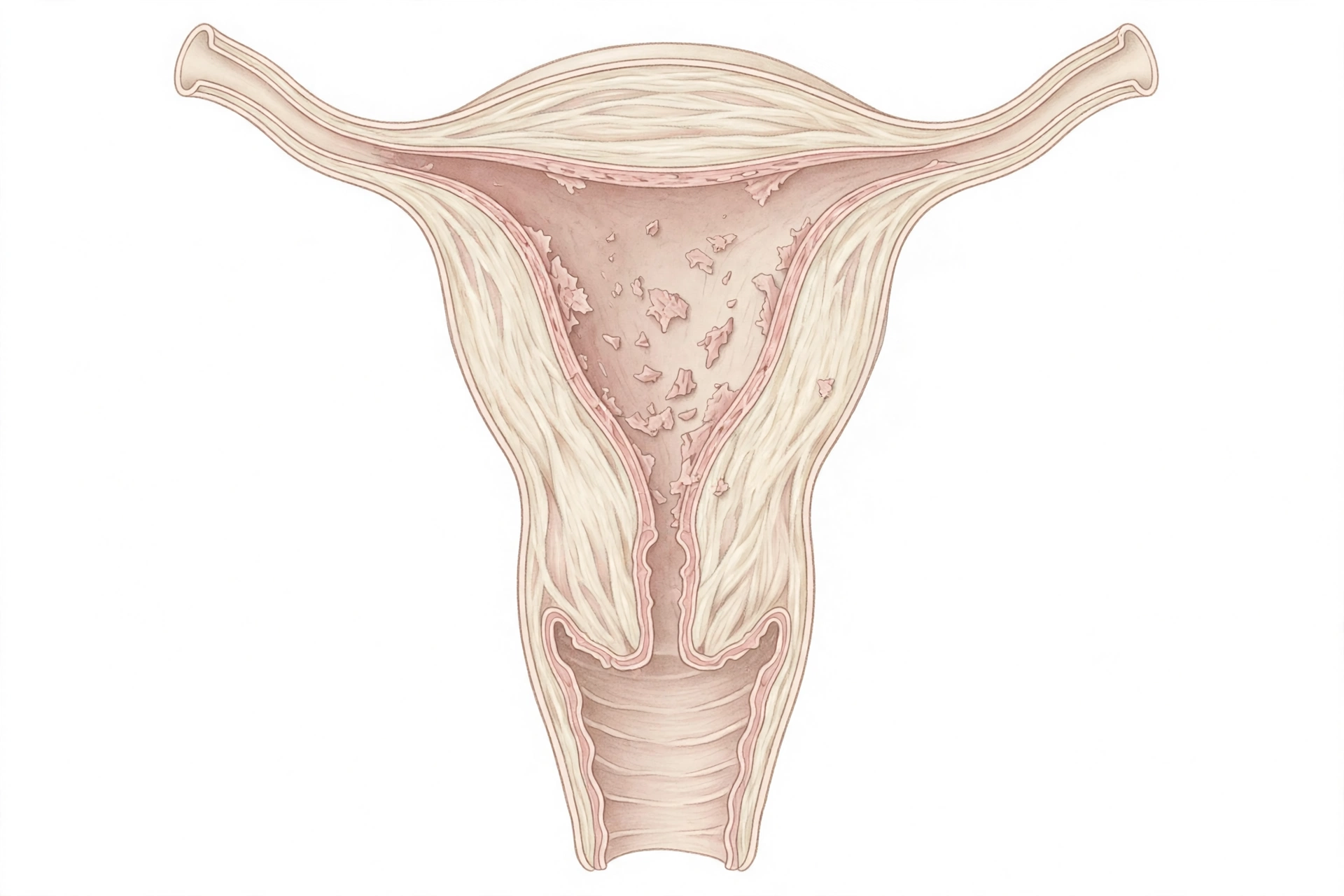
To understand spotting on birth control, it helps to picture the endometrium — the lining of the uterus. Hormonal contraceptives work in part by keeping this lining thin and stable, which is one reason periods often become lighter on the pill. But during the first weeks of a new method, the lining is in transition: blood vessels in the endometrium can be unusually fragile while they adapt to the new hormone levels, and small, unstable patches of the lining can shed at irregular intervals. That is what produces breakthrough bleeding — not a true menstrual period, but fragments of lining shedding ahead of schedule.
This also explains why the adjustment period has a natural end point for many users. Once the lining thins fully and stabilizes, there is less tissue available to shed irregularly, and spotting stops. It explains, too, why anything that destabilizes hormone levels — a missed pill, vomiting or diarrhea shortly after taking a pill, a significant time-zone shift that delays a dose — can trigger a fresh episode of spotting even in someone whose bleeding had settled months earlier.
Spotting by Method: Pill, Patch, Ring, Shot, Implant, IUD
Not all methods spot equally. The table below summarizes the typical spotting pattern for each common contraceptive method, so you can judge your experience against what is usual for the method you actually use. (Timelines are typical ranges, not guarantees — individual bodies vary widely.)
| Method | Typical spotting pattern | When it usually settles |
|---|---|---|
| Combined pill (estrogen + progestin) | Light spotting in about half of new users | Often resolves by month 3 of consistent use |
| Progestin-only mini-pill | Irregular spotting in over half of users; patterns stay unpredictable for many | May improve over months; some users never develop a regular pattern |
| Birth control patch | Similar to the combined pill | Usually by the third cycle |
| Vaginal ring | Similar to or slightly less than the combined pill, thanks to steadier hormone levels | Usually within the first few months |
| Contraceptive shot (Depo-Provera) | Most users experience breakthrough bleeding early on | Improves over time; many eventually stop bleeding altogether |
| Contraceptive implant | Nearly 80% report spotting in the first 3 months; irregular bleeding often continues | Unpredictable — it may settle, or irregular bleeding may persist |
| Hormonal IUD | Frequent spotting and irregular bleeding after insertion | Often improves within 3–6 months; many users end up with very light or absent periods |
| Copper IUD | Heavier, longer periods and cramping rather than classic spotting; some intermenstrual spotting possible early on | Heavier bleeding often improves over the first year |
If you are still choosing a method and predictable bleeding matters to you, it is worth reading up to compare the main birth control options before deciding — bleeding patterns are one of the most legitimate reasons people switch methods, and choosing with eyes open saves months of frustration.
What the Color of Spotting Can Tell You
Spotting is not all the same, and the color of the blood carries useful clues. It does not diagnose anything on its own, but it helps you describe what you are seeing to a clinician — and it reassures in some cases.
- Brown or dark rust-colored spotting is the most common color with breakthrough bleeding. It is usually older blood that has taken longer to leave the uterus, often oxidized along the way. Brown spotting during the first months of a new method, or after a late pill, is typically the most reassuring color.
- Pink spotting is light, fresh bleeding diluted with cervical fluid. It is common around the start or end of a withdrawal bleed, after a missed dose, or during the early adjustment months.
- Bright red spotting is fresh blood. Small amounts of bright red spotting can still be normal breakthrough bleeding, but if it is persistent, heavy, or accompanied by pain or discharge, it is worth reporting to your clinician sooner rather than later.
Color is a clue, not a verdict. What matters most is the overall pattern: how much, how long, whether it is improving or worsening, and what else is happening alongside it.
Spotting vs. Withdrawal Bleed: How to Tell the Difference
One of the most common confusions is mistaking normal withdrawal bleeding for spotting — or the reverse. If you use a combined pill, patch, or ring with a hormone-free interval (the placebo week, the patch-free week, or the ring-free week), the bleed that arrives during that interval is a withdrawal bleed, caused by the planned drop in hormones. It is expected, it is usually lighter than a natural period, and it is not spotting — even though it is technically induced bleeding rather than a true period.
True spotting, by contrast, appears outside the hormone-free interval: on active-pill days, mid-patch weeks, or while the ring is in place. A quick mental test: if the bleeding arrived during your placebo week, it is a withdrawal bleed and almost certainly fine. If it arrived on active-pill days, it is breakthrough bleeding, and the question becomes whether it falls inside the normal adjustment window described above. Spotting that straddles the boundary — starting a day or two before the placebo week — is extremely common and usually nothing to worry about.
Keep a Spotting Diary: What Clinicians Actually Want to Know
If your spotting lasts long enough to discuss with a clinician, the single most useful thing you can bring is a simple record. Most consultations about breakthrough bleeding stall on vague answers (“sometimes,” “a little,” “I think it was last month”). A short diary — even two or three weeks of notes — turns that into actionable information. Track:
- The date each spotting episode starts and stops
- How much — light spotting on a panty liner, staining only, or enough to need a pad or tampon (note the number of products used per day)
- The color — brown, pink, or bright red
- What day of your method cycle it happened on (e.g., “day 14 of active pills,” “two days before the placebo week,” “week 6 after the shot”)
- Triggers — a late or missed pill, vomiting, diarrhea, new medication or supplement, illness, significant stress, or recent travel across time zones
- Other symptoms — pelvic pain, cramping, unusual discharge, fever, or pain during sex
A phone notes app, a cycle-tracking app, or a plain calendar all work. Clinicians use this pattern — amount, timing, duration, triggers — to distinguish normal adjustment bleeding from bleeding that warrants examination, a pregnancy test, STI screening, or a method change. Your diary shortens the path to the right answer considerably.

How to Reduce Spotting on Birth Control
Some spotting simply needs time, but several practical steps can reduce it while your body adjusts:
- Take your method on schedule. This is the single most effective step for pill, patch, and ring users. Take the pill at the same time every day, apply the patch on the same weekday, and reinsert the ring on time. Alarms and reminder apps exist precisely because timing slips are the most common cause of breakthrough bleeding in otherwise settled users. If timing is already a problem, read what to do if you missed a birth control pill before it becomes a pattern.
- Do not skip doses to “rest.” Extra days off active pills destabilize the lining and usually cause more bleeding, not less.
- Give it the full adjustment period. For pills, patches, and rings, that is about three months; for hormonal IUDs, up to six months. Judging a method before the adjustment period ends often leads to abandoning a method that would have settled.
- Stop smoking if you smoke. People who smoke are measurably more likely to experience breakthrough bleeding, and quitting improves many aspects of contraceptive safety and effectiveness. Your clinician can help with cessation support.
- Review new medications and supplements. Some seizure medications, certain antibiotics used for tuberculosis, and the herbal supplement St. John’s wort can interfere with hormonal contraception and trigger spotting. Mention everything you take — including over-the-counter and herbal products — at your contraception appointments.
- Ask your clinician about options. Depending on the method, a clinician may suggest a slightly higher estrogen dose in a pill, a scheduled hormone-free break to let the lining shed fully (for continuous-use regimens), short courses of anti-inflammatory medication to calm bleeding, or switching to a different method. These are clinical decisions — do not adjust doses or regimens on your own.
When Spotting Is NOT Normal: Warning Signs to Take Seriously
Most spotting on birth control is harmless, but breakthrough bleeding can occasionally be the first sign of something that needs medical attention. Contact your clinician promptly — and seek urgent care for severe symptoms — if you notice any of the following:
- Heavy bleeding: soaking through a pad or tampon every hour for several hours, passing large clots, or bleeding that feels like a heavy period rather than spotting
- Severe pelvic pain or cramping that is new or markedly worse than usual
- Dizziness, fainting, or feeling faint — possible signs of significant blood loss
- Spotting that starts after months of predictable cycles — new irregular bleeding in a previously settled pattern warrants evaluation
- Bleeding that lasts longer than three months without improving, or keeps getting heavier
- Bleeding after sex — this has its own set of possible causes, and you can read more about bleeding after sex while you arrange an appointment
- Fever, pelvic pain with discharge, or foul-smelling vaginal discharge — possible signs of infection, including pelvic inflammatory disease or cervicitis
- Signs you could be pregnant: a positive pregnancy test, or pregnancy symptoms after missed doses — your clinician will likely recommend testing before anything else
None of these automatically means something serious is wrong, but all of them are reasons a clinician should take a look. Do not stop your contraception abruptly while waiting for advice unless your clinician tells you to — stopping without a backup plan leaves you unprotected against pregnancy.
Does Spotting Mean My Birth Control Isn’t Working?
This is the fear behind almost every worried search, so it deserves a direct answer: spotting does not mean your birth control has stopped working. If you are using your method correctly — pills taken daily, patch and ring changed on schedule, shot received on time, implant and IUD in place — breakthrough bleeding is a side effect, not a failure signal. Pregnancy protection depends on the hormones doing their job (suppressing ovulation, thickening cervical mucus, thinning the lining), and irregular shedding of that lining does not cancel those effects.
The exception is when spotting is caused by the very thing that can reduce effectiveness: missed or late doses, vomiting or diarrhea that prevented absorption, or interacting medications. That is why the trigger-tracking in your spotting diary matters — spotting plus a known trigger is the combination that should prompt a pregnancy test and backup contraception, not the spotting alone.
If spotting worries you enough that you are considering stopping your method, talk to your clinician first. Many people who abandon a method over spotting end up with an unplanned pregnancy they wanted even less than the spotting. There are usually several levers to try — dose adjustment, scheduled breaks, NSAID courses, or a different method — before quitting contraception altogether.
Spotting After Switching Methods or Restarting
Starting a method is not the only transition that causes spotting. Switching from one method to another — say, from the pill to a hormonal IUD, or from the shot to the implant — restarts the adjustment clock, and it is normal to spot during the crossover period even if your previous method had been perfectly settled. The same applies after a break: stopping contraception for a few months and then restarting usually brings back the spotting of the early months, because the endometrium has to re-adapt.
One practical note for switchers: if you switch because of intolerable bleeding on one method, tell your clinician exactly what the bleeding was like. Bleeding patterns are highly method-specific — the continuous spotting that makes some people abandon the implant is a completely different experience from the early-months spotting on the combined pill — and your clinician can steer you toward methods whose typical patterns match your tolerance.
Frequently Asked Questions
How long does spotting on birth control usually last?
For combined pills, patches, and the vaginal ring, spotting most often settles within two to three months of consistent use. Hormonal IUDs may take three to six months. Progestin-only methods — the mini-pill, implant, and shot — have more variable patterns, and irregular spotting can continue longer or become the ongoing norm for some users.
Is brown spotting on birth control normal?
Usually, yes. Brown spotting is typically older blood leaving the uterus more slowly, which is exactly what happens when small, unstable patches of a thinning endometrial lining shed irregularly. It is one of the most common forms of breakthrough bleeding and is generally the least concerning color — though persistent or heavy brown bleeding still deserves a clinician’s input.
Can stress cause spotting on birth control?
Stress itself is a less common direct cause, but the behaviors and body changes that come with stress — forgetting pills, disrupted sleep and routines, illness — can trigger spotting. If your pill-taking became irregular during a stressful period, that timing slip is the more likely explanation than stress hormones alone.
Should I stop taking my birth control if I’m spotting?
No — do not stop because of spotting unless your clinician advises it. Spotting usually improves on its own, and stopping abruptly removes your pregnancy protection. If you want to discontinue, plan the transition: start another reliable method or use condoms, and discuss timing with your clinician first.
Does spotting on birth control mean I’m pregnant?
Not usually. Spotting alone, in someone using their method correctly, is far more likely to be adjustment bleeding. Pregnancy becomes a realistic consideration when spotting follows missed or late doses, vomiting or diarrhea after pill-taking, or an interacting medication. In those cases, take a pregnancy test — it is the only way to know, and early testing gives you the most options.
Why am I spotting on birth control after years of no problems?
New spotting after months or years of predictable cycles is different from early-adjustment spotting and should be evaluated. Common explanations include a recently missed or late dose, a new medication or supplement, smoking changes, a recent illness, or — less commonly — infection, fibroids, cervical changes, or perimenopause in users in their 40s. A clinician visit is the right next step.
Can I skip my period to stop spotting?
For pill, patch, and ring users, clinicians sometimes recommend continuous or extended use — skipping the hormone-free interval — to stabilize the lining and reduce spotting, or conversely a scheduled break to let built-up lining shed. Both strategies are clinical decisions, not DIY adjustments. Do not change your regimen without your clinician’s guidance.
Does spotting on birth control affect fertility later?
No. There is no evidence that breakthrough bleeding on hormonal contraception harms future fertility. Fertility typically returns to its natural baseline after stopping contraception, regardless of whether you spotted while using it. Spotting is a lining-shedding side effect, not damage to your reproductive system.
Medical disclaimer: This article is for educational purposes only and is not medical advice. It does not diagnose any condition or prescribe any treatment, and it cannot replace the judgment of a qualified clinician who knows your medical history. If you are concerned about bleeding, think you may be pregnant, or are considering changing your contraceptive method, consult your doctor, nurse practitioner, midwife, or pharmacist. For general, authoritative information you can also consult the American College of Obstetricians and Gynecologists and Planned Parenthood.