Testicular Torsion: 5 Emergency Warning Signs Every Man Should Know
Testicular Torsion: 5 Emergency Warning Signs Every Man Should Know
Sudden, severe pain in the scrotum is never something to wait out — and when that pain is caused by testicular torsion, waiting can cost a man his testicle. Testicular torsion happens when a testicle twists inside the scrotum, cutting off its own blood supply. It is a genuine medical emergency, and the outcome depends almost entirely on how fast you get help.
The good news: if treated within six hours, the testicle can usually be saved. The bad news: most men and parents of teenage boys have never heard of this condition, so they delay. This guide covers the 5 warning signs you must recognize, what causes the twisting, and exactly what happens in the emergency room.
What Exactly Is Testicular Torsion?
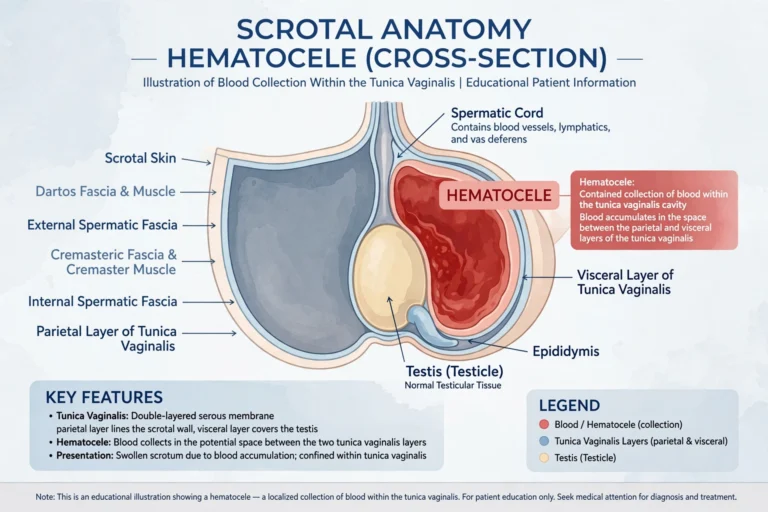
Each testicle is supplied with blood through a cord-like structure called the spermatic cord, which runs from the abdomen down into the scrotum. In testicular torsion, the testicle rotates on this cord — picture a headphone cable winding itself into a knot — and the twist chokes off blood flow.
Without blood, the testicle is starved of oxygen. Tissue begins to suffer within hours, and after too long, the damage becomes permanent and the testicle must be removed.
Why does it twist?
The most common underlying cause is a condition present from birth called bell clapper deformity. Normally, the testicle is anchored to the inside wall of the scrotum. In men with bell clapper deformity, the testicle hangs freely and can spin like a clapper inside a bell.
Other factors that can trigger a twist include:
- Rapid growth during puberty, which changes the balance of supporting tissue
- Injury or a blow to the scrotum
- Strenuous physical activity or sudden movements
- Cold exposure (the scrotum contracts tightly in cold weather)
- A family history of torsion
Who is at risk?
Testicular torsion most often strikes males between ages 12 and 18, and it affects roughly 1 in 4,000 males under age 25. But it is not exclusive to teenagers — newborns can be affected, and cases occur in men well past 25 too. The left testicle is affected slightly more often than the right.
The 5 Emergency Warning Signs
Memorize these. If any of them appear suddenly, treat it as an emergency and go to the emergency department — do not wait to see if it gets better.
1. Sudden, severe pain in one testicle
This is the hallmark sign. The pain arrives without warning — sometimes waking a boy from sleep, sometimes stopping an athlete mid-game — and it is intense. It does not ease with rest or painkillers. It usually affects only one side, because only one testicle twists at a time.
2. One testicle sitting higher or at an odd angle
The twisted testicle often rides up toward the body and may lie horizontally instead of vertically. Compare both sides: obvious asymmetry is a strong red flag. One useful clue doctors note is that lifting the scrotum does not relieve the pain (in infections like epididymitis, it often does).
3. Rapid swelling, redness, or firmness of the scrotum
Within minutes to hours, the affected side of the scrotum can swell dramatically. The skin may look red, taut, or even dark and purplish as blood flow is cut off. The testicle itself can feel hard rather than its normal soft, spongy texture.
4. Nausea, vomiting, and abdominal pain
Because the nerves of the testicles share pathways with the abdomen, the brain can misread the emergency. Many boys and men feel sick, vomit, or develop lower abdominal pain alongside (or even instead of) scrotal pain. If abdominal pain and nausea come with a painful, swollen scrotum, do not let the stomach symptoms distract you — the scrotum is the real problem.
5. Pain that comes and goes on its own
This is the most dangerous sign because it feels reassuring. Sometimes the testicle twists and then untwists by itself — intermittent torsion. The pain fades, and it is tempting to forget about it. But the twist almost always comes back, and the next time it may not release. Any sudden testicular pain that resolves on its own still deserves urgent medical evaluation — surgeons can fix the underlying looseness and prevent the emergency entirely.
If you want a broader understanding of scrotal symptoms and when they signal danger, read our guide to testicular pain causes and red flags.
The 6-Hour Rule: Why Speed Saves the Testicle
Time is tissue. Here is roughly what is at stake:
- Within 6 hours of symptoms starting: the testicle can usually be saved.
- 6–12 hours: the risk of permanent damage rises sharply.
- Beyond 12–24 hours: the testicle often cannot be saved and must be removed.
These are guidelines, not guarantees — some testicles are lost sooner, some survive longer. The only safe rule is: go immediately. Do not try to wait until morning, do not schedule an appointment for next week, and do not try to "walk it off." Call emergency services or go straight to the emergency department.
Parents should teach teenage sons this rule plainly: any sudden, severe testicle pain means telling an adult right away, day or night. Embarrassment has cost many boys a testicle.
What Happens at the Emergency Room
Knowing what to expect removes the fear that causes delays.
1. Physical examination. The doctor examines the scrotum, checks the position and tenderness of the testicles, and assesses the classic signs.
2. Doppler ultrasound. This painless scan uses sound waves to show whether blood is flowing to the testicle. Reduced or absent blood flow confirms the diagnosis. If the picture is unclear, doctors will operate anyway rather than risk the testicle.
3. Manual detorsion (sometimes). In the emergency department, a doctor may try to untwist the testicle by hand to restore blood flow quickly. This relieves pain but does not fix the problem — surgery is still required.
4. Orchiopexy (the fixing surgery). Through a small incision in the scrotum, the surgeon untwists the cord, restores blood flow, and stitches the testicle to the inside of the scrotum so it cannot twist again. The healthy testicle on the other side is usually stitched in place too, because the same looseness often exists there.
5. Orchiectomy (only if it is too late). If the testicle is dead, it must be removed to prevent infection and immune reactions that could harm the remaining testicle.
Orchiopexy is typically an outpatient procedure — most patients go home the same day.
Recovery and Life After Surgery
Recovery is straightforward for most patients:
- Soreness and swelling for a few days to a couple of weeks
- Ice, supportive underwear, and prescribed pain medication as needed
- Avoid strenuous activity, sports, and heavy lifting for about 2–4 weeks
- Return to sexual activity when the surgeon clears you, usually after a few weeks
One functioning testicle produces enough testosterone and sperm for normal health and fertility, so even the rare case that ends in removal does not mean infertility or low testosterone. That said, saving the testicle is always the goal — which is why speed matters.
Making testicular health a habit helps too. A monthly testicular self-exam takes two minutes and builds the familiarity that makes sudden changes obvious.
When to See a Doctor
Go to the emergency department immediately if you have:
- Sudden, severe testicle or scrotal pain
- Swelling of one side of the scrotum with pain
- A testicle that has moved to a higher or unusual position
- Testicular pain with nausea, vomiting, or abdominal pain
See a doctor urgently (same day) if:
- You had sudden testicular pain that went away on its own — possible intermittent torsion
- Mild scrotal discomfort keeps recurring
For authoritative patient information, academic centers like UC Davis Health's men's health program explain this emergency in detail.
Key Takeaways
- Testicular torsion cuts off blood flow to the testicle and is a true emergency.
- The 5 warning signs: sudden severe one-sided pain, a high-riding or oddly angled testicle, rapid swelling and redness, nausea/vomiting with abdominal pain, and pain that comes and goes.
- Treatment within 6 hours usually saves the testicle; delay risks losing it.
- Surgery (orchiopexy) untwists the testicle and stitches both sides in place to prevent recurrence.
- Pain that disappears on its own still needs urgent evaluation.
Frequently Asked Questions
Can testicular torsion happen in adults, not just teenagers?
Yes. It peaks between ages 12 and 18, but newborns and adult men can develop it too. Sudden severe testicular pain at any age deserves emergency evaluation.
Will testicular torsion affect my fertility?
If treated quickly and the testicle is saved, fertility is usually unaffected. Even if one testicle must be removed, the remaining testicle typically produces enough sperm and testosterone for normal fertility.
Can testicular torsion happen more than once?
Yes — a previous episode is a risk factor for recurrence, which is why surgeons stitch the testicle in place (orchiopexy) and usually secure the other side during the same operation.
Is surgery always necessary, or can it untwist on its own?
Even when pain resolves by itself (intermittent torsion), preventive surgery is strongly recommended, because the twist will likely return — possibly permanently. Do not skip follow-up care just because the pain stopped.