Penile Fracture: Signs and Emergency Care
A penile fracture is one of the few true urological emergencies — a sudden tear in the tough fibrous sheath that keeps an erection rigid. Recognizing penile fracture symptoms early matters enormously, because this is an injury where minutes and hours count. Prompt surgical repair usually restores normal function, while delaying care sharply raises the risk of lasting problems with erections, urination, and penile shape.
This guide walks you through exactly what a penile fracture is, the warning signs to watch for, how it differs from look-alike injuries, what to do in the first minutes, and what treatment and recovery involve. It is written in plain clinical language so you can act fast and confidently if it ever happens to you or a partner.
What Is a Penile Fracture?
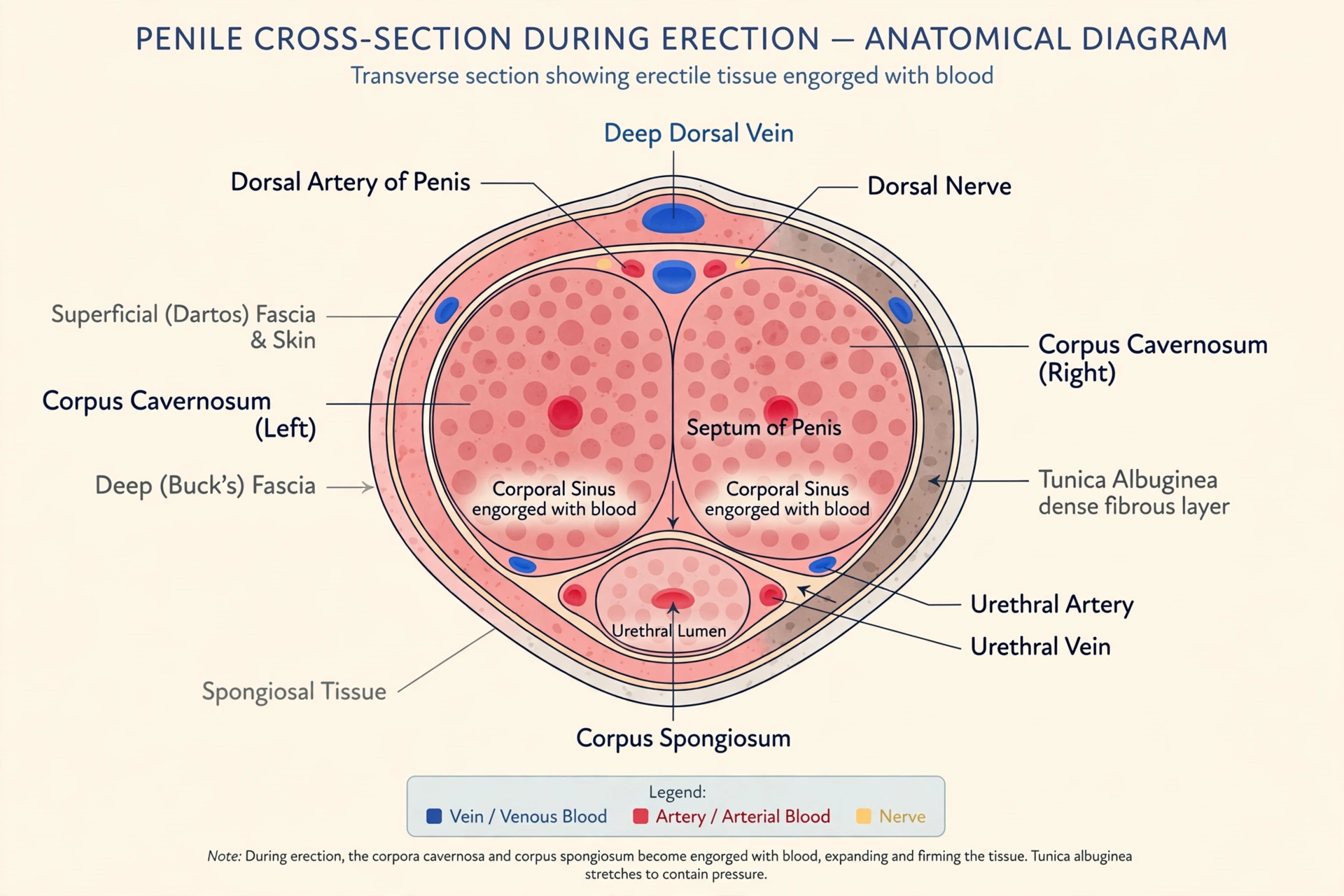
Despite the name, a penile fracture does not involve a broken bone — the penis contains no bone. The “fracture” is a tear in the tunica albuginea, a strong, fibrous sheath that wraps around the two erectile cylinders (the corpora cavernosa) running along the top of the penis. A third cylinder underneath, the corpus spongiosum, surrounds the urethra, the channel that carries urine and semen.
During an erection, the corpora cavernosa fill with blood and the tunica albuginea stretches thin — from about 2 millimeters at rest to as little as a quarter of a millimeter when fully erect. In that stretched state, a sudden, forceful bend can cause the sheath to snap like an overstretched rubber band. When it tears, blood escapes from the erectile tissue into the surrounding layers, producing the dramatic swelling and bruising that characterize this injury.
Penile fracture is uncommon — estimates range from roughly 1 in 10,000 to 1 in 100,000 people with a penis — but it is almost certainly underreported. Embarrassment keeps many people from seeking care promptly, and some do not realize the injury is a genuine emergency. Understanding penile fracture symptoms is the first step toward getting the urgent help this injury requires.
Penile Fracture Symptoms: The Warning Signs to Recognize
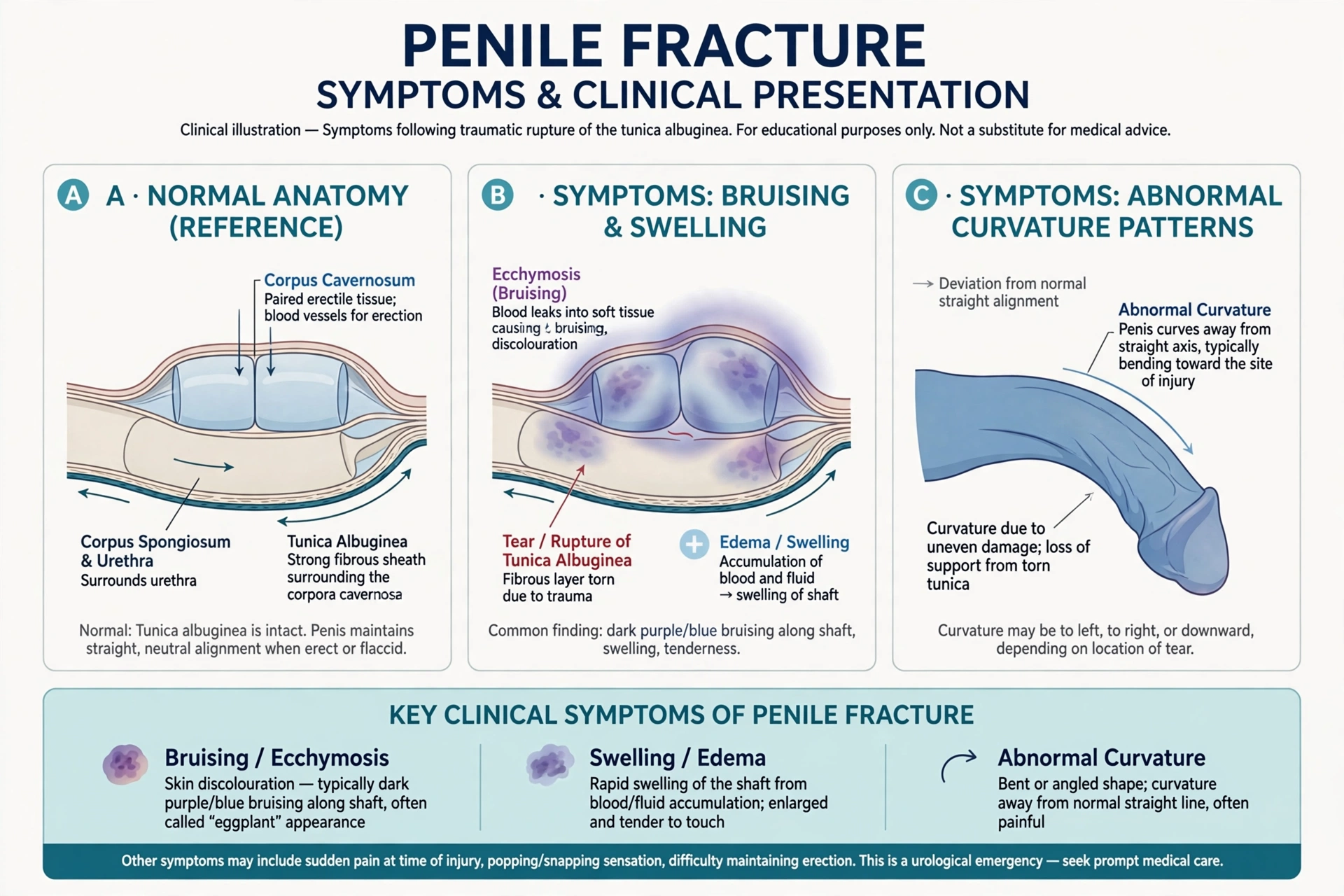
Penile fracture symptoms usually appear immediately after trauma to an erect penis. The classic presentation is unmistakable, but some signs can be subtle — which is why it helps to know the full list:
- An audible popping or cracking sound. This is the sound of the tunica albuginea tearing. It is the most distinctive of all penile fracture symptoms and is reported in the majority of cases.
- Sudden, severe pain. Intense pain at the moment of injury is typical. Note, however, that the pain can fade surprisingly quickly afterward — a fading ache does not mean the injury was minor.
- Rapid loss of the erection. The erection subsides within seconds to minutes as blood escapes the torn erectile tissue.
- Dark purple bruising and swelling (“eggplant deformity”). Blood trapped under the skin turns the shaft a deep purple or eggplant color while swelling distorts its shape. This is the sign doctors look for first.
- A localized lump or hematoma. A collection of clotted blood may form a firm, tender swelling at the site of the tear.
- A bent or abnormally shaped penis. The shaft may deviate to one side or take on an unusual contour where the blood has pooled.
- Blood in the urine or at the tip of the penis. In roughly one in five cases, the tear also involves the urethra. Any visible blood when urinating — or blood at the urinary opening — is an important red flag.
- Pain or difficulty urinating. A burning sensation, a weak stream, or an inability to pass urine can signal urethral involvement and needs immediate evaluation.
- Inability to get an erection afterward. Because the injured sheath is what traps blood to maintain rigidity, most people cannot achieve another erection until the tear is repaired.
Not every case shows every symptom. A fracture can occur without an audible pop, and pain may be milder than expected. The rule is simple: if an erect penis suffers a sudden forceful bend followed by any combination of swelling, bruising, deformity, or urinary changes, treat it as an emergency. Any combination of these penile fracture symptoms warrants the same urgent response — do not wait to see if they worsen.
Penile Fracture vs. Look-Alike Injuries
Several other injuries can mimic penile fracture symptoms, and only a clinician — usually a urologist, sometimes with imaging — can tell them apart. This table shows why self-diagnosis is unreliable:
| Condition | How it resembles a fracture | Key differences |
|---|---|---|
| True penile fracture | Pop, pain, detumescence, eggplant bruising | Tear of the tunica albuginea; requires prompt surgery |
| Ruptured dorsal vein (“false fracture”) | Swelling and bruising after trauma | Usually no audible pop and no immediate loss of erection; often managed without surgery |
| Isolated subcutaneous hematoma | Bruising and swelling | Erection mechanism intact; bruising is superficial and the shaft shape is mostly preserved |
| Urethral injury without fracture | Blood in urine, pain on urination | Bleeding from the urinary channel with little or no bruising or deformity of the shaft |
| Peyronie’s disease plaque | Curvature of the penis | Develops gradually over weeks or months, not suddenly after trauma; no acute bruising |
The practical takeaway: a “false fracture” (a torn superficial vein) can look alarming but is managed very differently from a true tear of the tunica albuginea. Because penile fracture symptoms overlap with look-alike injuries and the two cannot be distinguished reliably at home, any significant injury of this kind deserves same-day urological evaluation rather than a wait-and-see approach.
What Causes a Penile Fracture?
A penile fracture happens when an erect penis is suddenly bent with enough force to rupture the thinned tunica albuginea. The most common setting is sexual intercourse, when the rigid penis slips and strikes the partner’s pubic bone or perineum, causing a buckling injury. Certain dynamics raise the risk: vigorous intercourse, and positions where the receiving partner is on top or where thrusting force is less controlled, because the penis can bend sharply if it misses its target.
Other documented causes include forceful masturbation, rolling over onto an erect penis during sleep, falling out of bed with an erection, sports or traffic accidents involving blunt trauma to the groin, and deliberately bending an erect penis — a practice reported in some regions that accounts for a notable share of cases in parts of the Middle East. The unifying factor is always the same: sudden, forceful bending of a fully erect penis.
Understanding these mechanisms is not about assigning blame — injuries like this are accidents, and they happen to people of all ages. It is about recognizing that any forceful bending of an erect penis, in any context, can produce this injury — and the sudden penile fracture symptoms that follow it.
What to Do in the First Minutes: Emergency Care Steps
If you notice any penile fracture symptoms, the single most important action is to get to an emergency department immediately. Beyond that, these steps can help while you are on your way:
- Go to the emergency department now — do not wait until morning. Call emergency services or have someone drive you. If pain is severe, do not drive yourself.
- Do not try to straighten or “pop” the penis back into place. Manipulating the injured tissue can worsen the tear or damage the urethra.
- Apply cold through a cloth. A bag of ice or frozen peas wrapped in a towel, held gently against the area for 10–15 minutes at a time, can limit swelling. Never apply ice directly to skin.
- Keep the area still and supported. Snug (not tight) supportive underwear reduces movement and discomfort during transport.
- Note the time of injury and what happened. Doctors will ask; an accurate history speeds up diagnosis. There is no need to be embarrassed — urologists and emergency staff manage these injuries routinely.
- Do not force yourself to urinate to “check.” If you notice blood in your urine or at the tip of the penis, simply report it at the hospital. Straining can aggravate a urethral tear.
- Take nothing by mouth if surgery seems likely. Emergency staff may ask you to fast in preparation for anesthesia; follow their instructions.
- Bring your medication list and ID. Routine, but it saves time at triage.
What not to do matters as much: do not apply creams or home remedies, do not attempt to drain swelling, and do not assume that fading pain means the injury is healing. A tear that is left unrepaired does not mend properly on its own.
What to Expect at the Emergency Department
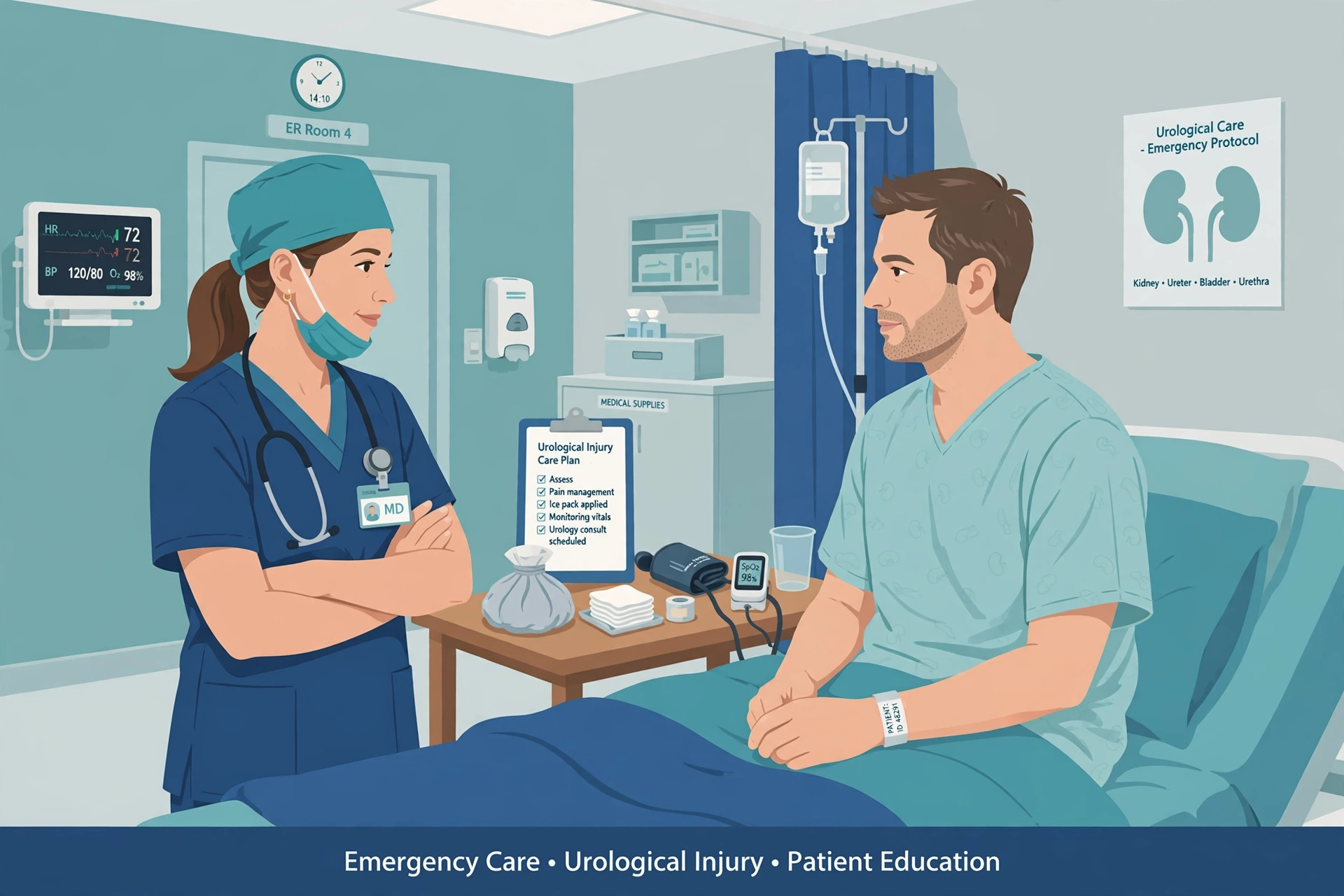
Knowing the process in advance can make it easier to walk through the door — and embarrassment-related delay is one of the best-documented reasons outcomes are worse than they need to be. When classic penile fracture symptoms are present, triage teams recognize the urgency and move quickly. Here is the usual sequence:
- Triage and history. A nurse will ask what happened and when. Answer plainly; staff have heard it all before, and accuracy helps them prioritize you correctly.
- Physical examination. A doctor examines the swelling, bruising pattern, and shape of the penis and checks for blood at the urinary opening. In classic cases, the history and exam alone are enough to diagnose a fracture.
- Imaging when the picture is unclear. If the diagnosis is uncertain or urethral damage is suspected, the team may order a penile ultrasound, an MRI, or a urethrogram (an X-ray study of the urethra) to map the injury.
- Urethral assessment. Blood in the urine, difficulty urinating, or blood at the tip usually triggers specific testing of the urethra before any repair is planned.
- Urologist consultation. A urology specialist reviews the findings and confirms whether surgical repair is needed — which, for a true fracture, it almost always is.
- Preparation for surgery. Most repairs happen urgently, often within hours. A urinary catheter may be placed, and you will receive instructions about fasting and anesthesia.
Authoritative overviews of this process are available from major medical centers; the Cleveland Clinic’s patient guide to penile fracture is a reliable reference for what standard care involves (Cleveland Clinic: Penile Fracture).
The Golden Hours: Why Fast Treatment Matters
The single biggest factor in how well someone recovers from a penile fracture is how quickly the tear is repaired — which is exactly why recognizing penile fracture symptoms without delay is so important. Urological literature consistently shows that immediate surgical repair — ideally within the first 24 hours — produces the best outcomes: normal erections return, the penis heals straight, and urinary function is preserved.
During surgery, the urologist makes an incision to access the injury, evacuates the trapped blood (hematoma), and stitches the torn tunica albuginea closed with fine sutures. Any associated injuries found along the way — a torn urethra, damaged blood vessels — are repaired at the same time. A urinary catheter is commonly left in place for a day or two, longer if the urethra was involved.
Delaying or skipping surgery after penile fracture symptoms appear carries real costs. Without repair, the tear heals with disorganized scar tissue, which can permanently impair the erection mechanism. The documented consequences of untreated or late-treated fractures include erectile dysfunction, lasting penile curvature (which may evolve into Peyronie’s disease), painful erections, urethral narrowing that makes urination difficult, and chronic pain. Non-surgical management is reserved for injuries that turn out not to be true fractures — it is not a safe alternative for a confirmed tear.
Surgery itself is not risk-free: possible complications include residual curvature, painful erections, infection, or, in a minority of cases, erectile difficulties despite repair. But the balance of evidence is clear — for a true penile fracture, prompt surgery offers by far the best chance of a full recovery.
Recovery: What Healing Looks Like
Most people go home within a few days of surgery. Healing follows a fairly predictable arc, though your surgeon’s instructions take precedence over any general timeline:
- First 1–2 weeks: swelling and pain gradually decrease. Prescribed pain relief and antibiotics should be taken as directed. Keep the surgical area clean and dry.
- Weeks 2–4: light daily activity can usually resume; strenuous exercise, heavy lifting, and all sexual activity — including masturbation — remain off-limits.
- Around 6 weeks and beyond: most surgeons clear patients to resume sexual activity no earlier than six weeks after repair, and only after a follow-up visit confirms healing is on track. Full tissue remodeling can take up to six months.
- Follow-up visits: expect scheduled check-ins to assess wound healing, urinary function, and the return of erections, sometimes with imaging to confirm blood flow.
During recovery, spontaneous nighttime or morning erections can be uncomfortable but are generally a reassuring sign that the erectile mechanism is intact. Report any lingering penile fracture symptoms — or anything that feels wrong, such as worsening pain, new swelling, fever, or discharge — rather than waiting for the next appointment. Detailed recovery timelines from patient education sources echo this staged approach (Healthline: Penile Fracture — Treatment and Recovery).
Red Flags After Surgery: When to Call Your Doctor
Contact your surgical team or return to the emergency department if you experience any of the following during recovery:
- Fever, chills, or a general feeling of being unwell
- Pain that worsens instead of improving, or swelling that increases after the first few days
- Inability to urinate, a sharply reduced urine stream, or new blood in the urine
- Bleeding, foul-smelling discharge, or opening of the surgical wound
- Severe or persistent penile pain during erections that does not ease over weeks
- A new or worsening bend in the penis as healing progresses
These are reasons to seek prompt medical review, not to panic — most are manageable when caught early. When in doubt, call: urology teams would far rather answer an unnecessary question than miss a developing complication.
The Emotional Side of a Penile Fracture
The physical injury heals in weeks; the psychological impact can linger longer. It is common to feel anxiety about sexual performance, fear of re-injury, embarrassment about how the injury happened, or tension with a partner who may feel guilty or worried. Some people avoid intimacy for months beyond the medical all-clear, and a smaller number develop persistent sexual anxiety.
A few strategies help. Talk openly with your partner about what happened and what the recovery timeline is — secrecy tends to amplify anxiety for both people. Resume intimacy gradually and only after your surgeon’s clearance, and treat the first experiences afterward as low-pressure. If worry about erections persists, remember that performance anxiety after a genital injury is a recognized pattern, not a personal failing, and it responds well to counseling.
Consider speaking with a therapist — ideally one experienced in sexual health — if anxiety is interfering with intimacy, sleep, or mood for more than a few weeks. There is nothing unusual about needing support after a traumatic injury to such a sensitive part of the body.
Penile Fracture Myths vs. Facts
| Myth | Fact |
|---|---|
| “The penis has no bone, so it can’t really break.” | The “fracture” is a tear of the tunica albuginea, a fibrous sheath — no bone required. It is a real, recognized medical emergency. |
| “If the pain eases off, it must not be serious.” | Pain often fades within minutes even with a complete tear. Fading pain is not a sign the injury is healing. |
| “It only happens during sex.” | Intercourse is the most common setting, but fractures also occur from masturbation, rolling over in sleep, falls, and blunt accidents. |
| “It will heal on its own if I rest.” | Untreated tears heal with scar tissue that commonly causes permanent erectile dysfunction and curvature. Surgery is the standard of care. |
| “Any bad bruising down there means a fracture.” | A ruptured superficial vein (“false fracture”) can cause dramatic bruising without a tear of the tunica albuginea. Only clinical evaluation distinguishes the two. |
| “You’ll never have normal erections again.” | With prompt surgical repair, most people regain full erectile and urinary function. |
Prevention: Lowering Your Risk
No strategy eliminates risk entirely, but sensible habits reduce it meaningfully:
- Communicate during sex. Partners who talk about pace, depth, and comfort are less likely to end up in the sudden misalignments that cause buckling injuries.
- Ease into vigorous activity. High-force, fast-paced intercourse — particularly in positions with less physical control — carries more risk than slower, deliberate movement.
- Use adequate lubrication. Reducing friction lowers the chance of sudden slippage and misalignment.
- Never forcefully bend an erect penis. Whether to “adjust” it, fit it into tight clothing, or as a habit — forceful bending is a documented cause of fracture.
- Mind your sleep position. If you regularly wake with erections and sleep restlessly, consider positions that reduce the chance of rolling your full body weight onto an erect penis.
None of this should make intimacy fearful — the absolute risk remains low. Think of it the way you think of any physical activity: awareness and moderation, not anxiety.
Medical Disclaimer
This article is for educational purposes only and is not medical advice. It does not establish a doctor–patient relationship and cannot diagnose any individual’s condition. Penile fracture symptoms overlap with other injuries that require different treatment, so any suspected genital injury should be evaluated promptly by a qualified clinician or emergency department. If you are experiencing a medical emergency, call your local emergency number immediately.
Frequently Asked Questions
Can a penile fracture heal on its own without surgery?
A true penile fracture — a tear of the tunica albuginea — does not heal properly without surgical repair. The torn edges mend with disorganized scar tissue, which commonly leads to permanent erectile dysfunction, penile curvature, and painful erections. Studies consistently show far better outcomes with prompt surgery than with conservative management. Non-surgical care is only appropriate when evaluation shows the injury is not a true fracture (for example, a ruptured superficial vein).
How soon after surgery can I have sex again?
Most urologists advise waiting at least six weeks after surgical repair before any sexual activity, including masturbation — and only after a follow-up visit confirms healing is progressing well. Some patients need longer. Resuming too early risks re-tearing the repair. Your surgeon’s clearance, not the calendar alone, is the green light.
Will I be able to get normal erections after a penile fracture?
In most cases, yes — provided the fracture is repaired promptly. The majority of people treated with timely surgery regain full erectile function. The risk of lasting erectile difficulties rises significantly when treatment is delayed or skipped, which is why this injury is treated as an emergency.
Does a penile fracture always make a popping sound?
Not always. An audible pop or crack is the most distinctive symptom and occurs in most cases, but its absence does not rule out a fracture. Swelling, rapid loss of erection, bruising, deformity, or urinary changes — all established penile fracture symptoms — warrant urgent evaluation regardless of whether a sound was heard.
What is the “eggplant deformity”?
It is the clinical nickname for the dark purple swelling and bruising of the penile shaft seen after a fracture. Blood escaping from the torn erectile tissue becomes trapped under the skin, turning it a deep eggplant-purple color while swelling distorts the shape. Doctors consider it a hallmark sign of penile fracture.
Can a penile fracture cause permanent problems with urination?
It can if the urethra is injured and not properly treated — about one in five fractures involves the urethra. Untreated urethral tears can lead to narrowing (stricture), which makes urination difficult. When urethral injuries are identified and repaired during the initial surgery, long-term urinary problems are uncommon. Blood in the urine or pain when urinating after such an injury should always be reported immediately.
Why do people delay seeking care, and does the delay matter?
Embarrassment is the main reason — many people hope the injury will resolve on its own rather than explain it to emergency staff. The delay matters a great deal: recognizing penile fracture symptoms early and getting repair within the first day produces the best outcomes, while waiting days or weeks increases the risk of erectile dysfunction, curvature, and urethral complications. Emergency and urology teams treat these injuries routinely and without judgment, so there is no reason to let embarrassment dictate the outcome.