
Non-Verbal Cues in Relationships: Reading Beyond Words
Your partner says “I’m fine” — but their arms are crossed, their voice has an edge, and they won’t quite look at you. Which message do you believe? Most of us would trust the body over the words, and research suggests we’re right to. Learning to read nonverbal cues in relationships is one of the most practical skills a couple can build: it helps you catch hurt feelings early, defuse tension before it explodes, and understand what your partner means even when they can’t quite say it.
This guide goes beyond the usual “crossed arms mean defensiveness” advice. You’ll learn the seven channels of nonverbal cues in relationships, the famous 55% figure explained correctly, what microexpressions actually reveal, how Gottman Institute research connects physiology to stonewalling, why your partner’s texting style is itself a nonverbal cue, and a concrete 7-day practice to sharpen your reading skills — without turning into an amateur mind-reader.
What Nonverbal Cues in Relationships Actually Are
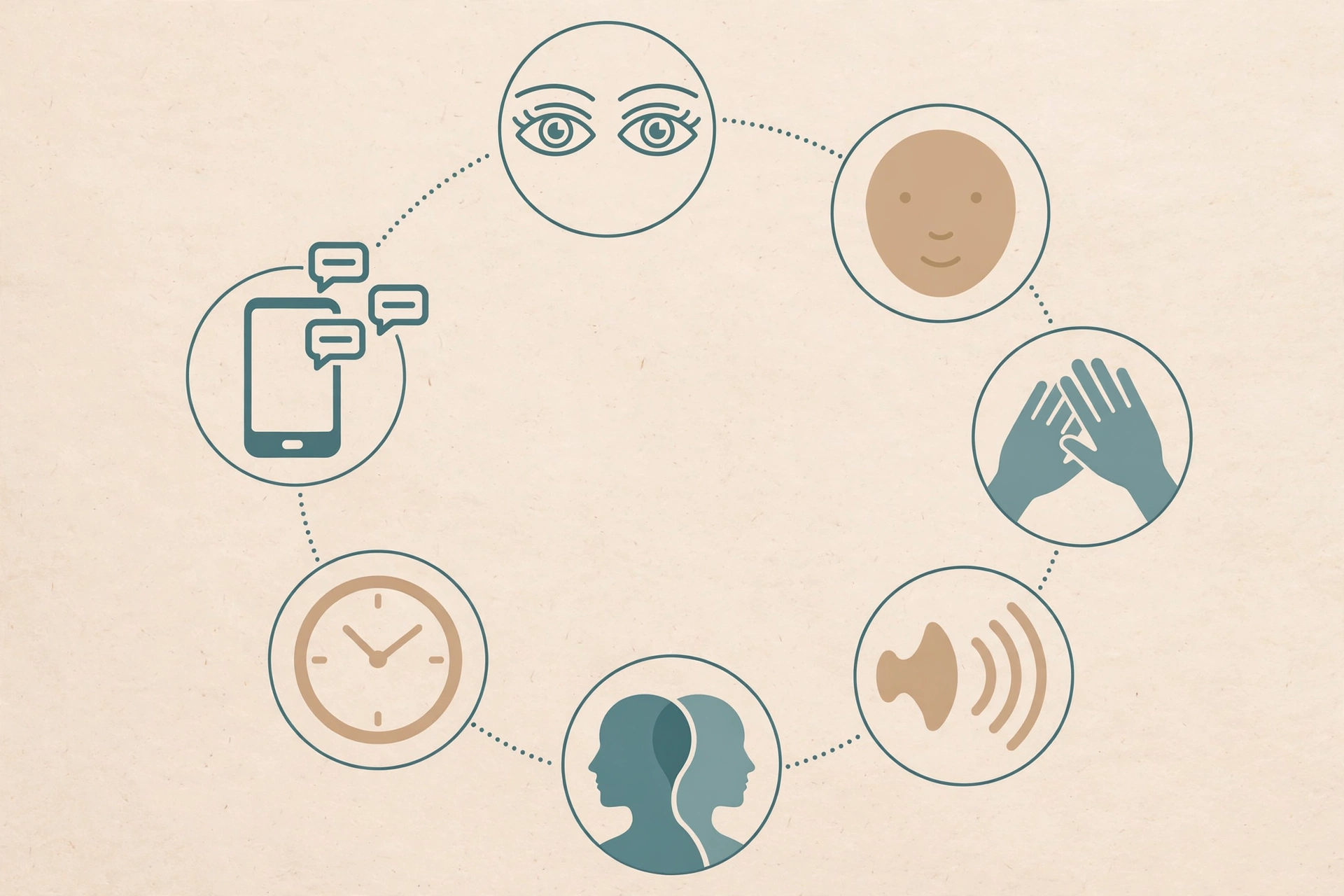
Nonverbal cues in relationships are everything you communicate without words: posture, gestures, facial expressions, eye behavior, tone and pace of voice, physical distance, touch, and even how you use time. Communication researchers organize these into formal channels with Greek-derived names — kinesics (body movement), oculesics (eye behavior), vocalics or paralanguage (voice qualities), proxemics (use of space), haptics (touch), and chronemics (use of time).
Why does this matter in a romantic partnership? Because partners read each other constantly. When your words say one thing and your nonverbal signals say another, your partner almost always trusts the nonverbal version. That mismatch — called incongruence — is one of the most common hidden causes of couple conflict, which is why learning to spot nonverbal cues in relationships early matters so much.
The famous “55%” figure — explained correctly
You may have seen the claim that 93% of communication is nonverbal. The real figure comes from psychologist Albert Mehrabian’s 1967 research, and it is widely misquoted. The 7-38-55 rule — 7% words, 38% tone, 55% body language — applies specifically to the communication of feelings and attitudes when words and nonverbal signals conflict, not to all communication. It still tells us something important: when someone says “I love you” in a flat, irritated tone with a turned-away body, the feeling message lands as “I am annoyed with you.” The words lose.
The 7 Channels: Your Complete Nonverbal Cues in Relationships Map
Here is how each channel shows up in daily couple life, and how to read these nonverbal cues in relationships day to day:
| Channel | What it is | Warm, connected examples | Distant or tense examples |
|---|---|---|---|
| Facial expressions | The emotional display on the face | Duchenne smile (eyes crinkle), soft relaxed brow | Tight jaw, pressed lips, eye-rolls, one-sided mouth pulls |
| Oculesics (eye behavior) | Gaze, eye contact, looking patterns | Sustained mutual gaze, soft eyes during listening | Consistent gaze avoidance, glancing at the phone mid-conversation |
| Kinesics (body language) | Posture, gestures, orientation | Body turned toward you, leaning in, postural mirroring | Crossed arms, turned-away torso, head shaking, agitated fidgeting |
| Vocalics (tone of voice) | Pitch, pace, volume, rhythm — not the words | Soft, unhurried, warm tone even in disagreement | Shrill or clipped delivery, sighing, rapid-fire impatient speech |
| Haptics (touch) | Physical contact | Hand on the knee, arm around the shoulder, lingering hug | Pulled-away hand, flinching, absence of once-routine touch |
| Proxemics (space) | Physical distance and orientation | Sitting close, choosing the same couch cushion | Maximizing distance, always a room away, sleeping turned away |
| Chronemics (time) | How time is spent and punctuality | Putting the phone down when you talk, showing up on time | Chronically late for couple time, always “too busy” |
The key insight competitors often miss: no single cue is a verdict. A crossed-arm posture during a cold evening might mean comfort, not defensiveness. Always read clusters of cues in context, not isolated gestures.

How to Read the 7 Channels: A Practical Field Guide
Reading nonverbal cues in relationships well is a three-step habit: notice, cluster, and check.
1. Notice — tune your attention
Start by simply watching during ordinary moments, not only during arguments. Research on couples consistently finds that happy partners spend more time in mutual gaze and show more synchronous body language. Try this: during your next dinner conversation, notice three things — where your partner’s body is oriented, what their face does when you speak, and the pace of their voice. That alone trains your attention.
If eye contact feels effortful, a guided eye-gazing exercise can rebuild comfortable mutual gaze gradually and safely.
2. Cluster — look for patterns, not moments
One eye-roll during a long stressful week means little. But an eye-roll plus a turned-away body plus a clipped tone plus no touch for three days is a pattern worth taking seriously. Communication scientists call this the “baseline plus deviation” method: learn your partner’s normal nonverbal baseline, then notice meaningful deviations from it. Someone who is normally animated and goes flat is telling you something — and someone who is normally reserved and starts leaning in is telling you something too.
3. Check — ask, don’t assume
This is the step most articles skip, and it’s the most important. After noticing a cluster, translate it into a gentle question rather than an accusation. Compare:
- Accusation: “You clearly don’t care — you won’t even look at me.”
- Curious check: “I notice you’ve been quiet and turned away since we started talking about the budget. Are you feeling overwhelmed, or is something else going on?”
The second script names the observed cues without interpreting them as fact, and offers your partner a way to correct your reading. This is the difference between reading cues skillfully and weaponizing them.
When Words and Body Disagree: Reading Incongruence
Incongruence — when someone’s words say one thing and their body says another — is the single most useful thing to learn to read. A partner who says “it’s no big deal” while gripping their coffee cup and speaking through clenched teeth is not actually fine with the situation. Incongruence usually signals one of three things:
- Unspoken emotion: they feel something they haven’t named yet, even to themselves.
- Conflict avoidance: they want to keep the peace but their body leaks the stress.
- Testing safety: they’re checking whether it’s safe to be honest before committing to the words.
The constructive response is to make the conversation safer, not to win the “I caught you” moment. A useful script: “Your words say you’re okay, but you seem tense to me. You don’t have to talk about it right now — I just want you to know I notice, and I’m here when you’re ready.” This respects their pace while signaling that their nonverbal honesty landed.
Note the parallel skill: how you orient your own body matters just as much as how you read theirs. The difference between active listening and defensive listening is largely a nonverbal one — open posture, eye contact, and an unhurried voice versus crossed arms and a clipped tone.
The Science You Didn’t Get Elsewhere: Microexpressions, Mirroring, and Flooding
Microexpressions: real, brief, and easy to overclaim
Psychologist Paul Ekman’s research identified microexpressions — involuntary facial expressions that flash across the face in under half a second and can reveal concealed emotion. They are real, but the popular “human lie detector” framing is overstated. What microexpressions genuinely offer couples is a heads-up: a flicker of sadness before the neutral mask returns might mean “there’s more they haven’t said yet.” Treat it as an invitation to ask gently, not as proof of deception.
Mirroring and synchrony
When two people are connected, they unconsciously mirror each other’s posture, gestures, and even breathing rhythm — a phenomenon linked to rapport and empathy. Researchers have found that behavioral synchrony predicts relationship satisfaction. The practical takeaway works in reverse too: deliberately matching your partner’s relaxed posture and breathing pace during a tense conversation can help you both settle. It is the body leading the mind.
Physiological flooding and stonewalling
One of the most important findings in relationship science comes from the Gottman Institute’s laboratory research: during conflict, one partner’s nervous system can become so overwhelmed — heart rate above 100 beats per minute, adrenaline surging — that they literally cannot process information. Gottman calls this diffuse physiological arousal, or “flooding.” The flooded partner shuts down, goes silent, and stares ahead. To the other partner, this looks like cold withdrawal. To the flooded partner’s body, it is self-protection.
Recognizing the nonverbal signature of flooding — blank stare, rigid posture, one-word answers — changes everything, because the correct response is not “talk to me right now” but a structured break. Learn more about how flooding leads to stonewalling, and how couples set conversational boundaries instead from the Gottman Institute’s own research summary.
Digital Nonverbal Cues: Reading Texts, Voice Notes, and Read Receipts
Most existing articles treat nonverbal communication as if couples only talk face to face. But a huge share of modern couple communication happens through screens, and digital behavior has become a genuine nonverbal channel of its own:
- Response latency: a partner who normally replies within the hour going silent for a day is the digital equivalent of turning their body away.
- Message texture: the shift from warm, emoji-sprinkled messages to terse one-liners carries the same weight as a tone-of-voice change.
- Read receipts and “online” presence: watching a partner read a message and not reply triggers the same threat response as being ignored in person.
- Voice notes and calls: choosing a voice note over text when something matters signals care; voice carries vocalics that text strips away.
Our deeper guide on how texting patterns shape relationships unpacks these signals further, and modern tools that help decode the tone of a text message can act as a second opinion when you’re unsure whether you’re reading too much into a dry reply.
The same cluster rule applies digitally: a single short reply means nothing; a pattern of short replies, longer latencies, and fewer voice notes is worth a curious check-in.
Common Misreads: Culture, Neurodivergence, and Context Filters
Competitor articles rarely mention this, but it is the most common source of nonverbal misreading in relationships: cues are not universal. Direct eye contact signals respect in many Western contexts and can feel confrontational in others. Some people naturally gesture little; some naturally speak flatly. A partner on the autism spectrum may avoid eye contact while listening with complete attention — reading that as disinterest would be exactly wrong.
Before interpreting any cue, run it through three filters:
- Baseline: is this unusual for this person, or is this just how they are?
- Context: are they exhausted, ill, stressed about work, or mid-migraine? Physiology overrides attitude.
- Culture and wiring: does their background or neurotype shape this behavior independently of their feelings about you?
When all three filters still point to a real signal, that is when you check in with the curious question — not before.
A 7-Day Practice: Getting Better at Reading Nonverbal Cues in Relationships
Reading nonverbal cues in relationships is a trainable skill. This one-week practice builds it deliberately:
Day 1 — Baseline. Spend one ordinary conversation just noticing. Write down your partner’s normal posture, gaze, and voice pace when they’re relaxed. This is your reference point.
Day 2 — Faces. During the day, notice three genuine Duchenne smiles (eyes involved) versus polite mouth-only smiles — in anyone, not just your partner. You’re calibrating your eye.
Day 3 — Tone audit. In one conversation, listen to how your partner speaks rather than what they say. Notice pace, pitch, and sighs. Journal one sentence about what the tone told you.
Day 4 — Your own body. Ask yourself mid-day: how am I sitting right now? What is my face doing? You can’t read others well while broadcasting tension yourself. Adjust to open posture deliberately and notice the effect on your mood.
Day 5 — One curious check. If you notice a cue cluster, use the gentle script from the incongruence section. One check, phrased with curiosity. Notice how your partner responds to being noticed.
Day 6 — Digital scan. Review the week’s texting: latencies, message warmth, emoji use. Any pattern shifts? If yes, mention one observation lightly — not as an accusation.
Day 7 — Share and compare. Tell your partner what you’ve been practicing and ask them what they’ve noticed about your nonverbal cues. Making the practice mutual removes any hint of surveillance and turns it into connection. Pairing this with regular emotional check-ins locks in the habit long-term.
Frequently Asked Questions
Are nonverbal cues in relationships more reliable than words?
Not always — but when words and body conflict, the body usually carries the emotional truth. Mehrabian’s research showed that in messages about feelings and attitudes, tone (38%) and body language (55%) outweigh the words themselves (7%). The wise approach: treat words as the stated position and nonverbal cues as the emotional weather around it, then check your reading with a question.
What are the most important nonverbal cues to watch for in a partner?
Eye behavior (sustained gaze versus chronic avoidance), facial warmth (genuine versus flat expressions), body orientation (turned toward you versus away), touch frequency and quality, and tone of voice. Changes in these five channels — especially when several shift together — are the strongest signals that something needs a conversation.
How can I tell if my partner is losing interest by reading nonverbal cues in relationships?
Look for sustained patterns, not single moments: disappearing “tie signs” like hand-holding, body consistently angled away, gaze avoidance, flat tone, and withdrawal from touch. These can indicate drifting interest, but they can also indicate depression, burnout, or stress — which is why you should ask with curiosity rather than conclude. If distance has been growing quietly for months, our guide on emotional distance in long-term relationships can help you name what’s happening.
Can you really read microexpressions in everyday relationships?
To a limited degree. Microexpressions are genuine brief facial flashes studied by Paul Ekman, but reading them reliably takes training, and they reveal that an emotion occurred — not what caused it. In relationships, treat a fleeting expression as a prompt to ask a gentle question, never as proof of what your partner feels or whether they’re being honest.
What should I do when my partner’s words and body language don’t match?
Name what you observe without interpreting it: “You say you’re fine, but you seem tense.” Then create safety rather than pressure: “You don’t have to talk about it now — I’m here when you’re ready.” Avoid the gotcha approach; incongruence usually means unspoken emotion or conflict avoidance, and pressure makes both worse.
Do texting habits count as nonverbal cues in relationships?
Yes — researchers increasingly treat digital behavior as a nonverbal channel. Response time, message length and warmth, emoji use, voice notes versus text, and read-receipt patterns all carry relational meaning, the same way tone of voice does. Read them as clusters and in context, just like face-to-face cues.
How do I improve my own nonverbal communication with my partner?
Start with the channels you control: put the phone down and turn your body toward them when they speak, maintain soft eye contact, unclench your jaw and shoulders, and slow your voice when tension rises. Small deliberate changes — an open posture, a warm tone, a hand on the arm — reliably increase your partner’s sense of being heard.
Conclusion: The Quiet Language That Shapes Every Relationship
Mastering nonverbal cues in relationships is not about becoming a human lie detector or analyzing your partner’s every gesture. It is about attention: noticing the cluster of signals around the words, filtering them through baseline and context, and turning what you notice into curious, kind questions. Couples who read each other well don’t avoid conflict — they catch it while it’s still small, in a turned-away shoulder or a flattened tone, before it becomes a slammed door.
Start this week with the 7-day practice above. Pay attention to the eyes, the body, the tone, the touch, and yes, the texting patterns. And when the cues and the words disagree, trust the body enough to ask — and trust your partner enough to listen to the answer.
Disclaimer: This article is for educational purposes only and is not a substitute for professional therapy, counseling, or medical advice. Reading nonverbal cues can support communication, but it cannot diagnose relationship problems or mental health conditions. If communication difficulties are persistent or distressing, consider consulting a qualified couples therapist or counselor.




One Comment