
The Linguistics of Conflict: How Word Choice Shapes Fights
The next time a fight starts, notice which words fire first. Not the topic — the bills, the dishes, the forgotten errand — but the actual words. “You never listen.” “I feel ignored when this happens.” Same grievance, same two people, same evening. Yet one sentence reliably opens a conversation and the other reliably opens a war. That difference is what researchers call the linguistics of conflict in couples: the study of how pronouns, verb choices, absolutes, and tone shape whether a disagreement heals the relationship or wounds it.
This is not about policing every syllable or speaking in therapy jargon at the dinner table. It is about a small set of well-documented language patterns — measured in university laboratories, transcribed from thousands of recorded arguments, and linked to outcomes as concrete as heart rate, stress hormones, and marital satisfaction. Once you can hear these patterns, you can change them. And the research suggests changing them changes the fight itself.
The Linguistics of Conflict for Couples: Pronouns as Teamwork Signals
The most studied finding in this field comes from a UC Berkeley project led by psychologist Robert Levenson and researcher Benjamin Seider, published in Psychology and Aging. The team re-analyzed videotaped 15-minute conflict conversations from 154 middle-aged and older couples (data originally collected in 1989–1990 as part of a long-term marital study), counting every pronoun while simultaneously tracking physiological signs of stress: heart rate, body temperature, and sweating.
Understanding linguistics of conflict is essential for couples who want to break destructive patterns and build healthier communication.
The pattern was striking. Couples who framed disagreements in first-person plural — “we,” “our,” “us” — behaved more positively toward one another (more affection, less anger) and showed lower physiological stress during the disagreement. Couples who emphasized separateness — “I,” “me,” “you” — were less satisfied in their marriages, and their bodies stayed more agitated while arguing. The effect was strongest in older couples, whose heavy use of “separateness” language tracked most tightly with unhappy marriages. As Seider summarized the researchers’ interpretation, “we” language appears to help partners realign during conflict — to see themselves as teammates facing a shared problem rather than adversaries trading charges.
Two caveats matter. First, the study found that “we” language was tied to behavior and stress during the conflict conversation, and researchers cautioned that it may reflect in-the-moment emotional regulation rather than overall relationship happiness. Second, older couples used more “we” language than middle-aged couples, suggesting shared identity grows as partners accumulate joint history — which means younger couples cannot simply copy the vocabulary without doing the teamwork it expresses. Still, the broader literature on relational pronouns has repeatedly found that “we-ness” language is a strong indicator of satisfaction and emotional alignment in younger couples as well.
Experts emphasize that recognizing linguistics of conflict early gives couples the best chance to change course before resentment builds.
The practical takeaway is modest but powerful: during a disagreement, notice your own pronoun ratio. “We have a problem with the budget” lands differently than “You are terrible with money.” The first sentence recruits your partner as an ally; the second recruits them as a defendant.
“You Always” vs. “I Feel”: The You-Statement Problem
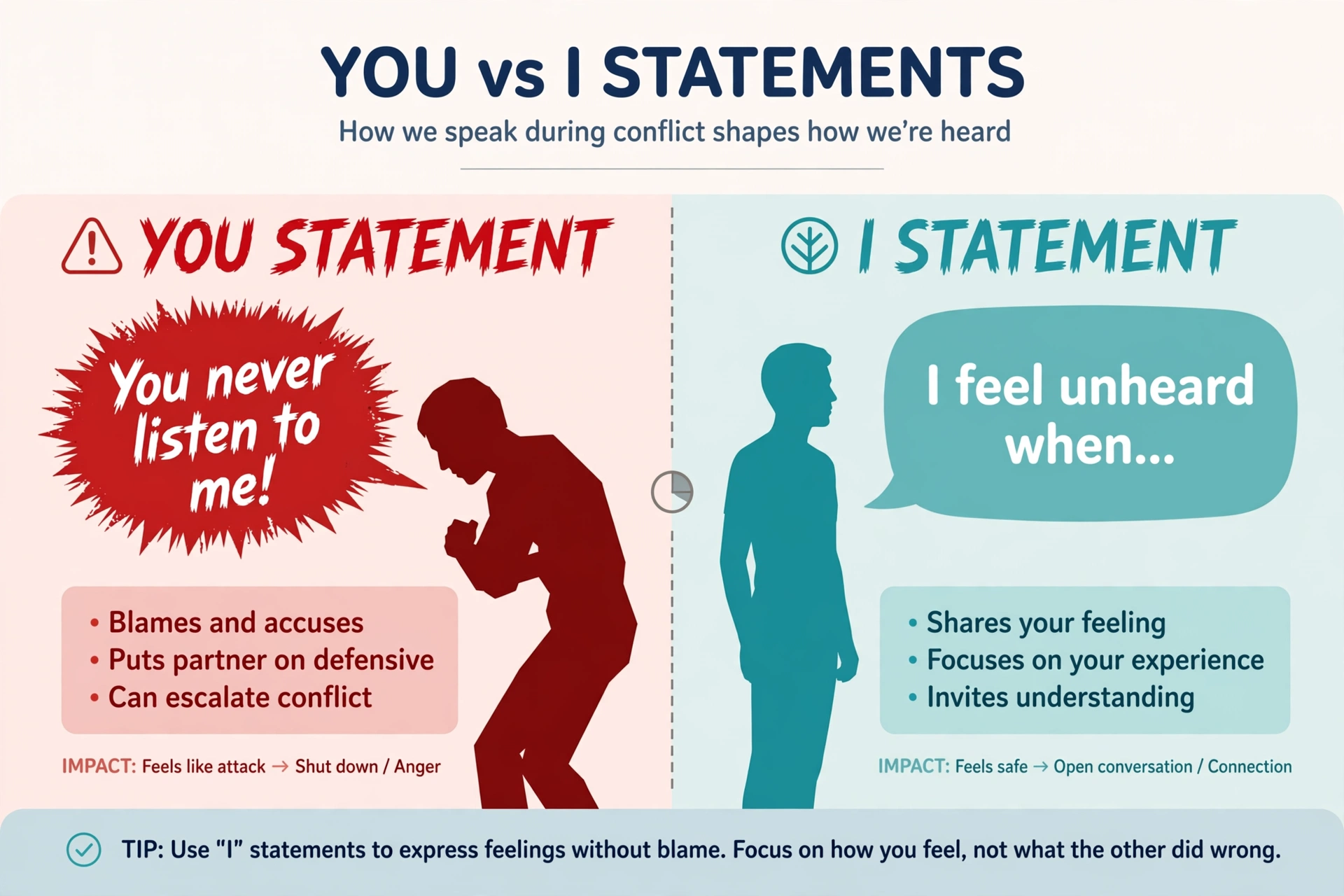
Every couples therapist knows the classic “you statement”: a sentence that begins with an accusation about the partner’s character and ends with a courtroom verdict. “You never listen to me.” “You are so selfish.” Linguistically, you-statements do two things at once: they assign a fixed trait (“you are”) and they erase the specific behavior that triggered the complaint. The partner no longer hears “something went wrong Tuesday”; they hear “I am a defective person.” Defensiveness follows almost automatically — and defensiveness, as we will see, is one of the most corrosive patterns in conflict.
Experts emphasize that recognizing linguistics of conflict early gives couples the best chance to change course before resentment builds.
The alternative is the “I statement,” and its structure matters more than its exact wording. A functional I-statement contains three parts: the feeling (“I feel unheard”), the specific situation (“when plans change without me”), and the need or request (“I need us to check in before rearranging the weekend”). Compare:
- You-statement: “You never listen when I talk about things that matter.” (global claim, character verdict)
- I-statement: “I feel dismissed when I bring up the school schedule and the topic gets changed. I need twenty minutes of your attention after dinner.” (specific situation, named feeling, concrete request)
The second version still raises the complaint — nothing is swallowed or softened into meaninglessness. But it gives the partner something actionable instead of something to defend against. For a fuller breakdown of the shift from character attacks to behavioral complaints, the Gottman Institute’s explanation of criticism versus complaint walks through the distinction with additional examples.
Experts emphasize that recognizing linguistics of conflict early gives couples the best chance to change course before resentment builds.
Absolutes and Intensifiers: The Small Words That Detonate Big Fights
Some of the most destructive words in any fight are tiny: “always,” “never,” “everything,” “nothing.” Linguists call them absolutes — universal quantifiers that assert a claim about every instance. And because no partner literally always ignores you or never helps around the house, absolutes are almost always factually wrong. That makes them uniquely provocative: the accused partner’s brain instantly goes to the counter-examples. “That’s not true — I called your mother on her birthday!” The argument then stops being about the original issue and becomes a courtroom debate about the accuracy of the word “always.” The topic is lost; the vocabulary won.
Intensifiers work the same way from the emotional side. Words like “disgusting,” “pathetic,” “insane,” “ridiculous” do not describe a behavior — they grade the partner’s character on a moral scale. A useful practice is the “swap drill”: take the sentence you are about to say, identify the absolute or intensifier, and replace it with the specific fact.
| Instead of this… | Try the specific version… |
|---|---|
| “You never do the dishes.” | “The dishes have sat for three nights this week.” |
| “You always take your sister’s side.” | “In yesterday’s call, you agreed with her before I’d finished.” |
| “This is ridiculous.” | “This feels unfair to me, and here’s why…” |
| “You nothing without me.” | “I feel our contributions aren’t being acknowledged.” |
The replacement sentences feel oddly flat — and that is exactly the point. Flat sentences do not trigger the partner’s defense systems, which leaves both of you with cognitive resources to solve the actual problem. As an exercise, keep a small private log for one week: each time you catch an “always” or “never” leaving your mouth mid-argument, jot it down later and rewrite the sentence with the specific fact. Most couples discover the absolute was standing in for an unexpressed need — usually for attention, respect, or predictability.
The Four Horsemen, Linguistically
John Gottman’s decades of laboratory observation of couples identified four communication patterns that reliably predict relationship breakdown: criticism, contempt, defensiveness, and stonewalling. Each one is, at bottom, a language habit — which means each one has a linguistic antidote. Readers new to the model may want to start with a comprehensive overview of the Gottman Method’s conflict research before diving into the word-level details below.
| Horseman | What it sounds like | The antidote language |
|---|---|---|
| Criticism — attacking character instead of raising a complaint | “What’s wrong with you? You’re so careless.” | Gentle start-up: “I feel anxious when the budget is exceeded; I need us to agree on a limit.” |
| Contempt — disgust or superiority: mockery, name-calling, sneering, eye-rolling, hostile humor | “Ugh, genius idea. As usual.” / “You’re such a child.” | A culture of appreciation: regularly voicing specific admiration and fondness, especially outside conflict. |
| Defensiveness — counter-attacking, making excuses, playing the victim, reversing blame | “Well, YOU did the same thing last month!” / “Yes, but…” | Taking responsibility for a piece of the problem: “You’re right that I was late. Here’s what happened.” |
| Stonewalling — the silent one: monosyllables, looking away, leaving, going numb | Silence, sighing, “Whatever,” physically leaving | Named timeout: “I’m flooded and shutting down. I need 20 minutes, and I’ll be back at 7:30.” |
Note that stonewalling deserves a linguistic note of its own: silence is a message, and most partners decode it as “you don’t matter enough to answer.” Gottman’s research found stonewalling usually erupts when a person is physiologically flooded — heart rate over roughly 100 beats per minute, stress hormones surging — a state in which listening and reasoning are biologically impaired. The antidote is therefore not “talk through it” but a structured break: name it, soothe the body (a walk, deep breathing, twenty-plus minutes of genuine down-regulation), and return at a stated time. The stated return time is itself a piece of language that converts abandonment into a pause.
Comparing these patterns across different conflict-resolution paradigms shows how consistently the same insight appears: repair starts when the language moves from verdicts about the person to descriptions of the problem.
How a Fight Begins Predicts How It Ends: The Language of Start-Up
Gottman’s lab quantified something couples sense intuitively: roughly 96 percent of the time, the way a conflict conversation begins predicts the way it ends. A harsh start-up — accusation, sarcasm, a raised voice, launching in the middle of another activity — puts both nervous systems on a defensive track that the rest of the conversation rarely recovers from. A softened start-up, by contrast, keeps the partner’s threat response quiet enough for listening to survive.
A softened start-up has three learnable components:
- Complain, don’t criticize. A complaint targets the situation (“The rent is late again and I’m worried”); a criticism targets the person (“You’re irresponsible with money”). Same issue, different subject of the sentence.
- Lead with “I,” not “you.” “I feel anxious about the bills” invites partnership. “You make me anxious” assigns fault and triggers defense.
- State a positive need, not a negative ban. “I need us to review the budget Sunday evening” gives your partner something to do. “Stop spending so much” only gives them something to stop being.
Timing and framing count as language too. “We need to talk” — the most feared four words in relationships — is a sentence that primes dread before a single grievance is stated. Try instead: “There’s something on my mind and I’d like 15 minutes tonight to talk it through — nothing terrible.” The informational content is identical; the emotional envelope is entirely different.
Repair Language: Words That Stop a Fight in Its Tracks
If start-up language decides how a fight opens, repair language decides whether it closes. Gottman’s team defined a “repair attempt” as any statement or action that prevents negativity from escalating — a small bid to reconnect mid-conflict. Successful couples are not those who never fight; they are those whose repair attempts land. And repair attempts are, overwhelmingly, made of words:
- The ownership fragment: “You’re right about that part.” Conceding even a small slice of a complaint deflates defensiveness instantly.
- The humor release: A shared joke or a gentle self-deprecating line (“I hear myself and I sound like my mother”) breaks the tension loop — provided it never mocks the partner.
- The touch + words combo: Reaching for a hand while saying “I don’t want to fight about this” signals that the relationship is still the priority.
- The meta-comment: “We’re arguing about how we’re arguing now” names the loop from the outside and invites both partners to step out of it together.
Watch one grammatical hinge in particular: the word “but.” “You’re right, but here’s the problem” erases everything before it — the listener hears the agreement evaporate. Training yourself to say “You’re right, and here’s what worries me” preserves both halves of the sentence and keeps two truths alive at once.
Repair language also includes the apology that follows a bad fight — which deserves its own study. A genuine apology in a relationship has a linguistic anatomy (acknowledgment, responsibility, remorse, repair plan) that empty “sorry, whatever” lacks, and learning that anatomy is part of the same vocabulary.

Listening for the Shift: Pronoun Drift as an Early Warning
Here is an advanced skill the laboratory research points toward: track pronoun drift in real time. Arguments rarely start with “you always.” They usually start near neutral — “Hey, the trash didn’t go out” — and then, as arousal rises, the language drifts: “I asked you” → “You never” → “You are so…” → silence. Each step is a small linguistic signal that the emotional temperature has risen one notch before the shouting begins.
Couples who learn to hear the drift can interrupt it. A simple agreed phrase — “we’re drifting” or “language check” — functions as a shared alarm that neither partner has to earn by getting loud. The rule, agreed in advance during a calm moment: when either person calls the drift, both pause, each names one feeling in one sentence (“I’m feeling cornered”; “I’m feeling unheard”), and the conversation restarts with the specific complaint. This is the same principle therapists teach through active listening techniques: listening works best when it is switched on deliberately, before defensiveness has taken the wheel.
Multilingual couples face an added layer worth naming: research on bilingual couples’ conflict (including studies of Urdu- and Punjabi-speaking partners in Pakistan) has found that switching languages mid-fight can itself escalate tension, because politeness strategies and emotional weight differ between a person’s languages. If you fight in a second language, agree in advance which language feels safest for hard conversations — and notice whether switching languages mid-argument is tracking a rising temperature.
A Seven-Day Conflict Vocabulary Practice
Insight without practice evaporates. This one-week plan turns the patterns above into habits. Pick one step per day; fifteen minutes is enough.
- Day 1 — Count your pronouns. After any disagreement, large or small, replay it mentally and count: how many sentences started with “you” versus “I” or “we”? No judgment — just data.
- Day 2 — Ban one absolute. For 24 hours, strike “always” and “never” from disagreements. When one slips out, pause and rephrase with the specific fact.
- Day 3 — Rewrite three sentences. Take three you-statements you have used recently and convert each to the three-part I-statement (feeling, situation, need).
- Day 4 — Practice the softened start-up. Raise one real but low-stakes complaint (“the laundry system”) using complain-not-criticize, “I” lead-in, and a positive need.
- Day 5 — Deploy one repair. Mid-disagreement, try one repair phrase from the list above. Note whether the temperature dropped.
- Day 6 — Notice the drift. During your next tense exchange, listen for the pronoun drift (we → I → you → silence) and call it out gently if it appears.
- Day 7 — Review together. Share what you each noticed. End with one sentence of appreciation each — the linguistic foundation repair attempts stand on.
Frequently Asked Questions
Can changing my word choice really change my relationship, or is that superficial?
It is not superficial, because the words are not decoration on top of the conflict — they are part of the conflict’s machinery. Research shows that accusatory language reliably triggers defensiveness and physiological stress, which impair listening and problem-solving. Changing the language changes the nervous-system response, which changes what the conversation can accomplish. Words are levers, not wallpaper.
Is saying “we” instead of “you” just manipulative if I don’t feel like a team?
Forced “we” language that you do not mean will sound hollow, and partners detect insincerity quickly. The research finding is about authentic “we-ness” — a genuine sense of shared identity that shows up naturally in speech. If you cannot honestly say “we,” start smaller: describe the specific situation instead of the person. “The bills are late” is already less adversarial than “You’re irresponsible,” and honesty is preserved.
What if my partner uses harsh language but I do all the “right” wording?
One partner’s improved language genuinely helps — it reduces the other person’s defensiveness, which often de-escalates the whole exchange. But it cannot single-handedly fix a pattern where one partner consistently uses contempt or stonewalling. If harsh language is chronic and one-sided despite your efforts, that is a signal to seek couples counseling, not a sign your vocabulary failed.
Do “I statements” actually work, or do they sound robotic?
They work when they follow the three-part structure (feeling, specific situation, need) rather than the parody version (“I feel that you are a jerk”). Early attempts often feel robotic because the skill is new; with practice, the structure fades into natural speech. Most people report it stops feeling forced after two to three weeks of deliberate use.
Should we avoid fighting altogether and just use these techniques?
No — avoiding conflict is its own problem. Unresolved issues do not disappear; they accumulate into resentment, which research links to the contempt pattern that predicts relationship breakdown most strongly. The goal is not fewer disagreements but better ones: disagreements that stay specific, stay respectful, and actually resolve.
What about tone of voice — does wording matter if I say it angrily?
Wording and tone work together, and tone can override wording: “I feel SO unheard” delivered with a sneer is contempt wearing an I-statement’s clothes. If your voice is hot, the words cannot do their job — that is the moment for a structured break (the stonewalling antidote: name it, soothe, return at a stated time) rather than better sentences.
Is there any evidence these patterns apply across cultures?
The core findings — pronoun effects, the damage of contempt and criticism, the value of repair — have been replicated across Western samples, and parallel research exists in other contexts, including studies of bilingual couples’ politeness strategies during marital conflict. Cultures differ in directness norms (some prize blunt complaint, others prize indirect harmony), so the form of a softened start-up should be adapted to your cultural context while the underlying principle — attack the problem, not the person — holds broadly. Guidance from the American Psychological Association on marriage and relationships provides a culturally grounded starting point for further reading.
Conclusion: The Fight Is Won in the Wording
Every couple fights; the research has never suggested otherwise. What the linguistics of conflict in couples reveals is that fights are not won by the partner with the better argument, but shaped — often decided — by the partner with the better words. Pronouns that recruit a teammate instead of a defendant. Complaints aimed at situations instead of character verdicts. Absolutes swapped for specifics, “but” swapped for “and,” silence swapped for a named pause with a promised return. None of this requires a perfect temperament or a conflict-free home. It requires only that, in the heat of the next disagreement, you hear your own sentence before your partner has to answer it — and choose the version that leaves the relationship standing.
Disclaimer: This article is for educational purposes only and is not a substitute for professional therapy, counseling, or medical advice. It does not diagnose any individual or relationship condition. If conflict in your relationship feels overwhelming, persistent, or unsafe, please consult a qualified couples therapist or counselor in your area.