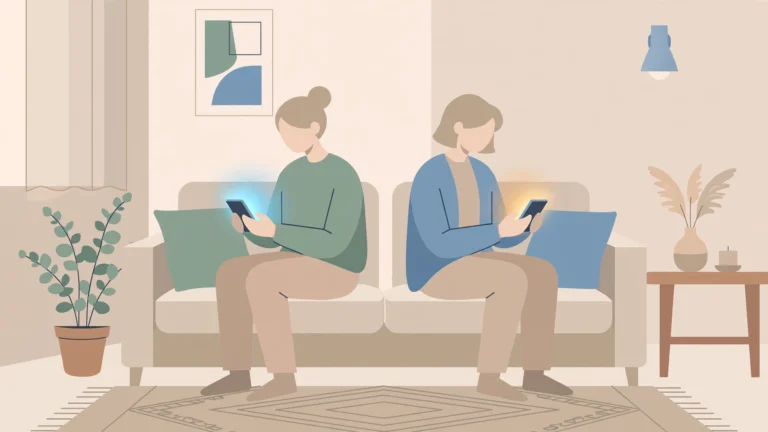
Microexpressions in Couples: What Faces Reveal
Your partner says “I’m fine,” but something in their eyes just flashed — a flicker you couldn’t name, gone before the sentence ended. Sixty seconds later the evening feels tense and you have no idea why. That flicker has a name: a micro-expression, an involuntary flash of real emotion that lasts less than a quarter of a second. Learning how microexpressions in couples communication work can transform how partners read each other — not as mind-reading, but as one more doorway into honest, kinder conversation.
This guide explains what faces reveal, what the science actually supports, how to spot these signals without turning your relationship into a surveillance project, and the exact words to use when you think you’ve seen something.
What microexpressions Actually Are (and Why Couples Are the Perfect Laboratory)
microexpressions are extremely brief facial expressions — most researchers place them between 1/15 and 1/25 of a second — that leak the emotions a person is trying to hide or hasn’t fully admitted to themselves. They became a serious subject of study in 1966, when researchers Haggard and Isaacs noticed patients in psychotherapy films showing momentary flashes of feelings they were suppressing or repressing. The pioneering emotion researcher Paul Ekman then showed these expressions are biologically encoded, not culturally learned: the same facial signals appear in preliterate communities and in modern cities alike.
Long-term relationships are where microexpressions matter most. Couples spend thousands of hours face to face, and the human brain’s threat-detection system is tuned to scan a partner’s face unconsciously. Research on couples has repeatedly found that partners register each other’s micro-signals — a flash of contempt, a tightened jaw, an eye-roll that happens in an instant — without realizing it, and that these unnoticed signals quietly steer the emotional climate of the household. A therapist observing a couple face to face, eye to eye, can watch this happen in real time: partners constantly signal how they truly feel, and constantly misread each other.
That misreading is the opportunity. Unlike strangers, partners have a baseline: you know your partner’s normal face. A deviation from that baseline — however brief — is information, and it arrives long before words do.
The Seven Universal Facial Expressions Every Partner Should Know
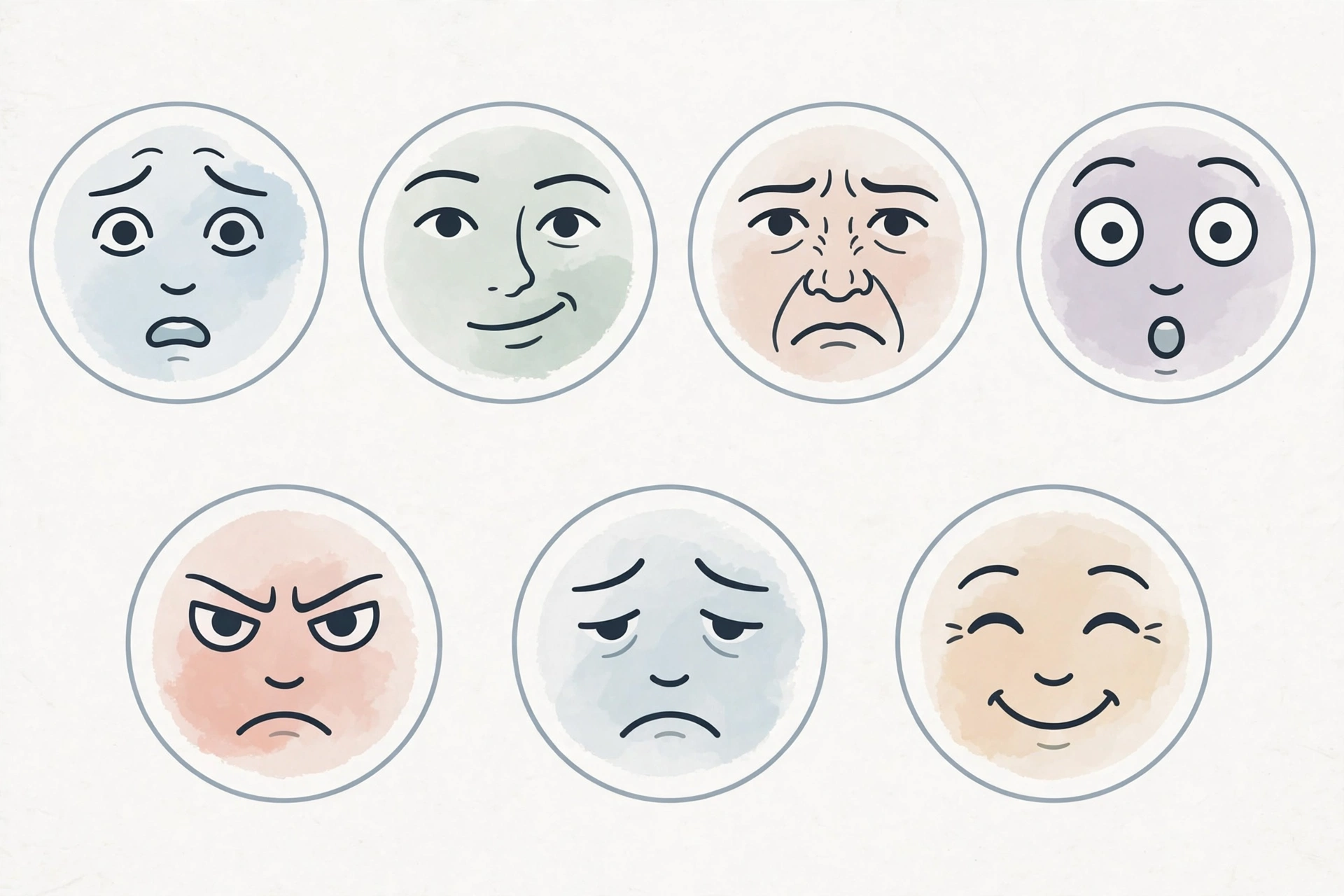
Ekman and his collaborator Wallace Friesen identified seven emotions with universal facial signals. Here is what each looks like at full expression, and the subtler micro-expression version you are most likely to catch in a partner:
| Emotion | Full-face signal | What the fleeting version looks like |
|---|---|---|
| Anger | Brows lowered and drawn together, eyes hard, lips pressed | A fast tightening of the lips or a downward flash of the brows |
| Contempt | One corner of the mouth pulled up and back (asymmetric) | A unilateral lip lift or half eye-roll — the single most corrosive signal between partners |
| Disgust | Nose wrinkled, upper lip raised | A quick wrinkle at the bridge of the nose or a nostril flare |
| Fear | Brows raised and drawn together, upper eyelids lifted | A brief widening of the eyes or a quick brow lift that vanishes |
| Sadness | Inner corners of the eyebrows raised, eyelids droop | A momentary sag of the eyelids or a slight downturn at the mouth corners |
| Surprise | Brows raised, eyes wide, jaw drops | Fast brow raise and eye widening — neutral or positive, unlike fear |
| Happiness | Crinkling around the eyes (the “Duchenne” smile), raised cheeks | Genuine smiles involve the eye muscles; a mouth-only flash usually means the feeling is performed |
Two of these deserve special attention in relationships. Contempt — that asymmetric smirk or eye-roll — is the facial signal most strongly associated with relationship breakdown in the research literature. Disgust matters too: a fleeting nose-wrinkle while your partner talks about something they value can register as rejection, even when neither of you consciously noticed it.
What the Research Says: Gottman’s Couples Lab
John Gottman famously filmed couples discussing conflict and then analyzed the footage frame by frame — essentially watching microexpressions unfold in slow motion. His team found that the small, involuntary signals partners exchange during disagreement predicted, with startling accuracy, whether a relationship would last. The destructive patterns he identified — criticism, defensiveness, contempt, and stonewalling, the “Four Horsemen” — all have visible micro-expression signatures, particularly contempt’s unmistakable half-smile and the facial withdrawal of stonewalling.
One consistent finding stands out: troubled couples interact fast. They flash contempt and escalate in an instant, with no pause between stimulus and reaction. Healthier couples are slower — they notice, they hesitate, they repair. The speed of the interaction, not just its content, is the difference. This is why the skill below matters so much: it is not about becoming a human lie detector; it is about slowing the exchange down enough for the real feeling to surface.
Other clinical work supports the broader point. Physicians trained to recognize patients’ fleeting expressions were rated as significantly more empathetic — suggesting that face-reading, at its best, is experienced by the other person as being understood. For couples, you can build your face-reading skills alongside the Gottman Method’s evidence-based approach to relationship repair, which uses these same observations in therapy.
Why microexpressions in Couples Communication Go Unnoticed
If faces are broadcasting constantly, why do partners miss so much? Four barriers show up again and again:
1. We listen with our own agenda
When your partner speaks, your brain is usually rehearsing your reply. That self-focus pulls visual attention away from the face. Partners who practice active listening instead of defensive listening consistently report noticing more of what their partner’s face is doing — because they finally have the bandwidth to look.
2. Stress narrows the visual field
Under tension, attention literally tunnels. A partner who is flooded — heart racing, thoughts looping — is physiologically less capable of registering subtle facial cues, and also more likely to misread neutral expressions as hostile. Calm bodies read faces better.
3. Familiarity breeds assumptions
Long-term partners often “see” the face they expect rather than the one in front of them. “He’s always annoyed when he gets home” becomes a self-fulfilling filter: you stop checking the actual expression and respond to the predicted one.
4. Screens replaced faces
Much of modern couple communication happens over text, where faces are absent entirely. The facial vocabulary atrophies with disuse — one more reason to protect face-to-face conversation time. Learning the broader landscape of nonverbal cues in relationships helps rebuild that vocabulary.
How to Read Your Partner’s Face Without Turning It Into Surveillance
Here is the crucial distinction: reading faces well is a tool for empathy, not interrogation. The goal is never “I caught you” — it is “I think I saw something, and I care enough to ask.” Follow these principles:
- Use the baseline you already have. You don’t need to memorize a textbook. You need to notice deviations from your partner’s normal resting face — the lip press that isn’t usually there, the eye-crinkle that usually is.
- Slow the moment down. When you catch a flicker mid-conversation, pause before responding. A simple “hang on, let me take a second” buys the time your nervous system needs to process what you saw.
- Treat the signal as a hypothesis, not a verdict. A flash of disgust might mean “I disagree with this idea,” not “I’m disgusted by you.” Faces tell you an emotion fired; they don’t tell you its cause.
- Ask gently, describe neutrally. “Your brow just tightened — are you okay with this?” works. “You just made a disgusted face at me” does not.
- Share the skill with your partner. One-sided face-reading creates a power imbalance. Practicing together turns it into a shared language rather than a weapon.

When Face-Reading Goes Wrong: 5 Traps to Avoid
This is the part most articles on this topic skip. Micro-expression literacy has failure modes, and knowing them is what separates a helpful skill from a harmful one.
Trap 1: Treating every flicker as truth
A micro-expression reveals that an emotion fired, not that it represents the person’s settled judgment. A flash of fear when you raise your voice can mean surprise at the volume, not fear of you. Over-interpreting trains your partner to hide their face — the opposite of what you want.
Trap 2: The confirmation bias loop
If you believe your partner resents you, you will start “spotting” contempt everywhere. Studies on emotion perception show that expectations shape what we see in ambiguous faces. Check your own mood before trusting your reading: are you already upset? If yes, discount the reading accordingly.
Trap 3: Forgetting display rules and culture
Facial expressiveness varies enormously between people. Some partners grew up in families where emotions stayed behind a neutral mask; others wear every feeling openly. A quiet face is not necessarily a hidden one. Judge deviations from their baseline, never against some universal standard of expressiveness.
Trap 4: Overlooking neurodivergence and physiology
Autistic partners, people with certain mental health conditions, and anyone who is simply exhausted or ill may show atypical facial patterns. A flat affect during depression is not contempt. Fatigue mimics disdain. If your partner’s expressions have changed suddenly, consider health and stress first, relationship trouble second.
Trap 5: Using readings as ammunition
“Your face said you were lying” is a relationship-damaging sentence, even if you’re right. The moment face-reading becomes evidence in an argument, your partner’s brain classifies your attention as a threat — and threat narrows, hides, and distorts everything you were trying to see. Keep a set of de-escalation phrases for couples handy for the moments a reading tempts you toward confrontation.
The Read–Check–Respond Script: A Step-by-Step Method
Here is a concrete, repeatable sequence for the moment you catch something on your partner’s face:
- Read (2 seconds). Silently name what you saw to yourself: “Lip press, brow flash — something like frustration or worry.” Don’t act yet.
- Pause (5 seconds). Breathe. Let your own reaction settle. This is the hardest step and the most important one.
- Check (one gentle question). Describe the observation without accusation: “I might be wrong, but I noticed your expression change just now. Is something sitting uneasily with you?” The words “I might be wrong” do real work — they give your partner permission to correct you.
- Respond to the answer, not the face. Whatever they tell you becomes the truth you work with. If they say “I’m fine, just tired,” believe the words and soften the evening. If they open up, you have just used the skill exactly as intended.
- Note the pattern, not the incident. One lip press means nothing. The same lip press every time the in-laws are mentioned is data — and it is worth raising calmly later, not mid-moment.
Notice what this script does: it converts a private observation into a shared conversation. That conversion is the entire point. Face-reading that stays inside your head becomes anxiety; face-reading that becomes a gentle question becomes intimacy.
Practice Drills: Train Your Eye in 10 Minutes a Day
Face-reading improves with deliberate practice, just like any perceptual skill. Three drills, drawn from how researchers and therapists train the eye:
- The slow-motion drill. Watch a movie scene with the sound off at reduced speed and narrate the emotions crossing each character’s face. You are training the exact perception the fast pace of real conversation denies you.
- The baseline journal. For one week, jot down your partner’s resting face at three calm moments a day (one line each: “Tuesday morning: soft eyes, relaxed mouth”). When tension rises, compare. The contrast teaches you faster than any chart.
- The mirror pause. In a calm moment, try to produce each of the seven expressions yourself in a mirror — especially contempt, which most people have never seen on their own face. Recognizing the muscular feeling from the inside makes the outside reading almost automatic. Some couples formalize this kind of face-to-face practice with eye-gazing intimacy exercises, which build the same sustained facial attention in a warmer context.
A final note from the American Psychological Association’s coverage of emotion science: emotions are complex, multi-channel experiences, and faces are only one channel among many — voice, posture, and words all carry information. For a broader scientific overview of how emotions work, the APA’s emotion resources are a solid starting point. Pair what you see with what you hear, and never let a facial reading overrule a partner’s own words.
Frequently Asked Questions
Can microexpressions really reveal what a partner is hiding?
Partially. They can reveal that an emotion fired beneath a composed surface — but they cannot tell you the emotion’s cause, its target, or whether it reflects a settled feeling or a passing flicker. Treat what you see as an invitation to ask a gentle question, not as evidence of deception.
How long do microexpressions actually last?
Most researchers measure them at roughly 1/15 to 1/25 of a second — far shorter than a blink. That is why they are so hard to catch in real time, and why slowing the pace of a conversation (pausing, breathing, not rushing to reply) is the single most practical way to notice more of them.
Is it possible to learn to read microexpressions, or is it a natural talent?
It is learnable. Training programs used with law enforcement, medical professionals, and therapists show measurable improvement with practice — and physicians trained in facial-expression recognition were rated as more empathetic by their patients. Partners have a head start: your familiarity with your partner’s baseline face is an advantage no training program can give you.
What does it mean if I keep seeing contempt on my partner’s face?
Frequent contempt signals — the asymmetric smirk, the half eye-roll — are the facial pattern most strongly linked to relationship distress in Gottman’s research. One incident means little; a pattern is worth taking seriously. Read the Gottman Institute’s introduction to the Four Horsemen to understand the full picture, and consider couples counseling if the pattern persists despite your best efforts.
Should I tell my partner I’m watching their face?
Yes — and ideally, learn the skill together. Secret face-reading creates a power imbalance and breeds paranoia. Framed openly as “I want to get better at noticing how you’re really feeling so I can be there for you,” it becomes a shared project rather than surveillance.
Can micro-expression reading backfire?
It can, in the traps described above: confirmation bias, over-interpreting single flickers, ignoring culture and neurodivergence, and using readings as argument ammunition. The safeguard is the Read–Check–Respond script: observe silently, ask gently, and always let your partner’s words have the final say.
Do microexpressions work over video calls or in photos?
Less reliably. Video compression and latency smear the fastest flickers, and photos freeze a single frame that may catch a mid-blink or a transitional muscle movement rather than a genuine expression. In-person, face-to-face conversation remains the gold standard for this kind of reading.
When should a couple seek professional help about communication patterns?
For couples willing to practice, reading microexpressions gets easier quickly: start by memorizing the seven microexpressions above, then watch for microexpressions during calm conversations. Most partners find that spotting microexpressions becomes second nature within weeks — and that catching microexpressions early helps repair attempts land more gently.
If you notice a persistent pattern of contempt, stonewalling, or escalation — or if attempts to talk about what you’re seeing always end in fights — a licensed couples therapist can observe the interaction dynamics objectively and teach repair skills. Seeking help is a sign of taking the relationship seriously, not of failure.
The Bottom Line
microexpressions in couples communication are real, research-backed, and genuinely useful — but their power lies in humility, not certainty. A flicker on your partner’s face is not a verdict; it is a question mark with a pulse. The partners who benefit most from this skill are not the ones who become flawless face-readers. They are the ones who slow down, notice a little more, and turn “I saw something” into “I’m here — tell me more.” The face opens the door. The conversation is what walks through it.
Disclaimer: This article is educational only and is not a substitute for professional therapy, counseling, or medical advice. If you are experiencing persistent relationship distress, consult a qualified mental health professional or licensed couples therapist.