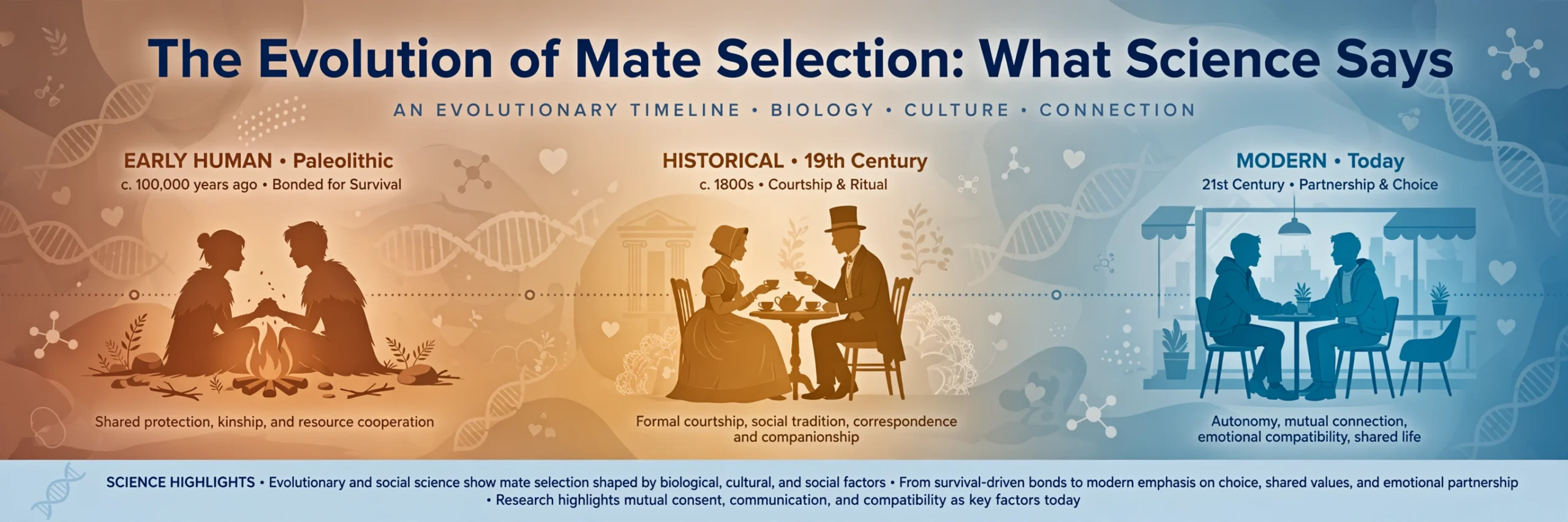
The Evolution of Mate Selection: What Science Says
Why do you feel an instant pull toward one stranger and nothing toward another? Why do kindness, confidence, and stability register as attractive across cultures, while cruelty and chronic instability rarely do? The evolution of mate selection offers one of the most researched — and most misunderstood — explanations science has for human attraction. This article walks through what researchers studying the evolution of mate selection actually know, where the science is settled, where it is fiercely debated, and what it practically means for how you date today.
Disclaimer: This article is educational only and is not a substitute for professional therapy, counseling, or medical advice. If relationship or mental-health concerns are affecting your life, consult a qualified professional.
Darwin’s Second Revolution: Sexual Selection
Most people know Charles Darwin for natural selection — survival of the fittest. But Darwin himself realized survival alone could not explain traits like the peacock’s extravagant tail, which makes its owner slower, louder, and easier for predators to spot. So in 1871 he proposed a second mechanism: sexual selection, in which some individuals reproduce more successfully simply because they are better at attracting mates.
Sexual selection comes in two flavors. Intersexual selection is mate choice itself: one sex preferring particular traits in the other, so those traits spread through generations. Intrasexual selection is competition within one sex — think of two men trying to outdo each other for a woman’s attention, or two women vying for social standing in a group. In humans, both forces operate together, shaping everything from our preferences to our courtship behaviors.
From an evolutionary perspective, the fundamental asymmetry is parental investment. Because pregnancy, breastfeeding, and child-rearing demand far more time and energy from women than conception demands from men, the two sexes faced different adaptive problems across human history. Women who could identify partners able and willing to invest in offspring — through resources, protection, and emotional commitment — left more descendants.
Men who could identify fertile partners and secure committed relationships left more descendants. That asymmetry is the seed of nearly every sex difference researchers of the evolution of mate selection study in mate preferences.
The Major Theories: Why We Want What We Want
Scientists have proposed several mechanisms for how the evolution of mate selection shaped our psychology. The leading theories are not mutually exclusive — each explains a different piece of the puzzle. Together, these theories show that the evolution of mate selection gave humans not a single instinct but a layered set of desires that still influence every swipe and first date.
1. Direct benefits: choosing a good partner, not good genes
The simplest theory says we prefer mates who give us something directly useful: food, shelter, protection, help raising children, emotional support, and social status. A partner who is kind, reliable, and industrious delivers tangible benefits regardless of their genes. This is why traits like warmth, trustworthiness, and work ethic rank at the very top of mate-preference lists in almost every culture studied — they predict how a partner will actually treat you and your family.
2. Indicator traits and costly signaling
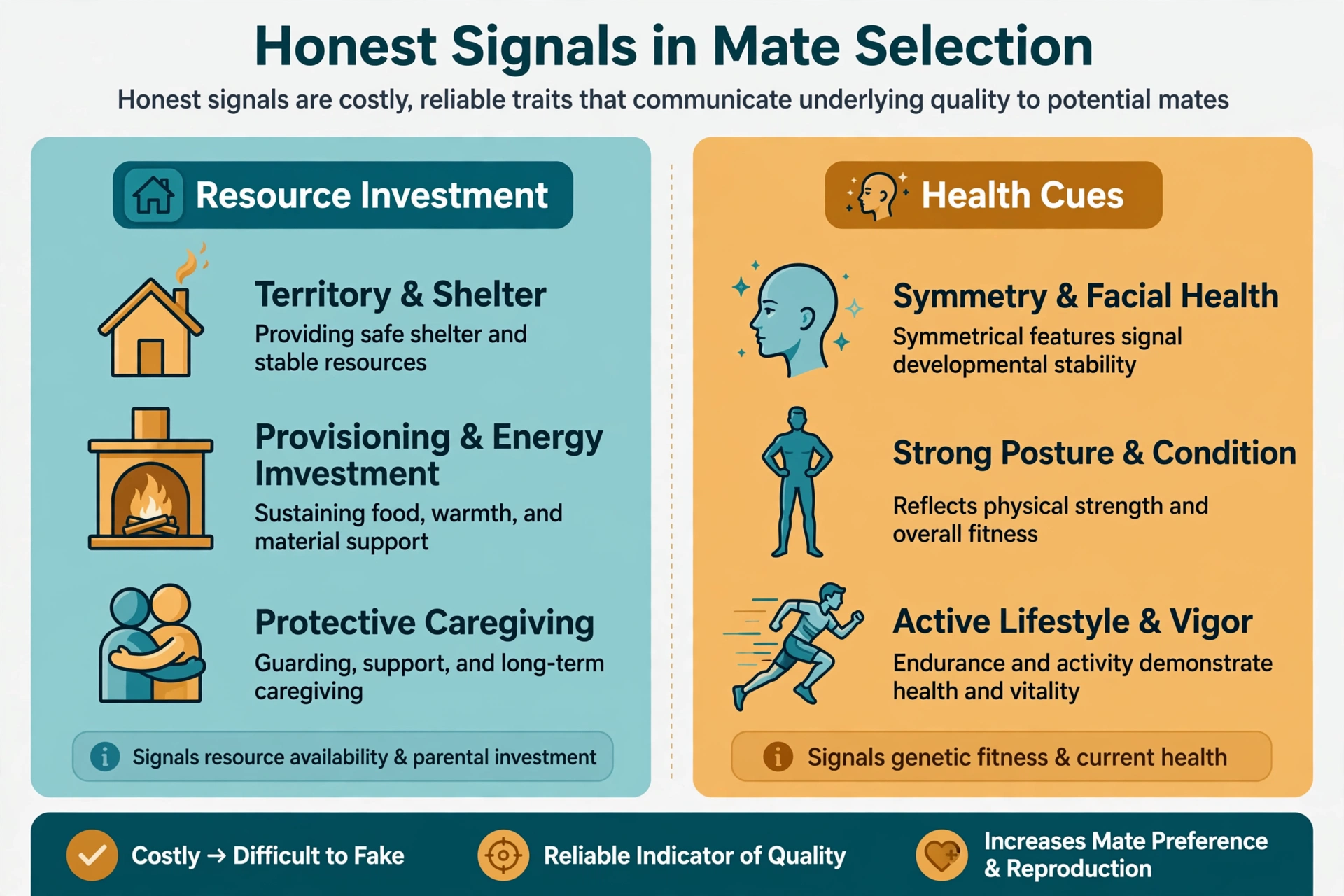
Amotz Zahavi’s handicap principle proposes that some attractive traits evolved precisely because they are expensive. A genuinely costly signal — one that a weak or deceptive individual cannot fake — is an honest advertisement of underlying quality. Sustained generosity, long-term loyalty, and creative talent function this way in humans: they take real resources and effort to display, so they cannot be easily counterfeited.
3. The Fisherian runaway: attraction feeding on itself
Ronald Fisher showed mathematically that if females prefer a trait, and that preference itself is inherited, the two can chase each other in a self-reinforcing loop — the “runaway process.” In the evolution of mate selection, human preferences may partly work this way: once a community agrees that confidence or athleticism is attractive, the preference intensifies simply because it is shared, regardless of any objective benefit.
4. Sensory bias and genetic compatibility
Some attractions studied in the evolution of mate selection may begin as side effects of how our brains were already wired — we find symmetrical faces appealing partly because our visual systems are tuned to detect pattern and order. Related research on the major histocompatibility complex (MHC), the genes governing immune function, suggests people tend to prefer partners whose immune-related scent differs from their own, potentially giving offspring broader disease resistance.
There is also a powerful opposite tendency: assortative mating, in which people pair up with partners similar to themselves in education, values, religion, and even appearance — and these similarities are among the strongest predictors of long-term stability.
What the Big Studies Actually Found
David Buss and colleagues famously surveyed more than 10,000 people across 33 countries and 37 cultures, producing landmark evidence in the evolution of mate selection: men on average placed more weight on physical attractiveness and youth (cues to fertility), while women on average placed more weight on financial prospects, ambition, and status (cues to resource acquisition). A later analysis by Daniel Conroy-Beam showed the researchers could predict a person’s sex with over 92 percent accuracy from their mate preferences alone.
But here is the crucial nuance the headlines usually skip: a 2014 replication study by Bech-Sorensen and Pollet found that several of these sex differences had shrunk significantly over twenty years of growing gender equality. Men and women converged on preferences related to race, education, and age. The largest remaining gaps concerned age and employment preferences. The takeaway the researchers emphasized is important: biology and culture are not opponents here. Evolutionary pressures set the starting conditions; social and economic change reshapes how strongly they show up.
Understanding the evolution of mate selection means tracking both.
Equally important is what the data say about variation. Average differences between men and women are real, but individual variation within each sex is far larger. Plenty of men prioritize ambition and emotional depth; plenty of women prioritize physical attraction. Treating evolutionary findings as rigid rules about individuals is the most common misuse of this science — and researchers in the field consistently warn against it. In short, the evolution of mate selection describes population-level tendencies, not personal destinies.
Where the Science Gets Controversial
No honest article on the evolution of mate selection can skip the fights. Two are especially worth knowing about.
The ovulatory-shift controversy
For years, researchers debated whether women near ovulation prefer more masculine faces, deeper voices, and more dominant partners. Early studies suggested yes; but large, well-powered replication efforts in the 2010s and 2020s largely failed to reproduce the effect, and a landmark large-scale replication effort found essentially no robust ovulatory shift in preferences. The current consensus among researchers studying the evolution of mate selection: if the effect exists at all, it is small and unreliable — certainly not something to base real dating decisions on.
The critique from social role theory
Psychologists like Alice Eagly argue that many observed sex differences in mate preferences stem not from ancient evolution but from contemporary social roles — women seeking providers because they were historically excluded from earning, men seeking youth because older men held power. The interactionist view of the evolution of mate selection now gaining ground holds that both perspectives capture part of the truth: evolved tendencies exist, but they are expressed through, and filtered by, the culture and economy a person lives in.

Modern Mismatch: Evolution Meets the Dating App
Here is where the evolution of mate selection becomes directly practical. Our mating psychology evolved for small communities where reputation was everything, you met few potential partners, and commitment was nearly unavoidable. Dating apps invert all of that: infinite options, split-second visual judgments, anonymity, and trivially easy exit.
This creates what evolutionary psychologists call evolutionary mismatch — ancient preferences operating in a novel environment they were not designed for. Viewed through the lens of the evolution of mate selection, a dating app is a radically new environment that ancient instincts never had to navigate — which is why understanding those instincts is now a practical skill, not just academic trivia:
- Choice overload: Ancestral humans evaluated a handful of potential partners; modern daters swipe through hundreds. Research on decision-making shows that overwhelming choice tends to reduce satisfaction and increase regret, not improve outcomes.
- Signals without cost: Costly signaling theory says attractive traits work because they are hard to fake. But a filtered photo or a witty opening line is cheap — which is exactly why catfishing and “love bombing” behaviors thrive online. Learn to watch for consistency over time, which is expensive to fake and therefore trustworthy. For a deeper look at early red flags, read our guide on love bombing signs to watch for.
- Assortative mating at scale: Algorithms that match people by education, interests, and background are, in effect, industrial-scale assortative mating — and the data suggest similarity remains one of the strongest predictors of lasting satisfaction.
- The missing slow signals: Ancestral courtship unfolded over weeks of observable behavior — how someone treats elders, how they handle stress, whether they keep promises. Apps compress this into profiles. Deliberately slowing down and observing behavior in real settings restores information our ancestors got for free.
None of this means dating apps are doomed to fail. It means the people who use them best are the ones who understand which ancient buttons the app is pressing — and who deliberately reintroduce the slow, costly signals that evolution taught us to trust.
What This Science Actually Means for Your Love Life
Forgetting the academic debates for a moment, here are the evidence-based takeaways that matter for a modern dater. The evolution of mate selection leaves us with one overarching lesson: the traits that predict lasting happiness are the slow, costly ones, not the traits a profile can fake in a second.
- Invest in what evolution marks as attractive — and it is mostly free. Warmth, humor, reliability, kindness, and physical health are consistently rated attractive across cultures. A stable routine, decent fitness, and genuine generosity cost far less than luxury goods and signal far more.
- Prioritize similarity in values. Assortative mating research is clear: shared values, education, and life goals predict long-term happiness better than the intensity of initial attraction. The first-date question that matters most is not “do I feel a spark?” but “do we want the same life?” Understanding your attachment style helps you recognize whether a mismatch in values or a mismatch in attachment needs is driving your doubts.
- Let time do the filtering. Because cheap signals are easy to fake, give potential partners time to demonstrate consistency. The research on the neurochemistry of romantic love shows that early infatuation is driven by a powerful chemical cocktail — dopamine, norepinephrine, and suppressed serotonin — that naturally clouds judgment. That is a biological reason to slow down, not just folk wisdom.
- Judge the bond, not just the spark. Initial attraction fades; what remains is how you function as a team. Couples who navigate conflict well and maintain emotional intimacy are the ones who last — a point reinforced by decades of research from the Gottman Institute. If you notice the spark dimming, our article on losing attraction in a long relationship explains why it happens and what genuinely helps.
- Check compatibility deliberately. Beyond physical attraction, alignment in intimacy, communication, and conflict style is what sustains a partnership. Our sexual compatibility guide for couples offers a structured way to assess it. And for understanding what holds couples together over decades, see our deep dive into the neurochemistry of long-term bonding.
Applying the evolution of mate selection to your own dating life
You do not need to memorize the theories to benefit from the evolution of mate selection. Just remember the pattern: favor partners who show costly, consistent signals; give attraction time to be tested against reality; and choose shared values over a fleeting spark. Those are the conclusions the science keeps returning to.
Frequently Asked Questions
Is mate selection mostly biology or mostly culture?
Both, interacting. Cross-cultural research finds consistent average patterns (such as both sexes ranking kindness and reliability at the top), which points to shared biology. But the size of sex differences shifts with gender equality and economic development, which points to culture. Any account of the evolution of mate selection that gives you only one half is oversimplified.
Do men really care only about looks and women only about money?
No. That is a caricature of the findings. In large surveys, both sexes rank mutual attraction, a pleasing personality, and emotional stability among their top criteria. Average differences on physical attractiveness and resources are real but modest, and individual variation within each sex dwarfs the average gap between them.
Does the science say love at first sight is real?
What we call love at first sight is best understood as instant attraction plus a neurochemical surge — measurable and powerful, but not the same as love. Evolution equipped us to notice potential mates quickly; the deeper bonding systems (oxytocin and vasopressin-driven attachment) develop over time through repeated positive interaction.
Can knowing about evolutionary psychology improve my dating life?
Indirectly, yes. Learning about the evolution of mate selection helps you understand your own reactions — why you feel drawn to confidence, why early passion clouds judgment, why infinite swiping feels unsatisfying — so you can make choices with your slower, more deliberate judgment rather than on autopilot. It does not hand you scripts or guarantees.
What is the biggest myth about the evolution of mate selection?
The biggest myth is that it prescribes fixed roles: that men must provide and women must nurture. The research describes average tendencies shaped by ancient environments, not rules for individuals. Modern environments differ enormously from ancestral ones, and human behavior is remarkably flexible — which is exactly why the sex differences keep shrinking as societies change.
How do dating apps change the science of mate selection?
They do not change the underlying psychology, but they change the environment it operates in. Infinite choice, cheap signals, and rapid evaluation create evolutionary mismatch: our brains evolved for slow, reputation-rich courtship in small communities. Daters who deliberately slow down, verify consistency, and prioritize shared values tend to get better outcomes. The evolution of mate selection equipped your brain for courtship in small communities; recognizing that mismatch is the first step to using apps wisely instead of being used by them.
Should I worry if I do not match the “evolved” preferences?
Not at all. Evolutionary findings describe population-level averages, not personal destinies. Attraction is also shaped by your individual experiences, culture, attachment patterns, and plain idiosyncrasy. The most consistent finding in the field is that kindness, reliability, and shared values matter most for lasting relationships — qualities anyone can cultivate.
The Bottom Line
The evolution of mate selection is ultimately a story about how ancient problems — finding a healthy, reliable, committed partner — shaped a psychology that still runs in our heads today. Darwin’s sexual selection, costly signaling, Fisherian runaway, genetic compatibility, and assortative mating each explain part of why we desire whom we desire.
But the newest science adds a critical correction: these tendencies are averages, not destinies, and they interact constantly with culture, economics, and personal experience.
Understanding the evolution of mate selection will not tell you who to date. What it gives you is something better: a clearer view of your own instincts — which ones to trust, which ones to question, and why the slow, unglamorous signals of consistency and shared values are still the best predictors of a relationship that lasts. For broader context on how healthy relationships function day to day, the American Psychological Association’s resources on marriage and relationships are a reliable starting point.