The Neurochemistry of Romantic Love: Dopamine, Oxytocin and More
The racing heart, the sleepless nights, the inability to think about anything but one person — the neurochemistry of romantic love explains why falling in love feels less like a decision and more like something happening to you. Behind those overwhelming sensations is not magic but measurable biology: a coordinated shift in dopamine, serotonin, oxytocin, vasopressin, adrenaline, and several lesser-known players that together transform how your brain prioritizes, perceives, and bonds with another human being.
Researchers have spent three decades scanning the brains of people in love — from brand-new couples to pairs married for over twenty years — and the picture that emerges of the neurochemistry of romantic love is remarkably consistent. Romantic love is not a single chemical event. It is a sequence of neurochemical phases, each with its own cast of molecules, its own brain regions in charge, and its own behavioral signature. Understanding this sequence changes how you interpret your own relationships: the fading of early intensity is not a failure of love but a planned handoff from one system to another.
Your Brain on New Love: The Reward System Takes Over
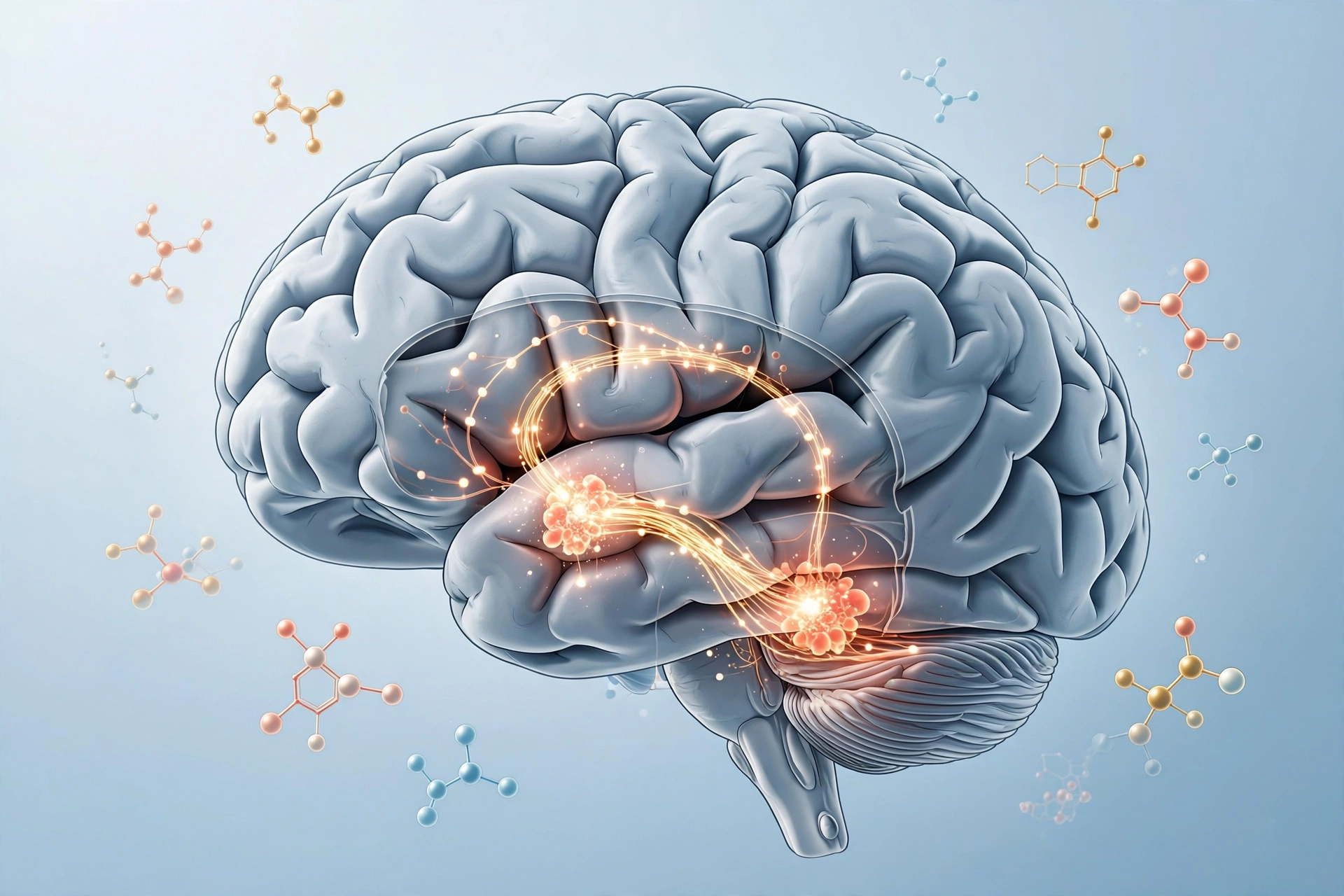
When scientists placed newly-in-love volunteers inside fMRI scanners and showed them photographs of their partners, they did not see activity in the brain’s calm, contented regions. Instead, two regions lit up intensely: the ventral tegmental area (VTA) and the caudate nucleus — the same deep-brain reward and motivation centers that activate for food, money, and addictive drugs. The intensity was comparable to what researchers measure with cocaine, which is why new love genuinely feels like a high — and why the neurochemistry of romantic love is so often compared to addiction.
Crucially, these are motivation circuits, not pleasure circuits alone. They do not just make you feel good; they make you want, pursue, and focus. That is why early love is characterized less by peaceful happiness and more by driven pursuit: checking your phone, planning the next meeting, rearranging your life around a person. Your brain has identified the single most important reward stimulus in your environment and is organizing your behavior around acquiring it. This finding comes from landmark neuroimaging research on early-stage intense romantic love, which mapped these reward and motivation systems in detail.
Dopamine: The Motivation Molecule Behind the Obsession
Dopamine is the star of the early phase in the neurochemistry of romantic love, and understanding how it works explains nearly every hallmark of new romance. Dopamine neurons do not fire simply when a reward arrives — they fire most intensely when the reward is uncertain. Neuroscientists call this the reward prediction error: the signal spikes when an outcome is better than expected, and stays quiet when the outcome is fully predictable.
In a new relationship, almost everything is uncertain. Will they text back? Do they feel the same way? What will the next date be like? Each positive answer produces a dopamine spike that feels like the swooping “falling” sensation people describe as chemistry. This means the electric feeling of early romance is partly a measure of uncertainty, not of compatibility — a useful thing to remember when deciding how much weight to give to first-month fireworks.
Dopamine also explains the focus and energy of new love. Elevated dopamine sharpens attention on the beloved to the exclusion of almost everything else, boosts energy and motivation, and reduces the need for sleep. Partners report feeling they could talk all night, lose track of time, and function on little rest. That is the same stimulant-like profile that makes the early phase feel effortless and exhilarating.
Norepinephrine and Adrenaline: Why Your Body Reacts Before Your Mind Does
In the neurochemistry of romantic love, dopamine does not work alone. Norepinephrine (also called noradrenaline) and adrenaline flood the body during attraction, producing the unmistakable physical symptoms of a crush: pounding heart, sweaty palms, flushed cheeks, and a heightened, almost electric alertness. These are the same chemicals behind the fight-or-flight response, which is why being near someone you are intensely attracted to can feel strangely similar to being nervous — physiologically, the two states overlap.
This overlap is one reason for the classic “misattribution of arousal” effect studied in psychology: physiological arousal from one source (a scary bridge, an intense workout, a thrilling movie) can intensify romantic attraction to whoever is present. Your body reads the racing heart and concludes the person in front of you must be the cause. Couples who do exciting, novel things together often report stronger attraction afterward — and now you know one reason why.
Serotonin Drops: Why You Cannot Stop Thinking About Them
Perhaps the most surprising finding in love research is that serotonin — the neurotransmitter associated with mood stability and calm — actually decreases in the early stages of romantic love. Italian researcher Donatella Marazziti and colleagues found that serotonin transporter levels in newly-in-love people were indistinguishable from those measured in people with obsessive-compulsive patterns. In plain language: the brain of a new lover looks chemically like a brain stuck in a loop.
This explains the intrusive, repetitive thinking that defines infatuation. You do not think about the person constantly because the connection is uniquely profound; you think about them constantly because your serotonin system is in a state that makes repetitive thoughts about one stimulus neurologically almost inevitable. Up to 85 percent of waking thoughts can revolve around the beloved during this phase. The same mechanism that makes you replay conversations and imagine futures also fuels jealousy and anxious checking — the low-serotonin state amplifies worry and rumination, which is why jealousy tends to peak when love is newest and most uncertain.
There is a practical upside to knowing the neurochemistry of romantic love: the obsessive phase is temporary chemistry, not a permanent verdict on the relationship’s quality. Serotonin levels normalize as the relationship stabilizes, typically within the first year or two, and the constant mental looping fades into calmer, more voluntary attention.
Oxytocin and Vasopressin: The Bonding Chemicals of Lasting Love
If dopamine, adrenaline, and low serotonin are the chemicals of falling in love, oxytocin and vasopressin are the chemicals of staying in love. These two closely related neuropeptides are released during physical touch — hugging, holding hands, cuddling, kissing, and sexual intimacy — and during childbirth and breastfeeding. They promote trust, reduce fear, and create the warm sense of safety and belonging that defines attachment.
Animal research first revealed their power: in monogamous prairie voles, blocking oxytocin or vasopressin receptors prevents pair-bonding entirely, while stimulating them can create partner preference even without mating. In humans, oxytocin released during affectionate touch deepens feelings of closeness, increases generosity and trust toward a partner, and dampens the brain’s threat-detection systems. Vasopressin appears particularly involved in mate-guarding and long-term commitment behaviors in men.
The shift from the dopamine phase to the oxytocin phase is the most misunderstood transition in relationships. Couples often panic when the electric obsession fades, interpreting it as falling out of love. In reality, the brain is handing the relationship over to a different, calmer system — one built for decades of partnership rather than weeks of pursuit. Learning how the brain shifts from passion to long-term bonding — a central insight from the neurochemistry of romantic love — helps couples recognize this transition as success, not loss.

The Neurochemistry of Romantic Love Across Three Phases
Anthropologist Helen Fisher proposed the most widely used framework for organizing the findings of the neurochemistry of romantic love: romantic love unfolds in three overlapping systems — lust, attraction, and attachment — each driven by different chemistry and each serving a different evolutionary purpose.
| Phase | Primary chemicals | Brain focus | What it feels like | Typical duration |
|---|---|---|---|---|
| Lust | Testosterone, estrogen | Hypothalamus | Sexual desire, physical craving | Can persist indefinitely |
| Attraction (passionate love) | Dopamine, norepinephrine, low serotonin, adrenaline, PEA | VTA, caudate nucleus, nucleus accumbens | Euphoria, obsession, sleeplessness, racing heart | Months to ~2 years |
| Attachment (companionate love) | Oxytocin, vasopressin | Ventral pallidum, reward-attachment circuits | Calm closeness, trust, deep security | Years to decades |
In the neurochemistry of romantic love, these phases overlap and interact rather than switching cleanly. A couple can feel deep attachment while still experiencing strong attraction, and long-term partners can reawaken attraction-phase chemistry under the right conditions — more on that below.
The Lesser-Known Players: PEA, Cortisol, NGF, and Testosterone Shifts
Beyond the headline chemicals, the neurochemistry of romantic love includes several lesser-known molecules that shape the experience of love in ways most articles skip entirely. For a broader scientific overview of how these systems interact, the American Psychological Association’s review of the chemistry between partners is a useful starting point.
Phenylethylamine (PEA): the “love molecule”
PEA is a natural stimulant released when you are near someone you find attractive, and it is partly responsible for the “butterflies in the stomach” sensation. It amplifies dopamine’s effects, which is why attraction can feel like a mild natural amphetamine rush. PEA breaks down quickly, which is one reason the giddy, fluttery feeling is strongest in the earliest encounters and fades as familiarity grows.
Cortisol: love is stressful at first
Marazziti’s team also found something counterintuitive: cortisol, the primary stress hormone, is significantly elevated in people who have just fallen in love — at levels comparable to people under serious strain. This makes sense: new love is high-stakes uncertainty, and the body responds accordingly. The good news is that cortisol returns to normal after roughly six to twelve months as the relationship stabilizes, which is another biological marker of the transition from attraction to attachment.
Nerve growth factor (NGF): your brain is literally growing
In a striking 2006 study, Italian researchers found that nerve growth factor — a protein that supports the growth and survival of neurons — was significantly higher in the blood of people who had recently fallen in love compared to singles or long-term couples. The researchers suggested that falling in love triggers genuine neural remodeling: your brain is physically rewiring itself around the new bond. NGF levels returned to baseline after about a year, suggesting the remodeling phase has a natural endpoint.
Testosterone convergence
Early love also reshapes sex hormones in an unexpected direction: testosterone levels tend to decrease in men and increase in women during the first months of a relationship, narrowing the usual gap between the sexes. Researchers have speculated that this temporary convergence softens typical sex-differentiated behaviors — men becoming gentler and less competitive, women becoming more assertive — which may ease the fragile early bonding process. Like the other early-phase changes, hormone levels drift back toward baseline as the relationship matures.
Why the Brain Deactivates Fear and Judgment When You Fall in Love
Neuroimaging pioneer Semir Zeki found that romantic love does something remarkable to the brain’s alarm systems: it deactivates the amygdala, the region that coordinates fear and threat responses, and quiets parts of the frontal cortex responsible for critical judgment and social assessment. In other words, being in love literally turns down your brain’s ability to feel afraid of your partner and to judge them critically.
This explains two familiar phenomena: why new lovers feel so safe and fearless with each other so quickly, and why they seem “blind” to red flags that are obvious to everyone else. The suspension of judgment is not a character flaw — it is a neurochemical feature designed to let bonding happen despite imperfect information. The wisdom from the neurochemistry of romantic love is practical: major life decisions are better made after the frontal cortex comes back online, which is one more reason not to rush commitments during the first year.
Long-Term Love: What Happens to the Chemistry After Decades
Here is the finding from the neurochemistry of romantic love that should reassure every long-term couple: dopamine does not have to die. A well-known 2011 brain-imaging study of couples married an average of over twenty years who still reported intense romantic love found that their reward systems — including dopamine-rich regions — still activated when they viewed photos of their partners. Long-term love is not just oxytocin and habit; in thriving couples, the reward circuitry stays engaged.
So why does passion fade for so many? The answer lies in how dopamine works. Once the brain can reliably predict a reward, dopamine stops firing at the reward itself and fires only at unexpected cues. Your partner’s presence becomes the neurological equivalent of background music: still valued, no longer surprising. The reward has not diminished — your brain has just stopped being surprised by it.
The fix follows directly from the mechanism: reintroduce novelty and shared excitement. Studies on couples show that doing new, challenging, or mildly thrilling activities together — travel to unfamiliar places, learning a skill together, even exciting dates — reactivates the dopamine system and is associated with higher relationship satisfaction. You cannot will the chemistry back, but you can create the conditions that summon it.
Similarly, oxytocin is not automatic in long relationships; it responds to behavior. Affectionate touch, sustained eye gazing, synchronized activities like walking or dancing together, and genuinely attentive conversation all stimulate oxytocin release. When couples drift into parallel lives, the bonding chemistry quietly starves — which is often what emotional distance in long-term relationships actually is at the biological level. And because your attachment style shapes how your bonding system responds to closeness and distance, understanding your own patterns makes these habits easier to sustain.
Lovesickness and Heartbreak: The Withdrawal Side of Love Chemistry
The neurochemistry of romantic love predicts that losing love should produce withdrawal-like symptoms — and research suggests it does. After a breakup, the sudden absence of the partner removes the dopamine source the brain had organized itself around, while stress hormones surge and oxytocin-linked comfort disappears. The result is a recognizable cluster: craving and intrusive thoughts about the ex, disrupted sleep and appetite, low mood, and compulsive checking behaviors.
Brain imaging of people viewing photos of a rejecting ex-partner shows continued reward-system activation alongside regions involved in pain and craving — the brain simultaneously wants the person and registers their absence as suffering. This is why “just get over it” advice fails so completely: the bereaved brain is going through a genuine neurochemical recalibration, and it takes weeks to months for the circuits to re-stabilize. Time, social support, exercise, and new rewarding activities genuinely help, because they give the reward system alternative sources of dopamine while it adjusts.
Frequently Asked Questions
How long does the “in love” brain chemistry last?
The intense attraction phase — high dopamine and norepinephrine, low serotonin, elevated cortisol — typically lasts between six months and two years. The exact timeline varies, but the neurochemical signature of new love reliably fades as the relationship stabilizes and the brain shifts toward oxytocin- and vasopressin-driven attachment. This timeline is consistent across multiple studies of couples at different relationship stages.
Can you fall out of love because of brain chemistry?
Chemistry changes, but it does not single-handedly end relationships. The dopamine-driven intensity of early love always fades; what matters is whether the attachment system — oxytocin, vasopressin, trust, shared history — has developed enough to carry the relationship forward. Couples who mistake the natural chemical transition for “losing love” sometimes end healthy relationships prematurely.
Is love really like an addiction?
Within the neurochemistry of romantic love, the comparison has scientific merit but important limits. Early romantic love activates the same reward and motivation circuits as addictive drugs, and produces craving, tolerance-like effects, and withdrawal-like symptoms after loss. However, researchers note a key difference: natural rewards like love engage feedback mechanisms that allow the system to return to baseline, whereas addictive drugs progressively dysregulate those systems. Healthy reciprocal love is, in the researchers’ phrase, generally a “positive addiction.”
Do men and women experience love chemistry differently?
Broadly, the same systems operate in both sexes, but there are nuances. Testosterone temporarily converges (decreasing in men, increasing in women) during early love. Vasopressin appears more central to pair-bonding behavior in men, while oxytocin plays the larger role in women — though both chemicals matter for both sexes. Some imaging studies also suggest slightly different regional activation patterns, but the core reward-circuit findings replicate across genders.
Can you make the spark last with brain chemistry in mind?
You cannot freeze the early-phase chemistry permanently, but you can work with your biology. Novel, exciting shared activities reactivate dopamine; regular affectionate touch, eye contact, and undistracted togetherness stimulate oxytocin; managing stress protects the bonding system from cortisol interference. Long-term couples who still report intense love show continued reward-system activation — suggesting the spark is maintainable, just not on autopilot.
Why do I overlook red flags when I am falling in love?
Brain imaging shows that romantic love deactivates the amygdala (fear processing) and quiets regions of the frontal cortex involved in critical judgment. This temporary suspension of critical assessment appears to be a built-in feature that allows bonding to proceed despite imperfect information. It is one reason relationship experts advise against major commitments during the first year of intense infatuation.
Does antidepressant medication affect romantic love?
This is a question for your prescribing clinician, not an article — but it is worth knowing that researchers studying the neurochemistry of romantic love have raised the question because many antidepressants raise serotonin, and early love involves lowered serotonin. Some researchers have hypothesized that elevated serotonin could blunt the intensity of new romantic feelings, but the evidence is preliminary and individual. Never adjust medication based on relationship concerns without medical guidance.
What the Chemistry Really Tells Us About Love
The neurochemistry of romantic love reveals something more hopeful than reductive. Yes, the euphoria is dopamine, the obsession is low serotonin, the racing heart is adrenaline, and the deep calm of lasting partnership is oxytocin and vasopressin. But knowing this does not cheapen love — it clarifies it. The fading of early intensity is not a verdict on your relationship; it is a scheduled handoff between brain systems. The couples who thrive are not the ones who somehow keep the first-year chemistry frozen — they are the ones who understand the transition and actively feed the systems that come next: novelty for dopamine, touch and presence for oxytocin, honesty and reliability for trust.
The neurochemistry of romantic love shows that love, it turns out, is not just a feeling your brain produces. It is a process your brain is designed to complete — from the electric uncertainty of attraction to the quiet security of attachment — provided you give it the behaviors, time, and care it needs along the way.
Disclaimer: This article is for educational purposes only and is not a substitute for professional therapy, counseling, or medical advice. If you are experiencing persistent relationship distress, anxiety, or depression, please consult a qualified mental health professional or healthcare provider.