The Neurochemistry of Long-Term Bonding: Beyond the Honeymoon
When the dizzy, obsessive high of new love fades, many couples panic: Is something wrong with us? Neuroscience has a reassuring answer — nothing is wrong. Your brain is simply switching operating systems. Understanding the neurochemistry of long-term bonding explains why love changes shape after the honeymoon phase, and why the calmer love that replaces it can be deeper, steadier, and biologically more rewarding than the fireworks that came first.
This article walks through the three neurochemical stages of love, the specific hormones and neurotransmitters that maintain mature attachment — the core machinery of the neurochemistry of long-term bonding — the genetics that make bonding easier for some people than others, and evidence-based habits that actively feed your bond’s chemistry — all grounded in peer-reviewed research.
The Three Stages of Love in the Brain
Anthropologist Helen Fisher’s influential model divides romantic love into three overlapping systems: lust, attraction (the honeymoon), and attachment. Each runs on a different neurochemical profile, and each serves a different evolutionary job.
Lust is driven primarily by the sex hormones — testosterone and estrogen. Its function is simple: motivate us to seek a mate. Attraction — the classic honeymoon phase — is dominated by dopamine and norepinephrine, with unusually low serotonin. This is the brain chemistry of new romantic love: dopamine floods the reward circuitry (the ventral tegmental area and nucleus accumbens), producing euphoria, motivation, and a near-addictive focus on the new partner, while norepinephrine generates the racing heart and heightened energy. Serotonin, meanwhile, drops to levels that researchers have compared to those seen in obsessive-compulsive patterns — which helps explain why you cannot stop thinking about a new partner.
Attachment is the system this article is about. As relationships mature, the dominant chemistry shifts from dopamine-driven reward to oxytocin, vasopressin, and endogenous opioids — a neurochemical environment built for calm, trust, and sustained closeness rather than excitement. The transition typically unfolds over roughly 12 to 36 months: the most intense dopamine-driven phase usually lasts a year to a year and a half, with the neurochemistry of long-term bonding settling into its long-term pattern over the following couple of years. Couples who mistake this shift for falling out of love are misreading biology as failure.
What Actually Changes After the Honeymoon Phase
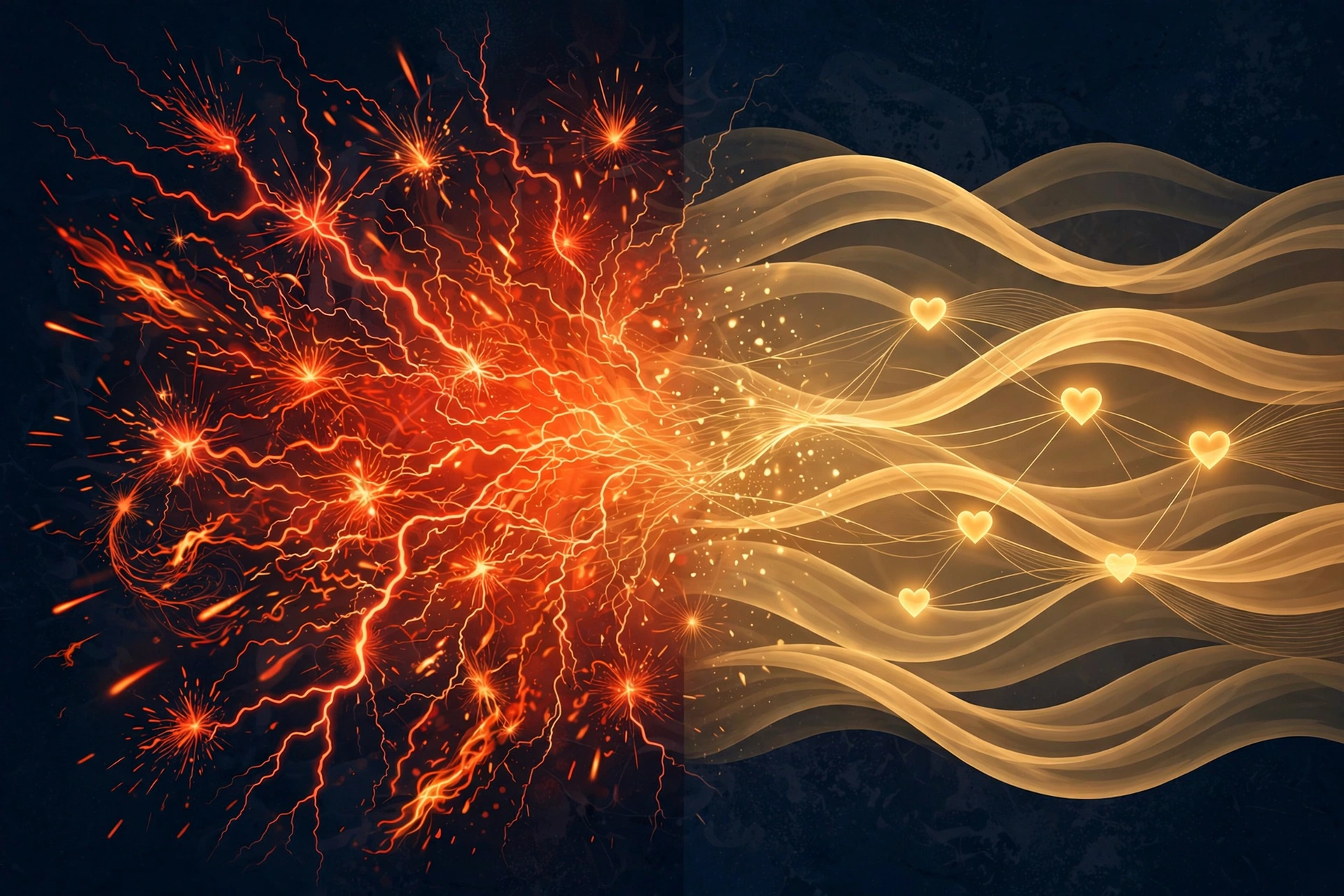
The single most important thing to understand is why dopamine quiets down. It is not because your partner is less wonderful — it is because of a mechanism neuroscientists call reward prediction error. Dopamine neurons fire hardest in response to unexpected rewards: the surprise text, the unexpected compliment, the first kiss. Once a reward becomes predictable — your partner comes home every evening, exactly as expected — the neurons stop firing in response to the reward itself and fire only for the cues that predict it. Your brain has learned the pattern; it no longer needs to shout about it. That quieting is one of the first signs the neurochemistry of long-term bonding is coming online.
Functional MRI research has added a fascinating twist: brain scans of people in long-term, intensely loving relationships show activity in reward regions (the VTA and nucleus accumbens) that can be just as strong as in new lovers. The reward system does not retire — it gets woven together with the attachment system. fMRI research on long-term romantic love published via the National Institutes of Health found that long-term partners show reward-region activation plus activity in brain areas rich in oxytocin and vasopressin receptors — a combined profile you do not see in new romance.
Practically, this means desire does not die in long relationships — it changes its trigger. Predictable comfort no longer spikes dopamine the way novelty did. Couples who understand this stop asking “why don’t I feel the rush anymore?” and start asking the far more useful question: “how do we introduce healthy novelty on purpose?” (We will get to the evidence-based answers below.)
Oxytocin and Vasopressin: The Architecture of Attachment
If dopamine is the spark, oxytocin and vasopressin are the foundation. Together they form the core architecture of lasting pair bonds — the heart of the neurochemistry of long-term bonding — a finding that began in an unlikely place: the prairie vole.
Oxytocin: the trust molecule
Oxytocin is released during physical touch — hugging, hand-holding, cuddling, kissing — and during meaningful emotional connection. It lowers cortisol (the stress hormone), increases trust and empathy, and strengthens the neural association between your partner’s presence and feelings of safety. Over time, this repeated pairing is what makes your partner neurologically feel like “home.”
This slow, steady accumulation of safety is what the neurochemistry of long-term bonding is really about: not fireworks, but a nervous system that has learned your partner means safety.
Research on human couples has shown that even modest, consistent touch rituals measurably move this system. Studies of affectionate touch — including findings that sustained hugs of around 20 seconds elevate oxytocin more than brief contact — suggest that couples who build small daily touch habits (a longer goodbye hug, hand-holding on a walk) are literally dosing the neurochemistry of long-term bonding. This is also why eye-gazing exercises can feel surprisingly powerful: sustained mutual gaze activates some of the same bonding pathways as physical touch.
Vasopressin: the commitment molecule
Vasopressin is oxytocin’s lesser-known partner and is especially important for long-term, exclusive pair bonding. In prairie voles — one of the rare monogamous mammals — blocking vasopressin receptors prevents pair bonding entirely, while the closely related but promiscuous montane vole has far fewer of these receptors in its reward circuitry. Human imaging studies show vasopressin-rich regions activating when long-term partners view each other’s faces — another signature of the neurochemistry of long-term bonding.
Here is the angle most articles skip: your genes influence how strongly this system works for you. Variations in the AVPR1a gene (which codes for the vasopressin receptor) have been linked to differences in pair-bonding behavior and relationship satisfaction in men — sometimes dubbed “the monogamy gene” in popular coverage. Similarly, variants of the oxytocin receptor gene (OXTR) are associated with differences in empathy and attachment security. None of this is destiny — attachment styles and learned relationship skills matter enormously — but it helps explain why bonding feels more effortless for some couples than others. Biology sets the starting point, not the finish line.
Endogenous Opioids: Why Your Partner Feels Like Home
The third pillar of mature bonding is the one almost nobody talks about: endogenous opioids — your brain’s own natural opiates. While dopamine drives wanting (motivation, pursuit), opioids drive liking (warmth, comfort, contentment). In long-term attachment, the opioid system becomes the dominant source of pleasure in the relationship — and that shift in pleasure is central to the neurochemistry of long-term bonding.
This explains two things couples often find confusing. First, why the pleasure of a long relationship feels like relief and warmth rather than excitement: sinking into the couch next to your partner after a hard day produces a genuine neurochemical reward — a quiet opioid-mediated sense of “all is well.” Second, why separation and loss hurt the way they do: the opioid system responds to partner absence with genuine distress signals. The ache of missing someone is not metaphorical — it is your attachment chemistry registering a deficit of its primary reward.
Endorphins — a related family of natural mood-lifters — rise through shared physical activity, laughter, and synchronized movement. Couples who exercise together, dance together, or simply laugh together regularly are topping up the same chemistry that makes long-term love feel comfortable and safe. It is one of the most underrated tools for nourishing the neurochemistry of long-term bonding in the research literature.
The Synchronized Brain: How Couples Co-Regulate
Perhaps the most remarkable finding in this field is that long-term partners do not just bond emotionally — their nervous systems synchronize. Studies of couples show aligned brain activity when partners see each other’s faces or hear each other’s voices, as well as coupled heart-rate and breathing patterns during close contact.
Neuroscientists call the practical version of this co-regulation: your partner’s presence measurably calms your stress physiology. Partners in secure, long-term relationships show lower cortisol reactivity during conflict and faster physiological recovery after stressful events. The relationship becomes part of each person’s stress-regulation infrastructure — not a source of excitement, but a source of physiological stability that no other relationship replicates. This is also why how stress and anxiety affect intimacy cuts both ways: chronic stress floods the body with cortisol, which directly suppresses oxytocin release — meaning an overwhelmed couple can get locked in a loop where stress blocks the very bonding chemistry that would help them recover from it.
The clinical takeaway is encouraging: the calm you feel around your partner is not boredom — it is your nervous system doing exactly what long-term attachment evolved to do. Scientists sometimes describe this state as the hallmark of a mature neurochemistry of long-term bonding: two nervous systems tuned to calm each other. Couples who reframe “we’re so comfortable” as a neurochemical achievement, rather than a romantic shortfall, tend to protect their bond far better than those chasing the honeymoon high.
What Sabotages the Neurochemistry of Long-Term Bonding
Understanding what disrupts the neurochemistry of long-term bonding is as important as knowing what feeds it:
- Chronic stress and sleep deprivation. Elevated cortisol suppresses oxytocin release and blunts the reward system’s sensitivity. A couple running on five hours of sleep and constant work pressure is biochemically handicapped at bonding — the connection between sleep and sex drive is only part of the story; sleep loss undermines the entire attachment system.
- Alcohol excess. While a glass of wine may lower inhibitions, regular heavy drinking disrupts sleep architecture, raises baseline cortisol, and interferes with the prefrontal regulation that keeps conflicts constructive — all of which erode bonding chemistry over time.
- Some medications. Certain antidepressants and other prescription drugs can blunt dopamine signaling and emotional responsiveness in some people. This is a medical matter, not a relationship verdict — anyone who notices emotional flattening after starting a medication should discuss it with their prescribing clinician rather than changing anything on their own. (No medication should ever be started, stopped, or adjusted without professional guidance.)
- Touch starvation. Oxytocin and vasopressin are use-it-or-lose-it systems. Couples who gradually stop touching — the goodbye kiss disappears, hand-holding stops — are slowly starving their attachment chemistry without realizing it. The decline is usually gradual enough that neither partner notices until distance has set in.
- Conflict without repair. Occasional conflict is normal and not harmful to bonding chemistry; unrepaired conflict is. Research from the Gottman Institute shows that the ratio of positive to negative interactions during conflict predicts relationship stability — their well-known finding is that stable couples maintain roughly five positive interactions for every negative one. You can read more in the Gottman Institute’s research on positive-to-negative interaction ratios. Each successful repair strengthens trust circuitry; each unrepaired rupture weakens it.

Feeding the Neurochemistry of Long-Term Bonding: 7 Evidence-Based Habits
Here is the good news the research consistently supports: the neurochemistry of long-term bonding responds to deliberate behavior. These are not vague “communicate more” tips — each habit below maps to a specific system described above.
1. Engineer novelty on purpose (dopamine)
Because dopamine responds to the unexpected, couples can deliberately re-engage the reward system. Psychologist Arthur Aron’s research on “self-expansion” found that couples who regularly do novel, slightly challenging activities together — a cooking class neither has tried, a weekend hike on an unfamiliar trail, learning a game together — report higher relationship satisfaction than couples who stick to pleasant but routine dates. Aim for one genuinely new shared experience every couple of weeks. Each one gives the dopamine side of the neurochemistry of long-term bonding a healthy, deliberate workout.
2. Build daily touch rituals (oxytocin)
The 20-second hug and the 6-second kiss (both popularized by relationship researchers) exist for a neurochemical reason: sustained contact gives oxytocin time to rise. Pick two or three daily touch points — morning goodbye, evening reunion, before sleep — and make them deliberate rather than perfunctory.
3. Practice sustained eye contact (oxytocin + vasopressin)
Two to four minutes of uninterrupted mutual gaze measurably increases feelings of closeness — directly engaging the neurochemistry of long-term bonding — even in established couples. It feels awkward at first; that is normal. Try it during a quiet moment rather than mid-conversation.
4. Move and laugh together (endorphins + opioids)
Shared exercise, dancing in the kitchen, watching something genuinely funny together — synchronized physical activity and laughter release endorphins and strengthen the opioid-mediated comfort bond. This is the chemistry behind “we have fun together” being one of the strongest predictors of long-term satisfaction.
5. Keep score of the good — 5:1 (trust circuitry)
During disagreements, deliberately maintain at least five positive moments (a touch, a bit of humor, an acknowledgment like “I see your point”) for every critical one. This is not about suppressing conflict — it is about keeping the attachment system online while you work through it.
6. Express specific gratitude daily (reward + attachment)
“Thank you for handling the car appointment — I felt taken care of” does more for bonding chemistry than a generic “love you.” Specific gratitude activates reward pathways while reinforcing the partner-safety association at the heart of attachment.
7. Protect sleep like a relationship habit (whole system)
Seven to eight hours of sleep keeps cortisol in check, preserves oxytocin sensitivity, and maintains prefrontal control during disagreements. Treating bedtime as a shared ritual — screens off, same schedule — is one of the highest-leverage bonding investments a couple can make. Few investments pay off as broadly across the neurochemistry of long-term bonding.
Beyond the Honeymoon: A New Definition of Romantic Success
The neurochemistry of long-term bonding tells a story that our culture rarely does: the fading of the honeymoon high is not the end of romance — it is romance growing up. Dopamine’s fireworks give way to oxytocin’s trust, vasopressin’s loyalty, and the deep opioid warmth of feeling truly at home with another person. The reward system never leaves; it simply joins a richer ensemble.
Couples who thrive for decades are not the ones who somehow kept the honeymoon alive. They are the ones who learned to value — and actively feed — the quieter neurochemistry of long-term bonding: the daily touch, the shared laughter, the repaired arguments, the nervous systems that have learned to calm each other. That is not a lesser love. Biologically speaking, it is the most sophisticated thing the human brain does.
Disclaimer: This article is for educational purposes only and is not a substitute for professional therapy, counseling, or medical advice. It does not diagnose any condition. If you are experiencing persistent relationship distress, anxiety, depression, or concerns about medication effects, please consult a qualified mental health professional or your healthcare provider.
Frequently Asked Questions
How long does the honeymoon phase last, neurologically speaking?
The most intense dopamine-driven phase typically lasts around 12 to 18 months, with the full transition to attachment-dominated chemistry unfolding over roughly two to three years. That gradual handover is the neurochemistry of long-term bonding taking the wheel. There is wide individual variation — and the shift is gradual, not a cliff. If you are two or three years in and the obsessive intensity has softened into comfortable closeness, that is the expected neurochemical trajectory, not a warning sign.
Can you get the honeymoon feeling back in a long-term relationship?
You cannot permanently restore the exact neurochemistry of new love — and you would not want to; that state is cognitively consuming and poorly suited to daily life. But you can periodically re-engage the dopamine reward system through deliberate novelty: new shared experiences, surprises, and unfamiliar challenges together. Research on self-expansion shows this reliably boosts passion and satisfaction in established couples — one of the best-studied ways to keep the neurochemistry of long-term bonding vibrant.
What is the difference between oxytocin and vasopressin in bonding?
Both support attachment, but with different emphases. Oxytocin is more associated with trust, empathy, calm, and the warm feelings of closeness — released strongly through affectionate touch. Vasopressin is more associated with long-term partner preference, protective behavior, and exclusive pair bonding. Think of oxytocin as the chemistry of “I feel safe with you” and vasopressin as the chemistry of “you are my person.”
Is there really a “monogamy gene”?
There is no single gene that determines faithfulness. However, research has linked variations in the AVPR1a gene (vasopressin receptor) and the OXTR gene (oxytocin receptor) to differences in bonding behavior, empathy, and relationship satisfaction. These genetic variants nudge tendencies — they do not dictate outcomes. Relationship skills, values, and choices remain the dominant factors in shaping the neurochemistry of long-term bonding.
Why does missing my partner physically hurt?
Because long-term attachment runs substantially on your brain’s endogenous opioid system — the same family of chemistry involved in comfort and pain relief. Your partner’s presence has become a genuine neurochemical reward, so their absence registers as a real deficit, producing distress signals that can feel physical. This is a sign of a well-formed bond, not of unhealthy dependence, provided it does not prevent you from functioning independently.
Does stress really damage a relationship at a chemical level?
Yes. Chronic stress elevates cortisol, which directly suppresses oxytocin release and dulls reward-system sensitivity — making partners feel less connected and less motivated toward each other. The effect is bidirectional: a strong bond buffers stress (partners show faster physiological recovery), while unmanaged stress erodes the bond. This is why stress management is genuinely a relationship skill, not just a personal wellness issue. It is also direct maintenance of the neurochemistry of long-term bonding.
When should a couple seek professional help for bonding or intimacy issues?
Consider couples therapy if emotional distance persists for months despite genuine effort, if conflicts consistently escalate without repair, if physical affection has disappeared entirely, or if either partner experiences persistent anxiety, depression, or distress about the relationship. A licensed couples therapist — particularly one trained in approaches like Emotionally Focused Therapy — works directly with the attachment system this article describes. Seeking help is a sign of investment, not failure.