Texting in Relationships: Digital Communication Rules for Couples
You send “We need to talk.” Three dots appear. They disappear. Ten minutes pass. You are now convinced the relationship is in crisis — and all you know is that nothing has actually been said yet. This is the paradox of texting communication in relationships: the channel couples use most is the one most likely to distort what they mean.
Texting is not just a convenience. For most couples, texting communication in relationships has become the primary channel for affection, logistics, conflict, and repair. The problem is that our brains were built to read faces, voices, and bodies — not blue bubbles. When those cues vanish, the mind fills the gaps, usually with the worst possible interpretation. This article gives you evidence-based rules for texting communication in relationships: what research says about how couples text, which habits predict satisfaction, the scripts to use when emotions run hot, and a step-by-step protocol for repairing a text misfire.
Why Texting Is the Trickiest Communication Channel for Couples
Face-to-face conversation is a full-bandwidth experience. You get words, tone of voice, facial micro-expressions, posture, and timing — all working together to tell you what your partner actually means. Texting strips almost all of that away. A message like “Fine.” arrives with zero tonal information, so your brain does what brains do: it consults your mood, your last fight, your attachment history, and your current stress level, then picks the interpretation that feels most threatening.
Psychologists call this the negativity effect of text-based communication. Without prosody (the rhythm and melody of speech), ambiguous messages skew negative. Researchers studying digital communication have found that people consistently misjudge how well their tone comes across in writing — you think your sarcasm is obvious, but your partner reads it as hostility. One study in the Journal of Experimental Psychology found that even small stylistic choices change how a message lands: texters who used abbreviations were perceived as putting in less effort, while warm punctuation and emojis made messages feel kinder and more attentive.
This matters because texting communication in relationships is where modern couples now handle a surprising share of emotional labor. Quick check-ins, apology bids, scheduling around stress, affection deposits, and even conflict all flow through the same tiny screen. Understanding the psychology of texting communication in relationships is the first rule of using it well.
What the Research Reveals About Texting Communication in Relationships
Science has moved past the old question of whether couples should text and now asks how they should text. At the American Psychological Association’s annual convention, researcher Leora Trub, PhD, presented findings that surprised many clinicians. In a study of 205 romantically committed adults, she found that couples with similar texting styles reported greater relationship satisfaction — regardless of whether their messages were love notes or complaints. According to the research presented at the APA convention, how couples texted mattered more than how often they texted.
A second study by Trub and colleagues surveyed 982 adults and found that the motivation behind texting determines whether it helps or harms the relationship. People text for practical reasons, but also to escape the present moment, to manage boredom, or because they find it easier than face-to-face expression. When texting becomes a way to avoid a hard conversation, it quietly functions as a barrier: “Texting all the time can also come from being lonely or bored, and that can lead to isolation and alienation,” Trub noted.
The takeaway for texting communication in relationships is powerful and practical. Compatibility in digital habits is a real relationship variable, not just a personality quirk. If one partner texts in paragraphs and the other replies with single words, neither is “wrong” — but the mismatch itself becomes a source of friction unless you name it and negotiate it together.
How Attachment Styles Hijack Your Texting
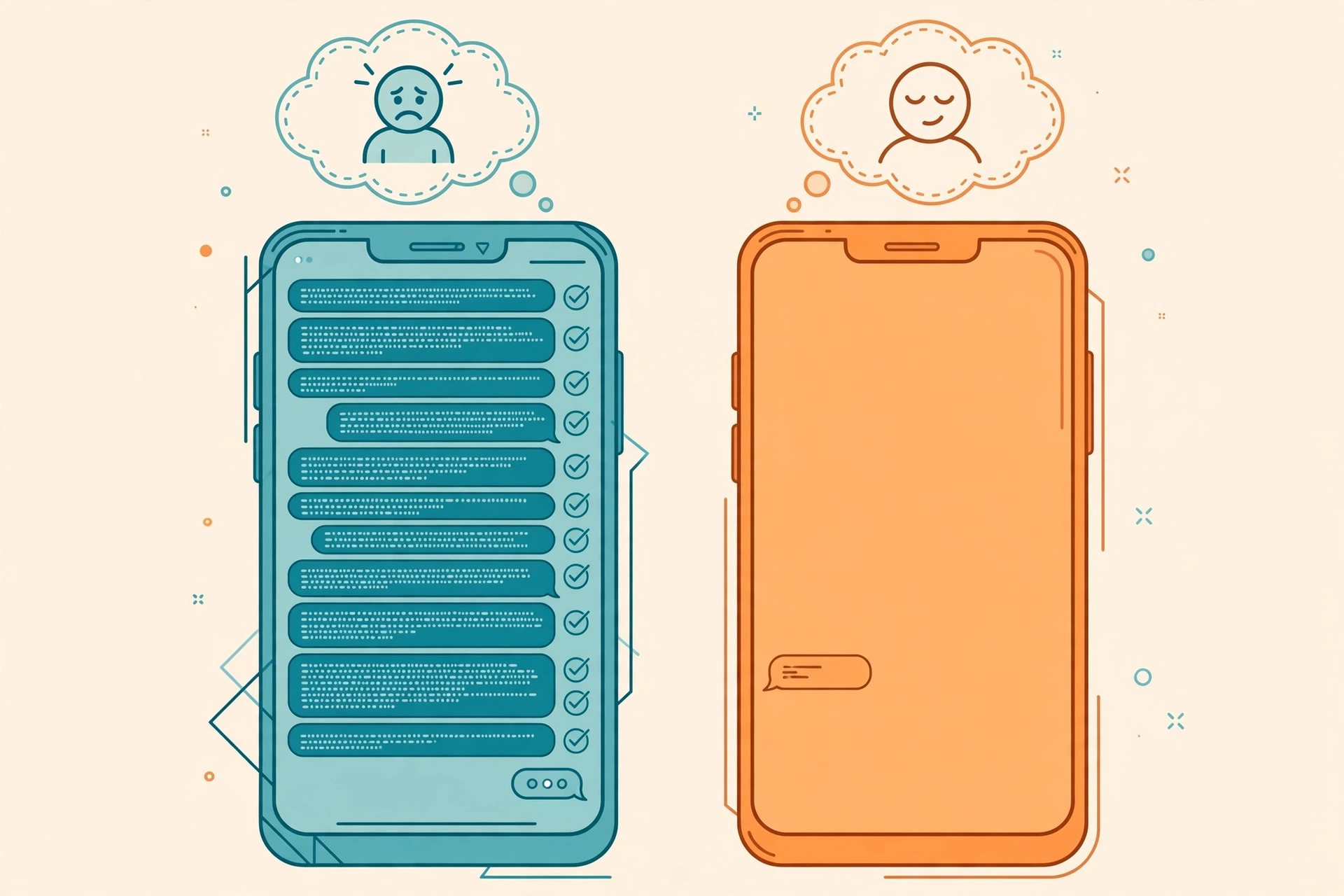
Here is an angle almost no relationship advice covers: your texting behavior is a live display of your attachment pattern. The partner who sends five follow-up messages when the reply is slow is not being “needy” — they are likely running an anxious attachment strategy, using constant contact to regulate security. The partner who takes six hours to reply and finds “we need to talk” an unreasonable opener is likely running an avoidant strategy, using distance to regulate overwhelm. Learn more about how anxious attachment influences everyday communication if this pattern feels familiar.
Read receipts and typing indicators supercharge this dynamic. For the anxiously attached partner, a blue double-tick with no reply is a trigger: it signals attention was paid and withheld, which reads as rejection. For the avoidant partner, being visible as “online” creates pressure to perform responsiveness on demand, which reads as intrusion. The same two dots mean opposite things to two different nervous systems.
This is not a flaw to fix in yourself or your partner — it is a design problem to solve together. Couples who thrive at texting communication in relationships make the invisible visible: they state their read-receipt philosophy (“I often read and reply later — it is never personal”), they name their triggers (“slow replies make me spiral, so a quick emoji helps”), and they treat texting expectations as a relationship agreement rather than a loyalty test.
The 8 Texting Rules That Actually Strengthen Couples
Forget the “wait three hours to look busy” games. Healthy couples follow rules built on respect and clarity. These eight are drawn from clinical guidance and the research above:
1. Match the medium to the message
Logistics belong in text. Feelings, conflict, apologies, and relationship-defining news belong in voice or in person. A good test: if the message could change how your partner sleeps tonight, do not send it as text.
2. Never text when you are emotionally flooded
Angry, tearful, jealous, or intoxicated? The send button is not your friend. Flooded brains write flooded texts. Write the draft, wait at least 30 minutes, and re-read it as if you were receiving it. Nine times out of ten, you will delete it or completely rewrite it.
3. Assume the kindest plausible interpretation
“K.” is probably your partner rushing between meetings, not a declaration of emotional war. Texting communication in relationships is inherently ambiguous; make charitable interpretation your default rule, and confirm before reacting: “Hey, that reply felt sharp — everything okay?” costs you nothing and saves you everything.
4. Sync your texting styles on purpose
Research on texting communication in relationships says matched styles predict satisfaction, so actively sync yours. If you are the paragraph writer and your partner is the emoji-and-done type, meet in the middle: you trim, they add a sentence of substance. This small act is the Gottman Institute’s idea of turning toward each other’s bids for connection — adapted for the digital age.
5. Use warmth markers deliberately
Since tone does not travel through text, add it back on purpose. Emojis, exclamation points, affectionate nicknames, and full sentences all function as warmth signals. “Love you, have a great meeting!” lands completely differently from “ok.” Spell out the first message in a conversation and avoid heavy abbreviation in emotionally meaningful texts.
6. Reply in layers, not instantly
You do not owe instant replies — but you do owe acknowledgment. The healthy middle ground is a two-layer system: a fast acknowledgment (“Got it, thinking, will reply properly after work”) plus a real reply later. This prevents read-receipt anxiety while protecting focus.
7. Keep a channel for affection, not just administration
Many couples’ entire text thread becomes logistics: groceries, pickups, bills. Actively keep an affection channel alive — a midday “thinking of you,” a photo, a voice note. Research on positive expression consistently links frequent small affectionate exchanges with better relationship functioning.
8. Have a code for “I need real contact”
Agree on a phrase that means “this needs a voice, not text” — something like “Can we switch to a call?” or a code emoji. This gives either partner a face-saving exit ramp from a conversation that is going wrong in writing.
Never Resolve Conflict Over Text: Know Your Medium Boundaries
This rule is worth its own section because it is where couples do the most damage. Text-based conflict fails for three compounding reasons. First, you cannot repair in real time: a spoken misunderstanding gets corrected in the next sentence, while a text misunderstanding festers for hours or days. Second, permanence fuels rumination: the angry message sits in the chat history, re-readable at 2 a.m., each reading refreshing the wound. Third, asymmetry of emotional state: one partner writes in a fury while the other reads hours later in calm — and then replies in a fury to words written hours ago, creating an endless desynchronization loop.
The clinical guidance is consistent: use text to schedule difficult conversations, never to conduct them. “I am upset about the money conversation and I want to talk tonight after dinner” is a good text. A 14-message argument about finances is not. If a conflict has already started in text, use the pause-and-switch script from the next section immediately. Clinicians also recommend keeping a small set of de-escalation phrases ready so you can cool a conversation down before switching mediums.
Scripts You Can Copy: What to Send Instead
Vague advice like “communicate better” is useless in the moment. Here are concrete, copy-paste templates for the most common flashpoints in texting communication in relationships:
| Situation | Instead of this | Send this |
|---|---|---|
| Partner is late replying | “Are you even going to answer me??” | “Hey, I am feeling a bit anxious — can you send a quick emoji when you get a sec?” |
| You are annoyed but busy | Silence, then a blowup later | “That bothered me. I do not have headspace to talk now — can we do a call at 7?” |
| A message reads as cold | “Why are you being so cold?” | “Your last text felt short — I am probably overreading it. Everything okay on your end?” |
| You want to raise an issue | A paragraph of grievances at noon | “Something on my mind about the weekend plans. Nothing urgent — talk tonight?” |
| Partner sends a sharp reply | A matching sharp reply | “Ouch, that one stung. I do not want to do this over text — can we pause and talk later?” |
| You owe an apology | “Sorry if you got upset” | “I re-read my message and it was harsher than I meant. I am sorry. Can I make it up on a call tonight?” |
The pattern across all of these: name the feeling briefly, state what you need, and move the conversation to a richer medium. You will notice none of them attempt to settle anything in writing. That is deliberate.
The 30-Minute Repair Protocol: Fixing a Text Misfire
Even with rules, misfires happen — a message lands wrong, a fight starts in the chat, someone says something they regret. Use this protocol, in order:
- Minute 0–5: Stop the bleeding. Send one closing text only: “I do not want to fight over text. I love you and I want to sort this out properly. Can we pause and talk at [time]?” Then put the phone down. Do not “clarify” with five more messages.
- Minute 5–30: Regulate yourself. Move your body, splash cold water on your face, breathe slowly. Re-read the thread once you are calmer and ask: “What is the most generous interpretation of what they meant?” Write down the facts without the story your anxiety added.
- Minute 30: Switch the medium. Call or meet. Start with the repair script: “My text probably sounded worse than I meant. What I was trying to say was [X]. How did it land for you?”
- After: Close the loop in text. Once resolved, send one warm closing text: “Glad we talked. Love you.” This rewires the chat thread so the last thing you both see is connection, not conflict.
Building this habit also pairs well with regular emotional check-ins — couples who have a standing weekly slot to clear the air have far fewer issues explode over text, because nothing festers long enough to detonate in a message.

Texting Rules for Long-Distance Couples
Long-distance couples live almost entirely inside their screens, so the rules change slightly. A study published in the Journal of Social and Personal Relationships (2021) surveyed 647 emerging adults and found something encouraging: among long-distance couples, more frequent and responsive texting predicted significantly greater relationship satisfaction. In geographically close couples, texting frequency did not predict satisfaction the same way — but for long-distance partners, the quality of remote responsiveness genuinely functions as closeness.
Practical rules for distance: schedule a daily “good morning / good night” anchor, because ritual predictability lowers anxiety; use asynchronous warmth (photos of your day, voice notes, short videos) to create a sense of shared life; and agree on response windows honestly rather than performatively — a partner who knows you reply properly at lunch is calmer than one hoping for an instant reply that never comes. For more on keeping closeness across the miles, read our guide to staying intimately connected in a long-distance relationship.
Build Your Digital Check-In Agreement
The single highest-leverage move a couple can make is to negotiate expectations around texting communication in relationships explicitly — once, calmly, not during a fight. Here is a step-by-step template:
- Share your styles. Each partner describes their texting style honestly: “I am a fast replier who sends lots of small messages” vs. “I batch my replies and hate long threads.”
- Name the triggers. Each person states what hurts: “Being left on read makes me spiral.” “Getting five messages in a row while I am in meetings stresses me out.”
- Set response norms. Agree on realistic windows: acknowledgment within an hour, proper replies by evening, with exceptions for work hours and sleep. Neither partner should have to guess.
- Define the conflict boundary. Both partners commit: no fighting over text, no relationship-altering news over text. Agree on the exact pause phrase you will both use.
- Protect phone-free time. Agree on windows where phones go away — meals, the first 30 minutes after getting home, date nights. Presence is the original message.
- Review quarterly. Habits around texting communication in relationships drift. Revisit the agreement every few months: what is working, what feels off, what needs updating.
Couples who do this report something interesting: the agreement itself rarely matters as much as the conversation it forces. Saying “this is how my phone makes me feel” out loud turns an invisible daily friction into a solvable, shared problem.
Frequently Asked Questions
How quickly should I reply to my partner’s texts?
There is no universal number — the research says matched habits matter more than speed. What works: acknowledge quickly (“saw this, replying properly later”) and reply substantively within a window you both agreed on. Instant replies are not a measure of love; reliable replies are.
Is it okay to argue over text if we are both calm?
Even calm texting arguments go badly. Without tone and real-time repair, small misunderstandings compound, and the permanent record invites re-reading and rumination. Use text to schedule the conversation (“can we talk about the budget at 8?”), then have it by voice or in person.
What does it mean if my partner takes hours to reply?
Usually: they are busy, batching replies, or avoiding phone distraction — not sending a secret message about the relationship. Slow replies feel personal because of attachment wiring, not because they are personal. If it genuinely bothers you, ask for a quick acknowledgment norm rather than demanding speed.
Should we keep read receipts on or off?
There is no right answer, only an agreed one. Read receipts on works if both partners understand that “seen” means “seen, replying later.” Off works if it removes anxiety. Decide together, and pair the choice with a clear acknowledgment norm so nobody is guessing.
How do we stop the “K” and one-word reply fights?
Address the pattern, not the message. Say: “When replies get super short, I read it as you being upset. Is that fair?” Most of the time your partner is just busy — and the conversation about it builds the warmth-marker habit (emojis, a quick “all good, swamped today”) that prevents the next one.
Can texting actually improve our relationship?
Yes — intentionally. Midday affection notes, gratitude texts, and sharing small moments of your day all function as “deposits” that keep the emotional balance positive. Research links frequent small positive exchanges with better relationship functioning. The key word is intentional: affectionate texting communication in relationships, not anxious monitoring.
What should I do if I already sent a text I regret?
Do not send five follow-ups trying to undo it. Send one clean repair message: “That came out wrong and I am sorry. I would rather say this properly — can we talk at [time]?” Then stop texting about it, regulate yourself, and have the real conversation by voice or in person.
Conclusion: Make Your Phones Work for the Relationship
Strong texting communication in relationships is not about texting less or texting more — it is about texting on purpose. Match the medium to the message, sync your styles instead of judging them, assume the kindest interpretation, never fight in the chat, and keep an affection channel open alongside the logistics. Research consistently shows that couples who align their digital habits and use texting communication in relationships for connection rather than avoidance report higher satisfaction. Draft your digital check-in agreement this week, try the repair protocol once, and notice how much quieter the anxiety gets when the rules are finally out loud.
Disclaimer: This article is for educational purposes only and is not a substitute for professional therapy, counseling, or medical advice. If texting-related conflicts are persistent, escalating, or affecting your well-being, please consider consulting a qualified couples therapist or mental health professional.