Scabies vs Herpes: How to Tell the Difference
When an itchy, uncomfortable rash appears on your skin, two conditions often top the worry list: scabies and herpes. Understanding the difference between scabies vs herpes matters because these two conditions have completely different causes, are diagnosed with different tests, and are treated in very different ways.
Yet because both can spread through close skin-to-skin contact, and both can affect the genital area, they are frequently confused with one another — sometimes even by people who have been given one diagnosis but suspect the other. This scabies vs herpes clinical guide breaks down exactly how scabies and herpes differ, what signs point toward each, and what to expect when you see a clinician.
Understanding Scabies: A Parasitic Skin Infestation
Scabies is not an infection in the usual sense — it is an infestation of the skin by a microscopic human itch mite, Sarcoptes scabiei var. hominis. The female mite tunnels just beneath the upper layer of the skin, where she lives and lays her eggs. The signature symptom of scabies — intense itching that is often worse at night — is not caused by the tunneling itself, but by the body’s allergic (hypersensitivity) reaction to the mites, their eggs, and their droppings.
Scabies spreads mainly through direct, prolonged skin-to-skin contact with a person who has it, and less commonly through sharing clothing, towels, or bedding. According to the Centers for Disease Control and Prevention, anyone can get scabies, and it spreads easily in crowded conditions where close personal contact is frequent, such as nursing homes, childcare facilities, and dormitories. Interestingly, a person can transmit scabies even before symptoms appear: the first time someone is infested, it can take 4–8 weeks for symptoms to develop, though they are contagious during that time.
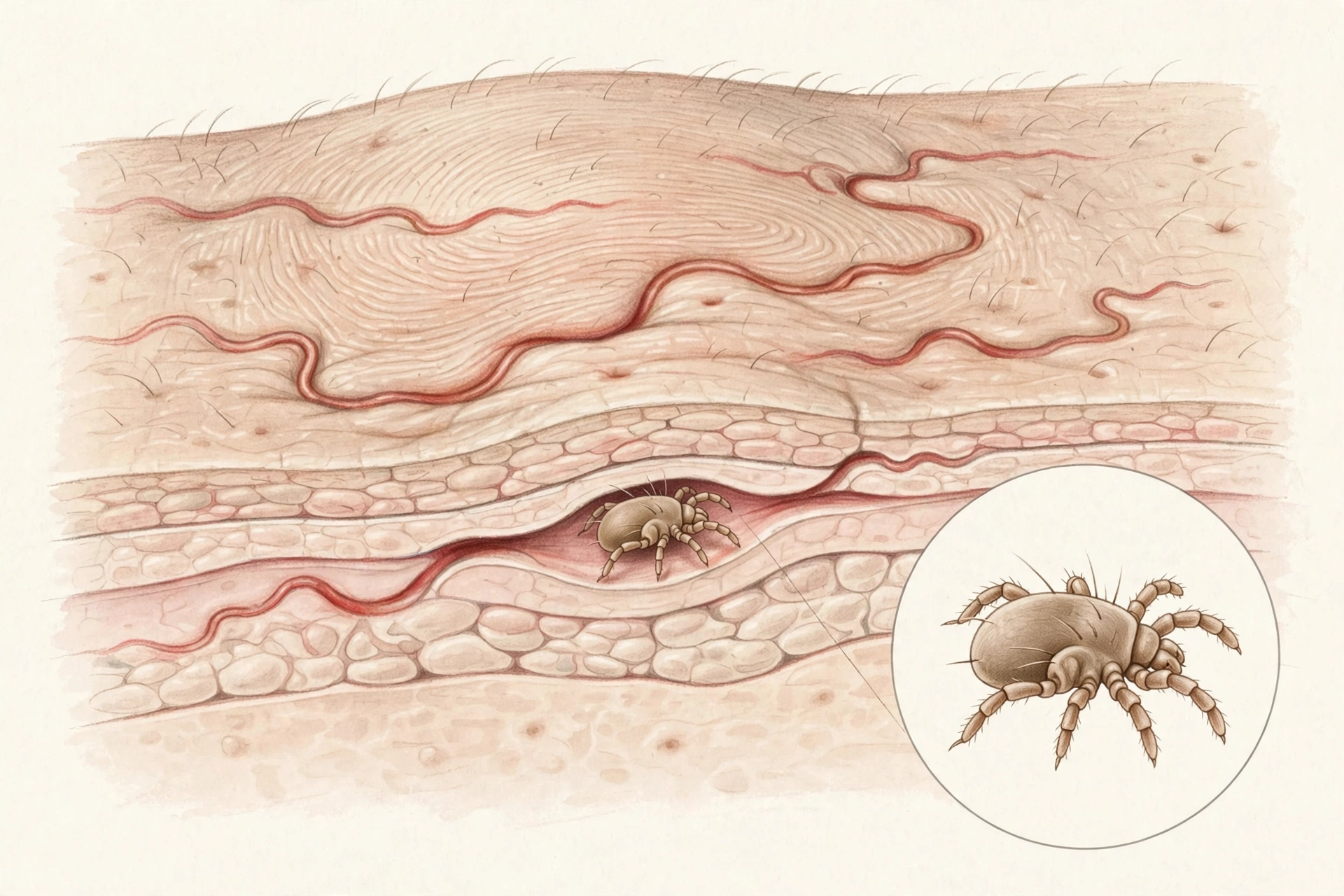
The classic scabies rash looks like small pimple-like bumps, often accompanied by thin, irregular “burrow tracks” — tiny grayish or reddish lines on the skin where the mites have tunneled. Common sites include between the fingers, the folds of the wrists, elbows and knees, the armpits, the waist, the buttocks, the nipples, and the penis. In infants and very young children, the rash can also appear on the head, face, neck, palms, and soles.
The burrow tracks are the signature clue on the parasitic side of the scabies vs herpes question.
Understanding Herpes: A Viral Infection
Herpes, by contrast, is caused by the herpes simplex virus (HSV), of which there are two types: HSV-1, which most commonly causes oral herpes (cold sores) but can also cause genital herpes, and HSV-2, which primarily causes genital herpes. Unlike scabies, herpes is a true viral infection: the virus lives inside nerve cells, alternating between dormant and active phases, and it can reactivate throughout life, producing recurrent outbreaks.
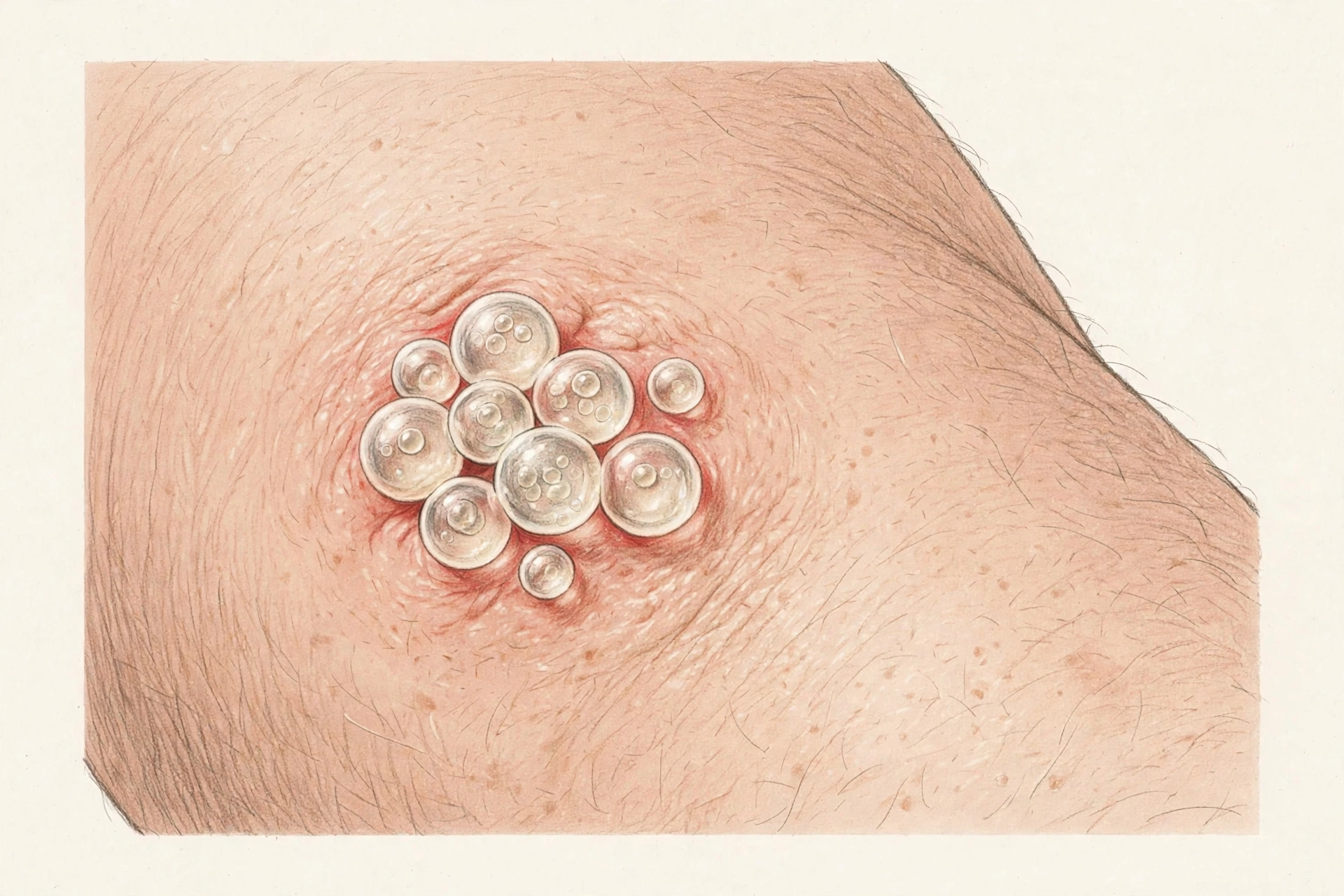
The World Health Organization estimates that most HSV infections are asymptomatic or unrecognized, yet when symptoms do occur, they typically take the form of painful blisters or open sores (ulcers) that can recur over time. A first outbreak often begins with tingling, itching, or burning near where the sores will appear, followed by bumps that develop into fluid-filled blisters. These blisters may break open, ooze, and then crust over before healing. First infections can also bring fever, body aches, and swollen lymph nodes.
Genital herpes spreads through sexual contact with the genital or anal surfaces, skin, sores, or fluids of an infected person. Crucially, HSV can be transmitted even when no symptoms are visible — asymptomatic shedding is one of the main reasons herpes is so widespread. Unlike scabies, herpes is not curable: medicines can shorten and ease outbreaks and reduce transmission risk, but the virus remains in the body. This lifelong viral persistence is the central contrast in any scabies vs herpes comparison. If you want a deeper dive into the virus itself, see our guide on herpes symptoms and testing.
Scabies vs Herpes at a Glance
Here is a head-to-head comparison of the key features that separate these two conditions. Use this scabies vs herpes table as a quick reference, then read the detailed symptom breakdown below.
| Feature | Scabies | Herpes |
|---|---|---|
| Cause | Parasitic mite (Sarcoptes scabiei) | Herpes simplex virus (HSV-1 or HSV-2) |
| Primary sensation | Intense itching, often worse at night; not usually painful | Pain, tenderness, or burning; itching is secondary |
| Appearance | Pimple-like rash with thin burrow tracks; no ulcers | Grouped fluid-filled blisters that break into painful ulcers and crust over |
| Typical locations | Between fingers, wrists, elbows, knees, armpits, waist, buttocks, penis, nipples | Mouth and lips, genitals, anus, sometimes fingers (herpetic whitlow) |
| Incubation | 4–8 weeks on first infestation; 1–4 days on reinfestation | 2–12 days before the first outbreak (if symptoms appear at all) |
| Course | Persists and spreads until treated; does not recur on its own once cured | Initial outbreak heals, then recurrent outbreaks possible for life |
| Contagious period | Contagious before and during symptoms; mites die within 2–3 days off human skin | Most contagious during active outbreaks; can shed asymptomatically between outbreaks |
| Diagnosis | Skin scraping examined under a microscope for mites, eggs, or feces | Viral culture or PCR swab of an active sore; blood tests can detect past infection |
| Treatment | Prescription scabicidal cream, lotion, or pill that kills the mites; all close contacts treated simultaneously | Antiviral medicines that shorten outbreaks and reduce recurrence; no cure |
How to Tell the Difference: Symptom by Symptom
When you compare scabies vs herpes symptom by symptom, four clues separate them: what the lesions look like, whether pain or itch dominates, where they appear, and how they behave over time.
The lesions themselves
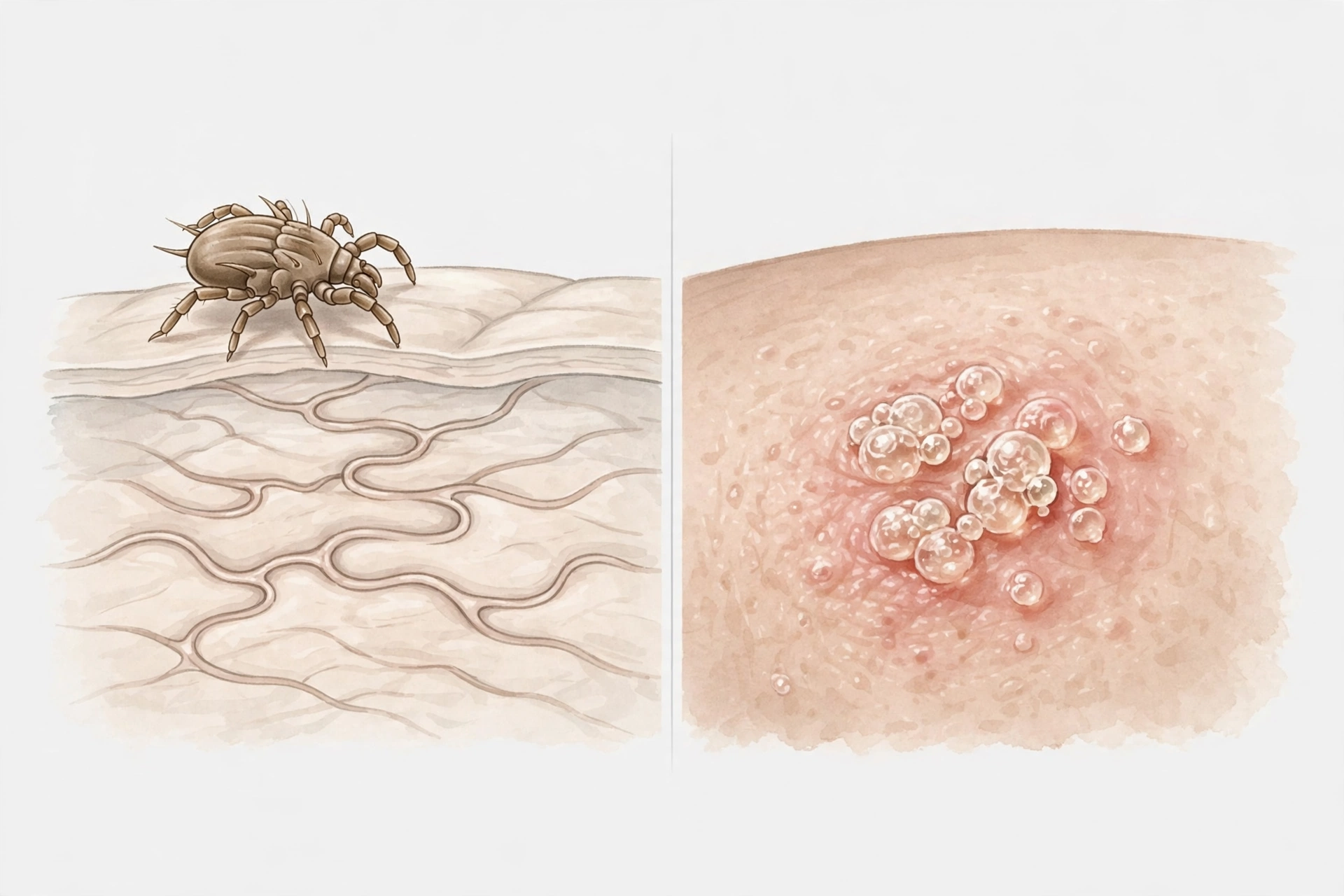
The single most reliable visual clue is what the spots look like. Scabies produces small red, pimple-like bumps and, in many cases, the telltale burrow tracks — thin, wavy, slightly raised lines a few millimeters long. The skin is itchy but intact: scabies does not form open ulcers. Herpes, on the other hand, produces clusters of small, clear fluid-filled blisters grouped tightly together on a reddened base. Those blisters break open to form shallow, tender ulcers that ooze and eventually crust over. In the scabies vs herpes visual test, broken blisters and crusting ulcers point to herpes, while intact itchy bumps with burrow tracks point to scabies. If you are seeing actual blisters or ulcers that break and scab, that points toward herpes, not scabies.
Pain versus itch
Ask yourself which sensation dominates. Scabies is famous for itching “like nothing else” — an intense, maddening itch that characteristically worsens at night — but it is not typically painful or tender to the touch. Herpes lesions are usually tender, sore, or burning when touched. The outbreak may start with tingling, itching, or a burning prodrome, but once the sores appear, pain is the dominant feature.
Where it shows up
Scabies has preferred territory: the webs between the fingers, the inner wrists, the elbows, knees, armpits, waistline, buttocks, and (in adults) the genitals and nipples. It often appears symmetrically on both sides of the body. Herpes outbreaks tend to be localized to one spot — around the mouth, on the genitals or anus, or on a finger — and recur in roughly the same place each time.
The timeline
Scabies is a slow burn: on a first infestation, weeks can pass before the itching starts, and once it starts, it steadily intensifies and spreads until treated. Herpes is episodic: a first outbreak appears days to weeks after exposure, lasts one to several weeks, and then heals completely — only to return later in recurrent episodes that are usually shorter and milder than the first. To learn how oral and genital presentations differ, read our article on oral vs genital herpes differences.
Genital Scabies vs Genital Herpes: The Most Confusing Case
The confusion between scabies and herpes is at its worst when symptoms appear on or around the genitals. Scabies commonly involves the penis and the surrounding genital skin, producing an intensely itchy rash with small bumps — and because it appeared after sexual contact, it is easily mistaken for genital herpes or another sexually transmitted infection. This is why people who develop genital-area symptoms should be tested broadly rather than assuming a single cause. Our STI testing guide explains when and how often testing is appropriate.
The distinctions still apply in the genital area: genital herpes tends to produce painful, tender, clustered blisters that ulcerate and crust, often preceded by tingling or burning. Genital scabies produces intensely itchy bumps and possibly burrow tracks, without blisters or open ulcers. Another clue is the company the symptoms keep: if you are also itching between your fingers, at your wrists, or around your waist, scabies becomes much more likely, because genital herpes stays local while scabies is usually a body-wide infestation.
There is also an important practical difference in how partners are handled. With scabies, every household member and close contact — including sexual partners — should be treated at the same time as the infested person, even if they have no symptoms, because the mites’ long incubation period means contacts may already be infested without knowing it. With genital herpes, management centers on disclosure to partners, avoiding sexual activity during outbreaks, and consistent condom use to reduce transmission risk.
How Clinicians Tell Them Apart: The Tests
You cannot reliably diagnose either condition at home — this is where professional evaluation is essential, and it is one more reason the two are often confused, since both are sometimes misdiagnosed on visual inspection alone. Sorting out scabies vs herpes in the clinic comes down to two completely different tests.
For scabies, a clinician may start with a physical examination and history, but confirmation typically requires finding the mite, its eggs, or its feces. This is done by scraping the skin at the site of a burrow or bump and examining the sample under a microscope, or by carefully extracting a mite from the end of its burrow with a needle. An ink test — applying ink to the skin and wiping it away so burrows remain visible — or dermoscopy can also support the diagnosis. Note that a negative scraping does not fully rule out scabies, since a healthy person may carry fewer than 10–15 mites.
For herpes, the gold-standard test during an active outbreak is a swab of one of the sores for viral culture or, more commonly now, PCR (nucleic acid amplification) testing, which detects the virus’s genetic material. Between outbreaks, blood tests can detect antibodies showing past infection with HSV-1 or HSV-2, though they cannot tell you where on the body the infection is located.
Because the tests are so different — a microscope slide versus a viral swab — getting the right diagnosis is simply a matter of being evaluated for both possibilities. If you have been treated for one and the symptoms persist or do not behave as expected, ask your clinician about the other.
Treatment Differences: What to Expect
Treatment is where scabies and herpes diverge most sharply. Scabies is curable: a clinician prescribes a scabicidal product — a cream, lotion, or pill — that kills the mites, and with correct use the infestation is eliminated. Everyone with close skin contact must be treated at the same time to prevent reinfestation, and clothing, bedding, and towels used in the days before treatment are washed in hot water and dried on a hot cycle. The scabies vs herpes treatment divide is stark: scabies is curable, while herpes is managed for life.
One common source of confusion after treatment: because the itch is an allergic reaction to the mites and their droppings, itching can continue for two to four weeks even after every mite is dead. This lingering itch does not mean the treatment failed — but if new burrows or rash appear, retreatment may be needed.
Herpes, in contrast, has no cure. Outbreaks are managed with antiviral medicines, which work best when started within 48 hours of symptoms appearing and can shorten episodes and reduce their severity. People with frequent or severe recurrences may take daily suppressive therapy, which also lowers the risk of passing the virus to partners. Symptomatic relief measures include warm baths for genital outbreaks and loose-fitting clothing. For practical day-to-day strategies, see our guide on managing herpes outbreaks.
A special note on crusted scabies: this severe form, which can develop in people with weakened immune systems, involves thick crusts containing enormous numbers of mites and is highly contagious. It requires prompt medical attention and can trigger outbreaks in care facilities — another reason any suspected scabies case should be evaluated rather than self-managed.
Prevention and Partner Protection
Preventing scabies centers on avoiding prolonged skin-to-skin contact with someone who is infested and not sharing clothing, towels, or bedding. In households, simultaneous treatment of all close contacts and hot-water laundering of fabrics are the key control measures.
Preventing herpes centers on safer sexual practices: avoiding sexual activity during outbreaks, consistent and correct condom use (which reduces but does not eliminate risk, since the virus can spread from skin not covered by a condom), open communication with partners, and never sharing items that have touched oral sores. Because the virus can be transmitted when no symptoms are visible, these precautions apply even between outbreaks.
When it comes to scabies vs herpes prevention, scabies control targets skin contact and fabrics, while herpes prevention targets sexual transmission routes.
Frequently Asked Questions
These are the scabies vs herpes questions clinicians hear most often.
Can you have scabies and herpes at the same time?
Yes. Scabies and herpes are caused by completely different organisms — a mite and a virus — so there is no biological reason they cannot coexist. In fact, having scabies can increase scratching and skin damage, and any unexplained genital sore should be evaluated for herpes regardless of a scabies diagnosis. If symptoms do not fully resolve after appropriate treatment for one condition, ask your clinician to evaluate for the other.
Does scabies turn into herpes?
No. Scabies is a parasitic infestation and herpes is a viral infection; one cannot transform into the other. However, scabies can be mistaken for herpes (especially genital scabies mistaken for genital herpes), which is why laboratory confirmation matters when the diagnosis is uncertain.
Is scabies an STI?
Scabies is not classified as a sexually transmitted infection, because it spreads through any prolonged skin-to-skin contact — not just sexual contact — and it is common in households, childcare settings, and care facilities. That said, scabies can be transmitted during sexual activity because of the close skin contact involved, which is part of why the two are confused.
Which is worse: scabies or herpes?
“Worse” depends on what you mean. Scabies is curable with a single course of treatment, but the itching can be severe and sleep-disrupting, and outbreaks can sweep through households or facilities. Herpes is incurable and recurrent, but many people have mild or asymptomatic infections and manage outbreaks effectively with antiviral therapy. Both are manageable with proper medical care.
How quickly will treatment work?
Scabies treatment kills the mites quickly, though the allergic itching may take two to four weeks to fully settle. Antiviral treatment for herpes works best when started within 48 hours of an outbreak’s first symptoms and can shorten the episode, but it does not remove the virus from the body. Your clinician can advise on what timeline to expect in your specific situation.
Can scabies be transmitted through bedding or clothing?
Yes, though this is less common than direct skin-to-skin transmission. Scabies mites generally do not survive more than two to three days away from human skin, which is why control measures focus on hot-water washing and hot drying of clothing, towels, and bedding used in the days before treatment. Herpes, by contrast, does not spread through bedding or clothing.
Do I need to tell my partner if I have scabies or herpes?
With scabies, all close contacts — including sexual partners and household members — should be treated at the same time as you, even without symptoms, to prevent reinfestation. With herpes, partners should be informed so they can make informed decisions, and sexual activity should be avoided during outbreaks. Honest communication protects both partners in either case.
Medical disclaimer: This article is for educational purposes only and is not a substitute for professional medical advice, diagnosis, or treatment. Skin rashes and sores can have many causes, and only a qualified clinician who examines you — and, when needed, performs laboratory testing — can determine what condition you have. Never attempt to diagnose or treat yourself based on online information. If you have symptoms that concern you, consult a qualified healthcare provider promptly.