Alcohol and Female Libido: What Research Finds
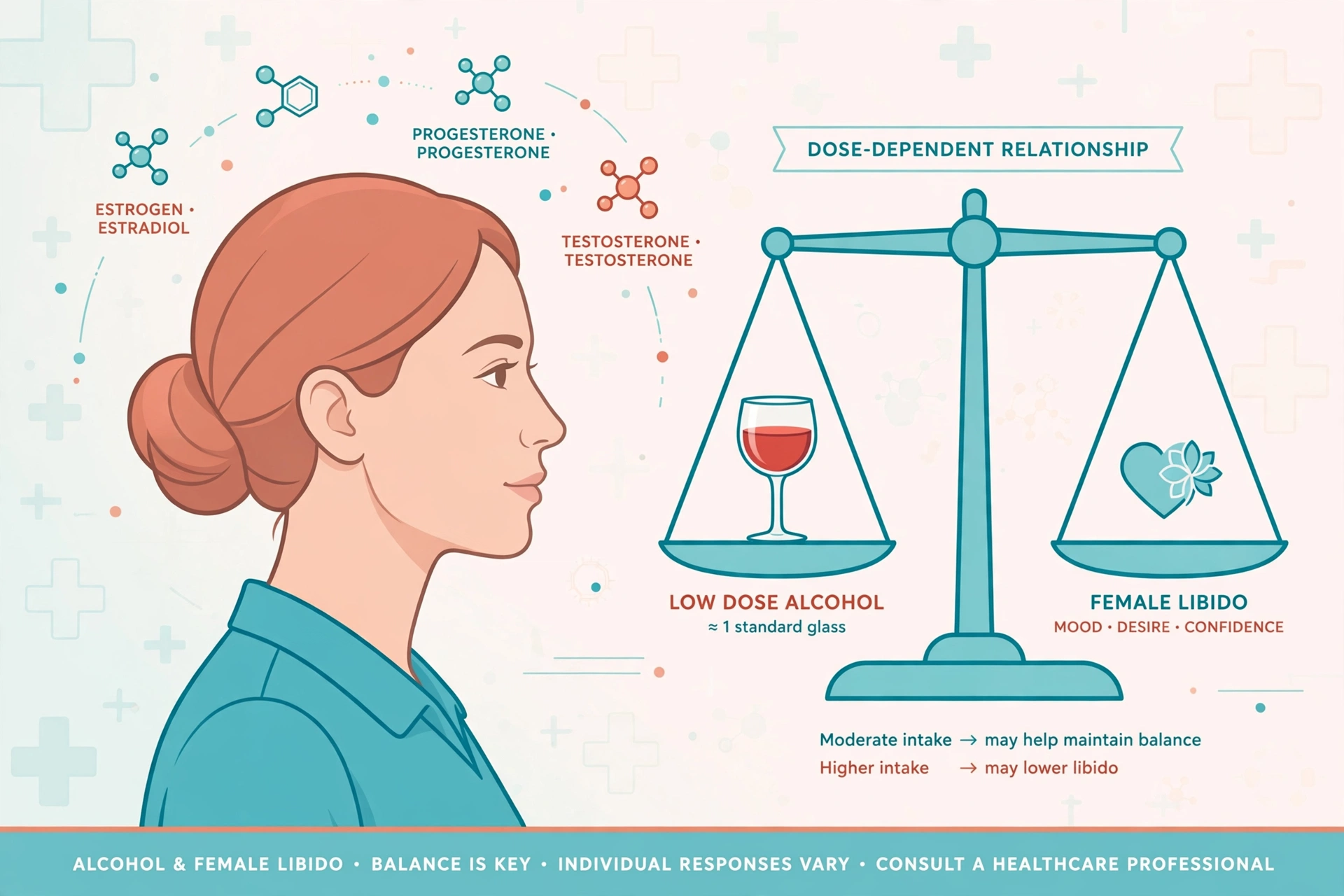
Does a glass of wine make a woman want sex more, or less? Popular culture leans hard one way — alcohol is sold as a social lubricant that loosens inhibitions and stokes desire. But alcohol and libido have a far more complicated relationship than the “romantic drink” trope suggests. Researchers have been studying this question for decades, and the picture that emerges is consistent: the effect depends almost entirely on dose. A small amount can temporarily lift desire and ease anxiety around intimacy, while heavier drinking reliably suppresses arousal, delays orgasm, and, over time, damages sexual health.
This article reviews what the research actually finds — from hormone studies and lab experiments to large surveys — so you can separate evidence from folklore.
The Short Answer: Alcohol and Libido Follow a Dose Curve
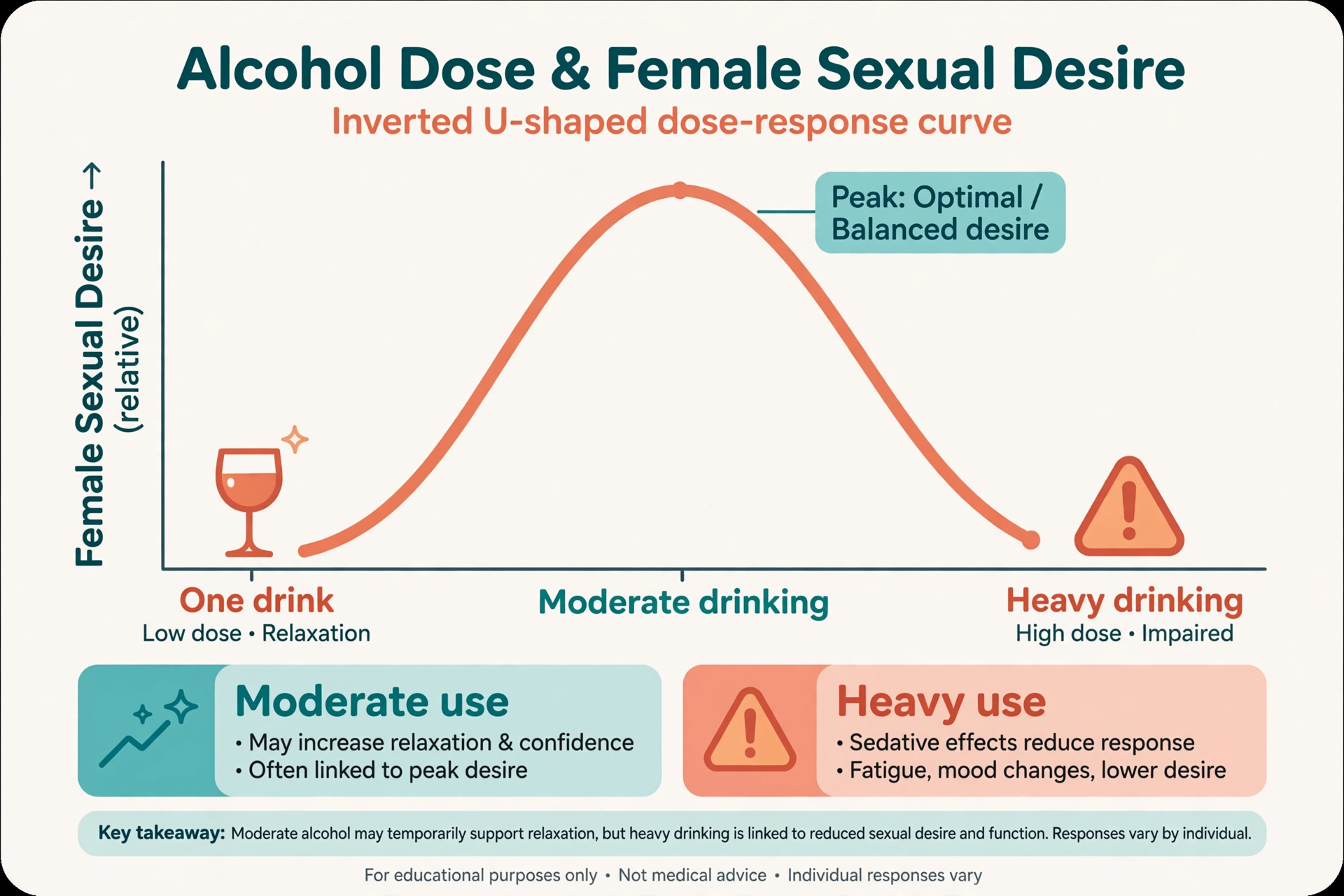
If the entire scientific literature on alcohol and libido could be squeezed into one sentence, it would be this: low doses tend to increase how much desire a woman feels, while higher doses suppress it. The pattern is so consistent that researchers describe it as a dose-response curve shaped like an inverted U: desire rises slightly with one drink, plateaus, then falls as blood alcohol concentration climbs.
Here is the pattern in plain terms:
| Amount | What studies typically find |
|---|---|
| About one drink | Increased self-reported desire and sexual activity; relaxation and reduced performance anxiety |
| Two to three drinks | Mixed results — some women feel more desire, physiological arousal often begins to decline |
| Heavy drinking / intoxication | Suppressed arousal, delayed or absent orgasm, poorer overall sexual experience |
| Chronic heavy use | Lower desire, sexual dysfunction, hormonal disruption, relationship strain |
In a broad review of the alcohol-and-sex literature covering more than a hundred experimental studies, researchers found that 13 of 16 studies showed women reporting increased sexual arousal as they became mildly intoxicated — but at high doses, what psychologists call “stumbling drunkenness,” arousal was suppressed. That finding captures the whole story: alcohol provokes desire at low levels and takes away performance at high ones.
How Alcohol Acts on the Female Body and Brain
To understand the research, it helps to know what alcohol does inside a woman’s body — because it does not act the same way it does in a man’s.
Women metabolize alcohol differently
Alcohol is water-soluble: after absorption, it distributes into the body’s water compartments. Women, on average, have a higher proportion of body fat and less body water than men of the same weight, which means less water is available to dilute the alcohol. The result is that a woman typically reaches a higher blood alcohol concentration than a man after the same number of drinks — and her body takes longer to clear it, roughly a third longer by some estimates.
Practically, this means the “one drink” that research associates with increased desire may arrive faster and linger longer in women, and the dose at which the curve turns downward can be lower than many people expect.
The brain gets two opposing messages
Alcohol is a central nervous system depressant, but its first noticeable effects feel like stimulation: talkativeness, lowered inhibitions, reduced social anxiety. The reason is that alcohol initially dampens activity in the prefrontal cortex — the brain region involved in self-monitoring and restraint — while enhancing the release of dopamine in reward pathways.
This two-stage action explains the libido paradox. At low doses, the disinhibiting effect dominates: a woman may feel more relaxed, more confident, and more open to intimacy. As the dose rises, the depressant effect takes over: reaction times slow, sensory perception dulls, and the physiological machinery of arousal — blood flow, nerve sensitivity, lubrication — begins to work less well. The same drug produces both halves of the curve.
What the Research Shows About Desire, Arousal, and Orgasm
Scientists distinguish between three things that everyday language lumps together as “libido”: desire (the mental interest in sex), physiological arousal (the body’s response, such as increased blood flow and lubrication), and orgasm. Alcohol affects each of them differently.
Desire: what women report feeling
Across laboratory and survey studies, the most robust finding is that women who have had one or two drinks report feeling more sexually interested than when sober. In one widely cited synthesis, 13 of 16 studies found that self-reported sexual arousal increased as women became intoxicated. This is the effect most people notice in themselves — and the one that feeds the cultural belief that alcohol is an aphrodisiac.
Physiological arousal: what the body actually does
Here the research gets more interesting — and more divided. When researchers measure genital arousal directly (in studies using instruments such as vaginal photoplethysmography, which measures changes in vaginal blood volume), mild intoxication produces inconsistent results: about half of the studies show no change in physiological arousal, and the other half show a decline. In other words, how aroused a woman feels after drinking does not reliably match how her body is responding.
This disconnect matters. A woman may feel quite interested in intimacy after a couple of drinks while her body’s arousal response is actually diminished — a mismatch that can lead to frustration or discomfort during sex. At higher doses, the physiological picture becomes clearer: genital response declines, natural lubrication decreases, and sensitivity dulls.
Orgasm: delayed, diminished, or absent
The research on orgasm is more consistent than the research on arousal — and less favorable. Intoxication is associated with longer orgasmic latencies (it takes longer to reach orgasm), reduced intensity of orgasm, and, at higher doses, an inability to reach orgasm at all. A 2016 study found that alcohol negatively affected how positive the overall sexual experience was for both women and men.
So the pattern across the three phases is: desire may rise briefly at low doses, the body’s arousal response is unreliable, and orgasmic function suffers — all of which is exactly what you would expect from a depressant drug acting on the nervous system.
The Hormone Angle: Testosterone, Estrogen, and the Red-Wine Study
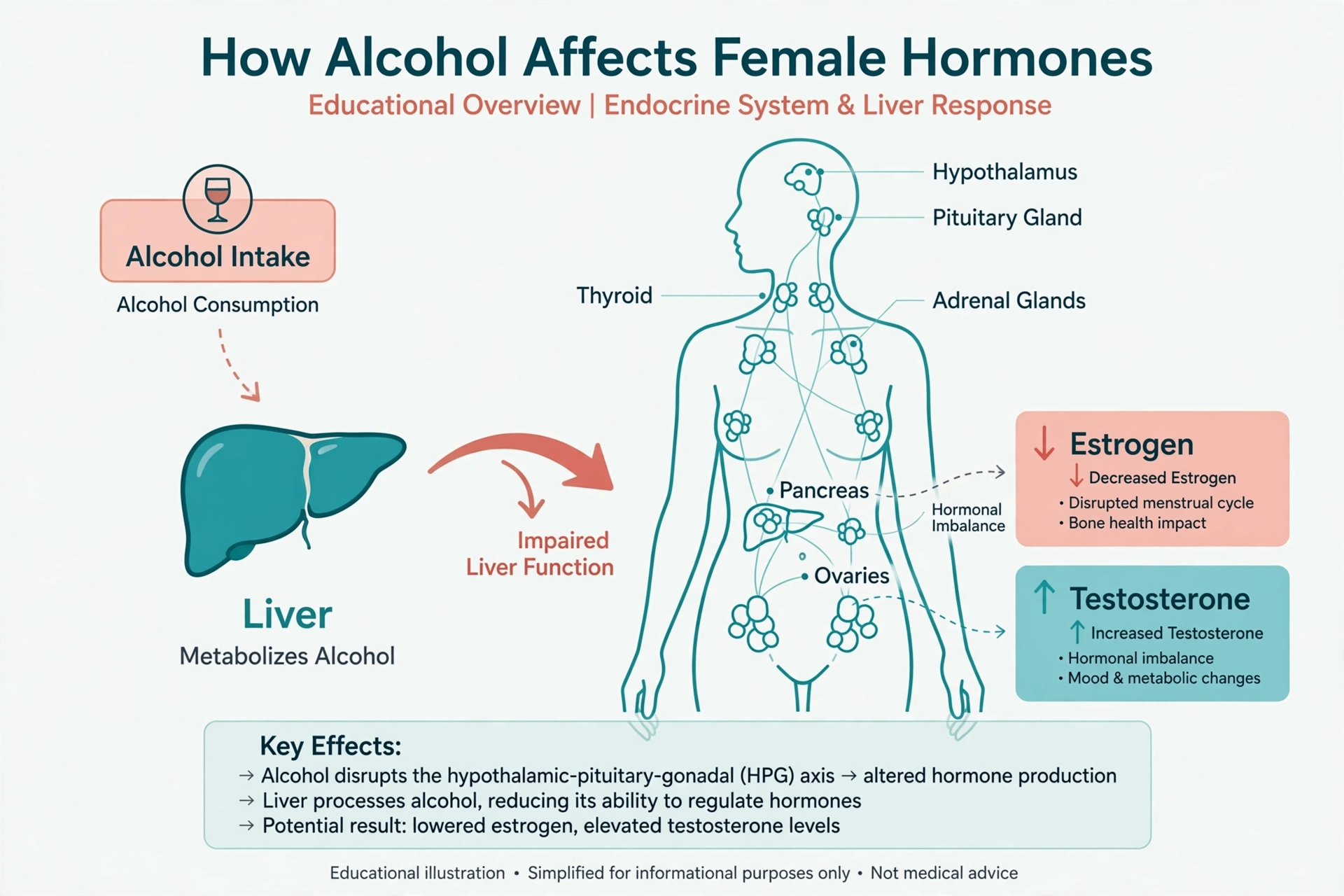
Hormones add another layer to the story. In women, testosterone — often thought of as a male hormone — plays an important role in sexual desire. Several studies have found that acute alcohol consumption causes a temporary rise in testosterone and estradiol levels in premenopausal women, which could provide a physiological basis for the brief increase in desire some women notice after drinking. Interestingly, the effect appeared most pronounced in women taking hormonal birth control.
One of the most discussed studies in this area comes from the Santa Maria Nuova Hospital in Florence, published in The Journal of Sexual Medicine in 2009. Researchers surveyed 789 Italian women aged 18 to 50 and found that those who drank one to two glasses of red wine per day scored higher on standardized measures of sexual function — including desire — than women who abstained or drank more. The researchers proposed that red wine’s antioxidant polyphenols, combined with its relaxing effect, might contribute to the finding.
It is worth treating this study with appropriate caution: it was observational, so it cannot prove that the wine caused the difference. Women who drink moderate amounts of red wine may differ from abstainers in many other ways — stress levels, relationship satisfaction, overall health habits — that also influence desire. For more on the broader hormonal picture, see our guide to hormones and female libido.
Alcohol Expectancy: Belief Itself Changes the Experience
One of the most fascinating findings in this literature has nothing to do with chemistry. In classic experiments, researchers gave some participants alcohol and others a placebo drink that merely tasted like alcohol — and found that women who believed they had been drinking reported increased arousal even when they had consumed no alcohol at all.
Psychologists call this alcohol expectancy: because drinking situations (dates, parties, celebrations) are culturally linked to romance and sex, people anticipate feeling more desire when alcohol is present, and that expectation can be self-fulfilling. The implication is practical as well as scientific — some of the “libido boost” people attribute to a drink may actually come from the setting, the mood, and the expectation, not the ethanol.
This also helps explain why the research sometimes looks contradictory: if expectation drives part of the effect, then a woman’s beliefs about alcohol, her comfort with her partner, and the social context all shape the outcome alongside the dose.
Chronic and Heavy Drinking: Where the Curve Bends Down
Everything discussed so far concerns occasional, moderate drinking. The research on chronic heavy drinking and alcohol use disorder paints a consistently negative picture for women’s sexual health:
- Persistent low desire. Women with alcohol use disorder report lower sexual desire and higher rates of sexual dysfunction than women in the general population. When desire is chronically suppressed, couples often find that intimacy becomes infrequent or stops feeling pleasurable.
- Hormonal disruption. Long-term heavy drinking can disrupt the menstrual cycle, reduce estrogen production, and contribute to conditions such as anovulation — all of which can dampen libido and affect fertility.
- Vaginal dryness and pain. Chronic alcohol use is associated with reduced vaginal lubrication, which can make intercourse uncomfortable and further reduce interest in sex.
- Mood and sleep effects. Heavy drinking worsens anxiety and depression and fragments sleep — and poor mental health and poor sleep are themselves two of the strongest known suppressors of sexual desire. Alcohol may therefore lower libido indirectly even on days when a woman is not drinking.
- Relationship strain. Alcohol misuse is linked to more conflict, less emotional closeness, and higher rates of intimate partner problems — and emotional disconnection is one of the most common reasons women report low desire.
The good news in this literature is that many of these effects improve when heavy drinking stops. Studies of women in recovery from alcohol use disorder generally show improvements in sexual function and desire over time, particularly when mood and relationship quality also improve.
Life Stages That Change the Equation
A woman’s age, hormonal status, and medications change how alcohol interacts with libido — an angle most general articles on this topic skip.
Hormonal birth control
As noted above, the temporary testosterone surge after drinking appears stronger in women using hormonal contraception. That does not mean the pill plus alcohol is a libido strategy — hormonal birth control itself can lower desire in some women, and alcohol adds its own dose-dependent effects. If you use hormonal contraception and have noticed changes in your sex drive, that is a topic worth raising with your clinician rather than self-managing with alcohol.
Midlife and menopause
During perimenopause and after menopause, estrogen decline already brings changes — reduced desire, vaginal dryness, and longer arousal times are common. Alcohol’s depressant and drying effects can compound these: it may worsen hot flashes and night sweats, fragment already-fragile sleep, and add dryness to tissue that is already estrogen-deprived. Women in this life stage often find that even amounts of alcohol that once felt harmless now noticeably affect their interest in and comfort during intimacy. For more, read our article on menopause and changes in sex drive.
Consent, Safety, and Sexual Health
No honest article on this topic can skip the safety dimension. Because alcohol impairs judgment and because women reach higher blood alcohol levels than men after the same drinks, drinking raises real risks around sexual health and consent:
- People who are intoxicated are less likely to discuss contraception and use condoms consistently — and when condoms are used while intoxicated, they are more likely to be used incorrectly.
- Alcohol is the substance most commonly involved in drug-facilitated sexual assault; most assaults involve alcohol the victim consumed voluntarily. A person who is incapacitated by alcohol cannot give consent.
- Researchers have found that men perceive women holding alcoholic drinks as more sexually available — a perception gap that makes clear communication and sober check-ins with a partner especially important when drinking is involved.
The practical takeaway: decisions about intimacy are best made before drinking begins, not during. Discussing boundaries and contraception with a partner while sober protects both people.
Practical Ways to Keep Alcohol From Undermining Your Sex Life
You do not need a medical degree to apply what the research shows. Consider these evidence-informed habits:
- Stay at the low end of the curve. Public health guidance in many countries sets the low-risk limit for women at one standard drink or fewer per day. If you enjoy a drink before intimacy, keeping it to one is the amount most consistent with the desire-preserving part of the curve.
- Eat and hydrate first. Drinking on an empty stomach spikes blood alcohol faster, pushing you past the beneficial part of the curve sooner.
- Notice the mismatch. If you feel interested but your body is not responding — dryness, difficulty reaching orgasm — that is the subjective-objective disconnect the research describes. A water-based lubricant and slowing down can help in the moment; repeatedly needing more alcohol to feel interested is a sign to step back.
- Protect sleep. Alcohol fragments sleep even in moderate amounts, and poor sleep reliably lowers next-day desire. If your sex life matters to you, the nightcap is working against it.
- Talk with your partner sober. Desire, boundaries, and what feels good are conversations that go better without alcohol. Couples who communicate openly about intimacy report higher satisfaction regardless of drinking habits.
- Track patterns, not just drinks. For a few weeks, note your drinking and your interest in intimacy. Many women discover their own personal curve — and are surprised at where it turns.
When to Talk to a Clinician
Consider speaking with a doctor, gynecologist, or sexual health counselor if any of the following apply:
- Your interest in sex has dropped noticeably and stayed low for months.
- You find you need alcohol to feel interested in or comfortable with intimacy.
- Drinking is affecting your relationship, your mood, or your ability to meet daily responsibilities.
- You experience pain, persistent dryness, or inability to reach orgasm that does not improve.
- You are trying to conceive, are pregnant, or could become pregnant — in which case no amount of alcohol is considered safe.
Persistent low desire has many possible contributors — stress, medications, thyroid problems, depression, relationship difficulties — and a clinician can help sort through them. Our overview of low libido in women covers the most common causes and what evaluation usually involves.
Medical disclaimer: This article is for educational purposes only and is not medical advice. It does not diagnose any condition and does not replace professional evaluation or treatment. Alcohol affects everyone differently, and medication interactions vary. If you have questions about alcohol use, sexual health, or any symptom described here, please consult a qualified clinician. If you or someone you know is struggling with alcohol use, confidential help is available through national helplines and treatment services in your country.
Frequently Asked Questions
Does alcohol increase female libido?
At low doses — typically about one drink — many women report a temporary increase in sexual desire, likely due to reduced inhibitions, relaxation, and possibly a short-lived rise in testosterone. At higher doses, alcohol suppresses arousal, delays orgasm, and worsens the overall sexual experience. The effect is dose-dependent, not a simple yes or no.
Why do I feel more aroused after drinking even though my body doesn’t respond?
Research shows a real disconnect between subjective and physiological arousal in women: you can feel quite interested while measurable genital response is unchanged or reduced. Alcohol enhances the feeling of arousal (through disinhibition and expectation) while its depressant effects can blunt the body’s response. This mismatch is well documented in laboratory studies.
Does red wine really boost women’s sex drive?
One Italian study of 789 women found that those drinking one to two glasses of red wine daily scored higher on sexual function measures than abstainers. However, the study was observational and cannot prove cause and effect. Moderate red wine drinkers may differ in many other lifestyle factors that also influence desire. It is interesting evidence, not a prescription.
Can drinking too much cause long-term loss of libido in women?
Chronic heavy drinking is consistently linked to lower sexual desire, sexual dysfunction, hormonal disruption, and menstrual irregularities. The encouraging finding is that sexual function often improves after sustained reduction or cessation of heavy drinking, especially when mood and relationship quality improve alongside it.
Is it safe to mix alcohol with birth control?
Alcohol does not make hormonal birth control less effective at preventing pregnancy, but it can make you forget a pill or patch change, which does reduce protection. Some research also suggests the hormonal effects of alcohol on libido may be stronger in women using hormonal contraception. If you use contraception and drink, set reminders and discuss any libido changes with your clinician.
How much alcohol is considered low-risk for women?
Public health authorities such as the CDC and the U.S. Dietary Guidelines advise women who drink to limit intake to one standard drink or fewer per day — and note that drinking less is better for health. A standard drink is about 12 ounces of beer, 5 ounces of wine, or 1.5 ounces of spirits. For more on official guidance, see the CDC’s overview of alcohol use.
Should I avoid alcohol completely for a better sex life?
Not necessarily. The research does not show that light, occasional drinking harms women’s sexual health. But if you notice that alcohol is consistently followed by poorer arousal, difficulty with orgasm, or next-day low desire — or if you feel you need it to be intimate — cutting back or taking a break is a reasonable experiment, and one many women find improves their sex life.
Does a glass of wine make a woman want sex more, or less? Popular culture leans hard one way — alcohol is sold as a social lubricant that loosens inhibitions and stokes desire. But alcohol and libido have a far more complicated relationship than the “romantic drink” trope suggests. Researchers have been studying this question for decades, and the picture that emerges is consistent: the effect depends almost entirely on dose. A small amount can temporarily lift desire and ease anxiety around intimacy, while heavier drinking reliably suppresses arousal, delays orgasm, and, over time, damages sexual health.
This article reviews what the research actually finds — from hormone studies and lab experiments to large surveys — so you can separate evidence from folklore.
The Short Answer: Alcohol and Libido Follow a Dose Curve
If the entire scientific literature on alcohol and libido could be squeezed into one sentence, it would be this: low doses tend to increase how much desire a woman feels, while higher doses suppress it. The pattern is so consistent that researchers describe it as a dose-response curve shaped like an inverted U: desire rises slightly with one drink, plateaus, then falls as blood alcohol concentration climbs.
Here is the pattern in plain terms:
| Amount | What studies typically find |
|---|---|
| About one drink | Increased self-reported desire and sexual activity; relaxation and reduced performance anxiety |
| Two to three drinks | Mixed results — some women feel more desire, physiological arousal often begins to decline |
| Heavy drinking / intoxication | Suppressed arousal, delayed or absent orgasm, poorer overall sexual experience |
| Chronic heavy use | Lower desire, sexual dysfunction, hormonal disruption, relationship strain |
In a broad review of the alcohol-and-sex literature covering more than a hundred experimental studies, researchers found that 13 of 16 studies showed women reporting increased sexual arousal as they became mildly intoxicated — but at high doses, what psychologists call “stumbling drunkenness,” arousal was suppressed. That finding captures the whole story: alcohol provokes desire at low levels and takes away performance at high ones.
How Alcohol Acts on the Female Body and Brain
To understand the research, it helps to know what alcohol does inside a woman’s body — because it does not act the same way it does in a man’s.
Women metabolize alcohol differently
Alcohol is water-soluble: after absorption, it distributes into the body’s water compartments. Women, on average, have a higher proportion of body fat and less body water than men of the same weight, which means less water is available to dilute the alcohol. The result is that a woman typically reaches a higher blood alcohol concentration than a man after the same number of drinks — and her body takes longer to clear it, roughly a third longer by some estimates.
Practically, this means the “one drink” that research associates with increased desire may arrive faster and linger longer in women, and the dose at which the curve turns downward can be lower than many people expect.
The brain gets two opposing messages
Alcohol is a central nervous system depressant, but its first noticeable effects feel like stimulation: talkativeness, lowered inhibitions, reduced social anxiety. The reason is that alcohol initially dampens activity in the prefrontal cortex — the brain region involved in self-monitoring and restraint — while enhancing the release of dopamine in reward pathways.
This two-stage action explains the libido paradox. At low doses, the disinhibiting effect dominates: a woman may feel more relaxed, more confident, and more open to intimacy. As the dose rises, the depressant effect takes over: reaction times slow, sensory perception dulls, and the physiological machinery of arousal — blood flow, nerve sensitivity, lubrication — begins to work less well. The same drug produces both halves of the curve.
What the Research Shows About Desire, Arousal, and Orgasm
Scientists distinguish between three things that everyday language lumps together as “libido”: desire (the mental interest in sex), physiological arousal (the body’s response, such as increased blood flow and lubrication), and orgasm. Alcohol affects each of them differently.
Desire: what women report feeling
Across laboratory and survey studies, the most robust finding is that women who have had one or two drinks report feeling more sexually interested than when sober. In one widely cited synthesis, 13 of 16 studies found that self-reported sexual arousal increased as women became intoxicated. This is the effect most people notice in themselves — and the one that feeds the cultural belief that alcohol is an aphrodisiac.
Physiological arousal: what the body actually does
Here the research gets more interesting — and more divided. When researchers measure genital arousal directly (in studies using instruments such as vaginal photoplethysmography, which measures changes in vaginal blood volume), mild intoxication produces inconsistent results: about half of the studies show no change in physiological arousal, and the other half show a decline. In other words, how aroused a woman feels after drinking does not reliably match how her body is responding.
This disconnect matters. A woman may feel quite interested in intimacy after a couple of drinks while her body’s arousal response is actually diminished — a mismatch that can lead to frustration or discomfort during sex. At higher doses, the physiological picture becomes clearer: genital response declines, natural lubrication decreases, and sensitivity dulls.
Orgasm: delayed, diminished, or absent
The research on orgasm is more consistent than the research on arousal — and less favorable. Intoxication is associated with longer orgasmic latencies (it takes longer to reach orgasm), reduced intensity of orgasm, and, at higher doses, an inability to reach orgasm at all. A 2016 study found that alcohol negatively affected how positive the overall sexual experience was for both women and men.
So the pattern across the three phases is: desire may rise briefly at low doses, the body’s arousal response is unreliable, and orgasmic function suffers — all of which is exactly what you would expect from a depressant drug acting on the nervous system.
The Hormone Angle: Testosterone, Estrogen, and the Red-Wine Study
Hormones add another layer to the story. In women, testosterone — often thought of as a male hormone — plays an important role in sexual desire. Several studies have found that acute alcohol consumption causes a temporary rise in testosterone and estradiol levels in premenopausal women, which could provide a physiological basis for the brief increase in desire some women notice after drinking. Interestingly, the effect appeared most pronounced in women taking hormonal birth control.
One of the most discussed studies in this area comes from the Santa Maria Nuova Hospital in Florence, published in The Journal of Sexual Medicine in 2009. Researchers surveyed 789 Italian women aged 18 to 50 and found that those who drank one to two glasses of red wine per day scored higher on standardized measures of sexual function — including desire — than women who abstained or drank more. The researchers proposed that red wine’s antioxidant polyphenols, combined with its relaxing effect, might contribute to the finding.
It is worth treating this study with appropriate caution: it was observational, so it cannot prove that the wine caused the difference. Women who drink moderate amounts of red wine may differ from abstainers in many other ways — stress levels, relationship satisfaction, overall health habits — that also influence desire. For more on the broader hormonal picture, see our guide to hormones and female libido.
Alcohol Expectancy: Belief Itself Changes the Experience
One of the most fascinating findings in this literature has nothing to do with chemistry. In classic experiments, researchers gave some participants alcohol and others a placebo drink that merely tasted like alcohol — and found that women who believed they had been drinking reported increased arousal even when they had consumed no alcohol at all.
Psychologists call this alcohol expectancy: because drinking situations (dates, parties, celebrations) are culturally linked to romance and sex, people anticipate feeling more desire when alcohol is present, and that expectation can be self-fulfilling. The implication is practical as well as scientific — some of the “libido boost” people attribute to a drink may actually come from the setting, the mood, and the expectation, not the ethanol.
This also helps explain why the research sometimes looks contradictory: if expectation drives part of the effect, then a woman’s beliefs about alcohol, her comfort with her partner, and the social context all shape the outcome alongside the dose.
Chronic and Heavy Drinking: Where the Curve Bends Down
Everything discussed so far concerns occasional, moderate drinking. The research on chronic heavy drinking and alcohol use disorder paints a consistently negative picture for women’s sexual health:
- Persistent low desire. Women with alcohol use disorder report lower sexual desire and higher rates of sexual dysfunction than women in the general population. When desire is chronically suppressed, couples often find that intimacy becomes infrequent or stops feeling pleasurable.
- Hormonal disruption. Long-term heavy drinking can disrupt the menstrual cycle, reduce estrogen production, and contribute to conditions such as anovulation — all of which can dampen libido and affect fertility.
- Vaginal dryness and pain. Chronic alcohol use is associated with reduced vaginal lubrication, which can make intercourse uncomfortable and further reduce interest in sex.
- Mood and sleep effects. Heavy drinking worsens anxiety and depression and fragments sleep — and poor mental health and poor sleep are themselves two of the strongest known suppressors of sexual desire. Alcohol may therefore lower libido indirectly even on days when a woman is not drinking.
- Relationship strain. Alcohol misuse is linked to more conflict, less emotional closeness, and higher rates of intimate partner problems — and emotional disconnection is one of the most common reasons women report low desire.
The good news in this literature is that many of these effects improve when heavy drinking stops. Studies of women in recovery from alcohol use disorder generally show improvements in sexual function and desire over time, particularly when mood and relationship quality also improve.
Life Stages That Change the Equation
A woman’s age, hormonal status, and medications change how alcohol interacts with libido — an angle most general articles on this topic skip.
Hormonal birth control
As noted above, the temporary testosterone surge after drinking appears stronger in women using hormonal contraception. That does not mean the pill plus alcohol is a libido strategy — hormonal birth control itself can lower desire in some women, and alcohol adds its own dose-dependent effects. If you use hormonal contraception and have noticed changes in your sex drive, that is a topic worth raising with your clinician rather than self-managing with alcohol.
Midlife and menopause
During perimenopause and after menopause, estrogen decline already brings changes — reduced desire, vaginal dryness, and longer arousal times are common. Alcohol’s depressant and drying effects can compound these: it may worsen hot flashes and night sweats, fragment already-fragile sleep, and add dryness to tissue that is already estrogen-deprived. Women in this life stage often find that even amounts of alcohol that once felt harmless now noticeably affect their interest in and comfort during intimacy. For more, read our article on menopause and changes in sex drive.
Consent, Safety, and Sexual Health
No honest article on this topic can skip the safety dimension. Because alcohol impairs judgment and because women reach higher blood alcohol levels than men after the same drinks, drinking raises real risks around sexual health and consent:
- People who are intoxicated are less likely to discuss contraception and use condoms consistently — and when condoms are used while intoxicated, they are more likely to be used incorrectly.
- Alcohol is the substance most commonly involved in drug-facilitated sexual assault; most assaults involve alcohol the victim consumed voluntarily. A person who is incapacitated by alcohol cannot give consent.
- Researchers have found that men perceive women holding alcoholic drinks as more sexually available — a perception gap that makes clear communication and sober check-ins with a partner especially important when drinking is involved.
The practical takeaway: decisions about intimacy are best made before drinking begins, not during. Discussing boundaries and contraception with a partner while sober protects both people.
Practical Ways to Keep Alcohol From Undermining Your Sex Life
You do not need a medical degree to apply what the research shows. Consider these evidence-informed habits:
- Stay at the low end of the curve. Public health guidance in many countries sets the low-risk limit for women at one standard drink or fewer per day. If you enjoy a drink before intimacy, keeping it to one is the amount most consistent with the desire-preserving part of the curve.
- Eat and hydrate first. Drinking on an empty stomach spikes blood alcohol faster, pushing you past the beneficial part of the curve sooner.
- Notice the mismatch. If you feel interested but your body is not responding — dryness, difficulty reaching orgasm — that is the subjective-objective disconnect the research describes. A water-based lubricant and slowing down can help in the moment; repeatedly needing more alcohol to feel interested is a sign to step back.
- Protect sleep. Alcohol fragments sleep even in moderate amounts, and poor sleep reliably lowers next-day desire. If your sex life matters to you, the nightcap is working against it.
- Talk with your partner sober. Desire, boundaries, and what feels good are conversations that go better without alcohol. Couples who communicate openly about intimacy report higher satisfaction regardless of drinking habits.
- Track patterns, not just drinks. For a few weeks, note your drinking and your interest in intimacy. Many women discover their own personal curve — and are surprised at where it turns.
When to Talk to a Clinician
Consider speaking with a doctor, gynecologist, or sexual health counselor if any of the following apply:
- Your interest in sex has dropped noticeably and stayed low for months.
- You find you need alcohol to feel interested in or comfortable with intimacy.
- Drinking is affecting your relationship, your mood, or your ability to meet daily responsibilities.
- You experience pain, persistent dryness, or inability to reach orgasm that does not improve.
- You are trying to conceive, are pregnant, or could become pregnant — in which case no amount of alcohol is considered safe.
Persistent low desire has many possible contributors — stress, medications, thyroid problems, depression, relationship difficulties — and a clinician can help sort through them. Our overview of low libido in women covers the most common causes and what evaluation usually involves.
Medical disclaimer: This article is for educational purposes only and is not medical advice. It does not diagnose any condition and does not replace professional evaluation or treatment. Alcohol affects everyone differently, and medication interactions vary. If you have questions about alcohol use, sexual health, or any symptom described here, please consult a qualified clinician. If you or someone you know is struggling with alcohol use, confidential help is available through national helplines and treatment services in your country.
Frequently Asked Questions
Does alcohol increase female libido?
At low doses — typically about one drink — many women report a temporary increase in sexual desire, likely due to reduced inhibitions, relaxation, and possibly a short-lived rise in testosterone. At higher doses, alcohol suppresses arousal, delays orgasm, and worsens the overall sexual experience. The effect is dose-dependent, not a simple yes or no.
Why do I feel more aroused after drinking even though my body doesn’t respond?
Research shows a real disconnect between subjective and physiological arousal in women: you can feel quite interested while measurable genital response is unchanged or reduced. Alcohol enhances the feeling of arousal (through disinhibition and expectation) while its depressant effects can blunt the body’s response. This mismatch is well documented in laboratory studies.
Does red wine really boost women’s sex drive?
One Italian study of 789 women found that those drinking one to two glasses of red wine daily scored higher on sexual function measures than abstainers. However, the study was observational and cannot prove cause and effect. Moderate red wine drinkers may differ in many other lifestyle factors that also influence desire. It is interesting evidence, not a prescription.
Can drinking too much cause long-term loss of libido in women?
Chronic heavy drinking is consistently linked to lower sexual desire, sexual dysfunction, hormonal disruption, and menstrual irregularities. The encouraging finding is that sexual function often improves after sustained reduction or cessation of heavy drinking, especially when mood and relationship quality improve alongside it.
Is it safe to mix alcohol with birth control?
Alcohol does not make hormonal birth control less effective at preventing pregnancy, but it can make you forget a pill or patch change, which does reduce protection. Some research also suggests the hormonal effects of alcohol on libido may be stronger in women using hormonal contraception. If you use contraception and drink, set reminders and discuss any libido changes with your clinician.
How much alcohol is considered low-risk for women?
Public health authorities such as the CDC and the U.S. Dietary Guidelines advise women who drink to limit intake to one standard drink or fewer per day — and note that drinking less is better for health. A standard drink is about 12 ounces of beer, 5 ounces of wine, or 1.5 ounces of spirits. For more on official guidance, see the CDC’s overview of alcohol use.
Should I avoid alcohol completely for a better sex life?
Not necessarily. The research does not show that light, occasional drinking harms women’s sexual health. But if you notice that alcohol is consistently followed by poorer arousal, difficulty with orgasm, or next-day low desire — or if you feel you need it to be intimate — cutting back or taking a break is a reasonable experiment, and one many women find improves their sex life.