
HPV and Throat Cancer: The Oral Sex Link
HPV Throat Cancer Oral Sex: What You Need to Know
Can oral sex really cause throat cancer? The short answer is that the HPV throat cancer oral sex link is real — but widely misunderstood. The human papillomavirus (HPV) is the most common sexually transmitted infection in the world, and one specific type, HPV 16, can in rare cases lead to a cancer of the back of the throat called oropharyngeal cancer. The overwhelming majority of people who acquire oral HPV will never develop cancer. This guide covers how the virus reaches the throat, who is at higher risk, the symptoms that merit medical attention, how doctors diagnose and treat HPV-related throat cancer, and — most importantly — what you can do to protect yourself.
Understanding HPV: The Virus Behind the Link
HPV is a family of more than 100 related viruses. Most types are harmless and clear from the body without ever causing symptoms. About 40 types spread through direct sexual contact, including contact involving the genitals, the anus, and the mouth and throat. Fourteen of these are classified as high-risk types because of their ability to cause cellular changes that can eventually lead to cancer.
HPV 16 is the high-risk type most strongly associated with throat cancer. In more than 90 percent of HPV-related oropharyngeal cancers, HPV 16 is the driving strain. The same virus is also the leading cause of cervical cancer, which is why understanding who needs the HPV vaccine matters far beyond any single body site.
Most sexually active adults will encounter HPV at some point, and most infections are cleared by the immune system within one to two years. Cancer develops only when a high-risk infection persists and, over many years, alters the DNA of throat tissue.
What Is Oropharyngeal Cancer?
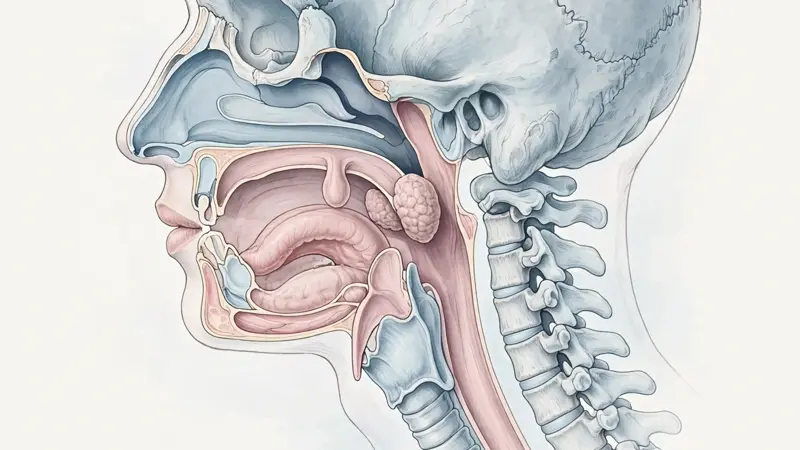
The cancer linked to oral HPV has a specific name: oropharyngeal cancer. It develops in the oropharynx — the middle section of the throat — which includes:
- The tonsils
- The base (back third) of the tongue
- The soft palate (the soft tissue at the back of the roof of the mouth)
- The back and side walls of the throat
This is a distinct area from the oral cavity (the front of the tongue, lips, gums and cheeks). That distinction matters: as the CDC’s overview of HPV and oropharyngeal cancer notes, HPV is not known to cause other head and neck cancers, including those of the larynx, lip, nose or salivary glands. The HPV link is specifically with the back of the throat — and researchers believe one reason is structural. The tonsils contain deep grooves called crypts, and some scientists suggest these crypts can trap viral particles, giving the virus more opportunity to establish the persistent infection that precedes cancer.
Oropharyngeal cancer is now the most common HPV-associated cancer, and cases have been rising steadily for years. In the United States, between 40 and 80 percent of these cancers are caused by HPV. The increase is driven largely by sexual transmission rather than tobacco, and roughly 12,000 HPV-associated oropharyngeal cancers are diagnosed in the US each year — more than 80 percent of them in men.
How Oral Sex Transmits HPV to the Throat
The chain of events from oral sex to throat cancer is long, and each step explains why the final outcome is uncommon:
- Exposure: During oral sex, HPV present in the skin or mucous membranes of a partner’s genitals can transfer to the mouth and throat.
- Infection: The virus infects cells lining the oropharynx. Most oral HPV infections produce no symptoms at all.
- Clearance: In the great majority of people, the immune system eliminates the infection naturally within one to two years.
- Persistence: In a small minority, a high-risk type such as HPV 16 is not cleared and remains in the tissue.
- Cellular change: Over years — sometimes decades — the persistent virus disrupts normal cell DNA in the throat tissue.
- Cancer: A small fraction of persistent infections eventually develop into oropharyngeal cancer.
This timeline answers a question doctors hear often: “How did I get this? I’m in a monogamous relationship.” The cancer reflects an infection acquired many years earlier — and cancer itself is never transmitted between people; only the virus is.
The Key Research Behind the Connection
The strongest evidence on the HPV throat cancer oral sex link comes from a landmark Johns Hopkins study published in the New England Journal of Medicine. Comparing 100 people newly diagnosed with oropharyngeal cancer against 200 healthy controls, the researchers found that:
- People with evidence of a prior HPV infection were 32 times more likely to develop the cancer than those without.
- People who tested positive specifically for HPV 16 were 58 times more likely to develop it.
- Participants reporting more than six lifetime oral sex partners were 8.6 times more likely to develop HPV-linked throat cancer.
- For comparison, smoking raised the risk about threefold and heavy drinking about two-and-a-half-fold.
Subsequent research has confirmed that the relationship is dose-dependent: the more lifetime oral sex partners someone has had, the higher the risk. In one study of over 350 oropharyngeal cancer patients, HPV-positive individuals reported an average of roughly 13 lifetime oral sex partners, compared with 6 among HPV-negative patients. Notably, the Johns Hopkins researchers found that oral HPV infection was the strongest risk factor regardless of tobacco and alcohol use.
Taken together, these findings established the HPV throat cancer oral sex link as one of the strongest associations in head and neck oncology.
Who Is at Higher Risk?
Not everyone who has oral sex faces the same level of risk. Research consistently identifies several factors that increase the likelihood of developing HPV-related throat cancer:
- Number of oral sex partners: Having multiple oral sex partners tops the list of sexual practices that raise risk. The dose-response pattern is well established.
- Age of first exposure: Beginning oral sexual activity at an earlier age, particularly under 18, has been linked to higher risk.
- Smoking: Men who smoked and had five or more lifetime oral sex partners had roughly double the prevalence of cancer-causing oral HPV compared with non-smokers with the same number of partners.
- Being male: Men are affected at more than four times the rate of women. Health authorities report that about 10 percent of men carry oral HPV compared with 3.6 percent of women.
- Deep kissing: People with ten or more lifetime deep-kissing partners were more than twice as likely to develop an HPV-related oropharyngeal cancer.
For a broader picture of the health risks associated with oral sex, including infections beyond HPV, see our dedicated guide.
Why Are Men Affected So Much More Than Women?
The male predominance is one of the most striking features of HPV-related throat cancer. Men are more likely to carry oral HPV in the first place, and some studies suggest women may clear oral HPV infections more efficiently, possibly because of differences in immune response. Differences in sexual behavior, including a higher average number of oral sex partners, may also contribute. Whatever the precise mix of causes, the practical takeaway is that men, particularly those over 50, should be especially attentive to both vaccination and symptoms. Our guide to HPV in men covers the testing landscape in more detail.
Symptoms to Watch For
There is no routine screening test for oral HPV or oropharyngeal cancer — nothing equivalent to the Pap smear. That makes symptom awareness the main tool for early detection. See a doctor if any of the following persist beyond a few weeks:
- A sore throat that does not resolve
- Hoarseness lasting more than a few weeks
- Difficulty or pain when swallowing
- A lump in the neck (often the first noticeable sign)
- Unexplained ear pain
- Swollen lymph nodes
- Unexplained weight loss
A neck lump deserves special attention: because the tonsils and base of the tongue drain to lymph nodes in the neck, an enlarged, painless lymph node is frequently the very first symptom patients notice. Early detection matters enormously — smaller, localized tumors have substantially better outcomes. Regular dental visits also help, since dentists routinely examine the mouth and throat and can spot suspicious lesions.
Diagnosis: What Happens at the Doctor’s Office
A doctor will begin with a physical examination of the mouth, throat and neck, checking for lumps and inspecting the tonsils and base of the tongue. Because many oropharyngeal tumors sit deep in tissue that is hard to see directly, the next steps usually include:
- Imaging: A CT scan, MRI or PET scan to locate a tumor and determine whether it has spread to lymph nodes.
- Biopsy: A small tissue sample, taken with a needle or through a brief procedure, examined under a microscope to confirm cancer.
- HPV and p16 testing: The biopsy tissue is tested for HPV DNA and for a protein called p16, which serves as a reliable marker of HPV-driven cancer.
The p16 result matters: HPV-positive oropharyngeal cancers respond to treatment significantly better than HPV-negative ones, with markedly higher survival rates. Doctors use this — along with tumor size and spread — to stage the cancer and tailor treatment.
Treatment Overview
Treatment depends on the cancer’s stage and location, the patient’s overall health, and the HPV status of the tumor. The main approaches are:
- Surgery: Removal of the tumor, sometimes through minimally invasive robotic techniques via the mouth.
- Radiation therapy: High-energy beams targeted at the tumor — often the primary treatment for oropharyngeal cancer.
- Chemotherapy: Used alongside radiation for more advanced cases, or when surgery is not suitable.
- Combination therapy: Surgery followed by radiation, or radiation combined with chemotherapy, for larger or node-involved cancers.
Because HPV-positive tumors respond so well, researchers are actively studying “de-escalation” — reducing radiation doses or chemotherapy intensity to maintain excellent cure rates while causing fewer long-term side effects such as dry mouth and swallowing difficulty. These gentler protocols are still largely in clinical trials, so standard treatment remains the norm outside research settings. Recovery typically involves speech and swallowing therapy, dental monitoring and long-term follow-up.
Prevention: The HPV Vaccine and Safer Practices
1. Get vaccinated
Because the HPV throat cancer oral sex link starts with a preventable infection, HPV vaccination is the single most effective protection. Gardasil 9, the current standard, protects against HPV 16 and other cancer-causing types — and the vaccine works in the mouth as well as the cervix and genitals: US data estimated that vaccination reduced oral HPV infection prevalence by about 88 percent among young adults. A 2024 study presented at a major oncology meeting further found that vaccination decreased the risk of HPV-related head and neck cancers in boys and men. For the key statistics, see the CDC’s facts on HPV and oral cancer.
The vaccine is most effective when given before sexual debut (routinely recommended from ages 9 to 12), but unvaccinated adults can still benefit: catch-up vaccination is recommended through age 26, and adults aged 27 to 45 can receive it after a discussion with their doctor about their individual risk. Health authorities estimate that HPV vaccination could prevent more than 90 percent of cancers caused by HPV from ever developing.
2. Use barriers during oral sex
Condoms used consistently and correctly during oral sex lower the chance of HPV transmission. For oral-vaginal or oral-anal contact, dental dams serve the same purpose. These barriers remain dramatically underused — surveys show condom use during oral sex is in the single digits — largely because of low awareness and the mistaken belief that oral sex is “safe sex.”
3. Protect your mouth
Cuts, bleeding gums, canker sores and recent dental work create entry points for infection. Avoid vigorous brushing or flossing immediately before oral sex, since this can cause micro-bleeding, and skip it when you or your partner has active mouth sores or has just had dental work.
4. Don’t rely on mouthwash
Despite viral headlines, antiseptic mouthwash is not an STI prevention tool. When a randomized trial tested daily use of an antiseptic mouthwash against a control mouthwash, it did not reduce the incidence of oropharyngeal gonorrhea. Mouthwash should never substitute for vaccination or barriers.
5. Keep up with dental visits
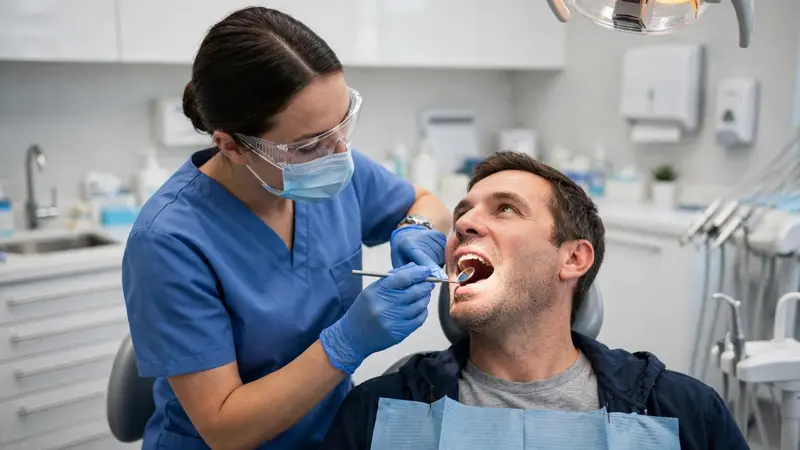
Routine dental checkups are an underappreciated line of defense. Dental professionals examine the oral cavity and visible throat structures at every visit and are increasingly encouraged to recommend HPV vaccination to patients. Good general oral health is protective in itself.
If Your Partner Has HPV: What Couples Should Know
An HPV diagnosis in a partner often triggers anxiety and difficult questions — most of them based on misconceptions. A few facts can steady the conversation:
- HPV is not a sign of infidelity. The virus can remain dormant for years, so an infection detected today may date from long before the current relationship.
- There is no approved HPV test for men and no test for oral HPV in the general population. Testing cannot tell a couple “who gave it to whom.”
- Most couples share HPV without either partner ever developing a problem. Persistent infection leading to cancer is the exception, not the rule.
- Vaccination is still worthwhile. Even within a long-term relationship, getting vaccinated protects against types neither partner has encountered.
- Communication helps more than avoidance. Discussing vaccination, regular dental checkups and symptom awareness together is far more protective than withdrawing from intimacy out of fear.
If the anxiety persists, speaking with a clinician or a couples counselor can help put the actual — and genuinely low — risk in perspective.
Frequently Asked Questions
Can oral sex really cause throat cancer, or is this exaggerated?
The HPV throat cancer oral sex link is real and well supported by research, but the absolute risk for any individual is low. Oral sex can transmit HPV 16 to the throat, and persistent HPV 16 infection is the leading cause of oropharyngeal cancer. However, most oral HPV infections clear on their own, and most people who have oral sex will never develop throat cancer.
How long after HPV infection does throat cancer take to develop?
Cancer typically takes years — often decades — to develop after the initial HPV infection. This long latency is why patients are frequently diagnosed in their 50s or 60s from infections acquired much earlier in life, and why a diagnosis says nothing about a person’s recent sexual history.
Is there a test for oral HPV?
There is no approved routine screening test for oral HPV in the general population. Researchers are studying saliva-based and biomarker tests, but none has yet been validated for widespread use the way the Pap smear was for cervical cancer.
Does the HPV vaccine help if I am already sexually active?
Yes, it can still help. The vaccine protects against HPV types you have not yet encountered, and catch-up vaccination is recommended through age 26, with shared decision-making for adults aged 27 to 45. Even if you have already been exposed to one type, the vaccine guards against the others — including HPV 16.
Can kissing transmit HPV?
Deep, open-mouth kissing has been associated with oral HPV transmission in research — people with many deep-kissing partners showed more than double the likelihood of HPV-related oropharyngeal cancer in one study. The risk from kissing is considered lower than from oral sex, but it is not zero.
If I am in a monogamous relationship, should I worry about HPV throat cancer?
For most monogamous couples, the risk is very low, since a long-standing relationship adds no new exposures. Sensible steps: stay current on vaccination if eligible, keep dental checkups, and see a doctor about persistent throat symptoms.
Does having my tonsils removed reduce the risk?
Tonsillectomy has been studied as a possible preventive measure, since many HPV-related cancers start in the tonsils — but the evidence does not support removing healthy tonsils to prevent cancer. No medical guideline recommends it. Vaccination is the proven preventive strategy.
This article is for educational purposes only and is not medical advice. If you have symptoms that concern you, or questions about HPV vaccination, please consult a qualified healthcare professional.