Trichomoniasis: Symptoms, Treatment, and Prevention
Trichomoniasis: Symptoms, Treatment, and Prevention
If you have ever heard someone say "it's probably just a yeast infection" about an unusual discharge, here is the catch: the most common curable sexually transmitted infection in the world is not yeast at all — it is trichomoniasis. Most people who have it feel perfectly fine, which is exactly why it spreads so quietly. The good news? A short course of pills cures it completely. Let's walk through what trichomoniasis is, how to spot it, how doctors treat it, and how you and your partner can keep it from coming back.
What Is Trichomoniasis?
Trichomoniasis — often shortened to "trich" — is an infection caused by a tiny parasite called Trichomonas vaginalis. Unlike bacteria or viruses, this organism is a protozoan: a single-celled creature that thrives in the warm, moist environment of the genital tract.
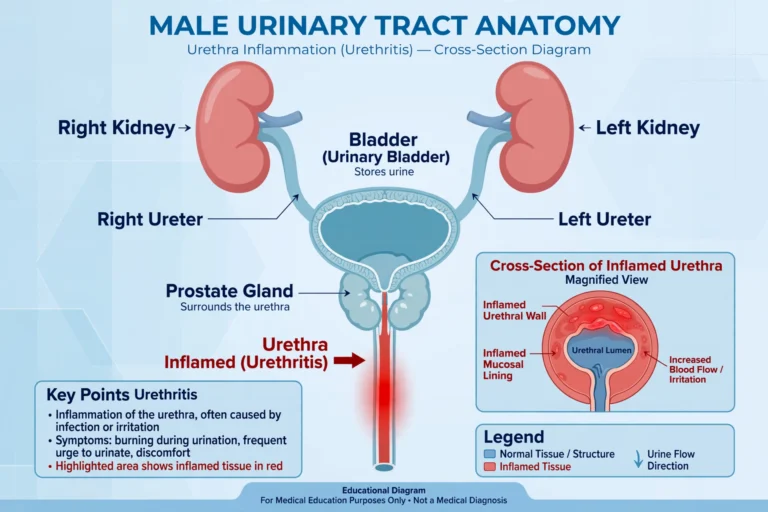
In women, it settles in the lower genital tract — the vulva, vagina, cervix, or urethra. In men, it typically infects the urethra inside the penis. It spreads almost exclusively through sexual contact: from a penis to a vagina, a vagina to a penis, or a vagina to another vagina. It does not infect the hands, mouth, or anus in any meaningful way, and you cannot catch it from toilet seats, swimming pools, or hugging someone.
Here is the striking part: the CDC estimates millions of infections in the United States at any given time, yet only about 3 in 10 people with trichomoniasis ever develop symptoms. Older women are more likely to carry it than younger women. Most of the time, the infection sits silently for months or even years — and silent carriers can still pass it on.
Trichomoniasis Symptoms in Women
When symptoms do appear, they usually show up 5 to 28 days after exposure — though sometimes they take much longer, and they can come and go on their own. Watch for:
- Unusual vaginal discharge — often thin, foamy, and yellow-green in color, with a distinct fishy smell. This discharge is the hallmark sign.
- Genital itching, burning, or redness — irritation of the vulva and around the vaginal opening.
- Burning during urination — a stinging sensation when you pee.
- Pain during sex — intercourse can feel uncomfortable or sore.
- Lower belly discomfort — a dull ache or pressure in the pelvic area.
- A "strawberry cervix" — during an exam, doctors sometimes see tiny red spots on the cervix caused by the infection. You cannot see this yourself, but it is a classic diagnostic clue.
Symptoms may fade without treatment, but do not be fooled: fading symptoms are not a cure. The parasite is still there, still transmissible, and still able to cause complications.
Trichomoniasis Symptoms in Men
Most men with trichomoniasis notice nothing at all — which is a major reason the infection keeps circulating between partners. When symptoms do occur, they are usually mild:
- Itching or irritation inside the penis
- A thin, white discharge from the tip of the penis
- Burning during urination or after ejaculation
Because men so rarely feel anything, male partners are often the unknowing link in a cycle of reinfection. That is why treatment guidelines insist both partners get treated — not just the one with symptoms.
How Trichomoniasis Spreads (and How It Doesn't)
The parasite travels through genital-to-genital contact during vaginal sex. Condoms greatly reduce the risk, but transmission can still occur in areas a condom does not cover. Oral and anal sex are not meaningful routes for this particular parasite.
A few myths worth clearing up:
- You cannot get it from a toilet seat. The parasite dies quickly outside the human body.
- Sharing damp towels or swimsuits is an extremely unlikely route. While the parasite can survive briefly on wet fabric, documented cases are vanishingly rare.
- You can get it more than once. Having trichomoniasis once does not make you immune. Reinfection is common — about 1 in 5 people treated for trich gets it again within three months, almost always from an untreated partner.
Risk factors include having multiple sexual partners, having a history of other STIs, and having unprotected sex.
Trichomoniasis vs. BV vs. Yeast: Telling Them Apart
All three cause discharge and irritation, but they are completely different conditions needing different treatments — which is why guessing from symptoms alone is risky:
| Feature | Trichomoniasis | Bacterial Vaginosis | Yeast Infection |
|—|—|—|—|
| Cause | Parasite (STI) | Bacterial imbalance | Fungal overgrowth |
| Discharge | Thin, foamy, yellow-green | Thin, gray-white | Thick, white, clumpy |
| Odor | Fishy | Fishy, stronger after sex | Usually none |
| Itching | Moderate | Mild or none | Often intense |
| Partner treatment | Required | Not required | Not required |
| Contagious via sex | Yes | No (not an STI) | No (not an STI) |
If you are unsure which you are dealing with, our guide to vaginal discharge, normal vs abnormal can help you compare symptoms — but a lab test is the only way to know for sure.
How Is Trichomoniasis Diagnosed?
Diagnosis is straightforward and starts with a visit to your doctor, gynecologist, or a sexual health clinic. Expect:
1. A conversation about your symptoms and sexual history.
2. A physical or pelvic exam to look for discharge and inflammation.
3. A lab test — the most sensitive method today is a nucleic acid amplification test (NAAT) on a vaginal swab or urine sample. Some clinics still use a "wet mount," where vaginal fluid is checked under a microscope on the spot, though it misses more cases.
Because trichomoniasis often travels with other STIs, your provider will usually test for chlamydia and gonorrhea at the same time. To understand when and how often screening makes sense for you, read our full STI testing guide.
Treatment: A Simple Course of Pills
Trichomoniasis is one of the most satisfying infections to treat because the cure is fast and simple. The standard treatment is a prescription antibiotic taken by mouth:
- Metronidazole — usually as a single large dose, or as smaller doses taken over 7 days.
- Tinidazole — usually a single dose, and sometimes used when metronidazole has not worked.
Important treatment rules:
- Take every pill, exactly as directed. Even if symptoms vanish after a day or two, unfinished treatment invites the infection back.
- Avoid alcohol while taking metronidazole (and for about 3 days after). The combination can cause nausea, vomiting, cramps, and flushing.
- Your partner must be treated too — at the same time. Treating only one partner in a couple is the number-one reason trich keeps bouncing back.
- No sex until treatment is complete and all symptoms are gone — typically about a week after the single dose.
- Get retested after about 3 months. Reinfection is so common that follow-up testing is part of standard care, even if you feel fine.
Vaginal metronidazole gel exists, but oral pills work far better for trich — the gel alone is not considered adequate treatment.
Trichomoniasis and Pregnancy
Pregnant women should take trichomoniasis seriously. The infection is linked to premature rupture of membranes, preterm labor, and low birth weight. The reassuring news is that treatment is considered safe during pregnancy — metronidazole can be used after the first trimester under a doctor's guidance. If you are pregnant and notice unusual discharge or odor, get tested promptly rather than waiting.
Complications of Untreated Trichomoniasis
Left alone, the infection can persist for months or years, and the inflammation it causes has real consequences:
- Higher risk of HIV. Genital inflammation makes it easier to acquire HIV if exposed, and easier to pass HIV to a partner.
- Higher risk of other STIs. The disrupted vaginal environment is more vulnerable to additional infections.
- Pregnancy complications, as described above.
- Pelvic discomfort and ongoing symptoms that erode quality of life and intimacy.
None of these are inevitable — they are simply reasons not to ignore symptoms or skip the retest.
Preventing Trichomoniasis
Prevention comes down to the same habits that protect against most STIs:
- Use condoms correctly, every time. They are the single most effective tool.
- Limit sexual partners, and be in a mutually monogamous relationship with a partner who has tested negative.
- Get screened regularly if you are sexually active with new or multiple partners — remember, most cases have no symptoms.
- Tell partners about a diagnosis. Anyone you have had sex with in the past two months should be tested and treated.
- Do not share sex toys without cleaning them, or cover them with a fresh condom each time.
When to See a Doctor
Book an appointment if:
- You notice unusual discharge, especially yellow-green, foamy, or foul-smelling.
- You have genital itching, burning during urination, or pain during sex that is new or persistent.
- A sexual partner tells you they have been diagnosed with trichomoniasis or any STI.
- You have been treated but symptoms return — you may need a retest or a different regimen.
- You are pregnant and notice any unusual vaginal symptoms.
For an authoritative medical overview, the CDC's trichomoniasis fact sheet covers symptoms, testing, and treatment in detail.
FAQ: Quick Answers About Trichomoniasis
Can trichomoniasis go away on its own?
Symptoms sometimes fade, but the infection itself rarely clears without treatment. It can linger for months or years and remains contagious the whole time.
Is trichomoniasis the same as a yeast infection?
No. Yeast infections are caused by a fungus (Candida) and are not sexually transmitted. Trichomoniasis is caused by a parasite and is an STI. Their treatments are completely different.
Can you get trichomoniasis from oral sex?
It is very unlikely. The parasite does not establish itself in the mouth or throat in any meaningful way; vaginal intercourse is the primary route.
Does my partner need treatment if they have no symptoms?
Yes — absolutely. Most infected men and many infected women feel nothing, but they can still pass the parasite back to you. Both partners must be treated simultaneously.
The Bottom Line
Trichomoniasis is common, usually silent, and completely curable — a combination that makes testing and partner treatment the real heroes of this story. If your discharge, odor, or discomfort does not match your normal, do not self-diagnose from the internet: get a swab, take the pills, treat your partner, and retest in three months. A week of treatment buys you lasting peace of mind, and that is a trade worth making.