
Navigating Debt as a Couple Before Marriage
Imagine sitting down with your fiance one quiet evening, opening your banking apps side by side, and discovering that one of you owes thirty thousand dollars and never said a word. For thousands of couples every year, this scene is not hypothetical — it is the moment that decides whether their marriage begins on solid ground or on a fault line. Learning how to handle debt before marriage is not about blame or shame. It is about honesty, planning, and teamwork — three of the strongest predictors of a lasting marriage.
Debt has become a near-universal part of adult life. Student loans, credit card balances, car payments, medical bills, and personal loans frequently accompany people into their relationships. What matters is not whether debt exists when you get engaged. What matters is what you do about it together.
Why Debt Conversations Before Marriage Matter So Much
Money is one of the most common sources of conflict between partners — the American Psychological Association reports that money remains one of the top sources of stress for adults — and debt carries an emotional charge that a simple budget discussion rarely does. Research consistently shows that financial disagreements are strong predictors of relationship distress and divorce. A Credit Karma survey found that roughly one-third of Gen Z adults and millennials say they have ended a relationship over financial issues. A Canadian research study found that 43 percent of married or common-law adults began their relationship carrying debt — and more than one in three admitted they never discussed that debt with their partner before marrying.
Couples who skip the debt conversation do not avoid the problem; they postpone it into the most stressful phase of marriage. Hidden balances surface when you apply for a mortgage, file your first joint tax return, or try to rent an apartment together. By then, the debt itself is only half the issue — the other half is the broken trust. A structured, honest approach to getting on the same financial page before marriage is one of the kindest things you can do for your future relationship.
What the Law Says: Who Owns the Debt After “I Do”
One of the biggest misconceptions about debt and marriage is that your partner’s balances automatically become yours when you sign the marriage certificate. In most cases, that is not true — but the exceptions are important enough to understand before you marry.
Pre-marital debt generally stays with the borrower
Any loan, credit card, or obligation taken on before marriage remains the legal responsibility of the person who incurred it, even after the wedding. Getting married does not merge your credit histories, and creditors cannot pursue you for accounts that exist solely in your partner’s name. However, there are several ways you can accidentally take on that responsibility:
- Cosigning or refinancing together: If you cosign your partner’s loan or open a joint account, you become fully liable for the balance.
- Joint tax returns: Filing jointly can expose your refund to offset a spouse’s pre-existing tax debt.
- Debt incurred during the marriage: Once married, most debt taken on by either spouse — especially in community property states — is considered shared.
Community property vs. common law states
This is a distinction many pre-marital guides gloss over, yet it has real consequences. In the United States, nine states (Arizona, California, Idaho, Louisiana, Nevada, New Mexico, Texas, Washington, and Wisconsin) use community property law, which generally treats debts incurred during the marriage by either spouse as shared obligations — even if only one name is on the account. Most other states follow common law (equitable distribution), where each spouse is responsible for debts in their own name unless the other cosigned. If you live in a community property state, any new debt either of you takes on after the wedding can affect you both. This makes pre-marital planning especially important — and it is worth confirming how your own jurisdiction handles marital debt before you make joint financial commitments.
The Full Disclosure Conversation: A Step-by-Step Guide
The single most valuable exercise you can do about debt before marriage is a structured disclosure meeting. Not a vague “do you have debt?” chat over dinner, but a scheduled, calm, distraction-free conversation where both partners lay everything out in full. Here is how to do it:
Step 1: Set the ground rules
Agree in advance that this conversation is judgment-free. The goal is information, not criticism. Schedule it at a calm time — not after work, not during wedding planning stress, and never during an argument. Ninety minutes is usually enough.
Step 2: Prepare your individual money snapshot
Before you meet, each of you independently writes down: total debts with balances and interest rates, minimum monthly payments, income, savings, and credit scores (free scores from your bank or card issuer are fine). Bringing numbers — not estimates — is what turns a vague conversation into a useful one.
Step 3: Share everything, without editorializing
Take turns reading your snapshots aloud. The listening partner’s only job is to listen and ask clarifying questions. Responses like “How did you let that happen?” shut the conversation down; “Thank you for telling me — help me understand the plan for this balance” keeps it open.
Step 4: Talk about your money histories
Debt rarely exists in a vacuum. Share how you each learned about money growing up: Were your parents savers or spenders? Did money feel scarce or abundant? These stories explain your instincts far better than any spreadsheet, and they build empathy instead of blame.
Step 5: End with one shared commitment
Close the conversation by agreeing on a single next step — for example, “We will pull our full credit reports together next Sunday” or “We will build our payoff plan before we book the venue.” For more on structuring these talks regularly, see our guide to building a collaborative budget together.

Classify Your Debt: Mine, Yours, and Ours
Not all debt is equal, and not all of it should be treated the same way. Before building a plan, sort every balance into one of three categories. This exercise alone resolves many disagreements, because it replaces a fuzzy sense of “your debt problem” with a clear, shared map.
| Category | What goes here | How to handle it |
|---|---|---|
| Mine | Debt one partner incurred alone before the relationship (student loans, old credit cards) | Primary responsibility stays with the borrower; the other partner can choose to help strategically |
| Shared | Debt both partners agreed to together (wedding costs, joint car loan, apartment move) | Repay jointly from shared funds with a written agreement on contributions |
| Ours going forward | Future household goals that require borrowing (mortgage, family car) | Plan together in advance; both names only when both are truly comfortable |
Note what is missing from the “mine” row: there is no expectation that a partner must pay the other’s pre-marital debt. You may choose to help — many couples do, especially when one partner’s high-interest balance is dragging down both of your shared goals — but it should be a deliberate, voluntary decision, not an unspoken obligation. Resentment grows fastest when help feels demanded rather than offered.
Build a Couple’s Payoff Plan Before the Wedding
Once you have full disclosure and a clear classification, you can build a joint payoff strategy. The two proven frameworks both work — the question is which one fits your psychology:
- The avalanche method: Pay minimums on everything, then throw every extra dollar at the highest-interest balance first. This saves the most money in interest and is mathematically optimal.
- The snowball method: Pay minimums on everything, then attack the smallest balance first. The quick wins build momentum and motivation, which is why many couples prefer it.
Consider a realistic example. Suppose one partner brings $18,000 in credit card debt at 24% APR and $22,000 in student loans at 6%, while the other brings $6,000 at 19% APR. With the avalanche approach, every extra dollar after minimums goes to the 24% card first, potentially saving thousands in interest versus attacking balances randomly. With the snowball approach, the $6,000 balance disappears first, giving both partners an early victory to celebrate. There is no wrong answer — research on goal pursuit shows that early wins increase follow-through, while the avalanche minimizes total cost. Pick the one you will actually stick to.
Practical planning tips:
- Automate minimum payments for every account so nothing ever goes late.
- Direct a fixed monthly “debt payment” amount first, then split it according to your chosen method.
- Set a joint milestone calendar: “Card A gone by March,” “under $20,000 total by June.”
- Keep a shared tracking sheet or app so both partners can watch the balances fall.
If money conversations tend to spiral into conflict, The Gottman Institute’s guide to financial freedom in marriage offers a research-backed framework for turning money talks into teamwork rather than gridlock.
How Your Partner’s Debt Affects Your Credit and Big Milestones
Even though your partner’s pre-marital debt is not legally yours, it can still shape your shared financial life in very practical ways. Understanding these mechanics before marriage helps you plan around them.
Mortgages and rentals
When you apply for a mortgage or rental together, lenders look at both credit files. One partner’s low score or high debt-to-income ratio can raise your interest rate, reduce the amount you qualify for, or require a larger down payment. Some couples choose to have the partner with stronger credit apply alone — but that also means qualifying on a single income. Running the numbers both ways, with a trusted lender, before you house-hunt is far better than discovering the problem at closing.
Credit scores are individual, but behavior is contagious
Marriage does not merge your credit scores. But if you open joint accounts, late payments or high utilization on those accounts affect both files. Protect both scores with a simple rule: never open a joint credit line until you have a written agreement about how it will be used and paid. Our guide to opening a joint account as a couple walks through the timing, structure, and safeguards that protect both partners.
Debt-to-income ratio
Lenders care deeply about how much of your monthly income goes to debt payments. If one partner’s minimum payments eat 25% of their income, that reduces what the household can borrow — even if the other partner is debt-free. Paying down high-payment balances before applying for major loans is one of the highest-leverage moves you can make.
Should You Get a Prenup for Debt Protection?
Prenuptial agreements have a reputation as romance-killers, but for couples with significant debt, they are better understood as clarity tools. A prenup can explicitly state that each partner’s pre-marital debt remains their separate responsibility, protecting the debt-free partner’s assets from the other’s creditors in case of divorce. It can also define how you will handle shared debt, business liabilities, and future earnings used for repayment.
A prenup is worth serious consideration when one partner brings substantially more debt than the other, when either partner owns a business, when there are significant assets to protect, or when family wealth or inheritances are involved. Both partners should have independent legal counsel, and the agreement should be finalized well before the wedding — last-minute prenups can be challenged. Done well, a prenup does not predict divorce; it removes ambiguity that causes conflict.
The Emotional Side: Shame, Defensiveness, and Red Flags
Debt conversations are difficult because debt carries shame. Many people tie their self-worth to their financial situation, so hearing “tell me about your debt” can feel like hearing “justify your worth.” If your partner gets defensive, shuts down, or deflects, respond to the emotion first: “I can see this is hard to talk about. I’m not judging you — I want us to face this as a team.” Most defensiveness melts when the other person feels safe.
There is a difference, however, between embarrassment and concealment. Watch for genuine red flags: a partner who refuses to disclose balances entirely, who becomes angry or threatening when money comes up, who continues taking on new debt while promising to stop, or who has hidden accounts or lies about spending. Persistent concealment of debt or spending is a form of financial infidelity, and it damages trust the same way other betrayals do. One difficult conversation is normal; a pattern of secrecy is a signal to seek professional couples counseling before the wedding, not after.
Also be honest about your own reactions. If your partner’s debt makes you feel contempt — a sense that they are irresponsible or lesser — that feeling itself is the danger, not the debt. Contempt is one of the strongest predictors of relationship failure in decades of marriage research. Curiosity and teamwork can be learned; contempt has to be confronted.
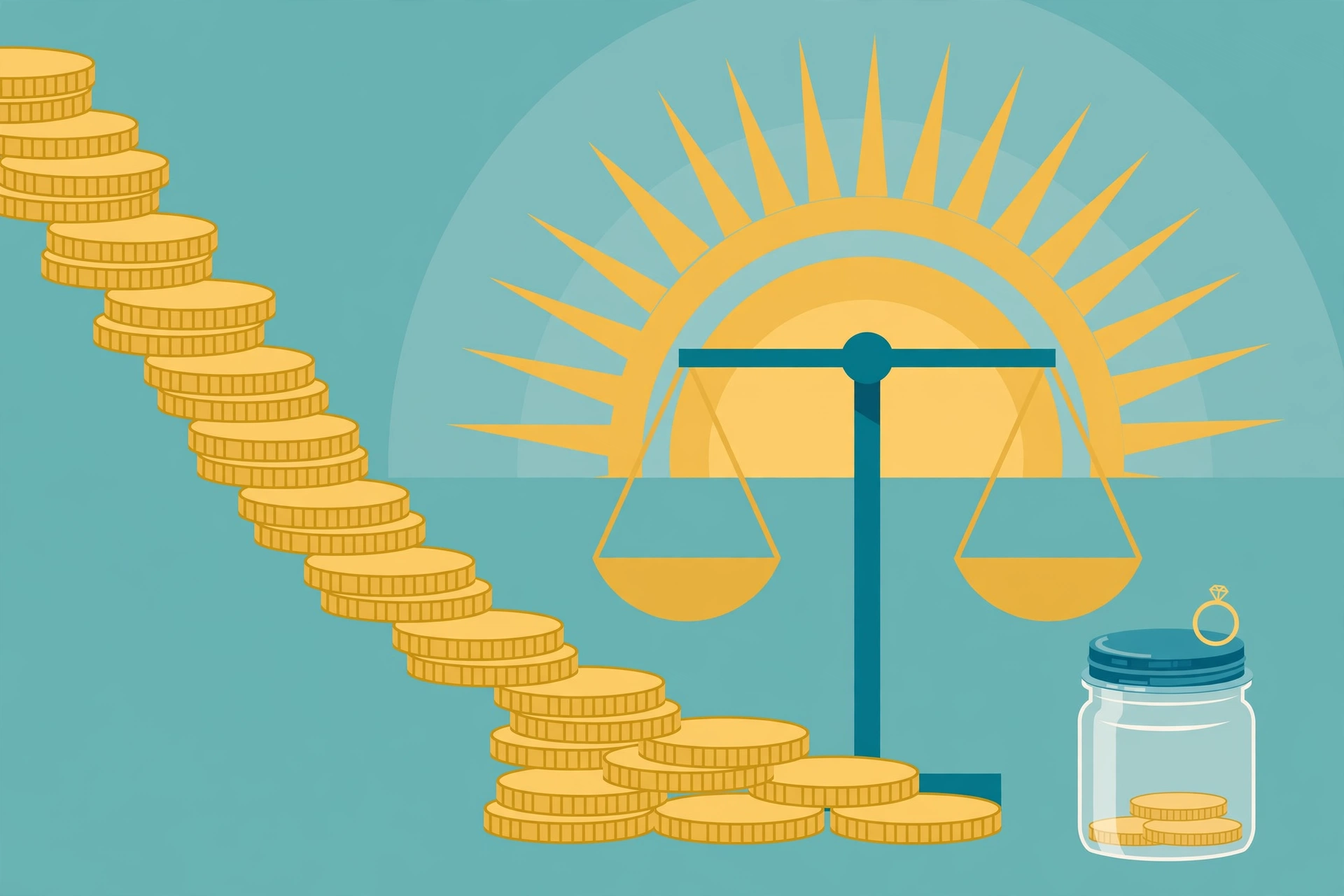
Planning a Wedding Without Going Deeper Into Debt
Here is the cruel irony many couples face: while trying to sort out existing debt before marriage, they take on new debt to pay for the wedding itself. The average wedding is a five-figure expense, and financing it with credit cards or personal loans can undo months of payoff progress.
- Set the wedding budget from your payoff plan, not from your dreams. Decide your maximum spend before touring a single venue, based on what you can afford without borrowing.
- Fund the wedding from a dedicated savings account. Open a separate account and auto-transfer a fixed amount each month. If the balance is not there, the expense does not happen.
- Question every big-ticket item. For each major cost, ask: “Would we rather have this, or be $3,000 closer to debt-free?” Couples are often surprised how many “must-haves” fail that test.
- Never finance a wedding on credit you cannot clear within months. A $15,000 wedding balance at 22% APR costs thousands in interest and can delay homeownership by years.
- Consider a smaller celebration now and a bigger party later. Many couples marry simply and celebrate lavishly on their first anniversary — debt-free.
The wedding is one day; the marriage — and its finances — is every day after. Guests remember how the day felt, not how much it cost.
Conclusion: Debt Is a Problem You Can Solve Together
Handling debt before marriage is ultimately a rehearsal for marriage itself. The couples who thrive are not the ones who arrive debt-free — they are the ones who arrive honest, organized, and committed to a shared plan. Disclose everything, classify what you owe, build a payoff strategy you will both follow, protect yourselves legally where it counts, and keep talking about money long after the wedding. Debt is temporary. The trust and teamwork you build by facing it together will outlast every balance you pay off.
Disclaimer: This article is for educational purposes only and is not a substitute for professional therapy, counseling, financial advice, or medical advice. Laws about marital debt vary by jurisdiction, so consult a qualified attorney or licensed financial professional about your specific situation.
Frequently Asked Questions
Do I become responsible for my partner’s debt when we get married?
No — not automatically. Debt incurred before marriage remains the legal responsibility of the person who took it on. You only become liable if you cosign a loan, open a joint account, refinance the debt together, or live in a community property state where debts incurred during the marriage may be shared. Always confirm the rules in your jurisdiction.
Should we pay off all our debt before getting married?
You do not need to be debt-free to marry. Financial experts generally agree that what matters more is full honesty about the debt and a realistic joint plan to pay it down. Postponing a wedding until every balance hits zero is usually unnecessary — but entering marriage with a clear payoff timeline and shared financial goals is essential.
How do we tell each other about our debt without fighting?
Schedule a calm, dedicated conversation with agreed ground rules: no judgment, no interruptions, facts first. Each partner prepares a written snapshot of balances, rates, payments, income, and savings in advance. The listening partner asks clarifying questions only. If conversations consistently escalate, a few sessions with a couples counselor or financial therapist can help enormously.
Should I help pay off my partner’s pre-marital debt?
There is no obligation to do so, but many couples choose to help strategically — for example, tackling a high-interest balance together because it blocks shared goals like buying a home. Make it a deliberate, voluntary decision with clear expectations, not an unspoken assumption. Document any large contributions so there is no confusion later.
Will my partner’s bad credit affect our ability to buy a house?
It can. When you apply jointly, lenders consider both credit files; one partner’s low score or high debt-to-income ratio may raise your rate or reduce your approval amount. Some couples apply with only the stronger credit profile, or spend six to twelve months improving scores and paying down balances before house-hunting.
What is financial infidelity, and how does it relate to debt?
Financial infidelity means hiding money behavior from your partner — concealing debt, secret spending, hidden accounts, or lying about income. It is considered a serious breach of trust because it undermines the shared reality a marriage is built on. If debt is being hidden rather than merely embarrassing to discuss, address it directly and consider professional counseling.
Is a prenuptial agreement a good idea if one of us has a lot of debt?
Often, yes. A prenup can formally keep each partner’s pre-marital debt separate and protect the other partner’s assets. It is especially worth considering with large debt imbalances, business ownership, or significant assets. Both partners should have independent lawyers, and the agreement should be completed well before the wedding day.
How much should we spend on the wedding if we are in debt?
Only what you can pay for without new borrowing — or with borrowing you can clear within a few months. Build the wedding budget from your debt payoff plan: set a hard maximum, save in a dedicated account, and test every major expense against your goal of becoming debt-free. A modest wedding now and financial freedom sooner is a trade most couples never regret.