AI Tone Detection: Spotting Passive Aggression in Texts
You sent a perfectly innocent question. The reply comes back: “Fine.” One word, a period, and suddenly your whole evening is spent decoding whether that period means anger, indifference, or nothing at all — the kind of everyday riddle AI tone detection passive aggression tools promise to decode. Welcome to the central anxiety of modern relationships: text messages carry none of the tone, facial expression, or body language that tell us what a person actually means, yet we argue about them as if every message were a sworn statement.
That is exactly why interest in AI tone detection passive aggression tools has surged. New tools promise to read between the lines of your texts — flagging the veiled digs, the loaded one-word replies, and the “jokes” that land like paper cuts. This guide explains how these tools work, what they can and cannot tell you, a practical step-by-step workflow for checking a suspicious text, and — most importantly — what to do with the answer so it strengthens your relationship instead of starting a fight.
Why Text Messages Are a Breeding Ground for Passive Aggression
Passive aggression is indirect hostility: instead of saying “I’m hurt,” a person says “Do whatever you want.” In face-to-face conversation, vocal tone and facial expressions usually give the game away. In text, those signals vanish. What is left — word choice, punctuation, emoji use, reply timing — is ambiguous enough that two people can read the same message in completely opposite ways.
Psychologists have long noted that passive-aggressive remarks can damage love and trust because the target feels attacked but cannot respond to something the sender denies saying. Texting makes this worse in three specific ways:
- No repair signals. In person, a softening smile or warm voice can tell you “I didn’t mean it that way.” Texts offer no such correction.
- Permanence. A message can be re-read, screenshotted, and forwarded to friends for group analysis. A throwaway line gets examined like evidence.
- Asynchronous ambiguity. A three-hour delay might mean they are busy — or it might be a deliberate cooling maneuver. You cannot tell which.
These are also the reasons common texting communication habits in relationships deserve their own skill set, separate from in-person communication skills. An AI tone detection passive aggression tool cannot fix your relationship, but it can serve as a useful second opinion — provided you understand what it is actually measuring.
AI Tone Detection Passive Aggression in Texts: How the Tools Work
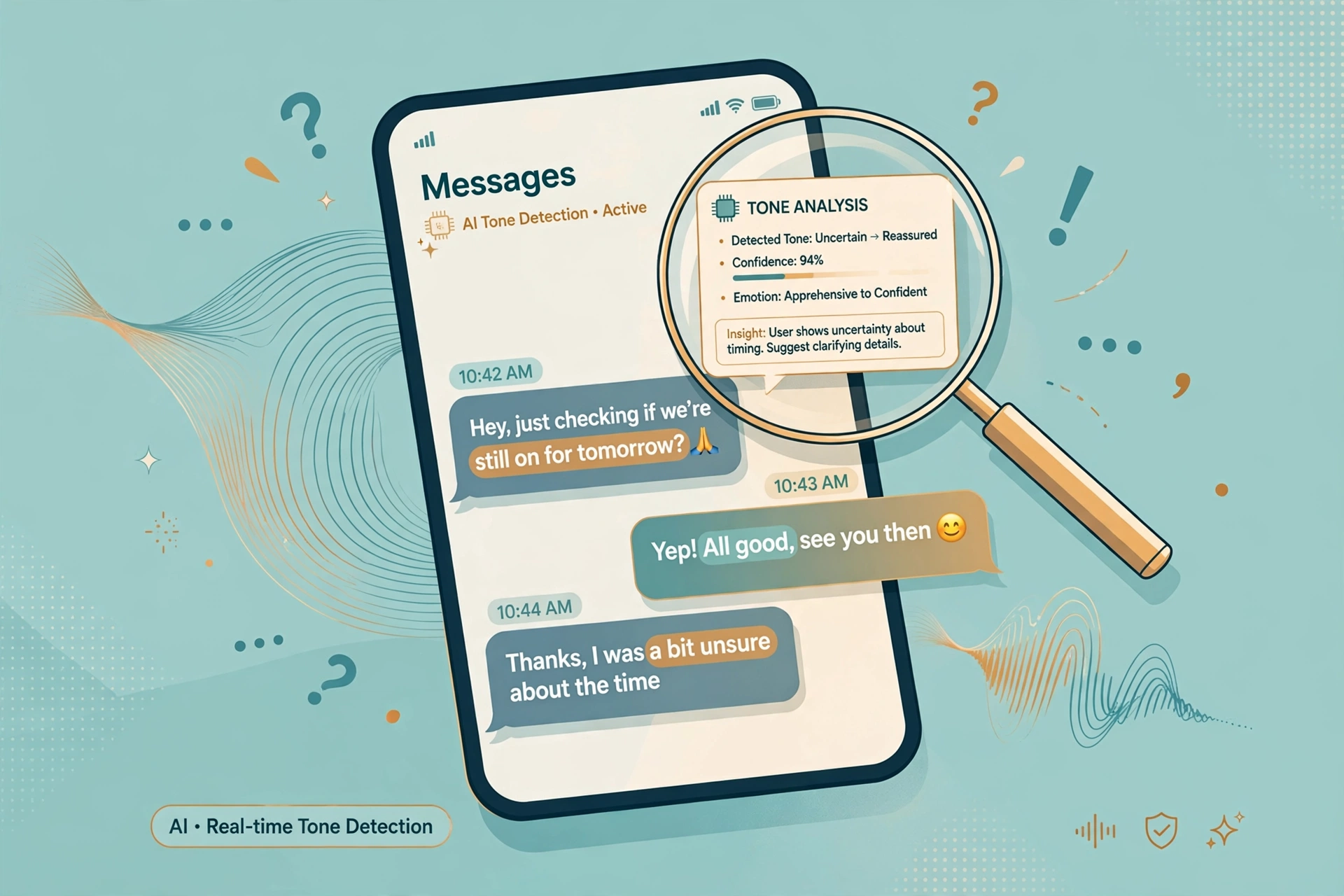
When you run a message through AI tone detection passive aggression software, it analyzes written language for emotional and social signals, then reports its best estimate of the sender’s tone. Under the hood, most tools — from grammar-checker tone meters to dedicated message analyzers — look at a similar set of signals:
1. Lexical markers: the telltale phrases
Certain phrases carry a strong statistical association with passive aggression: “per my last message,” “as I mentioned before,” “whatever you want,” “no worries,” “k.,” “fine,” “if that’s what you want,” “interesting choice,” and “must be nice.” Tools are trained to weigh these markers heavily, especially when they contradict the surface meaning of the sentence (as in “No worries!” sent after a clear complaint).
2. Punctuation, capitalization, and emoji patterns
Signals like a final period on a one-word reply (“Fine.” vs “Fine”), abrupt shifts from emoji-heavy to emoji-free texting, all-caps words, and quotation marks used for emphasis (“Thanks for ‘helping'”) all feed the analysis. Grammarly’s well-known Tone Detector, for example, explicitly reads capitalization, punctuation, and word choice to estimate how a message will sound to the receiver.
3. Timing and conversational context
More advanced tools consider not just one message but the exchange around it: a sudden drop in message length, uncharacteristic delays, or a reply that ignores the previous question. Context-aware analyzers can also be told whether the text is a work email, a dating-app message, or a partner’s text, which sharpens the reading considerably.
4. Emotional and intent scoring
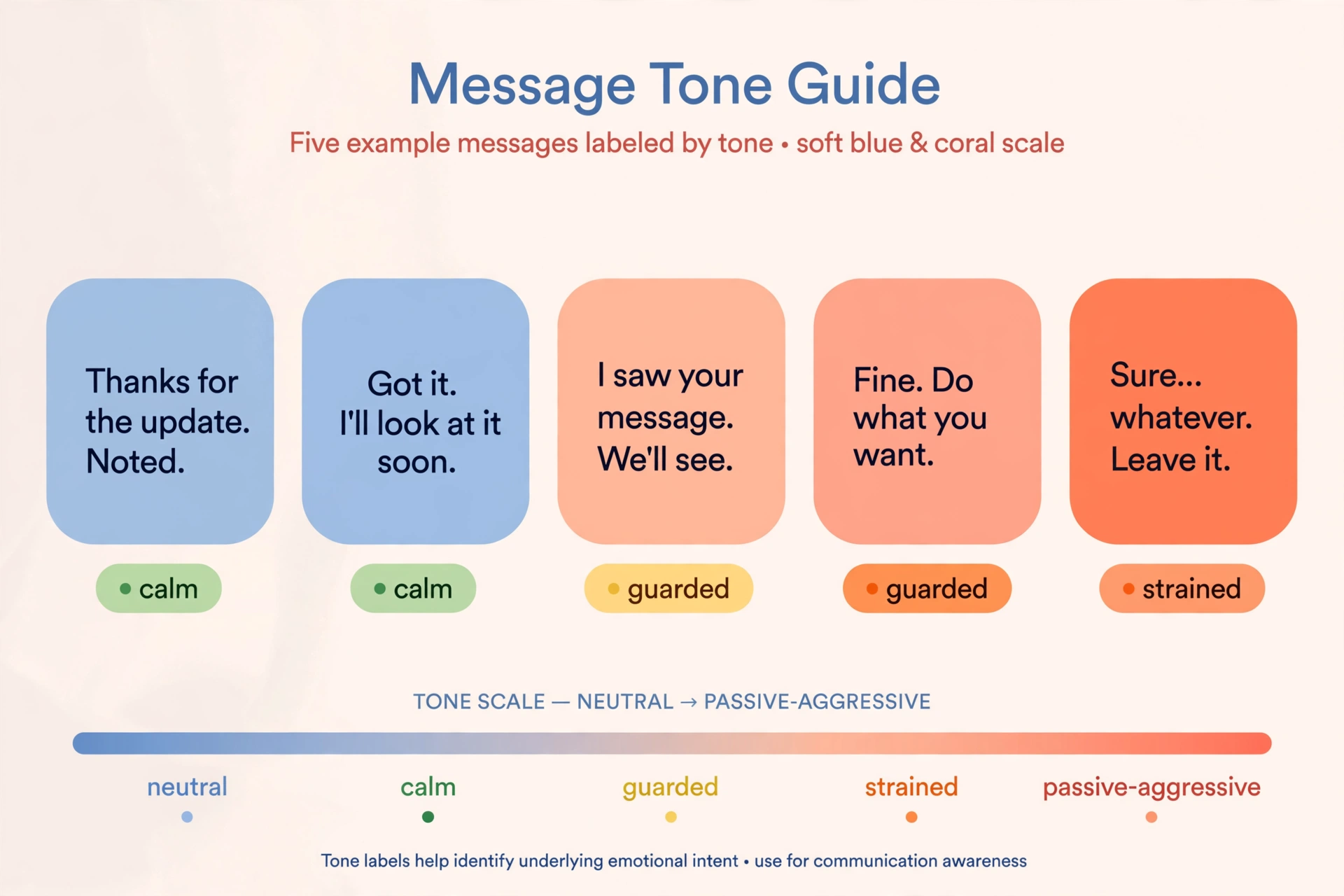
The output usually takes the form of tone labels (warm, neutral, guarded, hostile), an emotional breakdown, or even an estimated intent — “what does this person actually want?” Some newer open-source projects go further, flagging specific patterns such as blame-shifting, guilt-tripping, or dismissiveness and offering a suggested rewrite.
What AI Tone Detection Gets Right — and Where It Misses
AI tone detection passive aggression tools are genuinely useful as a pause button. When your blood is up, a detector’s calm breakdown — “this reads as guarded, possibly frustrated” — can slow you down before you fire off a reply you will regret. They are also good at catching your own tone: running a draft through an AI tone detection passive aggression checker before sending can reveal that your “quick question” reads like an accusation.
But the limitations matter more than the marketing suggests:
- Sarcasm and banter are nearly invisible to AI. Couples develop private humor — “oh, nice parking job” after you curb the wheels — that a detector reads as hostility. AI cannot distinguish your running joke from a genuine jab.
- Cultural and generational styles differ. What reads as blunt in one family reads as normal directness in another. Younger texters often drop punctuation and pleasantries entirely, which detectors may mislabel as coldness.
- Neurodivergent communication gets misread. People on the autism spectrum, or simply very literal communicators, may send messages that score as flat or aggressive when nothing of the kind was intended. An AI flag is never a diagnosis of anyone’s communication style.
- Single messages lack history. A detector sees one text; you know the whole relationship. “Whatever you want” from a partner who genuinely means it is not the same as the identical words from someone mid-fight.
- Over-pathologizing is a real risk. If you run every message through a scanner, you will start seeing hostility everywhere. A tool that confirms your suspicion is not proof — it is one more opinion.
The bottom line: treat AI tone detection passive aggression results the way you would treat a friend’s reading of a screenshot — a data point, not a verdict.
A Step-by-Step Workflow for Checking a Suspicious Text
Here is a practical process that uses AI tone detection passive aggression tools wisely, without letting them take over your judgment:
- Pause before reacting. Do not reply while you are still hot. Put the phone down for ten minutes. Most tone misreadings defuse on their own once adrenaline fades.
- Read the message twice — once out loud. Hearing the words in your own voice breaks the “angry inner narrator” that tends to read every message in a hostile tone.
- Check your own state first. Are you tired, already annoyed, or primed by an earlier argument? Your emotional state colors the reading more than any algorithm will admit.
- Run it through a detector — with context. Paste the message (redact names and private details), and where the tool allows, note who sent it and what kind of conversation it is. Dedicated AI tone detection passive aggression tools built for couples’ messages handle this context better than generic workplace tone checkers.
- Compare against their baseline. A terse “ok” from someone who always texts tersely means nothing. The same “ok” from someone who usually writes paragraphs means something. AI can score the message; only you know the baseline.
- Decide on one of three responses: clarify (“Hey, that read a little sharp — everything okay?”), let it go (not every slightly-off text deserves a hearing), or address it directly if there is a real pattern. Choose based on the relationship, not the score.
Common Passive-Aggressive Text Patterns AI Tools Flag
The following patterns show up again and again in both clinical descriptions of passive aggression and in what AI tone detection passive aggression analyzers are trained to catch. Recognizing them yourself makes you less dependent on any tool.
| Pattern | Example text | Why it reads as passive-aggressive |
|---|---|---|
| The one-word shutdown | “k.” / “Fine.” | Minimal effort plus terminal punctuation signals withheld engagement. |
| The fake blessing | “No worries!” / “All good” | Cheerful words that contradict the situation; the overcorrection is the tell. |
| The guilt invoice | “Thanks for finally noticing.” | Politeness wrapped around an accusation of neglect. |
| The comparison jab | “Must be nice to have free time.” | Frames your normal behavior as a privilege you do not deserve. |
| The reluctant permission | “Do whatever you want.” | Grants permission while making clear you will pay for using it. |
| The formality spike | “Per my last message…” | Sudden corporate language toward a partner implies contempt for their attention. |
| The backhanded compliment | “Wow, you actually cooked!” | Praise that assumes incompetence as the baseline. |
| The strategic delay | (three hours, then) “saw this” | Timing itself becomes the message: you were not a priority. |
Remember that any single example can be innocent in context — “k.” from a partner driving through traffic is just “k.” The American Psychological Association’s overview of passive-aggressive behavior emphasizes that it is the pattern, not any one message, that defines the behavior.
The Detector Says “Passive-Aggressive.” Now What?
AI tone detection passive aggression results are only useful if they lead to a better response. Here is how to handle the three most common situations:
If your partner’s text scores as hostile
Do not forward the AI’s verdict as evidence (“the app says you’re being passive-aggressive”). Nothing escalates a conflict faster than a third-party accusation. Instead, use the flag as a reason to get curious, not certain. A clarifying question — “That message felt a little sharp to me. Are you upset about something?” — invites honesty without cornering anyone. Keep a small stock of de-escalation phrases for couples ready for exactly these moments.
If YOUR draft scores as hostile
This is where AI tone detection passive aggression checking earns its keep. Before sending anything written in anger, run it through a checker and read the result honestly. If it flags frustration or contempt, rewrite it — or better, switch to a call. AI-powered empathy rewriting can help you restate a charged message so it communicates the same concern without the sting.
If there is a repeating pattern
One flagged text is a moment; a dozen flagged texts over a month is a dynamic. Relationship researcher John Gottman’s work found that contempt — the attitude passive aggression often expresses — is the single strongest predictor of a relationship failing, and he identified specific antidotes to destructive communication patterns. If you keep seeing the same patterns, it is worth studying Gottman method principles together or discussing the dynamic with a couples counselor — and if you were the one sending the sharp texts, crafting an effective apology is a better repair than any AI rewrite.

Privacy and Ethics: Whose Texts Are You Pasting?
Before you paste your partner’s messages into a free AI tone detection passive aggression tool, consider what you are handing over. Many free analyzers store or process your input on remote servers, sometimes retaining it for training. Intimate messages — arguments, apologies, private jokes — deserve more care than a random paragraph.
- Redact before you paste. Strip names, locations, and anything identifying before analyzing.
- Prefer tools that process locally or state a clear deletion policy. If the privacy policy is vague, assume your data is kept.
- Think about consent. You would likely be uncomfortable if your partner fed your private messages into an analysis tool without telling you. Extend the same courtesy — or better, use the tool on your own drafts rather than their messages.
- Screenshots to friends are still the classic. The “group chat jury” predates AI and carries the same ethical weight: your partner did not consent to that audience either.
When the Pattern Is Bigger Than Passive Aggression
AI tone detection passive aggression tools are tuned for tone, not for abuse — and it is important to know the difference. Passive aggression becomes something more serious when it is part of a consistent pattern of gaslighting (“that never happened”), blame-shifting, guilt-tripping used to control, or cycles of hostility followed by intense affection that keeps you off balance.
No tone score can tell you whether you are in a harmful dynamic. If reading your partner’s texts regularly makes you anxious, if you feel you are walking on eggshells, or if the same hurtful patterns keep repeating despite honest conversations, those are signals worth taking to a qualified counselor — not to an app. This article is for educational purposes only and is not a substitute for professional therapy, counseling, or medical advice. If you are concerned about your relationship, consider consulting a qualified therapist or counselor.
Frequently Asked Questions
Can AI accurately detect passive aggression in texts?
AI tone detection passive aggression systems can identify linguistic patterns statistically associated with passive aggression — loaded phrases, abrupt punctuation shifts, emotional contradictions — and they are reasonably good at flagging suspicious messages. It cannot reliably tell banter from hostility, account for your private communication style, or read the relationship history behind a message. Treat it as a helpful second opinion, not a lie detector.
What free tools can analyze the tone of a text message?
Several free AI tone detection passive aggression options exist: general tone judges (such as the free “Judge” tool from goblin.tools) that break down a message’s likely tone, keyboard-level tone detectors from writing assistants like Grammarly that show how your draft may sound, and newer context-aware analyzers that highlight specific phrases and suggest rewrites. When choosing one, check its privacy policy first — prefer tools that do not retain your pasted text.
What does “I’m fine” or “k.” really mean in a text?
There is no universal translation. In many contexts “k.” simply means acknowledged, and “I’m fine” means exactly that. These messages only read as passive-aggressive when they break from the sender’s normal style — for example, a partner who usually writes warm, full sentences suddenly replying “Fine.” Compare against the baseline, not the stereotype.
How do I respond when I suspect a text is passive-aggressive?
Lead with curiosity rather than accusation: “That message felt a little sharp — is everything okay?” Use I-statements about how the message landed, avoid forwarding an AI verdict as proof, and address repeating patterns in a calm face-to-face conversation rather than over text. If the pattern persists, a counselor can help more than any tool.
Is it wrong to run my partner’s texts through an AI tone checker?
It is not inherently wrong, but it deserves thought. Consider how you would feel if your private messages were analyzed without your knowledge, redact identifying details, choose tools with clear privacy policies, and be honest if it becomes a habit. Using the tool on your own outgoing messages — to check your tone before sending — avoids the ethical question entirely.
Can AI tone detection replace couples therapy?
No. A tone detector analyzes words; a therapist works with the relationship — its history, attachment patterns, and the dynamics no algorithm can see. AI tone detection passive aggression tools are best used as a supplement: a way to pause, reflect, and communicate more carefully between sessions or before a difficult conversation, not as a substitute for professional help.
Bringing It Together: AI Tone Detection as a Pause Button, Not a Verdict
AI tone detection passive aggression tools work best when you treat them as a mirror for your own reactions rather than a scanner for your partner’s faults. It can slow you down before an angry reply, reveal that your own draft sounds harsher than you intended, and give you language for the unease a message created. What it cannot do is tell you what someone meant, diagnose a communication problem, or replace an honest conversation.
The healthiest use of these tools is a simple one: let your AI tone detection passive aggression check prompt the pause, then do the human work — ask, listen, and repair. Combined with stronger everyday habits and other AI conflict-resolution tools used thoughtfully, AI tone detection passive aggression becomes one more way to choose understanding over assumption, one text at a time.