How Media Shapes Modern Heterosexual Partnerships
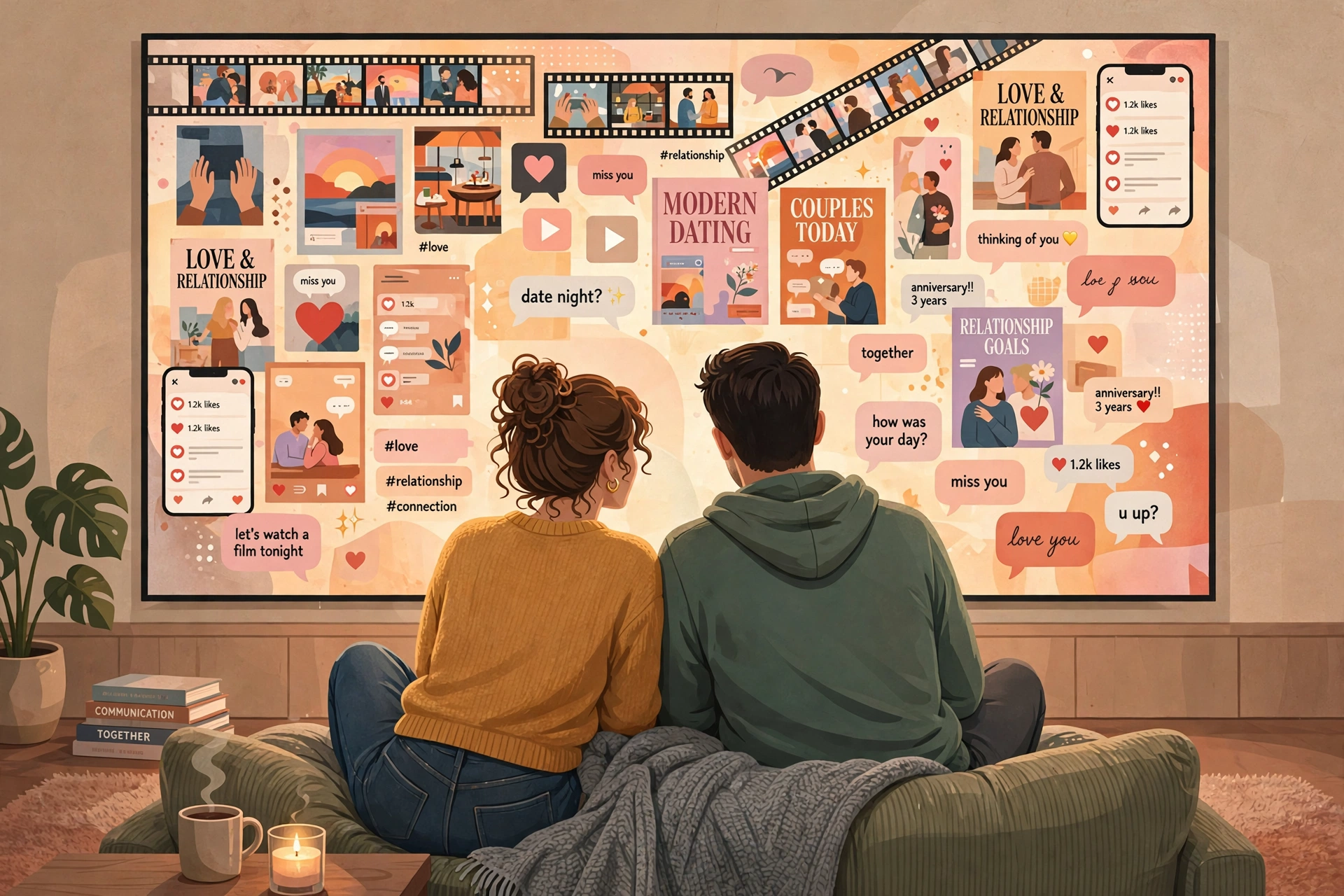
Long before most people enter their first serious relationship, they have already “been in” hundreds of them — on screens. By adulthood, the average person has watched thousands of fictional romances: the grand proposal in the rain, the couple who fight spectacularly and reunite passionately, the wife who is perpetually annoyed while her husband is perpetually clueless. This is not just entertainment. It is an informal curriculum in how men and women are supposed to love each other — and media representation of heterosexual relationships shapes modern partnerships in ways most couples never stop to examine.
This article looks at what researchers have actually found about media representation: which recurring stories the media tells about men and women together, the psychological mechanisms that carry those stories from the screen into the bedroom and the kitchen, and — most importantly — how couples can become media-literate together instead of being quietly scripted by fiction.
What Counts as “Media” in Modern Partnerships
When sociologists talk about media influence on relationships, they mean far more than romantic comedies. The full landscape includes:
- Film and television — rom-coms, dramas, sitcoms, reality dating shows, and the primetime series that research shows still carry heavily gendered romantic scripts.
- Advertising — fragrance ads, diamond commercials, and wedding-industry imagery that tie love to consumption and display.
- Music and celebrity culture — lyrics and tabloid narratives about breakups, cheating, and “power couples.”
- Social media — Instagram couple photos, TikTok relationship skits, and the meme economy of dating advice.
- Dating apps — gamified interfaces that train users to evaluate potential partners like products in a catalog.
- Adult content — the most widely consumed and least discussed media source of sexual scripts, disproportionately influential for young audiences.
Each channel tells its own version of the same underlying story: what a man wants, what a woman wants, and what their love should look like from the outside.
The Five Scripts Media Keeps Selling to Couples
Across decades of content, researchers keep finding the same handful of narrative templates recycled for male-female couples. Knowing them by name makes them easier to spot — and harder to absorb uncritically.
1. The Grand Gesture
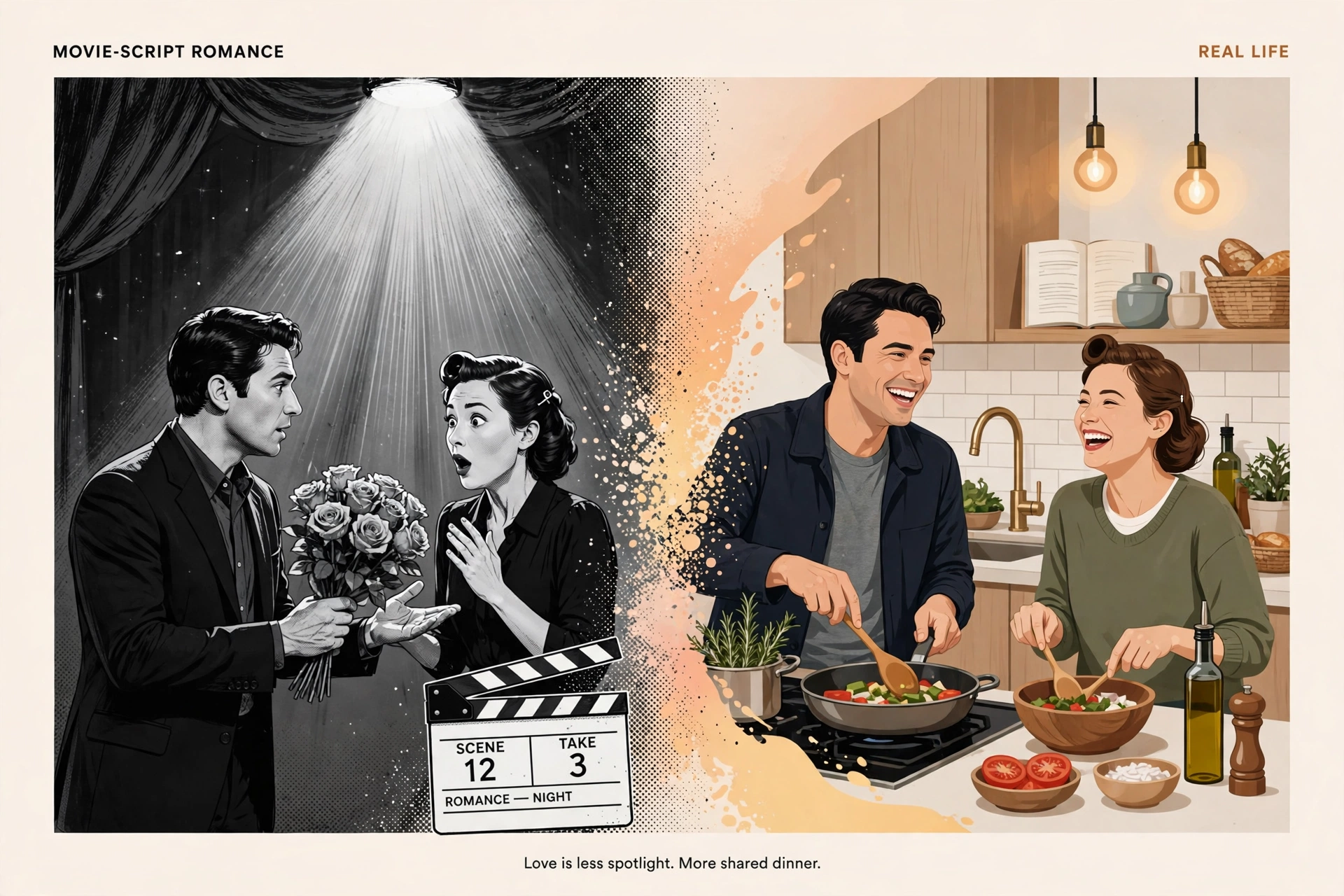
The man proves his love through one spectacular act: the airport chase, the flash-mob proposal, the boombox held overhead. The script teaches that love is demonstrated in dramatic peaks, not in the quiet maintenance of everyday care. Partners who internalize this may overlook consistent kindness and wait for cinematic proof.
2. Conflict as Passion
Screen couples argue furiously and reunite intensely; the fight is framed as evidence of depth. In real life, the healthier conflict resolution patterns that sustain partnerships — repair attempts, softened startups, physiological soothing — look nothing like the televised shouting match followed by a sweeping kiss.
3. The Sitcom Divide
The nagging wife and the emotionally clueless husband. The gold-digger and the commitment-phobe. Researchers studying adversarial relationship beliefs note that popular culture constantly propagates stereotypes depicting romantic relationships between men and women as inherently conflict-ridden or transactional — portrayals that normalize antagonism and distrust as the default setting of heterosexual interaction.
4. The Destiny Narrative
“The One,” “meant to be,” “you complete me.” This script suggests that the right partner arrives fully formed and effortless, so any serious work or mismatch must mean you chose wrong. Studies consistently find that destiny beliefs predict lower resilience: when believers hit ordinary friction, they interpret it as proof of incompatibility rather than an invitation to grow.
5. The Makeover Ending
One partner transforms the other — the wild man domesticated, the career woman softened. It flatters the fantasy of changing a partner rather than choosing a compatible one, and it quietly teaches that love means tolerating versions of people you hope to renovate later.
How Media Representation Shapes Heterosexual Relationships: The Psychology
Media does not brainwash couples in one sitting. The influence works through slower, well-documented psychological channels:
- Cultivation theory. Heavy, long-term exposure to consistent portrayals gradually shifts viewers’ sense of what is “normal.” If every sitcom couple bickers contemptuously, contempt starts to look like standard married life.
- Social learning. Viewers — especially adolescents — model behavior they see rewarded on screen. The guy who persists after rejection and “gets the girl” teaches a lesson about persistence that consent education then has to unteach.
- Sexual script theory. Researchers describe cultural “scripts” that tell people who initiates, what counts as a successful encounter, and what emotions belong afterward. Content analyses of primetime television have found these scripts still skew male-centric, and repeated exposure is linked to viewers internalizing those expectations, particularly among younger and less experienced audiences.
- Parasocial comparison. We compare our partners not only to real couples but to characters we have “relationships” with. A partner who does not plan surprise getaways can feel deficient — against a fictional standard no real person set.
- Confirmation bias. Once a viewer believes “all men are commitment-phobes” or “all women are manipulative,” media examples confirming the stereotype get noticed and remembered, while counterexamples fade — a feedback loop researchers link to adversarial relationship beliefs and declining satisfaction.
None of this requires conscious belief. The scripts operate as background assumptions — the water couples swim in.
What the Research Says About Media Representation and Heterosexual Relationships
The evidence base is larger than most people realize, and it points in a consistent direction:
- Expectations gap. Multiple studies link frequent consumption of romantic media with inflated expectations of partners — more mind-reading expected, more perfection demanded — and those inflated expectations predict lower satisfaction with real partners.
- Adversarial beliefs. Cross-cultural research on hostile attitudes toward the opposite sex finds that media depictions of relationships as battlegrounds reinforce zero-sum, distrustful schemas. People who score high on these measures report more jealousy and monitoring, more defensive conflict tactics, and higher dissolution rates — a self-fulfilling prophecy the media helped seed.
- Gender role rigidity. Traditional portrayals — man as provider, woman as caretaker — are associated with stricter personal gender-role adherence. Conversely, exposure to egalitarian portrayals predicts more flexible attitudes, suggesting representation cuts both ways.
- Sexual scripts and consent. Content analyses of primetime television and advertising show romantic and sexual scripts that underplay verbal consent communication and mutual pleasure. Among young viewers, researchers find these portrayals associated with more traditional — and less communicative — expectations about sex.
- Longitudinal couple research. Decades of observational research from the Gottman Institute show that real, lasting partnerships are built on unglamorous behaviors — turning toward bids for connection, repair after conflict, shared meaning rituals — none of which makes compelling television, and all of which the media script omits.
The takeaway is not that media ruins relationships. It is that media supplies a default instruction manual, and couples who never question it end up following it by default. Reviewing how gender roles play out in marriage is one concrete way to audit which of your assumptions came from experience — and which came from a screen.
The Social Media Multiplier
Traditional media was a broadcast: one story, passively received. Social media turned it into an interactive hall of mirrors, and the effects on partnerships are distinct. On these platforms, media representation becomes personal: every scroll can quietly reinforce the scripts a viewer has absorbed about how couples should look and act.
- Highlight-reel comparison. Couples post anniversaries, vacations, and proposals — never the Tuesday-night argument about dishes. Constant exposure to curated couple content raises the bar for what “normal love” looks like, even when viewers know, intellectually, that it is staged.
- Algorithmic extremism. Outrage and hot takes about the opposite sex travel further than nuance. A user who watches one video about “red flags” gets fed a diet of gendered grievance content that can genuinely reshape attitudes toward a real partner.
- Performance pressure. Proposals, gender reveals, and anniversary posts are now staged for an audience. The relationship becomes partly a production — and partners can feel like co-stars rather than companions.
- Relationship influencers. A new authority class dispenses absolute advice (“never do this,” “always leave if”) with no clinical training. Some of it is sound; much of it is scripted for engagement, not accuracy.
- Dating-app conditioning. Swiping interfaces train users to sort people by photo and first impression, normalizing disposability. That evaluative mindset can follow users into committed relationships, where a partner becomes someone to be optimized rather than known.
The screen is no longer just in the living room — it mediates texting and digital communication in relationships daily, from read-receipt anxiety to the performance of affection in stories and posts.
The Gendered Divide: Who Absorbs Which Messages
Men and women do not consume the same media diet, so they do not absorb the same scripts:
- Women are disproportionately targeted by romantic media, wedding-industry advertising, and “have it all” lifestyle content — scripts emphasizing emotional labor, appearance, and the perfect wedding as proof of the perfect relationship.
- Men are disproportionately exposed to sports media celebrating dominance, “lad” comedy normalizing emotional avoidance, and adult content presenting highly distorted sexual scripts — portrayals emphasizing performance, conquest, and stoicism.
- The collision. She may arrive expecting emotional attunement and verbal romance; he may arrive expecting low-maintenance ease and physical affirmation. Both expectations were partly authored by industries with no stake in their happiness.
These divergent scripts also feed the power dynamics in marriage that couples must consciously renegotiate: who pursues, who yields, who manages the emotional thermostat — and whether those roles were chosen or inherited from fiction.
Media Script vs. Healthy Alternative: A Side-by-Side Comparison
Here is how common media representation tropes compare with what relationship research shows actually works:
| The Media Script | What Healthy Partnerships Actually Do |
|---|---|
| Love is proven by grand gestures | Love is proven by consistent small acts of care — the research term is “turning toward” bids for connection |
| Passionate couples fight dramatically | Stable couples use softened startups, repair attempts, and physiological soothing during disagreements |
| A soulmate requires no work | All lasting partnerships require maintenance; “growth beliefs” outperform destiny beliefs |
| Jealousy proves devotion | Trust is built through transparency and reliability, not surveillance |
| One partner should complete the other | Healthy partners support each other’s separate identities, friendships, and goals |
| Physical chemistry solves everything | Friendship quality is the strongest predictor of long-term satisfaction |
| The story ends at the wedding | The wedding is the prologue; satisfaction follows a realistic curve with effortful rebuilding phases |
Becoming Media-Literate as a Couple
Awareness is the antidote. Couples who talk about media influence explicitly are far less likely to be steered by it. Here is a practical framework:
1. Name the script together
After watching a film or scrolling past a viral couple post, ask each other: “What is this telling us a relationship should look like?” Making the message explicit breaks its power as an invisible default.
2. Audit your expectations
Separately list three things you expect from your partnership that you have never actually discussed — then compare notes. Many items on the list will turn out to be inherited from media rather than agreed between you. Our guide to unrealistic expectations many couples carry into marriage offers a structured version of this exercise.
3. Curate the feed
Unfollow accounts that make either partner feel inadequate. Follow creators who model realistic, respectful partnerships. The algorithm will adjust within weeks.
4. Separate fiction from data
When a disagreement mirrors a movie trope (“you never plan anything romantic like in the films”), pause and translate it into a real request: “I’d love it if we planned a date night this month.” Concrete requests outperform scripted ones.
5. Talk about the hard scripts
Adult content is the media influence couples discuss least and absorb most. A non-judgmental conversation about what each partner has seen — and what felt realistic versus performative — is one of the highest-value talks a couple can have.
6. Build your own rituals
Replace scripted romance with rituals that are yours: a Sunday walk, a shared playlist, a silly private tradition. Real intimacy is authored, not imitated.
Frequently Asked Questions
Does watching romantic movies actually harm relationships?
Not automatically. Research suggests the risk comes from uncritical consumption combined with strong destiny beliefs — the idea that love should be effortless. Viewers who watch romantic media while recognizing it as fantasy show little negative effect; those who treat it as a template report lower satisfaction.
Can media representation of heterosexual relationships ever be positive?
Yes. Egalitarian portrayals — partnerships built on mutual respect, shared decision-making, and emotional honesty — are associated with more flexible gender attitudes in viewers. The problem is not representation itself but the narrow, commercialized range of stories that dominate.
Why do social media couples make me feel bad about my own relationship?
Because you are comparing your unedited daily life to someone else’s highlight reel. Studies on social comparison show that even when people know content is curated, the emotional comparison happens anyway. Curating your feed and limiting exposure measurably reduces this effect.
How do I talk to my partner about media expectations without starting a fight?
Externalize the issue: it is you two versus the script, not versus each other. Try: “I noticed that movie made me expect X — that’s probably not fair to us.” Framing it as a shared observation keeps defensiveness low.
Is pornography use always damaging to a partnership?
Research findings are mixed and depend heavily on context: secrecy, compulsivity, and distorted expectations are the risk factors, not use alone. What the evidence does support is that couples who communicate openly about it — rather than hiding it — report better outcomes than couples where it becomes a source of deception.
What is the single healthiest media habit for a couple?
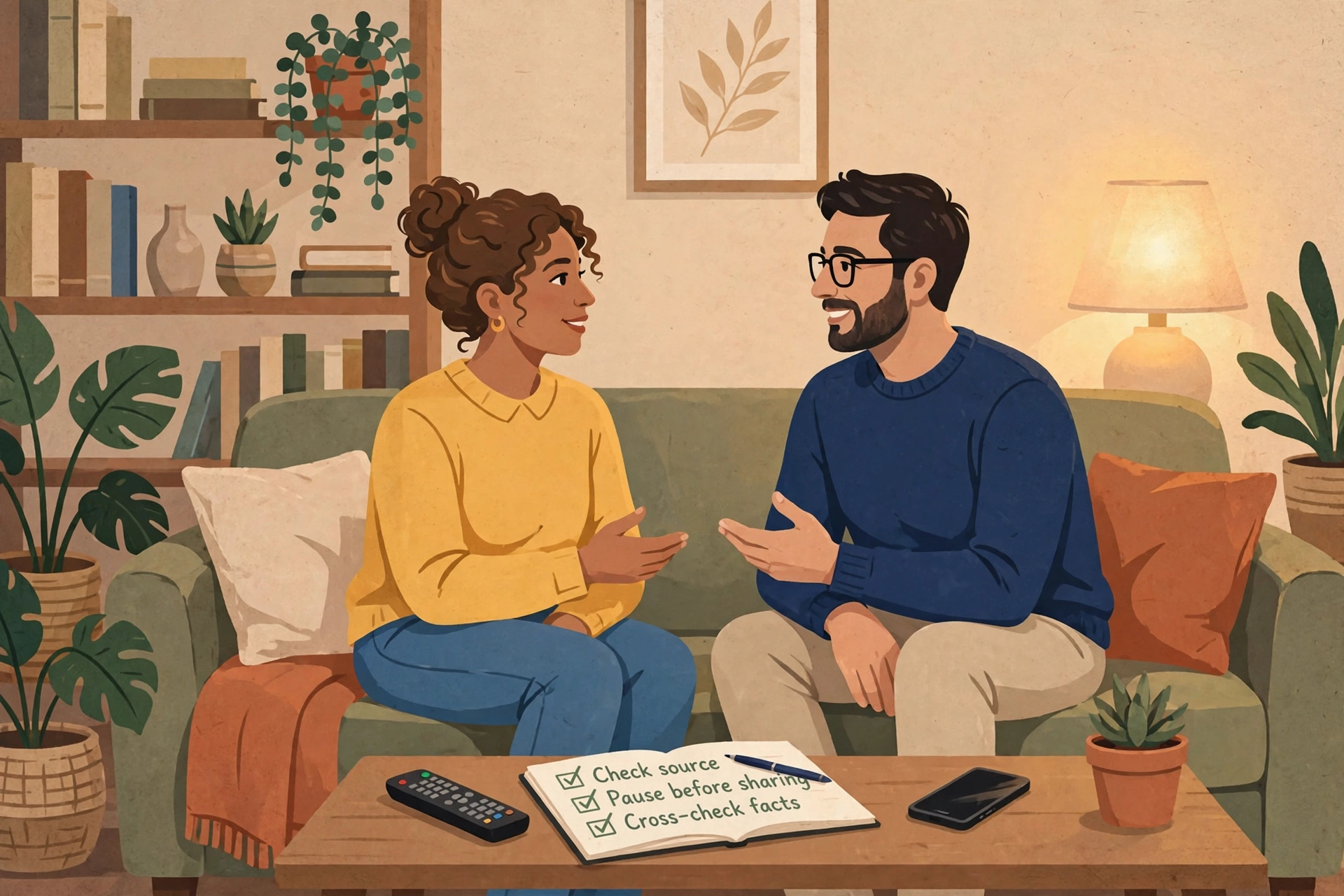
Co-viewing with commentary. Watching together and discussing what you see — the stereotypes, the unrealistic moments, the parts that actually resonate — converts passive absorption into active critical thinking, and the conversation itself builds intimacy.
Conclusion
Media representation of heterosexual relationships is not a villain to be eliminated — it is an environment to be navigated. Film, television, advertising, and social media will keep selling simplified scripts about men, women, and love, because simple stories sell. The couples who thrive are not the ones who avoid media; they are the ones who recognize the scripts, discuss them openly, and deliberately author their own. Your partnership does not need a grand gesture, a dramatic arc, or an audience. It needs two people willing to write the story together — in the unglamorous, unfilmed, deeply real scenes of everyday life.
Disclaimer: This article is educational only and is not a substitute for professional therapy, counseling, or medical advice. If media-driven expectations, conflict patterns, or intimacy concerns are affecting your relationship, consider consulting a qualified mental health professional or licensed couples therapist. Resources from the American Psychological Association can help you find support.