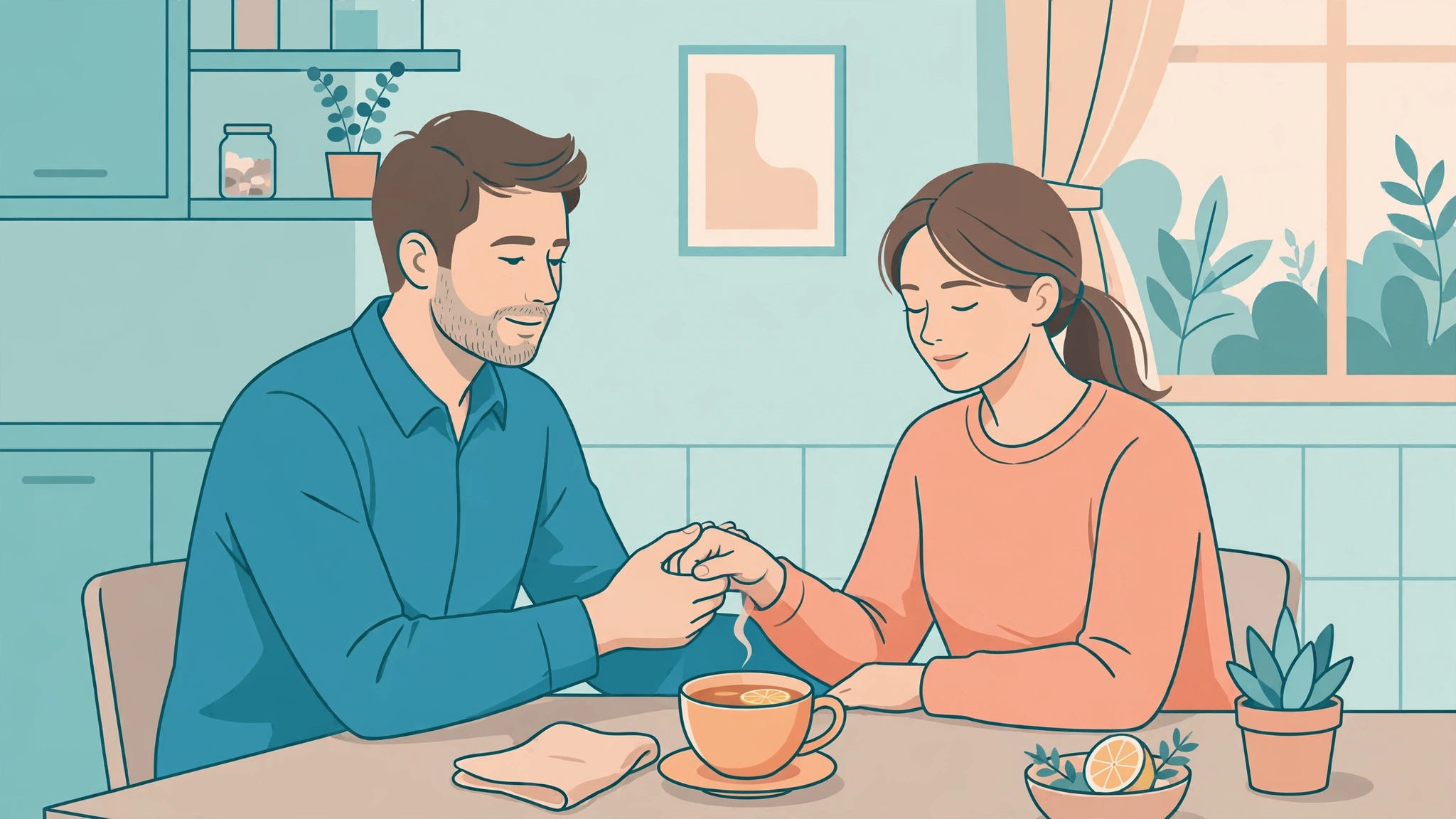
Menopause Partner’s Guide: How Husbands Can Truly Support Her
If you are reading this menopause partner support guide, you have already done the most important thing: you are trying to understand. Most husbands arrive here confused. Their wife, who has always been steady, suddenly seems like a stranger — tearful one evening, furious the next, drenched in sweat at 3 a.m., too tired for the life they built together. Many men quietly wonder whether their marriage is ending.
The truth, backed by every major medical authority from the Mayo Clinic to the North American Menopause Society, is far less dramatic and far more hopeful: your partner is going through a profound hormonal transition, and how you respond over the next few years can either deepen your marriage or quietly damage it. This guide gives you the knowledge, the language, and the practical playbook to get it right.
Menopause Partner Support Guide: Understanding What She Is Going Through
Menopause is not a single event. It is a transition that unfolds in three stages, and understanding them is the foundation of any real menopause partner support guide:
- Perimenopause: the years leading up to menopause, when estrogen and progesterone begin to fluctuate unpredictably. This phase can last from two to ten years, commonly beginning in a woman’s mid-40s.
- Menopause: the single day marking twelve consecutive months without a menstrual period — the end of reproductive years. The average age is around 51.
- Postmenopause: the years after, when many acute symptoms ease but long-term health considerations like bone density and cardiovascular risk take center stage.
The core driver is falling estrogen. Estrogen receptors exist throughout the brain and body — affecting temperature regulation, sleep, mood, memory, skin, bones, and the heart. When levels swing and then drop, the effects ripple everywhere, a fact confirmed by clinician resources like the Mayo Clinic and the NHS. Nothing about this is imagined, exaggerated, or “just in her head.”
The Symptoms You Are Actually Seeing: A Translator’s Chart
Husbands often misread symptoms as personality changes or relationship problems. Here is what the behavior usually means, and how a supportive partner can respond:
| Common Symptom | What It Looks Like at Home | Your Supportive Action |
|---|---|---|
| Hot flashes and night sweats | Sudden sweating, throwing off blankets, fanning herself | Lower the thermostat, keep a fan and cold water nearby, offer cooling bedding |
| Sleep disruption | Insomnia, tossing and turning, exhaustion by day | Protect the sleep environment — cool, dark, quiet; adjust your own bedtime habits |
| Mood swings and irritability | Short temper, tearfulness, emotional reactions that seem outsized | Listen without correcting; give her space to decompress before discussing |
| Brain fog | Forgetfulness, losing words, repeating herself | Be patient, offer gentle reminders, help organize — never point it out as a flaw |
| Low libido and vaginal dryness | Less interest in sex, discomfort or avoidance | Initiate a gentle, pressure-free conversation; suggest medical options together |
| Joint pain and fatigue | Skipping activities she used to enjoy, moving stiffly | Take on more household tasks; suggest joint-friendly exercise together |
| Anxiety and low mood | Worry, withdrawal, loss of confidence | Validate her feelings; watch for red flags that signal clinical depression |
| Body changes | Weight gain, hair thinning, sensitivity about appearance | Compliment genuinely; never comment on her appearance critically |
This transition commonly lasts four to eight years from perimenopause through early postmenopause, according to the North American Menopause Society. The most constructive thing a husband can internalize is that this is a multi-year season, not a bad month. Patience sustained over years matters more than any single grand gesture. Keep this menopause partner support guide’s symptom chart somewhere visible — understanding what you’re seeing is half the battle.

The 7 Habits of a Truly Supportive Husband During Menopause
Here are seven evidence-aligned habits that turn this menopause partner support guide into daily practice — small, repeatable behaviors that compound over the years of the transition.
1. Educate yourself — continuously
Reading this menopause partner support guide is a strong start, but keep going. Read clinician-authored resources from the Mayo Clinic, NHS, and the North American Menopause Society. When you understand the biology behind a hot flash or a sleepless night, you stop interpreting symptoms as personal attacks. Knowledge quietly replaces resentment with compassion.
2. Listen to understand, not to fix
When she describes what she is feeling, resist the instinct to solve it. Phrases like “have you tried…” or “at least it’s not…” shut her down. Instead, try: “That sounds genuinely awful — tell me what it’s like.” Women consistently report that feeling heard matters more than any proposed solution. Be a sounding board first, an advisor only when asked — a core rule of this menopause partner support guide.
3. Ask what she needs — never assume
No two menopause journeys are identical, and what helped last month may not help now. The single most effective sentence in this menopause partner support guide is a question: “What would be most helpful from me right now?” Then respect the answer — even if the answer is “just sit with me and say nothing.”
4. Take visible, unsolicited action at home
Fatigue and brain fog make daily life heavy. The partners who earn the deepest gratitude are the ones who act without being asked: taking over dinner when she is drained, handling the school run, managing the calendar. Reducing her mental and physical load is one of the most tangible forms of menopause partner support a husband can offer.
5. Protect sleep like it is sacred
Broken sleep amplifies every other symptom — mood, memory, and patience all collapse without it. Practical sleep support includes a cooler bedroom, breathable bedding, a quiet house after bedtime, and, on rough nights, graciously offering the spare room so she can rest undisturbed. Small sacrifices of comfort here pay enormous dividends. This menopause partner support guide considers protected sleep non-negotiable.
6. Show up for her medical care
Many menopause symptoms are highly treatable — from hormone therapy to non-hormonal prescriptions to vaginal moisturizers — but treatment decisions feel less overwhelming with a partner alongside. Offer to research menopause-informed clinicians with her, help weigh options, and attend appointments when she wants you there. Doctors consistently note that supported patients make better-informed health decisions — and this menopause partner support guide encourages you to be part of that process.
7. Keep the relationship deliberately alive
This menopause partner support guide’s seventh habit is simple: don’t let the transition shrink your marriage to a medical checklist. Plan date nights, take short trips, exercise together, keep laughing. Couples who protect their connection — separate from symptom management — report coming through menopause with stronger marriages. The North American Menopause Society notes that relationship satisfaction itself is linked to how women experience symptoms.
What to Say (and Never Say): The Phrase Cheat Sheet
Most relationship damage during menopause comes not from malice but from clumsy words. Competitors cover “use I statements” in the abstract; here is the exact language swap this menopause partner support guide recommends:
| Instead of This | Say This | Why It Works |
|---|---|---|
| “You’re being hormonal again.” | “This seems really hard right now — I’m here.” | Acknowledges her experience without pathologizing it |
| “Just relax / calm down.” | “I can see you’re overwhelmed. Want space or company?” | Gives her agency instead of a command |
| “There must be a cure for this.” | “Let’s learn about what treatments exist and see what feels right.” | Positions you as a teammate, not a mechanic |
| “You never want to be intimate anymore.” | “I’ve noticed we’re less connected physically — can we talk about what feels good for you now?” | Removes blame and opens a pressure-free conversation |
| “When will this be over?” | “I know this takes time — I’m in this for the long haul.” | Signals endurance instead of impatience |
| “Other women handle it fine.” | “Your experience is real, even if it looks different from others’.” | Validates her unique journey without comparison |
The pattern behind every good swap is the same: validate first, ask second, fix only with permission. Print this table, save it on your phone — whichever keeps it close on hard days.

Intimacy During Menopause: What Doctors Actually Recommend
Intimacy changes are among the least discussed and most distressing parts of menopause for couples. Declining estrogen thins vaginal tissue and reduces natural lubrication, which can make intercourse painful — a condition doctors call genitourinary syndrome of menopause. At the same time, hormonal shifts, poor sleep, and body-image worries can lower desire. None of this means your sex life is over; it means it needs adaptation, and doctors have clear guidance on how:
This section of the menopause partner support guide translates that medical guidance into steps you can take together.
- Talk about it directly but gently. Choose a calm, non-bedroom moment. Frame the conversation around closeness, not performance — “I miss being close to you; what would feel good for you these days?”
- Use high-quality lubricants and moisturizers. Clinicians widely recommend water- or silicone-based lubricants for intercourse and regular vaginal moisturizers for ongoing comfort. See our guide on choosing a body-safe lubricant for what to look for.
- Know that medical options exist. Doctors can recommend local vaginal estrogen, non-hormonal prescription treatments, and other therapies for painful intercourse. Our companion article on painful intercourse after menopause explains the causes and treatments in detail — consider reading it together.
- Redefine intimacy beyond intercourse. Extended foreplay, massage, mutual touch, and simply holding each other maintain physical connection while pressure is off. Many couples discover this phase deepens their intimacy rather than ending it.
- Never pressure or guilt-trip. Desire that is coaxed through obligation only builds resentment. Patience, warmth, and a genuine interest in her comfort are the real aphrodisiacs of midlife.
The Gap Nobody Talks About: Your Own Health Matters Too
Here is what most menopause guides for husbands miss entirely: supporting a partner through a years-long transition is demanding, and the husbands going through it are usually in midlife themselves. You may be facing your own sleep problems, work stress, aging parents, a changing body, and quiet anxiety about the future. That does not make you unsupportive — it makes you human, and it makes your self-care part of the menopause partner support plan.
When you exercise regularly, sleep adequately, and manage your own stress, three things happen: you have more patience, you model healthy coping, and you give her a partner who is thriving alongside her rather than silently resentful. Consider this menopause partner support guide your permission to keep your own doctor appointments, maintain your friendships, and ask for help — including couples counseling — when you need it. A husband running on empty cannot pour support into anyone — which is why this menopause partner support guide treats your self-care as part of the plan, not an afterthought.
Red Flags Only You Can Spot: When It Is More Than Menopause
Because you know her best, you are uniquely positioned to notice when symptoms cross the line from hormonal adjustment into something needing clinical attention. This menopause partner support guide lists the warning signs plainly, because doctors want partners to watch for them:
- Possible perimenopausal depression: persistent sadness or emptiness lasting two weeks or more, loss of interest in everything (not just sex), severe hopelessness, or withdrawal from friends and family. The North American Menopause Society confirms that the menopause transition carries a genuinely elevated risk of clinical depression — this is not “just hormones,” and it is highly treatable.
- Severe sleep loss affecting functioning: if insomnia is so persistent that daytime functioning, driving safety, or work performance is suffering, a clinician should evaluate it.
- Extreme hot flashes or other symptoms disrupting daily life: when symptoms consistently prevent normal activities despite lifestyle measures, medical treatment options should be discussed with a doctor.
- Any thoughts of self-harm: take these seriously immediately and seek professional help without delay.
That is what a real menopause partner support guide aims for: becoming her accountability ally — scheduling the bone-density scan together, making daily walks a shared ritual, and treating her preventive screenings with the same seriousness as your own. Support with a decades-long payoff.
FAQs
These are the questions husbands ask most — answered the way this menopause partner support guide answers everything: directly and without judgment.
How long will menopause last, and what does that mean for me as her husband?
The transition from perimenopause through early postmenopause typically lasts four to eight years, and hot flashes can persist for seven to ten years in some women. This menopause partner support guide is built for the marathon, not the sprint: pace yourself with sustainable habits of patience, communication, and shared healthy routines rather than expecting a quick resolution.
Is it normal that my wife seems angry at me all the time during menopause?
Irritability and a shorter fuse are among the most common emotional symptoms of perimenopause, driven by hormonal fluctuations, chronic sleep disruption, and real physical discomfort. It is rarely about you. Do not take it personally; give her space to cool down, then discuss conflicts at calm moments with “I” statements rather than reacting in the heat of the moment.
Should I go with my wife to her menopause doctor appointments?
Offer, but let her decide. Many women value having a partner present — a second set of ears, someone who can ask about treatment risks and benefits. Others prefer privacy for intimate health discussions. Ask directly: “Would you like me to come, wait outside, or skip this one?” Then respect her answer completely.
What can I do about our sex life during menopause?
Start with an honest, pressure-free conversation about what feels comfortable for her now. Clinicians recommend high-quality lubricants, regular vaginal moisturizers, and medical evaluation for painful intercourse, since effective treatments exist. Equally important: expand your definition of intimacy to include massage, extended foreplay, and physical affection without expectations. Never pressure — patience protects both desire and trust.
How do I know if her mood changes are depression rather than menopause?
Watch for persistence and severity: sadness lasting two weeks or more, total loss of interest in activities she once enjoyed, hopelessness, social withdrawal, or appetite and sleep changes beyond menopause norms. The menopause transition carries an elevated risk of clinical depression. If you see these signs, gently encourage professional evaluation — this menopause partner support guide’s single most important recommendation.
What are the worst things a husband can say to a wife going through menopause?
Dismissive phrases top the list: calling her “hormonal,” telling her to “calm down,” asking “when will this be over,” suggesting other women cope better, or implying her symptoms are exaggerated. Each minimizes a real physiological experience. Replace them with validation — “this sounds really hard, I’m here” — and specific offers of help. Words shape whether she feels like your teammate or your problem.
Next steps: Bookmark this menopause partner support guide and revisit it on hard days — the strategies that matter most are the ones you repeat. If her symptoms are significantly affecting her quality of life, encourage a conversation with her doctor, and explore our related guides on common causes of low libido and painful intercourse after menopause together. Couples who navigate this transition as a team often emerge stronger on the other side.
Medical disclaimer: This article is for educational purposes only and is not medical advice. Menopause symptoms vary widely between individuals, and treatment decisions should always be made with a qualified healthcare professional. If you or your partner are experiencing severe symptoms, signs of depression, or thoughts of self-harm, please consult a doctor promptly.