AI Conflict Resolution Tools for Couples
Imagine you are mid-argument with your partner at 11 p.m., both of you exhausted, the same fight circling for the third time this month. Now imagine a calm, neutral third party stepping in — not a therapist on a couch, but software in your pocket — that can tell you what your tone sounds like, rephrase the sharp sentence you are about to send, and show you that this exact fight follows a pattern you never noticed. That is the promise of conflict resolution are increasingly turning to: artificial intelligence designed to help partners fight fairer, communicate more clearly, and repair faster.
These tools are not science fiction anymore. A growing market of apps, chatbots, and guided platforms now claims to mediate disagreements, coach conversations in real time, and even track the emotional health of a relationship over time. But like any technology that sits in the middle of an intimate bond, they deserve more than hype — they deserve scrutiny. This guide explains what these tools actually do, where they genuinely help, where they fall short, and how to choose one wisely without handing your most private moments to a black box.
What AI Conflict Resolution Tools for Couples Actually Are
At their core, these are software products that use natural language processing (NLP), sentiment analysis, and large language models to observe, interpret, and shape how partners communicate. They fall into several distinct categories, and understanding the differences matters — an app that rewrites your text messages is doing something very different from a platform that mediates a live three-way session.
| Tool category | What it does | Example use case |
|---|---|---|
| Real-time coaching chatbots | Conversational AI that guides you through a structured conflict conversation, asking open-ended questions and suggesting calmer phrasing | You describe the fight to the chatbot; it walks you through each partner’s perspective step by step |
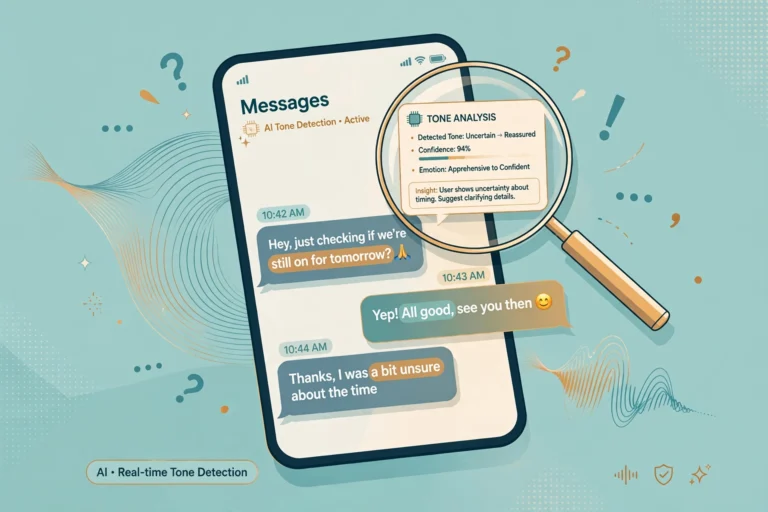
| Message rewriters and tone checkers | Analyze a text or email draft for harsh, blaming, or contemptuous language, then suggest a softer rewrite | You type “You never listen to me” and the tool suggests “I feel unheard when I’m interrupted — can we slow down?” |
| Shared mediation platforms | A neutral digital “room” where both partners interact with the AI simultaneously while it tracks the emotional logic of the conversation | Both partners join a guided session where the AI ensures each person feels heard before moving forward |
| Pattern and journal analyzers | Log arguments and moods over time, then surface recurring triggers, themes, and communication habits | After two months of journaling, the tool shows that 70% of your fights happen on Sunday evenings |
| Relationship health monitors | Combine check-ins, assessments (love languages, attachment styles, conflict styles), and dashboards into an ongoing picture | A weekly dashboard flags declining emotional connection before it becomes a crisis |
| Therapy-integration tools | AI assistants that support professional couples therapy — summarizing sessions, generating between-session exercises | Your therapist assigns AI-guided communication exercises as homework between visits |
Many real products blend several of these categories. Some are general-purpose AI assistants with relationship coaching skills bolted on; others are purpose-built for couples and grounded in established therapeutic models such as Emotionally Focused Therapy (EFT) or the Gottman Method. That grounding matters enormously — a tool built on validated relationship science is a very different proposition from a novelty chatbot trained on generic internet text.
How These Tools Work Under the Hood
You do not need a computer science degree to use these tools well, but a basic understanding of the machinery helps you judge their claims. Most platforms follow a three-stage pipeline:
1. Data collection
The tool ingests your input: typed messages, voice transcriptions, journal entries, answers to structured questionnaires, or the transcript of a guided session. Some tools also read metadata like message timing and frequency. This is the stage where privacy questions become critical — more on that below.
2. Behavioral analysis
NLP algorithms scan the text for signals: emotional tone (warm, neutral, hostile), blame patterns (“you always / you never”), contempt markers (sarcasm, mockery, stonewalling), and topic recurrence. Sentiment analysis scores each message; pattern detection looks across weeks of data to find triggers and cycles.
3. Insight and guidance generation
Based on the analysis, the system generates feedback: a rephrased sentence, a summary of each partner’s underlying need, a suggested repair attempt, or a visualization of your conflict patterns. Better tools frame these as options and explanations (“This sounds blaming because it starts with ‘you’ — here is an ‘I-statement’ alternative”) rather than orders.
What the machine cannot do is feel. AI detects statistical patterns in language; it does not experience empathy, understand your history together, or grasp cultural and family context unless that context is fed to it. Keep that limitation in mind whenever a tool sounds confident about your relationship.
Where AI Genuinely Helps During a Disagreement
Used with realistic expectations, AI conflict resolution tools for couples can be genuinely useful in specific moments. Here is where the evidence and the design logic are strongest.
De-escalating language in the heat of the moment
The single most practical use is the pause-and-rewrite function. Research on couples’ conflict has long shown that how a conversation starts predicts how it ends — harsh startups tend to produce harsh outcomes. A tool that flags contemptuous phrasing before you hit send interrupts that chain. Tools that check the tone of a text before you send it act as a friction layer: they do not censor you, they give you ten seconds to choose better words. Pair that habit with classic active listening instead of defensiveness, and the AI becomes a coach for skills you can eventually internalize.
Acting as a neutral third party
Many fights stall because each partner believes the other is not listening. A shared mediation interface forces turn-taking: Partner A speaks, the AI summarizes what it heard, Partner B confirms or corrects the summary before responding. This is essentially the structured “speaker-listener” technique from couples therapy, automated. It works because it externalizes the referee role neither partner has to play.
Revealing patterns you cannot see from inside the fight
Couples are notoriously bad at recognizing their own cycles. Logging conflicts over weeks and having software visualize them — same trigger, same day of week, same escalation sequence — turns a vague “we always fight about this” into a concrete, solvable map. Regular couples emotional check-ins combined with an analyzer can show whether a pattern is improving or just relocating to new topics.
Lowering the barrier to getting help
For couples who are hesitant about therapy — cost, stigma, scheduling, or simply not knowing where to start — an AI tool can be a first step. A structured conversation at midnight costs nothing and asks nothing of your pride. The best outcomes happen when this first step leads toward, not away from, human support: think of it as a bridge, not a destination.
Practicing empathy on demand
Empathy is a skill, and skills improve with practice. AI tools that rewrite messages with empathy essentially drill the “I feel / I need / can we try” structure until it becomes muscle memory. Over time, many users report that they start self-editing without opening the app — which is exactly what a good coach wants.
How to Use an AI Tool During a Real Argument: A Step-by-Step Script
Theory is nice; fights are messy. Here is a concrete workflow for using a conflict-resolution AI in the middle of an actual disagreement. Agree on this protocol with your partner in advance — ideally on a calm day — so the tool does not become another thing to fight about.
Step 1: Call the timeout
When voices rise or texts get sharp, either partner can say: “Let’s take twenty minutes and run this through the tool.” This is a structured timeout, not stonewalling — you agree on a return time before separating.
Step 2: Vent privately first
Each partner writes an unfiltered version of their position into the AI — the raw, unedited version. The tool’s job here is containment: it holds your frustration without judging you and without forwarding anything to your partner.
Step 3: Rephrase before sharing
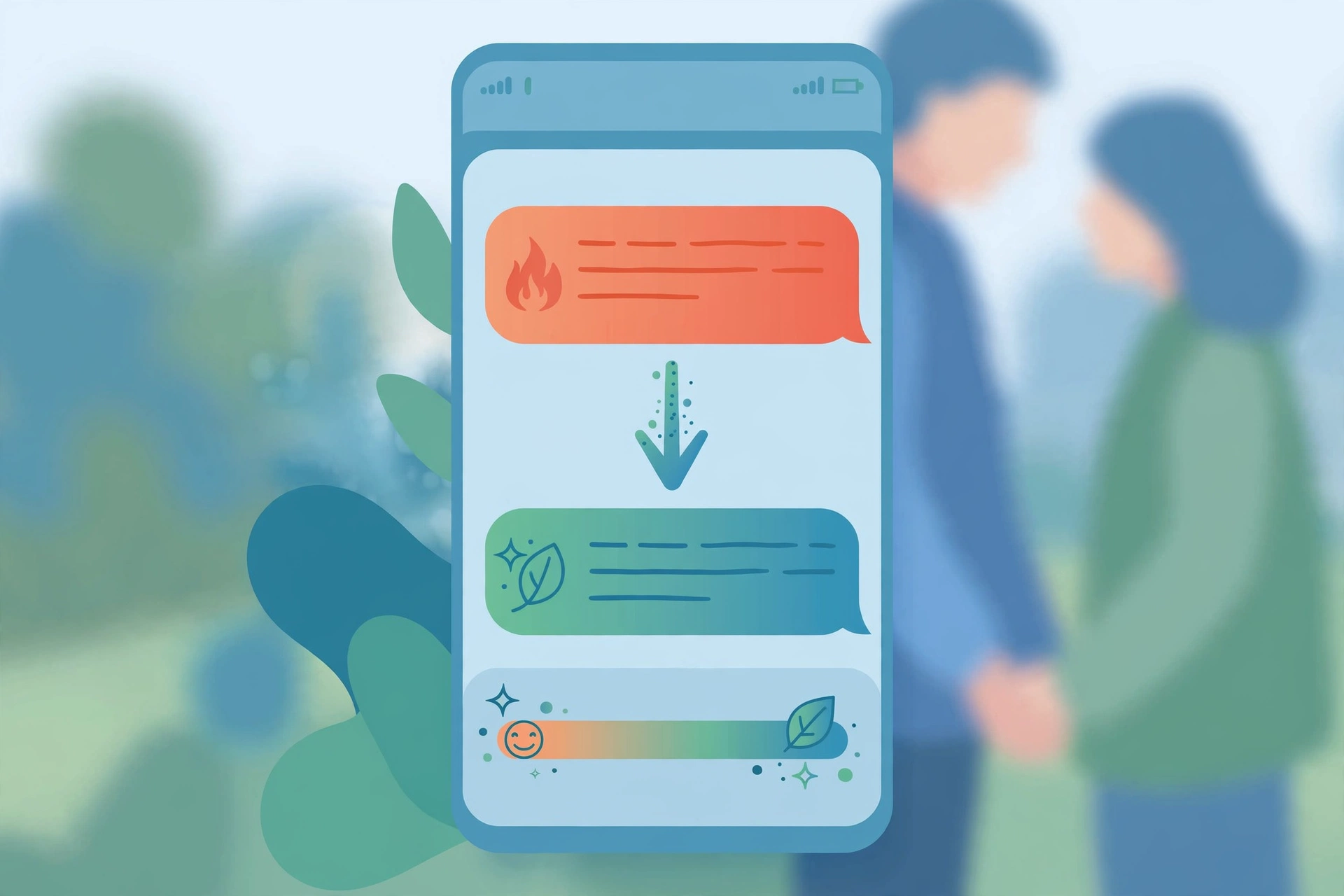
Ask the tool to convert each raw statement into a constructive version: one feeling, one need, one request. “You never care about my family” becomes “I felt hurt when the holiday plans were decided without me. I need to feel included. Can we revisit them together tonight?”
Step 4: Exchange summaries, not accusations
Have the AI generate a two-sentence summary of each partner’s position. Each partner reads the summary of the other’s position and confirms accuracy (“Yes, that’s what I meant” or “Close, but it’s more about…”) before anyone responds.
Step 5: Identify the real issue
Ask the tool to name the underlying need beneath the surface topic. Money fights are often about security; chore fights about respect; in-law fights about loyalty. Naming the layer underneath the argument is where resolution usually starts — a perspective explored more deeply in different paradigms of conflict resolution.
Step 6: Draft a small, specific agreement
End by asking the AI to draft one concrete, testable agreement: “For the next two weeks, we will decide holiday plans together before telling family.” Small agreements beat grand promises — they build a track record of repair you can actually verify.
When AI Is the Wrong Choice: Important Safety Limits
This is the section most marketing copy skips, and it is the most important one on this page. AI conflict resolution tools are inappropriate — and potentially dangerous — in several situations:
- Abuse, coercive control, or intimidation: If a partner uses threats, fear, monitoring, isolation, or physical aggression, an AI mediator is not merely unhelpful — it can be harmful. Shared-access tools can expose what a victim told the AI to the abusive partner, and “neutral” reframing can legitimize control as a mere communication problem. If you feel unsafe, contact a domestic violence helpline or local crisis service instead of an app.
- Acute crisis and self-harm: If either partner is expressing thoughts of suicide or self-harm, close the app and reach a crisis line or emergency services immediately. AI tools are not crisis responders and are not reliable at risk assessment.
- Severe untreated mental health conditions: Untreated depression, PTSD, substance use disorders, or personality disorders shape conflict in ways a general-purpose AI cannot responsibly navigate. These need qualified professionals.
- High-conflict separation or custody disputes: Anything typed into an app may become discoverable in legal proceedings. Do not narrate custody disputes or legal strategy into a consumer AI product without legal advice.
- When one partner refuses: Forcing a reluctant partner to “submit” to AI mediation is itself a form of control. Both partners must opt in freely, and either can stop at any time.
A useful rule of thumb: AI tools are for communication problems between fundamentally safe partners. They are not for danger, and they are not for pathology. Knowing the difference is a human judgment no app can make for you.
Your Data Is Your Fights: Privacy Questions to Ask First
Every argument you feed into an AI tool is data — among the most sensitive data you will ever generate. Before handing your relationship’s rawest moments to any platform, get clear answers to these questions:
- Is my data used to train AI models? The single most important question. Some products explicitly exclude your inputs from training; others use them by default with an opt-out buried in settings. Prefer tools that train on nothing you type, or that let you opt out easily.
- Is data encrypted in transit and at rest? Look for TLS in transit and AES-256 or equivalent at rest. Ask whether the company or its contractors can read plaintext conversations.
- Who can access my conversations — including my partner? Shared mediation tools may let both partners see session transcripts. Individual journaling tools should never share with a partner without explicit consent. Read the sharing defaults carefully.
- How long is data retained, and can I delete it? Prefer tools with clear retention windows and a real, verified deletion function — not just “deactivation.”
- Has the company had a data breach? A quick search for the product name plus “breach” takes thirty seconds and is worth it.
- What jurisdiction governs my data? Data stored in regions with strong privacy regulation (for example, the EU’s GDPR) generally carries stronger protections and enforcement.
As a baseline: never paste passwords, financial account numbers, immigration details, or anything you would not want read aloud in court into a consumer AI tool. The convenience of a chatbot is never worth that risk.
Choosing the Right Tool: A Practical Checklist
The market ranges from genuinely useful to cynically marketed. Use this checklist to separate them — it is the part of the decision competitors rarely spell out.
Green flags: signs of a trustworthy tool
- Clinically grounded: The product names its therapeutic model (EFT, Gottman Method, nonviolent communication) and ideally cites the research behind it.
- Human-in-the-loop options: The best tools offer escalation to licensed therapists, coaches, or at least curated professional resources — not an AI-only dead end.
- Transparent about limits: Trustworthy products state plainly that they are not therapy, not crisis services, and not suitable for abusive dynamics.
- Clear privacy terms: Short, readable privacy policies with explicit training-data opt-outs and deletion rights.
- Designed for both partners: Shared workflows, mutual consent requirements, and no features that let one partner monitor the other in secret.
- Honest evidence claims: Marketing that says “based on research about X” is fine; marketing that says “clinically proven to save marriages” without citing trials is a red flag.
Red flags: walk away
| Red flag | Why it matters |
|---|---|
| Promises to “save your marriage” or guarantee outcomes | No ethical tool guarantees relationship outcomes; this is a sales claim, not a clinical one |
| Stealth or spy features (reading a partner’s messages without consent) | This is surveillance, not conflict resolution — and it destroys the trust the tool claims to build |
| No named therapeutic model and no citations | The advice may be generated from generic internet text with no relationship-science basis |
| Opaque data practices or mandatory data-for-training | Your fights become product; you are the inventory |
| Handles crises with a generic disclaimer instead of routing to help | Signals the company has not thought seriously about safety engineering |
| Subscription traps with no export or deletion | You cannot leave with your own data — a bad sign for any service holding intimate records |
Cost reality check
Many tools are free to try with premium tiers from a few dollars a month to the price of a therapy session. Compare any subscription against its alternative: a single real couples therapy session typically costs far more than a year of an app subscription — but delivers something no app can, which is a trained human reading the room. The honest math is that AI tools are cheap supplements, not cheap substitutes.
What the Research Actually Says
Let us be candid: rigorous, peer-reviewed research specifically on AI conflict-resolution apps for couples is still young. What exists is promising but preliminary — pilot studies, user satisfaction surveys, and extrapolations from adjacent fields like AI-assisted mental health chatbots and digital therapeutic alliances.
What is well-established is the relationship science these tools borrow from. Decades of observational research — including the Gottman Institute’s research on how couples handle conflict — show that specific behaviors predict relationship outcomes: harsh startups, contempt, defensiveness, and stonewalling damage relationships, while repair attempts, physiological soothing, and turning toward a partner protect them. An AI tool that reliably coaches the second set of behaviors and interrupts the first is standing on solid ground, even if the tool itself has not yet been through large randomized trials.
The American Psychological Association’s resources on relationships similarly emphasize communication skills, conflict management strategies, and knowing when professional help is needed — all themes a well-designed AI tool should reinforce rather than replace. Treat vendor claims of “proven results” with the same skepticism you would apply to any health product: ask for the study, read the sample size, and check whether the research was independent.
Using AI Alongside Real Couples Therapy
The strongest use case for these tools may be as a therapy amplifier rather than a therapy replacement. Here is how that works in practice:
- Between-session homework: Your therapist assigns a structured exercise; the AI guides you through it at home and brings a summary back to the next session. This multiplies the value of expensive session time.
- Real-time coaching during the week: Insights surface exactly when conflict happens — at 11 p.m. on a Tuesday — not only during a Thursday appointment. The therapist reviews the week’s patterns with you later.
- Skill practice: Communication skills taught in session (I-statements, repair attempts, self-soothing) get drilled with AI feedback until they are automatic.
- Progress tracking: Shared dashboards give both the couple and the therapist objective data on whether fights are getting shorter, calmer, and less frequent.
If you work with a therapist, tell them which tool you are using and ask whether they are comfortable reviewing its outputs. Some therapists welcome the data; others worry about AI-generated advice conflicting with their treatment plan. That conversation itself is worth having — it keeps a human professional in charge of your care.
Frequently Asked Questions
Can AI really resolve conflicts between couples?
AI can facilitate better conflict resolution, but it does not resolve conflicts by itself. What it does well is structure conversations, flag destructive language, surface patterns, and suggest calmer phrasing. The actual resolution — understanding each other, making compromises, following through — is done by the humans. Think of AI as a coach and a mirror, not a referee with a whistle.
Are AI relationship tools a replacement for couples therapy?
No. A licensed couples therapist reads body language, tracks emotional undercurrents in real time, adapts treatment to trauma histories and mental health conditions, and carries professional accountability — none of which an app replicates. AI tools are best viewed as supplements: useful for practice, structure, and between-session support, but not substitutes for professional care when you need it.
Which is the best AI conflict resolution app for couples?
There is no single “best” app — the right choice depends on your needs, budget, and privacy comfort. Use the checklist in this article: prefer tools grounded in established therapy models, with clear privacy terms, human escalation options, and honest limits. Avoid anything promising guaranteed outcomes or offering surveillance features.
Is it safe to tell an AI app about my relationship problems?
It can be, if you choose carefully. Prefer tools that do not use your conversations to train models, encrypt your data, offer real deletion, and have no history of breaches. Avoid pasting highly sensitive details (financial accounts, legal matters, immigration status) into any consumer AI product. And never use a shared-access tool for anything you would not want your partner to read.
Can my partner see what I tell the AI?
It depends on the tool. Individual journaling and coaching apps are typically private; shared mediation platforms usually make session transcripts visible to both partners by design. Check the product’s sharing defaults before you type anything — and discuss expectations with your partner in advance.
What should I do if a fight turns scary or unsafe?
Stop using the tool immediately and prioritize safety. Leave the situation if you can, contact a trusted person, and reach out to a domestic violence helpline or emergency services in your country. AI conflict tools are designed for communication problems between safe partners — they are not equipped for abuse, threats, or intimidation.
How much do these tools cost?
Most offer free tiers with limited features and premium subscriptions ranging from a few dollars a month to roughly the cost of one therapy session per month. Evaluate cost against the alternative: apps are dramatically cheaper than therapy but deliver a fundamentally different service. Many couples use a cheap app for daily practice plus occasional professional sessions for the deep work.
The Bottom Line on AI Conflict Resolution Tools for Couples
AI conflict resolution tools for couples are neither the relationship savior their marketing promises nor the dystopian intrusion their critics fear. They are instruments — genuinely useful for de-escalating language, structuring difficult conversations, and revealing patterns, provided you choose a trustworthy product, protect your data, and stay honest about their limits. The couples who benefit most treat the AI as a coach for skills they are building together, not as a judge settling who is right.
The technology will keep improving, and the research will eventually catch up with the marketing. Until then, the wisest approach is the oldest one in relationship science: communicate with care, repair quickly, protect each other’s dignity — and let the AI hold the flashlight while you do the human work.
Disclaimer: This article is for educational purposes only and is not a substitute for professional therapy, counseling, or medical advice. AI tools cannot diagnose relationship problems or mental health conditions. If you are experiencing abuse, threats, or thoughts of self-harm, please contact a qualified professional, a crisis helpline, or emergency services in your country immediately.