
De-Escalating High-Stakes Domestic Disagreements
It starts with something small — an unpaid bill, a forgotten chore, a comment that lands sideways. Within four minutes your voices are raised, old grievances are back on the table, and neither of you remembers what the original point was. If that cycle sounds familiar, you are not broken — you are human, and you are missing a de-escalation playbook.
de-escalation is a trainable skill, not a personality trait. Researchers who study couples have spent decades mapping exactly how arguments ignite, peak, and cool — and what separates couples who recover quickly from those who spiral. This guide pulls that research into one practical framework: the physiology of why fights escalate, a seven-step sequence you can use mid-argument, word-for-word scripts for the topics that matter most, and a plan for building calmer patterns over time. It covers everything the standard advice covers — then goes further, into the angles most articles skip.
Why Domestic Disagreements Turn High-Stakes So Fast
Most household arguments are not really about the dishes, the spending, or the in-laws. They become high-stakes because they brush against deeper questions: Do you respect me? Can I trust you? Am I safe with you? When a disagreement about chores silently becomes a referendum on the relationship, the emotional temperature jumps far faster than the topic warrants.
Psychologist John Gottman calls the four communication habits that predict relationship damage the “Four Horsemen”: criticism, contempt, defensiveness, and stonewalling. You can read his team’s full breakdown in the Gottman Institute’s guide to the Four Horsemen. Contempt — eye-rolling, mocking, name-calling — is the single strongest predictor that a conflict pattern will cause lasting harm. The goal of de-escalation is not to win the argument; it is to keep these horsemen out of the room.
Three structural reasons explain the speed of escalation at home:
- No neutral ground. You cannot leave a workplace argument and go home to recover — the argument IS at home. There is no office door to close, so every unresolved fight bleeds into the same space where you sleep.
- Perpetual problems dominate. Gottman’s research suggests roughly two-thirds of couple conflicts are “perpetual” — they never fully resolve because they reflect genuine differences in personality or values. If you expect every disagreement to be solvable, you will fight harder than necessary.
- Audience pressure. Children, housemates, or relatives within earshot raise the stakes. Nobody wants to lose face in front of an audience, so both partners perform competence instead of seeking understanding.
The Physiology of Escalation: Why Your Body Hijacks the Conversation
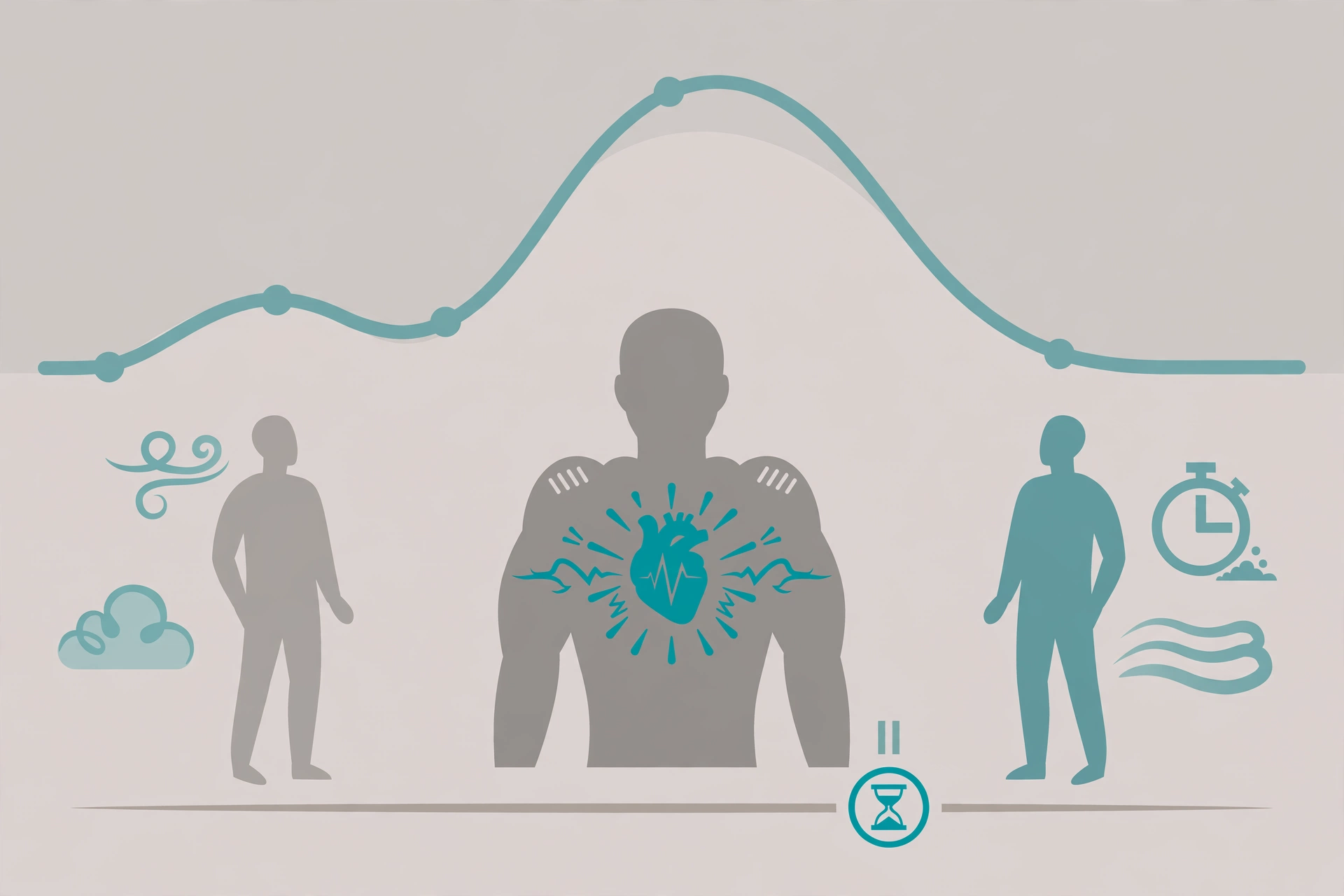
Gottman calls it “diffuse physiological arousal.” Most people know it as flooding — the moment your heart pounds, your hands shake, and words stop working. Understanding this state changes everything, because it reframes escalation as a body problem, not a character flaw.
When a threat is detected — including an emotional threat like a cutting remark — the sympathetic nervous system activates fight-or-flight. Heart rate climbs, often past 100 beats per minute. Stress hormones like adrenaline and cortisol flood the bloodstream. Complex reasoning, empathy, and language processing degrade measurably. You are not choosing to be unreasonable; your prefrontal cortex is literally being starved of resources.
Here is the part most articles understate: the chemistry takes time to clear. Adrenaline and cortisol have effective half-lives measured in tens of minutes, which is why Gottman’s lab landed on a minimum 20-minute break for a flooded person. Trying to reason through a conflict at minute five is like trying to swim while a wave is still breaking over you — the machinery of calm simply is not available yet. This is also why the break must be genuinely calming: ruminating on your comeback during the pause keeps the stress hormones flowing. Research by Bushman (2002) found that rehearsing grievances increased anger rather than releasing it. Venting does not clear the system; soothing does.
The 7-Step De-Escalation Sequence
Use this sequence in order. Each step works on its own, but together they form a complete loop: detect, calm, pause, reframe, validate, separate process from content, and repair.
Step 1: Detect the Red Zone Early
Escalation has a ramp, not a cliff. Before voices rise, the body signals first: tight jaw, clenched fists, heat in the face, faster breathing, shoulders creeping toward the ears. Some people feel their hands go cold as blood moves to the core. Pick your two or three personal early warnings during a calm moment and name them out loud now: “When my jaw tightens and I start rehearsing comebacks, I’m in the red zone.” Self-awareness before the fight is the cheapest de-escalation tool there is.
Step 2: Do the 20-Second Physiological Reset
When you catch the red zone, act on the body first, not the argument. Unclench your jaw. Drop your shoulders. Take one long exhale — breathing out for roughly twice as long as you breathe in (in for four, out for six or eight). Sit down if you are both standing; being upright and squared-off feeds the confrontation. This is not relaxation woo: slowing the exhale directly engages the vagus nerve and shifts the autonomic nervous system toward calm. Twenty seconds of this can be the difference between a disagreement and a blowup.
Step 3: Call a Strategic Pause With a Return Contract
If the reset is not enough — your heart is still hammering, you cannot follow what your partner is saying — say so and leave. But make it a pause, not an exit. The difference is the return contract: “I care about resolving this, and I’m too heated to do it well. Give me twenty minutes. I’ll come back at six and we’ll keep going.”
The return time is the crucial part. An open-ended break feels like abandonment to the partner left behind, which escalates them further. During the break, do something genuinely soothing — walk, shower, drink water — and do not rehearse the argument. A pause spent drafting your comeback is just escalation with better lighting.
Step 4: Name the State, Not the Story
Neuroscience research on affect labeling (Lieberman, 2007) found that simply putting feelings into words dampens reactivity in the brain’s threat centers. Try: “I’m getting loud, and that won’t help either of us.” This beats “You never listen” for one reason: it describes what is happening in the room right now without assigning blame. Naming the state also interrupts the narrative loop — the story your brain is building about your partner’s motives — which is where most of the emotional charge actually lives.
Step 5: Validate, Then Concede One True Thing
Validation does not mean agreement. It means showing your partner their feelings make sense from their perspective: “I can see why that felt dismissive to you.” Then go one step further and concede the part of their point that is true: “You’re right that I said I’d handle it and I didn’t.”
This combination is disarming because it removes the fuel most arguments run on — the fear of being unheard. You can hold a firm position and still acknowledge reality. For concrete phrasing you can rehearse ahead of time, see our collection of de-escalation phrases for couples.
Step 6: Split Process From Content
This is the framework’s least-used move, and it is the one most missing from standard advice. Every heated disagreement is actually two conversations tangled together:
- The content: the bill, the chore, the plan — the actual topic.
- The process: how you are talking — raised voices, interruptions, contempt, bringing up the past.
You cannot fix the content while the process is broken. So name the process explicitly: “I want to solve the money question, but the way we’re talking right now is making it harder. Can we each say our piece once without interrupting?” This reframes you as allies solving a shared problem — the tone — instead of opponents fighting over the topic. Couples stuck in a pattern where one partner pursues and the other withdraws will recognize this dynamic; our guide to the demand-withdraw cycle explains why that loop forms and how to interrupt it.
Step 7: Repair Before You Resolve
Only after the temperature drops should you return to the issue — and lead with repair, not with your case. A repair attempt is any small gesture that signals “we’re on the same team”: “That didn’t go how I wanted. Can we start over?” Gottman’s research found that the success or failure of repair attempts predicts relationship stability with remarkable accuracy. Accept your partner’s repair attempts even when they are clumsy — rejecting a peace offering teaches them not to offer one again. An effective apology matters enormously here; our guide to crafting an effective apology in a relationship walks through the anatomy of one that actually lands.
De-Escalating Over the Big Three Topics
Some topics escalate faster because they carry symbolic weight. Knowing what is really at stake beneath each one lets you defuse the subtext, not just the surface.
Money
Money fights are rarely about arithmetic. They are about security, freedom, and trust. One partner’s “sensible saving” is the other’s “controlling restriction.” The escalation trigger is usually a character judgment — “you’re irresponsible” or “you’re controlling” — disguised as a budget comment. The de-escalation move is to surface the underlying need: “Are we actually arguing about the purchase, or about whether we feel secure right now?” Agreeing on shared financial guardrails during calm times, as covered in our guide to collaborative budgeting for couples, removes half of these fights before they start.
Relatives and In-Laws
In-law conflicts are triangular: your partner is caught between loyalty to you and loyalty to their family, and any criticism of a relative feels like an attack on them. The escalation trigger is absolute language — “your mother always undermines me.” The de-escalation move is to keep the conversation between the two of you and frame the need: “I need us to agree on boundaries for the holidays” rather than “your family is the problem.” Establishing those limits ahead of time helps; see our guide to setting boundaries with in-laws.
Parenting
Parenting fights escalate because both partners hear criticism of their discipline as criticism of their love for the child. The trigger is usually disagreement in front of the children, which adds audience pressure and models conflict poorly. The de-escalation move is a two-part agreement: first, pause any discipline dispute in front of the kids (“we’ll discuss this later”); second, reunite as a team before addressing it. Under sustained stress, parenting disagreements compound — our article on co-parenting under stress goes deeper into keeping the team intact when exhaustion is high.
Build Your De-Escalation Contract During Calm Times
The worst time to negotiate the rules of conflict is during a conflict. Borrow an idea from aviation — checklists are written before the emergency — and draft a de-escalation contract together on an ordinary Tuesday. Write it down, keep it somewhere visible, and revisit it yearly. A strong contract covers:
- The pause phrase. Agree on exact words either partner can say to pause a fight: “I need twenty minutes” or “pause button.” Either partner can invoke it, no questions asked.
- The return rule. Every pause ends with a stated time. The person who called the break is responsible for returning.
- Forbidden moves. Agree in advance that the following are off-limits: name-calling, bringing up past resolved fights, threats (including “maybe we should just split”), and silent treatment beyond the agreed pause.
- The repair ritual. Decide what reconnection looks like after a fight — a walk together, tea, an apology conversation — so neither of you has to guess.
- The review slot. A weekly 20-minute check-in where small irritations get aired before they become ammunition. Regular emotional check-ins for couples are the single highest-leverage habit for preventing the buildup that fuels high-stakes fights.
One overlooked reason contracts help: they externalize the rule. When the contract says “no kitchen-sinking,” you can appeal to it — “that’s one of our contract rules” — instead of accusing your partner. The paper becomes the referee, which removes the sting.
Scripts for the Moments That Usually Explode
Prepared language matters because a flooded brain cannot compose one. Keep these on hand like a fire extinguisher — not for daily use, but for the moments that count:
| When this happens… | Say this instead of… | Try this de-escalating line |
|---|---|---|
| Your partner raises their voice | “Don’t yell at me!” | “I’m finding it hard to listen when voices rise. Can we bring it down?” |
| An old fight gets dragged in | “That was YEARS ago!” | “That deserves its own conversation. Can we stay with today’s issue?” |
| You feel accused unfairly | “That’s not true!” | “I hear how it looked. Here’s what was actually going on.” |
| They go silent (stonewalling) | “Answer me!” | “I’ll give you some space. Can we come back to this at eight?” |
| You realize you’re wrong mid-fight | Doubling down | “You’re right about that part. I don’t want to keep arguing about it.” |
| They use contempt (mocking, eye-roll) | Mocking back | “I need the sarcasm to stop so I can actually hear you.” |
De-Escalating in Front of Children: What to Model
Children will witness some of your disagreements no matter how careful you are, and research on family conflict is consistent on the key point: what damages children is not the existence of conflict but its destructiveness — contempt, threats, and unresolved hostility. Arguments that end in repair, by contrast, teach children one of life’s most valuable lessons: that conflict can be handled safely.
Three rules for when an audience is present:
- Lower the intensity, not the honesty. “We’re disagreeing about bedtime and we’re working it out” is far better than a screaming match or a fake-cheerful cover story.
- Never recruit. Do not ask children to take sides, deliver messages, or confirm your version of events. This puts them in an impossible loyalty bind.
- Repair visibly. If they saw the fight, let them see the repair: “Mom and Dad disagreed, we talked it through, and we’re okay.” That sentence alone rewrites the lesson they take away.

The Post-Fight 24-Hour Audit
De-escalation does not end when voices drop. Within 24 hours of a significant fight — once everyone is calm — spend ten minutes on a private audit. This converts every blowup into data for the next one:
- What was the real topic? Strip away the surface. Was the bill fight actually about feeling unappreciated?
- When did it tip? Identify the exact sentence or moment where the temperature changed. That is your early-warning signal for next time.
- What did I contribute? Not what your partner did wrong — what you brought to the escalation. One honest sentence.
- What worked? If you successfully de-escalated at any point, name what you did so you can repeat it.
- What needs a repair conversation? Some hurts need a follow-up apology or acknowledgment beyond the heat of the moment.
Over months, these audits reveal patterns no single fight can: the same trigger, the same hour of the evening, the same unspoken need. Broader conflict frameworks can help you interpret what you find — our overview of conflict resolution paradigms maps the major models therapists actually use.
When De-Escalation Isn’t Enough: The Safety Line
Every technique in this guide assumes a fundamental baseline: both partners are safe with each other. De-escalation skills are for disagreements between equals — not for situations involving fear, intimidation, or violence.
There is a critical distinction between conflict and control. Conflict is two people clashing over a disagreement; control is one person using threats, monitoring, isolation, or physical force to dominate the other. If your partner’s anger scares you, if you modify your behavior to avoid setting them off, or if disagreements end with broken objects, threats, or physical contact — that is no longer a communication problem. The de-escalation move is to disengage and seek safety, not to communicate better.
If you are in the United States, the National Domestic Violence Hotline (1-800-799-7233) offers confidential support 24/7. In the UK, the National Domestic Abuse Helpline is 0808 2000 247. If you ever feel you are in immediate danger, contact your local emergency services. A therapist or counselor experienced in domestic conflict can also help you distinguish a destructive pattern from an abusive one — and the American Psychological Association’s resources on marriage and relationships are a trustworthy starting point for finding qualified help.
Frequently Asked Questions
How do I de-escalate a domestic disagreement when my partner won’t stop yelling?
You cannot calm another person directly, but you can change the conditions. Lower your own voice — most people unconsciously match volume downward as well as upward. State the process problem plainly: “I want to hear you, but I can’t when you’re shouting.” If it continues, use your pause phrase and leave the room. Engaging with shouting rewards it; calmly refusing to participate does not.
What is the 20-minute rule in an argument?
It comes from John Gottman’s research on emotional flooding: once the body enters fight-or-flight, it needs at least 20 minutes of genuine calming to return to baseline. Crucially, the break must include a return time (“I’ll be back at 6:30”) and must be spent soothing yourself, not rehearsing your next point. A break without a return time is stonewalling, not de-escalation.
Is taking a break during a fight just avoiding the problem?
No — avoidance is refusing to return to the topic. A strategic pause with a stated return time is the opposite of avoidance: it is choosing to have the conversation when both of you can actually think. The test is simple: if you always come back at the agreed time, it is de-escalation. If topics keep getting postponed indefinitely, it is avoidance, and that needs addressing separately.
What should I say if I realize I’m wrong in the middle of a disagreement?
Say so, immediately and plainly: “You’re right about that part.” Mid-fight concessions are disarming because they instantly remove the fear of being unheard that drives most escalation. You do not have to surrender your whole position — conceding the true part while holding your boundary (“I was wrong about the timing, and I still need us to agree on a plan”) models exactly the firmness-without-hostility that de-escalates.
How do we stop the same fight from repeating every month?
Recurring fights are usually perpetual problems — value or personality differences that cannot be “solved,” only managed. The shift is from “how do we end this disagreement” to “how do we handle this disagreement with less damage.” The post-fight 24-hour audit above, a standing weekly check-in, and a written de-escalation contract turn repetition into manageable ritual instead of escalating war.
Can one person de-escalate a disagreement alone?
Yes — it takes two to escalate but only one to interrupt the pattern. Lowering your voice, refusing contempt, calling a pause, and offering repair attempts all change the dynamic even if your partner does not reciprocate immediately. That said, if one partner consistently refuses all de-escalation over months, that is a sign the pattern needs professional support, not better solo technique.
How do I de-escalate when the disagreement is about something genuinely serious, like finances or infidelity?
Serious topics need the same physiological rules plus structural support: agree on a time limit for the conversation, take breaks as scheduled rather than waiting for flooding, and consider a couples counselor as a neutral container. For high-stakes topics, many couples do better with a therapist in the room for the first few conversations — not because they are failing, but because the stakes deserve scaffolding.
When does a disagreement stop being a communication issue and become something more serious?
The line is safety and control. A communication issue involves two people who feel fundamentally safe but keep hurting each other with poor technique. It becomes something more serious when there is fear, threats, physical aggression, coercive control, or a consistent pattern of one partner dominating the other. In that case, de-escalation techniques are insufficient — prioritize safety and contact a professional or a helpline listed above.
Conclusion: Calm Is a Skill, Not a Trait
de-escalation is not about suppressing your feelings or always backing down. It is a learnable sequence: recognize the body’s red zone, reset your physiology, pause strategically with a return contract, name the state instead of the story, validate and concede what is true, separate how you are talking from what you are talking about, and repair before you resolve. Most articles on this topic stop at “take a breath and listen.” The difference here is the rest of the playbook — the pre-written contract, the topic-specific scripts, the visible repair in front of children, and the honest safety line.
You will not execute this perfectly the first time. Nobody does. But every time you catch the red zone one minute earlier, take the pause instead of delivering the comeback, or return at the promised time and repair, you are rewiring the pattern. Over months, those small choices compound into something neither partner could produce alone: a home where disagreements happen — and end — safely.
Disclaimer: This article is for educational purposes only and is not a substitute for professional therapy, counseling, or medical advice. Conflict patterns vary widely between households; if disagreements involve fear, intimidation, or violence, or if anger feels unmanageable, please consult a qualified mental health professional or contact a domestic violence helpline in your country.