
Active Listening vs. Defensive Rebuttals: Breaking the Cycle
You know the moment. Your partner starts talking about something that bothers them, and before they’ve finished the second sentence, your brain is already building your case. You’re not listening anymore — you’re defending. The conversation ends with both of you hurt, and nothing resolved. Again.
When you understand the mechanics of active listening vs defensive communication, you can spot the moment your brain switches from listening to defending — and interrupt it.
This pattern has a name in relationship science: the collision between active listening vs defensive communication. One style opens a conversation up; the other shuts it down. Most couples don’t need more topics to talk about — they need a fundamentally different way of hearing each other. This guide breaks down exactly how defensive rebuttals work, why they’re so hard to stop, and the research-backed path out of the cycle.
What Active Listening Actually Means
The concept of active listening didn’t start in couples therapy. It comes from the humanistic psychology of Carl Rogers, who found that people heal and grow when someone listens to them with full, non-judgmental attention. Communication researchers later built it into a teachable skill with three working parts: nonverbal involvement (eye contact, open posture, leaning in), verbal paraphrasing (restating what the speaker said in your own words), and elaborative questioning (open questions that invite the speaker to go deeper).
In a relationship, active listening is a shift in purpose: from “how do I respond?” to “how can I understand?” It means reflecting back what you heard before you explain yourself, naming the emotion underneath the words, and treating your partner’s perspective as worth understanding even — especially — when you disagree with it. It’s not passive or silent; it’s deliberate, engaged effort. That’s the core of the active listening vs defensive communication distinction: your purpose in the conversation determines its outcome.
Crucially, validation is not agreement. You can say “I can see why that would upset you” without conceding that you were wrong. Most couples stumble here: they fear that listening well means surrendering their position. It doesn’t. It simply creates the emotional safety in which real problem-solving becomes possible.
The Six Types of Defensive Rebuttals (and Why They Feel So Automatic)
Defensive communication is the brain’s threat response applied to conversation. When your partner’s words feel like an attack — even when they aren’t intended as one — your nervous system shifts into defend-or-explain mode before your rational brain catches up. Researcher John Gottman identified defensiveness as one of the “Four Horsemen” of relationship breakdown, behaviors that reliably predict relationship failure when left unchecked.
Defensive rebuttals tend to take six recognizable forms. Knowing which one you default to is the first step to catching it in real time. In the active listening vs defensive communication framework, these six moves sit firmly on the defensive end:
| Rebuttal Type | What It Sounds Like | The Active-Listening Antidote |
|---|---|---|
| The Counterattack | “Well, YOU did the same thing last week.” | Acknowledge their point first; raise your issue in a separate conversation. |
| The Excuse Maker | “I only did that because you made me late.” | Take ownership of your part before explaining context. |
| The Detail Corrector | “It wasn’t Tuesday, it was Wednesday — and I did call.” | Respond to the feeling first; facts can wait. |
| The Minimizer | “You’re overreacting. It’s not a big deal.” | Validate that it feels big to them: “This clearly matters to you.” |
| The Role Reversal | “So I’m the bad guy now? Fine.” | Resist the victimhood script; ask what they need from you. |
| The Shutdown | Silence, leaving the room, changing the subject. | Name the overwhelm honestly: “I need a short pause so I can listen well.” |
Every one of these moves has the same effect: it tells your partner that their concern is less important than your self-protection. The partner stops feeling heard, raises the intensity to break through, and the listener defends harder — the cycle tightens. Each time this loop runs, the active listening vs defensive communication gap widens — until one partner finally chooses to listen differently.
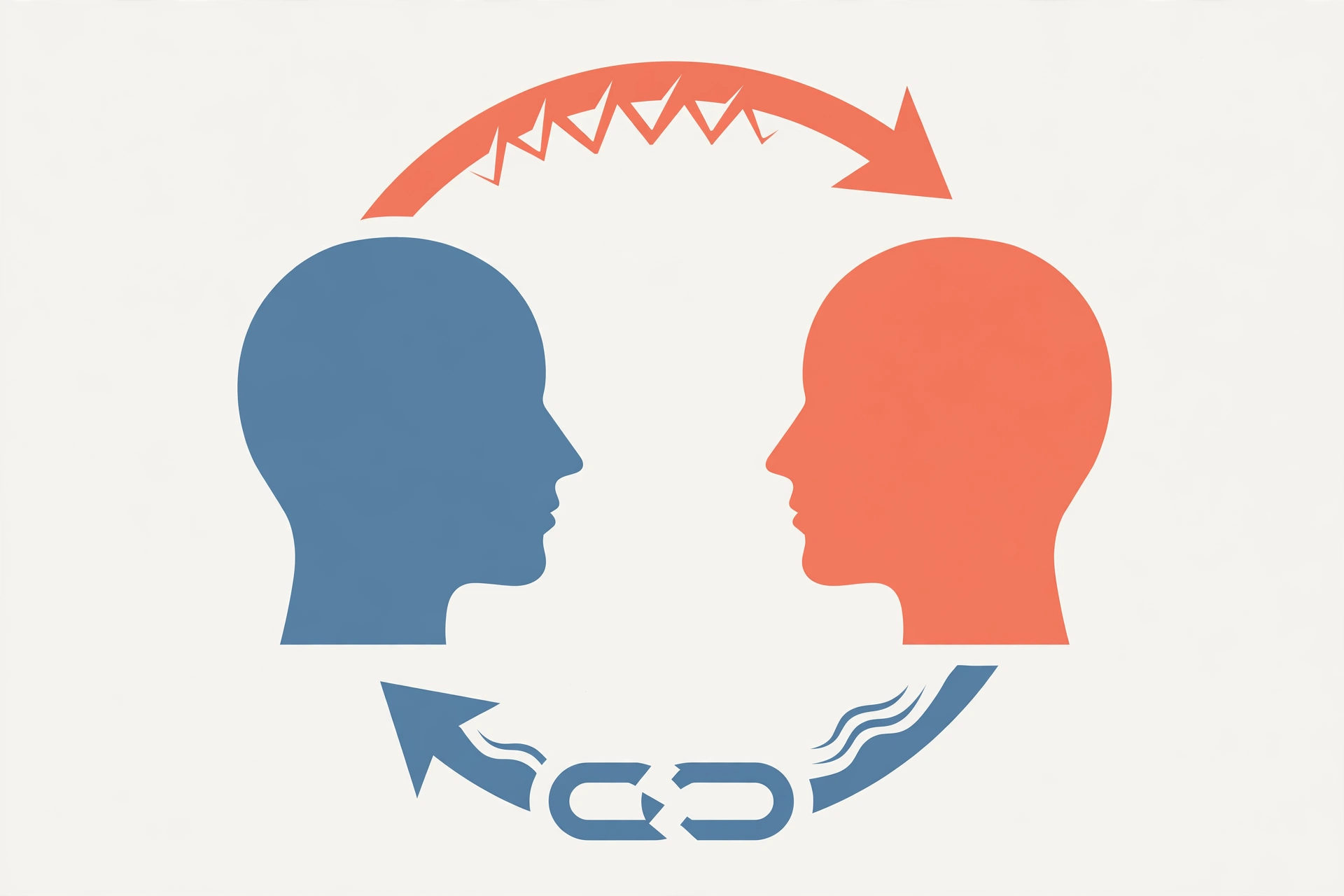
Active Listening vs Defensive Communication: The Cycle That Traps Couples
The real problem isn’t a single defensive comment. It’s the loop those comments create. Relationship researchers call it the demand-withdraw cycle: one partner raises an issue (often with growing intensity), the other deflects or shuts down, the first partner feels dismissed and pushes harder, and the second withdraws further. Each person’s response is the other’s trigger. Nobody is the villain; both are running on reflex.
Here’s what makes the cycle so durable: both partners usually believe they’re the one trying to communicate. The partner raising the issue thinks, “I keep talking because you won’t listen.” The defensive partner thinks, “I stop listening because you keep attacking.” Both perceptions contain truth. And both keep the loop spinning. The paradox of active listening vs defensive communication is that both partners usually believe they’re the one trying to communicate.
Breaking the cycle doesn’t require both partners to change at once. In fact, one partner shifting their listening style — paraphrasing instead of rebutting, asking “did I get that right?” instead of explaining — reliably changes the dynamic over time. When the raised issue meets a genuine effort to understand rather than a defensive wall, the intensity of the demand side drops, because the underlying need (to be heard) is finally being met.
Why “Just Try Harder” Fails: The Neuroscience of Defensiveness
Most couples advice treats defensiveness as a choice — as if you could simply decide not to be defensive. The biology says otherwise. When criticism registers as a threat, the amygdala activates the stress response: adrenaline rises, heart rate climbs, and the prefrontal cortex (the part of the brain that does perspective-taking and nuanced listening) goes partially offline. Gottman calls this state “diffuse physiological arousal,” or flooding.
Flooded people can’t listen well, and they shouldn’t try. Gottman’s lab research found that once heart rate exceeds roughly 100 beats per minute during conflict, productive conversation becomes physiologically impossible — and it takes at least 20 minutes of genuine calming for the stress hormones (adrenaline and cortisol) to clear the system. That’s why he recommends a structured 20-minute physiological self-soothing break: step away, do something calming, and agree to return. The pause isn’t avoidance; it’s biology.
This reframes the entire active listening vs defensive communication debate. Defensiveness isn’t a character flaw — it’s a nervous system state. Recognizing this biological reality is the first step in the active listening vs defensive communication journey. The goal isn’t to never feel defensive; it’s to recognize the state, regulate it, and return to the conversation with your listening brain back online. Couples who learn to practice regular couples’ emotional check-ins outside of conflict also build a buffer: it’s far easier to hear a complaint from someone you’ve been feeling close to.
What the Research Honestly Says About Active Listening
Here’s a nuance most articles skip. Gottman — the researcher most associated with promoting communication skills — actually found that active listening alone was a weaker predictor of relationship success than expected. A landmark study following 130 newlywed couples for six years found that active listening occurred infrequently during conflict and its use didn’t predict marital success. Gottman himself later called it a myth that teaching couples to communicate better is enough to save a relationship.
So what does the research say actually works? Three things consistently predict outcomes far better than paraphrasing technique alone:
- The soft startup. Gottman found that 96% of the time, the way a conversation starts determines the way it ends. Complaints that begin with “I feel…” and a specific request (the softened startup formula) land completely differently than ones that begin with “You always…”. The listener’s defensiveness often starts before the listener even speaks — it’s triggered by how the message was delivered.
- Repair attempts. Successful couples aren’t the ones who never get defensive — they’re the ones who catch themselves and repair mid-conversation: “That came out defensive. Let me try again.” Research shows it’s the success rate of repair attempts, not the absence of conflict, that separates stable couples from struggling ones.
- Physiological self-soothing. Couples who recognize flooding and pause effectively resolve conflict better than couples who “power through.” Taking a real break is a skill, not a failure.
Gottman also found that 69% of relationship problems are “perpetual” — rooted in fundamental personality or lifestyle differences that never fully resolve. For those issues, active listening isn’t a path to a solution; it’s a path to living well with the problem. For perpetual problems, the question isn’t whether active listening vs defensive communication can solve the issue — it’s whether you feel genuinely heard about it. Feeling genuinely heard about an unsolvable issue turns out to be most of what we need.
None of this diminishes active listening. It repositions it: not a magic fix, but the essential de-escalation tool inside a larger system of healthy habits — a finding supported by the Gottman Method couples therapy framework and decades of follow-up research.
Breaking the Cycle: A 5-Step Protocol That Works in Real Time
Knowing the theory is easy; using it when your heart is pounding is the hard part. Here’s a concrete active listening vs defensive communication protocol for the next difficult conversation:
Step 1 — Notice your body before your words
Racing heart, tight chest, the urge to interrupt? That’s flooding, not information. If you’re flooded, say so: “I want to hear this, but my body is in overdrive. Can we take 20 minutes and come back?” Honor the return time — walking away without a return plan is stonewalling, not self-soothing.
Step 2 — Mirror before you mean it
Repeat back the core of what you heard: “So you’re saying you felt dismissed when I made that decision without checking with you. Is that right?” You don’t have to agree or even be calm yet. Mirroring buys your nervous system time to settle while proving to your partner that their words landed.
Step 3 — Validate the emotion, not the verdict
“It makes sense you’d feel hurt by that” is validation. It doesn’t mean “you’re right and I’m wrong.” Most defensive rebuttals are born from the false belief that understanding equals conceding. Separate the two, and the active listening vs defensive communication battle loses its fuel.
Step 4 — Get curious, not corrective
Ask one open question: “Is there more I should understand?” or “What did that feel like for you?” Curiosity physically shifts the brain out of threat mode and into connection mode. Correction — “that’s not what happened” — does the opposite, even when you’re factually right. Facts can be revisited after feelings are heard.
Step 5 — Only then, take your turn
Now it’s your turn to speak — using the soft startup yourself. “I feel frustrated about how we handled the schedule, and I need us to make a plan together.” Keeping a few de-escalation phrases memorized for this moment makes the difference between knowing the protocol and actually using it.

A 7-Day Practice Plan to Rewire Your Listening Habits
Winning the active listening vs defensive communication battle takes practice: defensive listening is a habit, and habits change through repetition — not insight. Try this one-week plan:
- Day 1: Identify your default rebuttal type from the table above. Just noticing it in the moment (even mid-sentence) counts as progress.
- Day 2: Have one low-stakes conversation where you mirror everything your partner says before responding. Clumsy is fine — the mechanics build the muscle.
- Day 3: Practice the flooding check: during any tense moment, silently rate your tension 1–10. If it’s 7+, call the 20-minute pause.
- Day 4: Agree on a pause signal together (a word, a hand gesture) so neither partner experiences the break as abandonment.
- Day 5: Deliver one complaint using the full soft startup formula: “I feel ___ about ___ and I need ___.” Notice how your partner’s response changes.
- Day 6: Attempt one mid-conversation repair: “That sounded defensive — let me try that again.” Notice how it feels to say it.
- Day 7: Debrief together. What worked? Which rebuttal type showed up most? Set one goal for next week.
Couples who commit to rebuilding trust after a communication breakdown often find that the daily practice matters more than any single perfect conversation. Small, repeated deposits of feeling heard accumulate into the emotional safety that makes everything else easier.
Frequently Asked Questions
What causes defensive communication in relationships?
Defensiveness is a self-protection reflex, not a sign of bad intentions. It typically comes from emotional triggers, fear of criticism, feeling attacked, or learned patterns from earlier experiences. The nervous system interprets certain tones or phrases as threats and launches into defend-or-explain mode automatically. Understanding it as a biological response — rather than a character flaw — is the first step to changing it.
How do I stop getting defensive when my partner brings up a problem?
Pause before responding, breathe, and mirror what you heard before explaining yourself. Separate the feeling your partner is expressing from any blame you think you’re hearing. If you’re flooded (racing heart, tight chest), take a structured 20-minute calming break and return — don’t try to listen well while your stress response is in charge.
Why does my partner get defensive even when I’m calm?
They may be reacting to history, not to you in this moment. Past unresolved conflicts, earlier experiences with criticism, or simply a nervous system wired to brace for conflict can make even a calm complaint feel threatening. It also helps to check your delivery: the first three minutes of a conversation predict its outcome, so a harsh startup can trigger defensiveness regardless of your tone later.
Can active listening work if only one partner does it?
Yes — and this is one of the most encouraging findings in relationship research. When one partner consistently shifts from rebuttal to genuine listening, the other partner’s defensiveness almost always softens over time, because the loop loses its fuel. You don’t need to wait for your partner to change first; one person’s change can transform the dynamic.
Is active listening the same as just agreeing with everything?
No. Active listening is about understanding, not conceding. You can reflect, validate, and stay curious about your partner’s experience while still holding your own perspective. In fact, people find it easier to hear a differing viewpoint after they feel their own view has been genuinely understood. Validation is not agreement.
What’s the difference between taking a break and stonewalling?
A healthy break has three features stonewalling lacks: you name it (“I’m getting flooded”), you set a return time (20–30 minutes), and you actually return. Stonewalling is indefinite withdrawal — leaving the conversation with no plan to come back, which leaves your partner feeling abandoned. The difference isn’t the pause; it’s the promise to return.
How long does it take to break the defensive cycle?
Most couples notice a shift within a few weeks of consistent practice, because the cycle weakens each time a defensive response is replaced with listening. Deeper habits — like the automatic counterattack or shutdown — can take a few months to fully rewire. The 7-day plan above is designed to build early wins; lasting change comes from repetition, not perfection.
The Bottom Line on Active Listening vs Defensive Communication
The contest between active listening vs defensive communication isn’t really a contest at all — it’s a fork in the road that appears in every difficult conversation. Defensiveness protects you in the moment and costs you connection over time. Active listening costs you comfort in the moment and builds connection over time. The cycle breaks not when you stop feeling defensive, but when you stop letting the feeling drive your words: notice the reflex, regulate your body, mirror what you heard, get curious, and then speak. One conversation at a time, that’s how couples rewrite the pattern.
This article is educational only and is not a substitute for professional therapy, counseling, or medical advice. If communication problems are persistent, escalating, or accompanied by emotional or physical harm, please consult a qualified mental health professional or couples therapist. In an emergency, contact your local emergency services or a crisis helpline.





One Comment