
Attachment Styles in Relationships: How Yours Shapes Your Love Life
Ever wondered why you fall for partners who keep you at arm’s length — or why a perfectly loving partner somehow makes you anxious? The answer often lies in a pattern you learned long before your first date. Attachment theory, one of the most researched frameworks in relationship psychology, explains how the way you were cared for as a child shapes the way you love as an adult.
Understanding attachment styles in relationships is not about blaming your parents or boxing yourself into a label. It is about recognizing the automatic patterns that guide how you handle closeness, conflict, and commitment — and learning that these patterns can change. This guide covers the four adult attachment styles, how they pair up in couples, why you are drawn to certain partners, and the evidence-based steps that help anyone move toward secure attachment.
How Attachment Styles in Relationships Actually Work
Attachment theory was developed by psychiatrist John Bowlby and psychologist Mary Ainsworth in the mid-20th century. Bowlby proposed that humans are born with a biological need for a secure base — a trusted figure to return to for comfort — and a safe haven — someone who soothes us when we are distressed. Ainsworth’s famous “Strange Situation” experiments in the 1960s and 70s showed that infants responded to brief separations from caregivers in distinct, consistent ways, and those responses reflected how reliably the caregiver had met the child’s needs. This foundation is why attachment styles in relationships tend to follow predictable patterns.
Later researchers extended this work to adult romantic relationships, finding that the same core questions drive our behavior with partners:
- “Are you there for me?” — Can I count on my partner when I need them?
- “Am I worthy of care?” — Do I believe I deserve love and attention?
- “Is closeness safe?” — Does intimacy feel comforting or threatening?
Your answers to these questions — formed across thousands of early interactions and refined through later relationships — make up your attachment style. It shows up in how you text between dates, how you react when your partner is quiet at dinner, how you argue, how you apologize, and how you reconnect afterward. These everyday moments are where attachment styles in relationships show up most clearly.
The Four Attachment Styles at a Glance
Researchers describe four main attachment styles in relationships. Most people lean strongly toward one, with traces of others. Here is a quick overview before we go deeper:
| Style | View of self | View of partner | Core pattern |
|---|---|---|---|
| Secure | Worthy of love | Generally trustworthy | Balances closeness and independence; repairs conflict |
| Anxious–preoccupied | Unsure of own worth | Valued but unpredictable | Seeks closeness and reassurance; fears abandonment |
| Dismissive–avoidant | Self-reliant | Overly needy or intrusive | Protects independence; withdraws under stress |
| Fearful–avoidant (disorganized) | Unsure of own worth | Unpredictable or unsafe | Wants closeness but fears it; push–pull cycles |
1. Secure attachment
Securely attached adults are comfortable with intimacy and independence in roughly equal measure. They trust that a partner will be there when needed, ask for support directly, offer support willingly, and work through disagreements without catastrophizing. When hurt, they can say so plainly and forgive genuinely. Research consistently links secure attachment with higher relationship satisfaction, better conflict resolution, and greater emotional resilience. Roughly half of adults show a predominantly secure style — which means the other half are navigating love with an insecure pattern. Learning the signs of secure attachment styles in relationships gives you a useful benchmark for your own patterns.
2. Anxious–preoccupied attachment
People with an anxious attachment style crave closeness and reassurance, often worrying about where they stand. A delayed text can spiral into “Are they losing interest?” They may monitor the relationship closely, seek frequent validation, and struggle to self-soothe when upset. This pattern usually traces back to inconsistent caregiving — love that was real but unpredictable, teaching the child to stay vigilant. This vigilance is the hallmark of anxious attachment styles in relationships. For a full deep dive into this pattern, see our complete guide to anxious attachment in relationships.
3. Dismissive–avoidant attachment
Dismissive–avoidant adults prize self-sufficiency and feel uneasy with emotional closeness. Under stress they withdraw: going quiet, deflecting serious conversations, or emphasizing how fine they are alone. Partners often describe them as distant or hard to read. This style typically develops when early bids for comfort were dismissed or punished, teaching the child that needing others is risky. Recognizing avoidant attachment styles in relationships early helps partners respond with patience instead of pressure. Over years, the pattern can quietly create the emotional distance that grows in long-term relationships even when both partners care deeply.
4. Fearful–avoidant (disorganized) attachment
The fearful–avoidant style combines the anxious person’s hunger for closeness with the avoidant person’s fear of it. People with this pattern may desperately want connection and then panic when it arrives — pulling a partner close one week and pushing them away the next. It is the least common style and is most often linked to frightening or chaotic early caregiving, where the same person was both the source of comfort and the source of fear. Because the swings can be intense, this pattern benefits most from professional support. Of all the attachment styles in relationships, the fearful–avoidant pattern shows the strongest response to professional guidance.
Your Attachment Style Is a Spectrum, Not a Label
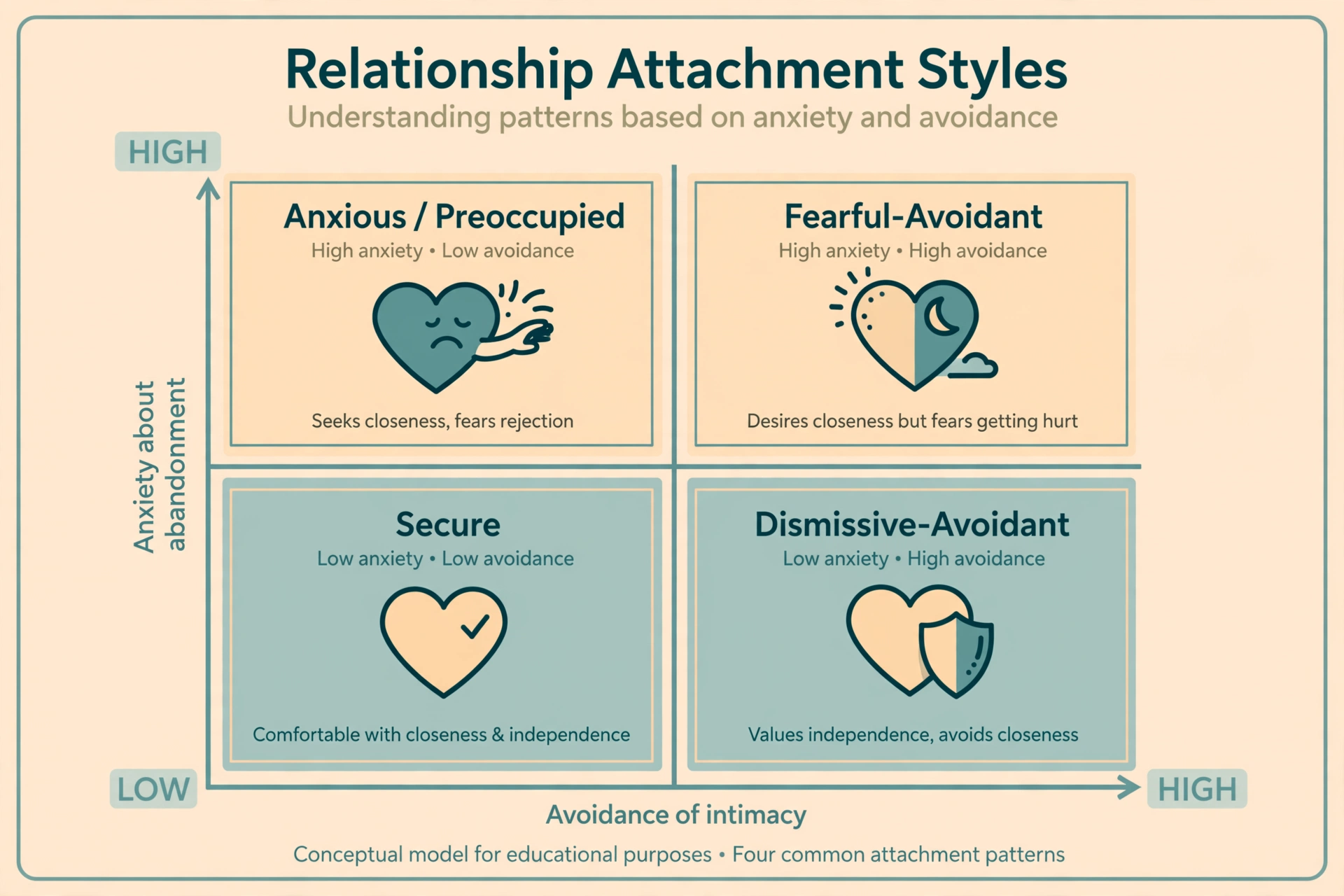
Here is something most pop-psychology quizzes skip: attachment researchers do not actually sort people into four neat boxes. Modern measurement — most notably the Experiences in Close Relationships scale used in research — places everyone on two continuous dimensions:
- Attachment anxiety — how much you worry about rejection and abandonment (low in secure and avoidant styles, high in anxious and fearful styles).
- Attachment avoidance — how uncomfortable you are with closeness and dependence (low in secure and anxious styles, high in avoidant and fearful styles).
The four styles are simply the four quadrants of this map. That matters for three practical reasons. First, you can be a blend — for example, moderately anxious with low avoidance, which looks like “secure with anxious leanings.” Second, your position is not fixed: major life events, a long stable relationship, or therapy can genuinely move you on the map. Third, you may show different patterns with different people — more secure with a steady partner, more anxious with an inconsistent one. According to the NIH’s StatPearls review of attachment theory, attachment patterns reflect internal working models that are updated by experience, which is exactly why they can be reshaped in adulthood. This flexibility is what makes attachment styles in relationships a hopeful framework rather than a fixed diagnosis.
How Attachment Styles Pair Up: The Patterns Couples Fall Into
Attachment styles in relationships do not exist in a vacuum — they collide, mesh, and sometimes combust with a partner’s style. Certain pairings produce famously sticky dynamics:
The anxious–avoidant trap (pursuer–withdrawer)
This is the most common painful pairing. The anxious partner pursues closeness and reassurance; the avoidant partner feels crowded and withdraws; the withdrawal triggers more pursuit. Each person’s coping strategy confirms the other’s worst fear: “See? They are pulling away” and “See? They are too demanding.” Gottman Method research on the demand–withdraw pattern identifies this exact cycle as one of the strongest predictors of relationship distress — not because either partner is broken, but because the cycle itself becomes the enemy. Understanding this loop is central to attachment styles in relationships research.
Breaking it requires both partners to recognize the loop. A practical reframe: the pursuer is not “needy,” they are protesting disconnection; the withdrawer is not “cold,” they are flooded and self-protecting. When both can name the cycle in the moment — “We’re doing the thing again” — the pattern starts to lose its power.
Secure + any style: the stabilizing pairing
A securely attached partner can be a powerful corrective experience. Corrective experiences like this are how attachment styles in relationships gradually shift toward security. Their consistency — responding to bids for connection, staying calm in conflict, not punishing vulnerability — slowly teaches an insecure partner’s nervous system that closeness is safe. This is one reason relationship researchers emphasize that who you partner with influences your attachment as much as your history does.
Anxious + anxious, avoidant + avoidant
Two anxious partners may bond intensely and quickly but can amplify each other’s fears, creating a relationship that runs hot and exhausting. Two avoidant partners often enjoy comfortable independence but may drift into parallel lives with little emotional intimacy. Neither pairing is doomed — awareness of the shared pattern is the starting point for change.
Why You Are Drawn to Certain Partners
One of attachment theory’s most unsettling insights is that we tend to be attracted to what feels familiar, not what is healthy for us. This familiarity principle is one of the most important lessons of attachment styles in relationships. An anxiously attached person may find a steady, available partner “boring” while feeling electric chemistry with someone inconsistent — because inconsistency matches their internal template of love. Avoidantly attached people may feel most comfortable with partners who do not ask much of them emotionally.
This does not mean chemistry is destiny. Noticing the pattern is the intervention: when you feel that familiar spark with someone who keeps you guessing, you can ask whether the excitement is attraction or your attachment system recognizing its childhood home. Many people report that as they move toward security, their “type” quietly changes — calm starts to feel attractive.
Can You Change Your Attachment Style? How to Earn Security
Yes. Researchers call it earned security: developing a secure attachment pattern in adulthood despite an insecure start. The science of earned security shows that attachment styles in relationships remain flexible throughout adulthood. It usually happens through sustained corrective experiences — a stable relationship, effective therapy, or deliberate practice. Here are evidence-informed steps tailored to each pattern:
If you lean anxious
- Build a self-soothing menu. Write down 5–6 things that genuinely calm you (a walk, a breathing exercise, calling a friend) and use one before sending the third “are we okay?” text.
- Schedule worry windows. Give relationship worries a contained 15 minutes a day instead of letting them run all day.
- Ask directly, once. Replace hinting and testing with one clear request: “I feel wobbly today — could we have dinner together tonight?” Then accept the answer.
If you lean avoidant
- Practice micro-vulnerability. Share one small genuine feeling daily — “I was nervous about my presentation today” — before attempting bigger disclosures.
- Stay 10 minutes longer. When you feel the urge to withdraw mid-conversation, agree with yourself to stay present for ten more minutes.
- Name the shutdown. Tell your partner: “When I go quiet, I’m overwhelmed, not angry. I need 20 minutes and then I’ll come back.” Then actually come back.
If you lean fearful–avoidant
- Track the swing. Journal when you pull toward and push away from closeness, and what triggered each shift. Patterns become visible fast.
- Prioritize professional support. This pattern is the most responsive to therapy — particularly approaches built on attachment itself.
For every style
- Consider couples therapy grounded in attachment. Emotionally Focused Therapy is a couples approach built directly on attachment research, with strong evidence for helping partners bond securely.
- Invest in small, consistent trust-building. Security is built in drops, not buckets — keeping small promises, showing up on time, remembering what matters to your partner. Our guide to practical trust-building exercises offers concrete daily practices.
- Repair quickly. Secure couples are not conflict-free; they repair fast. A sincere apology within hours beats a perfect one within weeks.
How to Talk About Attachment With Your Partner
Bringing up attachment styles in relationships can backfire if it sounds like a diagnosis (“You’re so avoidant”). The goal is a shared language, not ammunition. Try this approach:
- Start with yourself. “I read about attachment styles and recognized myself in the anxious description — I think that’s why I get uneasy when plans change.”
- Invite, don’t label. “Does any of this resonate with you?” beats “You are definitely avoidant.”
- Focus on the cycle, not the person. “When I pursue and you withdraw, we both end up miserable. How do we interrupt that?”
- Propose one experiment. “Next time I go quiet, I’ll say ‘I need 20 minutes’ instead of disappearing. And when you feel anxious, tell me directly what would help.”
Useful scripts for heated moments: the anxious partner can say, “I’m feeling disconnected and my alarm bells are ringing — I need reassurance, not solutions.” The avoidant partner can say, “I’m starting to shut down. I care about this conversation; I need a short pause so I can stay in it.” Over time, these scripts become second nature, and the couple develops its own secure dialect.

Spotting Your Own Style: A Reflective Checklist
Online attachment quizzes can be a useful starting point, but treat them as conversation starters, not diagnoses. They are self-report snapshots influenced by your current relationship and mood, and they cannot capture the full picture a trained clinician sees. Instead, reflect honestly on these questions:
- When my partner is upset with me, do I move toward them, freeze, or pull away?
- Do I find it easy or hard to ask for help when I am struggling?
- In past relationships, have partners called me “too much” or “too distant” — and which complaint came up more?
- When conflict ends, do I need to talk it through fully, or do I prefer to move on quickly?
- Do I trust that people I love will stay, or do I quietly prepare for them to leave?
Your honest answers will point toward your dominant pattern far more reliably than a ten-question quiz. And remember: identifying a pattern is the beginning of working with it, not a life sentence.
When to Seek Professional Support
Self-help goes a long way with attachment styles in relationships, but some situations call for a professional. Consider therapy — individually or as a couple — if attachment patterns are causing persistent distress, if you notice push–pull cycles you cannot interrupt on your own, if past trauma is shaping your reactions, or if conflict regularly escalates to shouting, stonewalling, or threats. Approaches with strong evidence for attachment-related difficulties include Emotionally Focused Therapy for couples and schema or psychodynamic therapy for individuals. The NHS guidance on counselling and talking therapies is a good starting point for understanding what professional support involves and how to access it. Seeking help is not a sign that your relationship is failing — it is often the decision that saves it.
Frequently Asked Questions
Can two insecure attachment styles have a healthy relationship?
Yes. Two insecurely attached partners can build a healthy relationship, but it takes more conscious work than a pairing that includes a secure partner. The key is recognizing the shared cycle — such as pursue–withdraw — and treating it as a third entity you tackle together rather than evidence that one of you is at fault. When both partners understand their attachment styles in relationships, they can interrupt destructive cycles together. Couples therapy, particularly attachment-based approaches, can accelerate this considerably.
What is the rarest attachment style?
Fearful–avoidant (disorganized) attachment is the least common of the four styles in the general population. Secure attachment is the most common, followed by the anxious and avoidant styles. Keep in mind that prevalence varies across studies and cultures, and most people show a blend rather than a pure type.
Can your attachment style change over time?
Absolutely. Attachment styles are relatively stable but not fixed. Research on “earned security” shows that long-term stable relationships, effective therapy, and deliberate practice can shift someone from an insecure pattern toward secure attachment. Change is gradual — think months and years, not weeks — but it is well documented.
Which attachment style is hardest to be in a relationship with?
There is no universally “hardest” style — difficulty depends on the pairing and the individuals involved. The anxious–avoidant combination tends to generate the most chronic friction because each partner’s coping strategy triggers the other’s core fear. That said, any pairing can thrive with awareness, communication skills, and willingness to grow.
Are attachment styles the same as love languages?
No. Attachment styles describe your underlying sense of safety in closeness — whether intimacy feels comforting or threatening. Love languages describe your preferred expression of affection, such as words of affirmation or quality time. The two interact: for example, an anxiously attached person may especially value frequent words of affirmation because reassurance calms their attachment system.
Do attachment styles affect physical intimacy?
They can. Securely attached partners generally find it easier to be emotionally present and communicative during physical intimacy. Anxiously attached people may use physical closeness to seek reassurance, while avoidantly attached people may keep emotional distance even during intimate moments. Understanding this connection often helps couples address intimacy difficulties at their root rather than treating them as purely physical issues.
Is it possible to be secure in friendships but insecure in romantic relationships?
Yes, and it is common. Attachment patterns can vary by relationship domain — you might be secure with friends and family but anxious with romantic partners, or vice versa. Romantic relationships tend to activate attachment systems most strongly because the stakes of closeness and potential loss feel highest there.
The Bottom Line
Understanding attachment styles in relationships gives you something rare in love: an explanation that is neither partner’s fault and a path forward that belongs to both of you. Your style was shaped by experiences you did not choose, but it is maintained — and can be reshaped — by choices you make now: how you communicate, how you repair, and whether you seek support when patterns run deeper than willpower. Security is not a personality trait reserved for the lucky. It is a skill, and like any skill, it responds to practice.
Disclaimer: This article is for educational purposes only and is not a substitute for professional therapy, counseling, or medical advice. Attachment patterns are complex, and only a qualified mental health professional can assess your individual situation. If you are experiencing significant relationship distress, please consult a licensed therapist or counselor.


One Comment