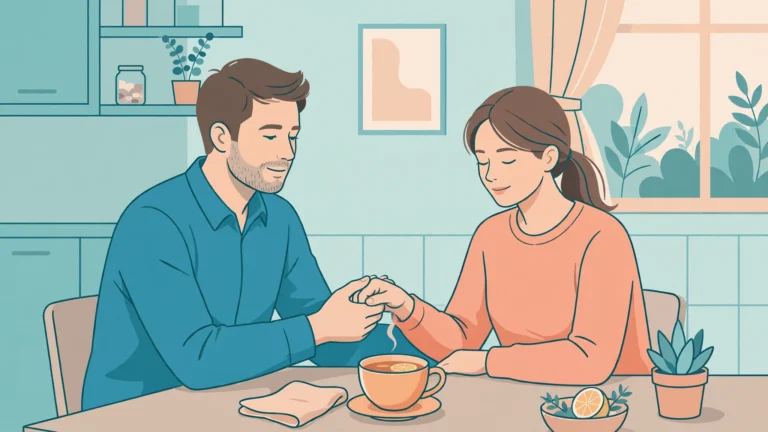
Mutual Masturbation: A Tasteful, Beginner-Friendly Guide for Couples
This mutual masturbation couples guide starts with a simple truth: the most private thing most adults ever do with their own bodies can also become one of the most connective things a couple does together. Mutual masturbation — touching yourself while your partner does the same, together — is completely normal, researched by sexual-health experts, and one of the lowest-pressure ways couples can rediscover curiosity about each other. Whether you are new to the idea or have been doing it for years, this beginner-friendly guide covers what it is, why sex therapists recommend it, how to bring it up, and tasteful techniques to explore with confidence.
What Is Mutual Masturbation, Exactly?
Mutual masturbation simply means partners pleasure themselves in each other’s presence — at the same time or taking turns. Some couples watch, some touch themselves while holding each other, and some guide their partner’s hand. There is no single “correct” version; the shared element is openness rather than performance. Because there is no expectation of intercourse, both partners stay in charge of their own pace, pressure, and rhythm. Throughout this mutual masturbation couples guide, “doing it well” means staying curious and kind, never performing.
Sexual-health researchers have taken the topic seriously. A 2023 study published in the International Journal of Sexual Health found that mutual masturbation was common among both men and women, and that recent mutual masturbation was positively associated with sexual satisfaction — especially for women. Planned Parenthood notes that masturbation is a normal, healthy activity with no harmful physical or emotional effects, which makes it one of the safest ways for couples to be intimate.
Mutual Masturbation Couples Guide: Why It Belongs in Your Relationship
Every guide to the topic will tell you it “builds intimacy,” but it helps to be specific about the mechanisms. Here are the research-backed and therapist-endorsed reasons this mutual masturbation couples guide exists at all.
| Benefit | How it works |
|---|---|
| Deeper sexual communication | Watching how your partner touches themselves teaches you their preferences far more precisely than words alone — a live demonstration you can then use every time you are together. |
| Zero performance pressure | Because each person controls their own stimulation, nobody is performing for anyone else. Anxiety about “doing it right” dissolves, which sex therapists consider essential for satisfaction. |
| Body acceptance | Being seen during a private act and being met with warmth rather than judgment builds trust fast. Many people report feeling more comfortable in their skin afterward. |
| Stress relief, doubled | Orgasm and sexual arousal release endorphins and oxytocin — the “bonding” hormone — which ease tension and improve sleep. Sharing that release can make the calm feel mutual. |
| Safer intimacy | Without penetration or fluid exchange, there is no risk of pregnancy and minimal STI risk, making it an ideal option when condoms are unavailable, during recovery, or when someone simply isn’t in the mood for intercourse. |
| Bridging desire gaps | When one partner wants sex more often than the other, mutual masturbation lets the more motivated partner be satisfied while the other joins in at whatever level feels good — connection without pressure. |
How to Bring It Up: Conversation Starters That Actually Work
Most entries in any mutual masturbation couples guide skip the hardest part: saying the words out loud. Bringing up mutual masturbation can feel vulnerable because masturbation itself is rarely discussed, even in long-term relationships. The trick is to frame it as curiosity and closeness, never as a complaint about your current sex life.
Scripts you can borrow
- The curious approach: “I read that a lot of couples explore mutual masturbation together — it sounded like a fun way to learn what we each enjoy. Would you ever be open to talking about it?”
- The learning approach: “I’d love to watch how you like to be touched so I can be better at it. Want to show each other sometime?”
- The low-pressure approach: “No pressure at all, but what if we just tried being close while we each do our own thing? If it feels weird, we stop — no big deal.”
- The playful approach: “Here’s a game: you can’t touch me, and I can’t touch you. We just watch. Deal?”
Ground rules to agree on first
Sex therapists recommend a short, honest check-in before the first session. Agree on boundaries: is touching each other allowed, or just watching? Are toys welcome? What if one person wants to stop? A simple “green, yellow, red” system — go, slow down, stop — gives both partners an easy way to adjust without awkwardness. Revisit the rules afterward; boundaries often expand naturally once curiosity replaces nerves.
A Beginner-Friendly First Session, Step by Step
This mutual masturbation couples guide goes further than most by giving first-timers a full picture: the setting, the pacing, and the aftercare. Here is a gentle framework for your first time.
- Set the scene. Lock the door, silence phones, and give yourselves unhurried time. Warm lighting, music, and fresh sheets do more for comfort than anything else.
- Ease in together. Start with kissing, massage, or simply lying close and talking. A short full-body massage with no goal — just touch for its own sake — helps the nervous system shift out of “thinking” mode.
- Go first, or let them go first. One partner begins while the other watches, holds, or mirrors the rhythm on themselves. Watching first often feels less exposing than starting together.
- Stay connected. Eye contact, soft verbal feedback (“I love watching you”), and occasional kisses between moments keep it intimate rather than parallel.
- Follow arousal, not a script. If you naturally start touching each other, great. If you each stay in your own lane, also great. There is no finish line you must cross.
- Debrief afterward. This is the step almost nobody mentions: afterward, share one thing you loved and one thing you’d tweak. “I liked it when you…” cements trust and makes the next time even better.
Tasteful Techniques and Approaches for Couples
Once the basics feel comfortable, there is plenty of room to play. The techniques in this mutual masturbation couples guide are described clearly but non-graphically — the focus is on what couples can try, not explicit detail.
Watch and mirror
Sit or lie facing each other and touch yourselves the way you would alone while your partner watches. Many couples find this surprisingly instructive: you finally see exactly the pressure, pace, and areas your partner favors, which improves your partnered touch permanently. For couples following this mutual masturbation couples guide, it is the fastest way to build both skill and confidence.
Take turns
One person pleasures themselves while the other watches, whispers encouragement, or guides — then swap. Turn-taking lowers self-consciousness for shyer partners and builds delicious anticipation. This mutual masturbation couples guide notes that turn-taking is especially reassuring for shyer partners.
Side-by-side synchronization
Lie next to each other and move in rhythm, matching each other’s pace. Some couples hold hands with their free hand, which keeps a thread of physical connection running through the whole experience. Readers of this mutual masturbation couples guide often report that the free-hand connection becomes their favorite part.

Adding toys
Vibrators, strokers, and couples’ toys integrate easily — one partner can use a clitoral stimulator while the other uses their hands, or both can explore devices simultaneously. Keep toys body-safe (medical-grade silicone, glass, or stainless steel) and wash them before and after with warm water and mild soap or a dedicated toy cleaner. Never share insertable toys between partners without cleaning them or using a fresh condom on the toy first. Any mutual masturbation couples guide worth reading stresses body-safe materials first — pleasure second.
The guided hand
Your partner places their hand over yours while you pleasure yourself, so they can feel the exact motion. This is one of the most direct communication tools a couple can use — and one many sex therapists assign as a structured exercise for partners who struggle to reach orgasm together. Sex therapists quoted in this mutual masturbation couples guide call it the single most effective teaching tool a couple can use.
Mismatched Libidos and Long-Distance: Two Situations Where It Shines
Few entries in the average mutual masturbation couples guide address the two scenarios where this practice is most useful — when partners want sex at different rates, and when partners are physically apart.
Bridging the desire gap
Desire differences are one of the most common reasons couples seek therapy. The higher-desire partner often feels rejected; the lower-desire partner feels pressured. Mutual masturbation offers a middle path: the partner who is “in the mood” gets genuine satisfaction while the other participates in whatever way feels right — holding, watching, or simply being close. Because there is no expectation to become fully aroused, it removes the pressure that makes the gap widen. Couples who practice this regularly often report that the lower-desire partner’s spontaneous interest returns, because intimacy stops feeling like an obligation.
Long-distance intimacy
Video calls make shared sessions entirely possible — many long-distance couples schedule them the way they’d schedule a date night. App-controlled vibrators that a partner operates remotely add a tactile dimension from another city or continent. Practical tips: charge devices in advance, use a stable connection, agree on timing that respects both partners’ comfort, and keep recordings strictly off-limits unless both partners explicitly and enthusiastically consent. Trust is the entire foundation here.

Safety, Hygiene, and Lubricant: The Practical Guide
Every mutual masturbation couples guide should include practical safety details, not just a one-line “it’s safe!” — so here they are.
- STI and pregnancy risk: Minimal. There is no risk of pregnancy, and STI transmission is very low when there is no fluid exchange or contact with sores. If either partner has open cuts, herpes lesions, or visible sores on the hands or genitals, pause or use barriers such as gloves and condoms on toys.
- Hygiene: Wash hands before and after. Clean toys every time. Change condoms or barriers between partners.
- Lubricant: A quality water-based or silicone-based lubricant reduces friction and increases comfort for both partners. Water-based lubes are compatible with all toy materials; silicone-based lubes last longer but can degrade silicone toys. Avoid oil-based products with latex, and skip products with fragrances or warming additives if either partner has sensitive skin.
- Skin care: If irritation occurs, give the area rest, avoid scented products, and see a clinician if redness or soreness persists beyond a day or two.
Common Mistakes to Avoid
Every mutual masturbation couples guide warns about these — and they are easy to avoid once you know them.
- Treating it as a replacement for talking. It improves communication, but it doesn’t substitute for honest conversations about desires and boundaries.
- Pressuring a hesitant partner. Enthusiastic consent applies here too. A “no” or “not yet” deserves full respect, and revisiting the topic gently later is fine — pressure is not.
- Comparing technique. Everyone’s body and preferences differ. Watching is for learning and enjoyment, never for judging.
- Skipping the debrief. A two-minute conversation afterward does more for your long-term sex life than the session itself.
- Ignoring discomfort. Emotional or physical discomfort is a signal, not a failure. Pause, talk, adjust.
When to Talk to a Doctor or Therapist
Mutual masturbation is healthy for most couples, but a few situations deserve professional guidance. See a clinician if either partner experiences pain during arousal or orgasm, difficulty reaching orgasm that causes distress, or changes in sexual function linked to medications or health conditions — these are common, treatable issues. Consider a certified sex therapist if shame, anxiety, or conflict around the topic keeps causing distress despite open communication, or if sexual behavior (solo or partnered) ever feels compulsive and hard to control. There is no shame in any of these; sexual-health professionals address them every day.
If you are exploring new territory as a couple more broadly, our beginner-friendly guide to the best sex positions for beginners pairs well with this one, and couples curious about adding toys can start with our guide to the best sex toys for couples beginners.
FAQs
Is mutual masturbation safe?
Yes — it is one of the safest forms of sexual activity. There is no risk of pregnancy and minimal STI risk when there is no exchange of bodily fluids or contact with open sores. Healthline and Planned Parenthood both describe masturbation as a normal, healthy activity with documented benefits like stress relief and better sleep. Basic hygiene, such as washing hands and cleaning toys, keeps risk negligible.
Does mutual masturbation count as “real” sex?
That depends on your definition, and couples define it differently. Many sex therapists encourage expanding what “counts” beyond intercourse — mutual masturbation is complete, satisfying intimacy for many couples, not merely foreplay. What matters is that both partners feel fulfilled, not whether the experience matches a particular definition of sex. This mutual masturbation couples guide treats it as complete intimacy, not merely foreplay or a consolation prize.
How do I suggest mutual masturbation to a shy partner?
Lead with curiosity rather than pressure. A good opener: “I’d love to watch how you like to be touched so I can learn.” Propose clear boundaries, emphasize that either of you can pause anytime, and consider starting with turn-taking rather than simultaneous sessions. If your partner is hesitant, respect it — revisiting the idea gently later often works better than one persuasive pitch.
Can mutual masturbation help with mismatched sex drives?
Yes, and therapists often recommend it for exactly this reason. The higher-desire partner gets real satisfaction while the lower-desire partner participates at whatever comfort level feels right — holding, watching, or being close — without pressure to perform. Many couples find that removing performance pressure actually helps the lower-desire partner’s spontaneous interest return over time. That is why this mutual masturbation couples guide lists it as the top strategy for bridging desire gaps.
What toys work best for mutual masturbation?
Choose body-safe, easy-to-handle toys: bullet or clitoral vibrators for partners with vulvas, strokers or rings for partners with penises, and app-controlled devices for long-distance couples. Prioritize medical-grade silicone, glass, or stainless steel, clean toys before and after every use, and avoid sharing insertable toys without cleaning or a fresh condom. If you are following this mutual masturbation couples guide, start simple and upgrade only when both partners are enjoying it.
Can we do mutual masturbation long-distance?
Absolutely. Video calls let couples watch, guide, and talk each other through the experience in real time, while app-controlled vibrators let one partner control the other’s toy remotely. Schedule it like a date, use a stable connection, and keep any images or recordings strictly consensual — trust is everything when distance is involved.
Ready to explore more? This mutual masturbation couples guide is just one entry in our library — browse our related intimacy guides to keep the conversation going, because every new thing you try together is a chance to know each other better. Keep this mutual masturbation couples guide bookmarked as your reference for the journey.
Medical Disclaimer: This article is for educational purposes only and is not medical advice. Sexual health is personal — if you have concerns about pain, sexual function, or any health condition, please consult a qualified healthcare professional for guidance tailored to you.