I Statements Examples for Couples: 20 Phrases That Stop Fights
Nothing starts a fight faster than the word "you." "You never listen." "You always make us late." The moment your spouse hears an accusation, their brain stops hearing your feelings and starts building a defense. That's why therapists teach one of the simplest, most powerful tools in marriage communication: the I statement. These I statements examples for couples show exactly how to say what hurts — without turning it into a blame game.
An I statement is a sentence that describes your feelings and needs instead of attacking your partner's character. It doesn't magically solve every problem, but it changes the conversation from a courtroom trial into a team discussion. And once you see real examples side by side, you'll understand why therapists recommend this technique to nearly every couple they counsel.
What Is an I Statement? The 4-Part Formula
A strong I statement has four parts:
1. "I feel…" — name the emotion (hurt, worried, overwhelmed, lonely)
2. "when…" — describe the specific situation or behavior
3. "because…" — explain why it affects you
4. A request — say what you need instead
Put together, it sounds like this: "I feel anxious when bills come due and we haven't talked about the budget, because I'm scared of going into debt. Can we sit down together on Sunday and make a plan?"
Notice what's missing: no "you always," no "you're terrible with money," no character attack. The focus is on your experience and your request. That's what makes it easier for your partner to respond with care instead of defensiveness.
20 I Statements Examples for Couples, by Situation
These examples are organized by the most common fight-starters. Each one pairs the attacking "you" version with the connecting "I" version.
About household chores
Instead of: "You never help around the house. You're so lazy."
Try: "I feel overwhelmed when I do the dishes, the laundry, and the cooking all in one evening. I need some help — could we split the chores this week?"
Instead of: "You left your clothes all over the floor again."
Try: "I feel frustrated when the bedroom is messy because it stresses me out. I'd feel so much calmer if we both put our clothes away at night."
About listening and attention
Instead of: "You never listen to me."
Try: "I feel lonely when I'm telling you about my day and your eyes stay on your phone. I need about ten minutes of your full attention — that would mean a lot."
Instead of: "You're always distracted."
Try: "I feel unimportant when I have to repeat myself. Could we make the first few minutes after work a phone-free zone?"
About money
Instead of: "You're terrible with money and you know it."
Try: "I feel scared when I see a big charge I didn't expect, because I worry about our savings. Can we agree to talk before any purchase over a certain amount?"
Instead of: "You care more about your car than our future."
Try: "I feel insecure about our finances when I don't know where we stand. I'd feel better if we looked at our budget together each month."
About in-laws and family
Instead of: "Your mother is ruining our weekend again."
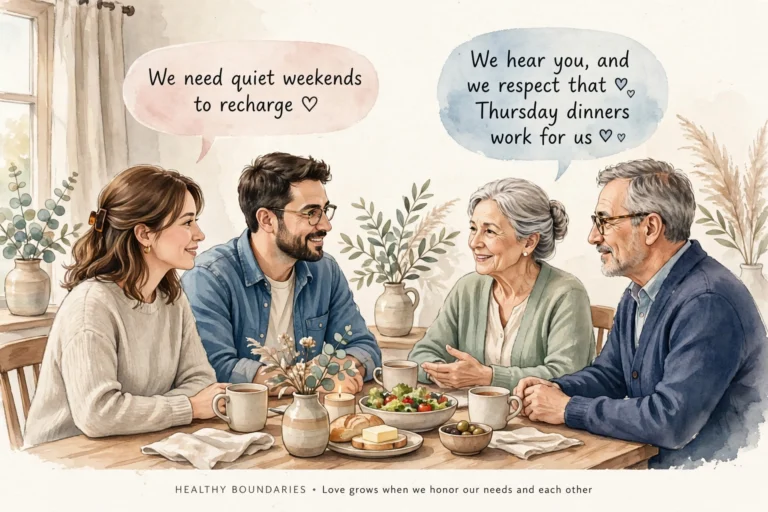
Try: "I feel drained when we have guests all weekend because I don't get any downtime. Could we set a limit on visit frequency that works for both of us?"
Instead of: "You always take your family's side."
Try: "I feel unsupported when disagreements come up with your parents. I need to know you're on our team — can we agree to discuss things privately first?"
About phone and screen time
Instead of: "You're addicted to your phone."
Try: "I feel invisible when we eat dinner together and you're scrolling. I'd love it if we kept phones in the other room during meals."
Instead of: "You ignore me for your games."
Try: "I feel disconnected when most evenings are spent apart on screens. Could we plan two evenings a week that are just for us?"
About intimacy
Instead of: "You never want me anymore."
Try: "I feel hurt when we go weeks without closeness, because I miss feeling desired by you. Can we talk about what's been getting in the way?"
Instead of: "You only care about yourself in bed."
Try: "I feel disappointed when I don't feel prioritized during intimacy. I'd love to talk about what we both enjoy — could we have that conversation?"
About punctuality and reliability
Instead of: "You're always late and you don't even care."
Try: "I feel embarrassed when we arrive late to things because I worry about what people think. It would help me a lot if we left fifteen minutes earlier."
Instead of: "You said you'd call and you didn't. Typical."
Try: "I feel anxious when I don't hear from you and the plan changes, because I start imagining the worst. Could you send a quick text when plans shift?"
About parenting disagreements
Instead of: "You let the kids walk all over you."
Try: "I feel worried when the bedtime rules are different between us, because the kids get confused. Can we sit down and agree on the rules together?"
Instead of: "You're too harsh with them."
Try: "I feel uncomfortable when voices get raised with the kids, because it scares me too. Could we talk about a calmer way to handle those moments?"
About feeling unappreciated
Instead of: "You don't appreciate anything I do."
Try: "I feel taken for granted when I plan things for us and they go unmentioned. Hearing a simple thank-you would recharge me completely."
Instead of: "You only notice what I do wrong."
Try: "I feel discouraged when I hear mostly criticism. It would really lift me up if you also pointed out the things I'm doing well."
About emotional distance
Instead of: "You never tell me how you feel."
Try: "I feel shut out when I ask how you are and get a one-word answer. I'd love to know what's really going on with you — even the messy parts."
Instead of: "You've changed and I don't even know you anymore."
Try: "I feel sad because I miss how close we used to feel. Can we talk about how to find our way back to each other?"
For more on tuning into your partner's signals, read our guide on active listening vs defensive listening. And if these conversations feel hard to start, our overview of relationship communication walks through the foundations.
The 5 Mistakes That Ruin I Statements
An I statement only works if it's genuine. Watch out for these common traps:
1. The disguised attack
"I feel like you're being selfish" is not an I statement — it's an accusation wearing an "I feel" costume. Feelings are emotions: hurt, sad, scared, lonely, frustrated. "Selfish," "stupid," and "crazy" are judgments, not feelings.
2. The mind-reading add-on
"I feel hurt when you ignore me because you obviously don't care about this family." The second half ruins the first. Stick to what happened and how you felt — don't guess at motives.
3. The exaggerated "always" and "never"
"I feel invisible when you always choose your friends over me." Words like always and never are almost never true, and they trigger instant defensiveness. Be specific instead: "I felt invisible on Saturday when plans changed."
4. Skipping the request
"I feel lonely" is a good start, but it leaves your partner guessing. Always add the need or request: "I feel lonely… could we plan a date night this week?" People can't fix what they don't understand.
5. Using them only during fights
If I statements only appear mid-argument, they start to feel like weapons. Practice them during calm moments too — appreciation is an I statement as well: "I feel so lucky when you make me coffee in the morning." The tool works best when it's part of everyday speech.
How to Practice I Statements Together
Changing a communication habit takes practice, not perfection. Try this approach:
- Pick one situation from the examples above that matches your most frequent fight. Agree to use the I-statement version for two weeks.
- Write it down first. Many couples find it easier to script the sentence on paper (or in their phone) before saying it aloud, especially when emotions are high.
- Debrief gently. After a conversation goes well, say so: "I liked how we talked about that. It felt good." Positive feedback locks in the new habit.
- Don't grade each other. If your partner's I statement comes out clumsy, don't correct them mid-sentence. The effort matters more than the formula.
The Gottman Institute's research on gentle start-ups and the Four Horsemen confirms what therapists see every day: conversations that begin softly — with feelings instead of criticism — are far more likely to end well.
Key Takeaways
- I statements describe your feelings and needs instead of attacking your partner's character.
- Use the 4-part formula: I feel → when → because → what I need.
- Real feelings are emotions (hurt, scared, lonely) — not judgments (selfish, lazy).
- Always add a specific request so your partner knows how to help.
- Practice during calm moments, not just in fights.
Frequently Asked Questions
Do I statements really work, or is it just therapy jargon?
They work because of how the brain responds to blame. Research on conflict shows that "you" language activates defensiveness, while "I" language about feelings invites empathy. It's not magic — it's psychology.
What if my partner still gets defensive when I use I statements?
Old habits don't change overnight. Your partner may still hear criticism at first. Stay calm, repeat your need gently, and give it time. If defensiveness never softens, a couples therapist can help you both practice in real time.
Can I statements be manipulative?
Any communication tool can be misused, but a genuine I statement isn't manipulative — it's honest. Manipulation hides the real goal; an I statement states it openly ("I need your help," "I want closeness"). Honesty is the opposite of manipulation.
Should I use I statements with my kids too?
Absolutely. The same principle applies: "I feel scared when you run near the street" teaches more than "You're being careless." Children learn emotional language by hearing it modeled.